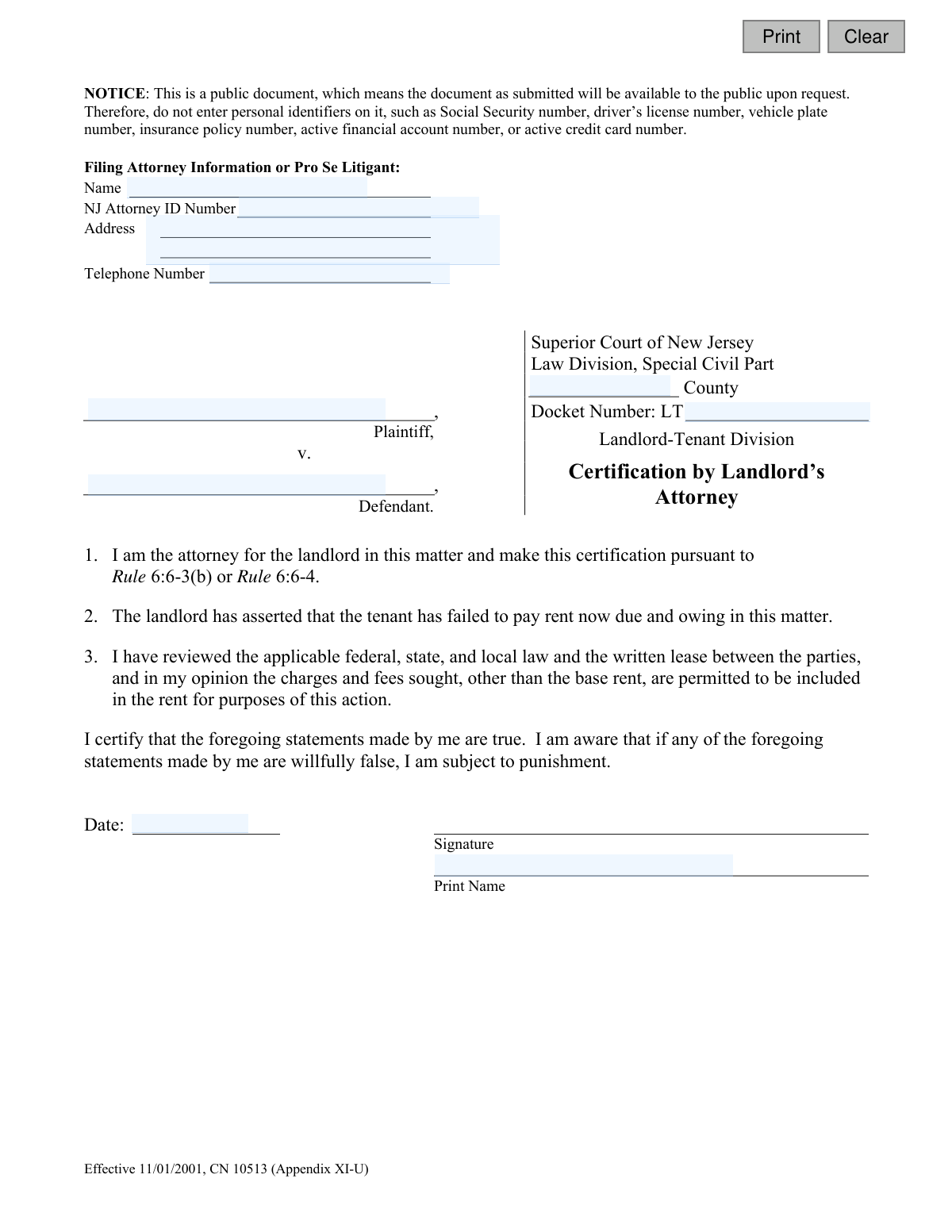
Yes! You can use AI to fill out Certification by Landlord's Attorney - Appendix XI-U

The Certification by Landlord's Attorney, Appendix XI-U, is a legal document used in the Superior Court of New Jersey's Special Civil Part for landlord-tenant disputes. In this form, the landlord's attorney certifies that they have reviewed the case, the lease, and applicable laws, and confirms that the tenant has failed to pay rent and that any additional fees sought are legally permissible. This certification is a crucial step in eviction proceedings based on non-payment of rent. Today, this form can be filled out quickly and accurately using AI-powered services like Instafill.ai, which can also convert non-fillable PDF versions into interactive fillable forms.
Appendix XI-U is part of the New Jersey forms category on Instafill.
Our AI automatically handles information lookup, data retrieval, formatting, and form filling.
It takes less than a minute to fill out Appendix XI-U using our AI form filling.
Securely upload your data. Information is encrypted in transit and deleted immediately after the form is filled out.

Form specifications

Form name: Certification by Landlord's Attorney - Appendix XI-U
Number of fields: 12
Number of pages: 1
Language: English
main-image

Instafill Demo: How to fill out PDF forms in seconds with AI

How to Fill Out Appendix XI-U Online for Free in 2026

Are you looking to fill out a APPENDIX XI-U form online quickly and accurately? Instafill.ai offers the #1 AI-powered PDF filling software of 2026, allowing you to complete your APPENDIX XI-U form in just 37 seconds or less.
Follow these steps to fill out your APPENDIX XI-U form online using Instafill.ai:
  1. 1 Navigate to Instafill.ai and upload or select the Appendix XI-U form.
  2. 2 Enter the filing attorney's information, including name, NJ Attorney ID, address, and telephone number.
  3. 3 Specify the court details, including the county and the Landlord-Tenant (LT) docket number.
  4. 4 Clearly identify the names of the plaintiff (landlord) and the defendant (tenant).
  5. 5 Review the certification statements to ensure they accurately reflect your legal opinion on the matter.
  6. 6 Date the document, provide a legally binding signature, and print your name to complete the certification.
  7. 7 Download, print, or securely share the completed form for filing with the Superior Court.

Our AI-powered system ensures each field is filled out correctly, reducing errors and saving you time.

Why Choose Instafill.ai for Your Fillable Appendix XI-U Form?

Speed

Complete your Appendix XI-U in as little as 37 seconds.

Up-to-Date

Always use the latest 2026 Appendix XI-U form version.

Cost-effective

No need to hire expensive lawyers.

Accuracy

Our AI performs 10 compliance checks to ensure your form is error-free.

Security

Your personal information is protected with bank-level encryption.

Frequently Asked Questions About Form Appendix XI-U

This form is used by a landlord's attorney in a New Jersey eviction case to certify that any charges beyond base rent, such as late fees or legal costs, are legally permissible to be included as 'rent' in the action.

The landlord's attorney must complete and sign this form. It is a professional certification made by the legal representative, not by the landlord themselves.

This certification is filed with the Superior Court of New Jersey, Special Civil Part, as part of a landlord-tenant eviction case where the landlord is seeking to recover more than just the base rent.

This refers to any costs sought in addition to the monthly base rent, such as late fees, attorney's fees, or other charges that the lease specifies are to be treated as 'additional rent'.

This form is a public document, so to protect privacy and prevent identity theft, you must not include sensitive information like Social Security numbers, driver's license numbers, or active financial account numbers.

The Docket Number is assigned by the court when the landlord-tenant complaint is first filed. It will be present on all official court documents related to the case and typically begins with 'LT'.

By signing, the attorney certifies that they have reviewed the relevant laws and the written lease and have concluded, in their professional opinion, that the extra fees being sought are legally chargeable as rent.

The form explicitly warns that an attorney who knowingly makes false statements on this certification is subject to punishment, highlighting the legal seriousness of the document.

Yes, services like Instafill.ai use AI to help you accurately auto-fill form fields like your name, attorney ID, and case details, which saves time and helps prevent errors.

Simply upload the Appendix XI-U PDF to the Instafill.ai platform. The AI will identify all the fields, allowing you to fill them out quickly and generate a completed document ready for review and signature.

You can upload the flat, non-fillable PDF to a service like Instafill.ai. It can convert the document into an interactive, fillable form that you can complete and save digitally.

No, this specific form is a certification to be made by an attorney. A pro se landlord cannot sign a document stating 'I am the attorney for the landlord in this matter'.

Compliance Appendix XI-U
Validation Checks by Instafill.ai

1
Ensures Attorney Name is Provided
This check verifies that the 'attyName' field is not empty. The identity of the filing attorney is essential for court records and for all subsequent communication. If this field is left blank, the form submission will be rejected, and the user will be prompted to enter the full name of the attorney.
2
Validates NJ Attorney ID Number Format
This validation ensures the 'attyId' field contains a value that matches the expected format for New Jersey attorney identifiers, which is typically a numeric string. This prevents data entry errors and ensures the ID is a plausible, correctly formatted number that can be used for verification. Submissions with non-numeric or incorrectly formatted IDs will be flagged for correction.
3
Verifies Attorney Address is Complete
This check confirms that the 'attyAddrFull' field for the filing attorney is filled out. A complete and valid mailing address is mandatory for official correspondence from the court and other parties. An empty address field will result in a validation error, preventing form submission until the information is provided.
4
Validates Attorney Telephone Number Format
This check ensures the 'attyPh' field conforms to a standard US phone number format (e.g., XXX-XXX-XXXX or (XXX) XXX-XXXX). Proper formatting is crucial for ensuring the contact number is valid and usable for communication. The system should reject entries that do not match a recognized phone number pattern and ask the user to re-enter the number.
5
Ensures Plaintiff (Landlord) Name is Provided
This validation confirms that the 'plaName' field is not empty. Identifying the landlord is a fundamental requirement for any landlord-tenant action, as it legally establishes one of the primary parties in the case. The form cannot be processed without this information, and a missing plaintiff name will trigger an error.
6
Ensures Defendant (Tenant) Name is Provided
This check verifies that the 'defName' field has been filled in. The identity of the tenant is necessary to properly name the party against whom the action is being taken. A submission lacking the defendant's name is incomplete and legally insufficient, so the system will block it until the name is entered.
7
Ensures County is a Valid NJ County
This validation checks the 'typeCounty' field against a predefined list of the 21 official counties in New Jersey. This prevents misspellings and the entry of invalid locations, ensuring the case is filed in the correct jurisdiction. If the entered text does not match a valid county, the user will be shown an error and may be presented with a dropdown list of valid options.
8
Validates Docket Number Entry
This check ensures the 'docketNo' field is not empty and contains only numeric characters, as it follows the 'LT' prefix shown on the form. The docket number is the unique identifier for the case within the court system, and its accuracy is critical. The validation prevents submission if the field is blank or contains invalid characters, ensuring proper case linkage.
9
Validates Signature Date is Present and Logical
This check verifies that the 'sigDt' field is not only filled but also contains a valid date that is not in the future. The signature date establishes when the certification was made, which has legal significance. A future date is illogical and invalid, so the system will reject it and require the user to enter the current or a past date.
10
Verifies Printed Signature Name Matches Attorney Name
This is a logical consistency check that compares the 'sigName' field with the 'attyName' field. These two names must match to ensure the person signing the certification is the same attorney representing the landlord. A mismatch indicates a potential error or discrepancy and will prevent submission until the names are consistent.
11
Scans for Prohibited Personal Identifiers
This validation scans all text fields for patterns matching personal identifiers like Social Security numbers, driver's license numbers, or financial account numbers, as explicitly warned against in the form's notice. This is a critical privacy and security measure to prevent sensitive data from entering a public document. If a potential identifier is detected, the system will flag it and require the user to remove it before submission.
12
Ensures NJ Attorney ID is Provided
This check confirms that the 'attyId' field is not empty. Since the form is a 'Certification by Landlord's Attorney', it is filed by a licensed attorney, making the ID number a mandatory piece of identifying information for the court. A missing ID will block the submission and prompt the user to provide it.

Common Mistakes in Completing Appendix XI-U

Incorrect or Incomplete Docket Number

Filers often mistype the docket number or forget to include the required 'LT' prefix. The docket number is the primary identifier for the case, and any error can lead to the document being misfiled, rejected by the court clerk, or associated with the wrong case. To avoid this, double-check the number against official court documents. AI-powered tools like Instafill.ai can help by remembering and correctly formatting previously used case information.

Entering the Incorrect County

A common mistake is listing the county where the attorney's office is located instead of the county where the property is located and the case is filed. This legal certification must be filed in the correct jurisdiction's Special Civil Part. Filing in the wrong county will result in the document being rejected and can cause significant delays, potentially requiring the attorney to refile the entire action.

Inconsistent Landlord (Plaintiff) Name

The landlord's name must be listed exactly as it appears on the lease and other legal filings. People often mistakenly use an individual's name when the property is owned by an LLC or corporation, or vice versa. This inconsistency can be used by the defendant to challenge the validity of the filing, potentially leading to dismissal of the case.

Misidentifying or Omitting Tenants (Defendants)

Failing to list all tenants named on the lease or misspelling a tenant's name is a critical error. An incorrect or incomplete defendant name can invalidate the notice for the person who was omitted or misidentified, creating problems with service of process and the subsequent enforcement of any judgment. It is crucial to copy the names exactly as they appear on the signed lease agreement.

Including Prohibited Personal Identifiers

Despite a clear warning on the form, filers sometimes inadvertently include personal data like Social Security or bank account numbers. This form is a public document, and including such information creates a serious privacy breach and identity theft risk. This mistake happens out of habit, but it can have severe consequences for the individual whose data is exposed.

Omitting or Mistyping the NJ Attorney ID

The NJ Attorney ID number is essential for verifying the filing attorney's credentials with the state bar. Forgetting to include it, or entering an incorrect number, can cause the court clerk to question the legitimacy of the filing and delay processing. Pro se litigants (landlords representing themselves) should clearly write 'Pro Se' in this field to avoid confusion.

Missing or Invalid Signature

The attorney's signature certifies the truthfulness of the statements under penalty of punishment, making it the most critical part of the form. Forgetting to sign the document, or having a paralegal sign instead of the attorney of record, renders the certification invalid. An unsigned form will be rejected outright by the court, halting the legal proceedings.

Using Illegible Handwriting

When filling out a printed PDF by hand, illegible writing for names, addresses, or docket numbers is a frequent problem. If the court clerk cannot decipher the information, it can lead to data entry errors on their end, misdirected mail, or rejection of the form. Using a tool like Instafill.ai can convert this non-fillable PDF into a cleanly typed, legible, and fillable document, eliminating this issue entirely.

Incomplete Attorney Contact Information

Leaving out a suite number, ZIP code, or a full telephone number with an area code can disrupt communication. The court and opposing counsel rely on this information to send notices and communicate about the case. Incomplete information can lead to missed deadlines and delays because the attorney cannot be reached.

Incorrect or Missing Signature Date

The date next to the signature is legally significant, as it establishes when the attorney made the certification. Using a future date (post-dating), a past date that doesn't align with the case timeline, or leaving it blank can create legal vulnerabilities. Opposing counsel could use date discrepancies to challenge the validity and timing of the filing.
Saved over 80 hours a year

“I was never sure if my IRS forms like W-9 were filled correctly. Now, I can complete the forms accurately without any external help.”

Kevin Martin Green

Your data stays secure with advanced protection from Instafill and our subprocessors

Robust compliance program

Transparent business model

You’re not the product. You always know where your data is and what it is processed for.

ISO 27001, HIPAA, and GDPR

Our subprocesses adhere to multiple compliance standards, including but not limited to ISO 27001, HIPAA, and GDPR.

Security & privacy by design

We consider security and privacy from the initial design phase of any new service or functionality. It’s not an afterthought, it’s built-in, including support for two-factor authentication (2FA) to further protect your account.

Fill out Appendix XI-U with Instafill.ai

Worried about filling PDFs wrong? Instafill securely fills certification-by-landlords-attorney-appendix-xi-u forms, ensuring each field is accurate.