Yes! You can use AI to fill out Certification for Support Order to be Administered Through Probation Division
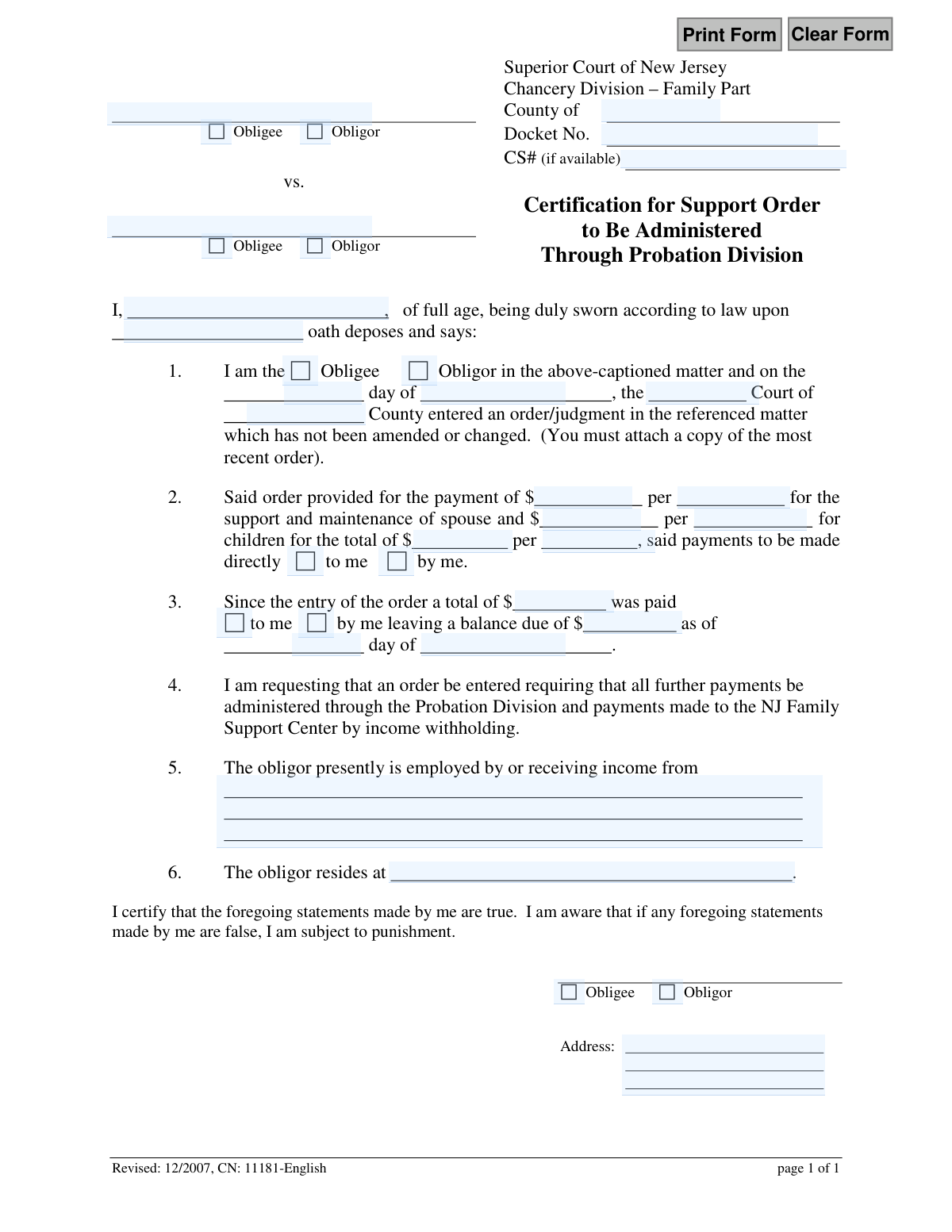
The Certification for Support Order to be Administered Through Probation Division is a legal document filed in the Superior Court of New Jersey's Family Part. It allows either the person paying support (obligor) or the person receiving it (obligee) to request that the court mandate payments be processed through the state's Probation Division, typically via income withholding. This formalizes the payment process, ensuring a clear record and facilitating enforcement. Today, this form can be filled out quickly and accurately using AI-powered services like Instafill.ai, which can also convert non-fillable PDF versions into interactive fillable forms.
CN 11181 is part of the
New Jersey forms category on Instafill.
Our AI automatically handles information lookup, data retrieval, formatting, and form filling.
It takes less than a minute to fill out CN 11181 using our AI form filling.
Securely upload your data. Information is encrypted in transit and deleted immediately after the form is filled out.
Form specifications
| Form name: | Certification for Support Order to be Administered Through Probation Division |
| Number of fields: | 38 |
| Number of pages: | 1 |
| Language: | English |
Instafill Demo: How to fill out PDF forms in seconds with AI
How to Fill Out CN 11181 Online for Free in 2026
Are you looking to fill out a CN 11181 form online quickly and accurately? Instafill.ai offers the #1 AI-powered PDF filling software of 2026, allowing you to complete your CN 11181 form in just 37 seconds or less.
Follow these steps to fill out your CN 11181 form online using Instafill.ai:
- 1 Navigate to Instafill.ai and upload or select the 'Certification for Support Order to be Administered Through Probation Division' form.
- 2 Provide the case details, including the New Jersey County, Docket Number, and CS# if available.
- 3 Identify yourself as the Obligee or Obligor and input the date and county of the original support order.
- 4 Detail the payment amounts for spousal and child support, the payment frequency, and calculate any outstanding balance.
- 5 Enter the obligor's current employer and residence information to facilitate the request for income withholding.
- 6 Review all the information auto-filled by the AI for accuracy and completeness.
- 7 Certify the statements are true, then download, print, and sign the completed form to be filed with the court.
Our AI-powered system ensures each field is filled out correctly, reducing errors and saving you time.
Why Choose Instafill.ai for Your Fillable CN 11181 Form?
Speed
Complete your CN 11181 in as little as 37 seconds.
Up-to-Date
Always use the latest 2026 CN 11181 form version.
Cost-effective
No need to hire expensive lawyers.
Accuracy
Our AI performs 10 compliance checks to ensure your form is error-free.
Security
Your personal information is protected with bank-level encryption.
Frequently Asked Questions About Form CN 11181
This form is used to request that an existing child or spousal support order, where payments are made directly, be officially managed by the New Jersey Probation Division through income withholding.
Either the obligee (the person receiving support) or the obligor (the person paying support) can complete this form to request that payments be administered through the Probation Division.
The obligee is the person who receives the support payments, while the obligor is the person ordered by the court to make the payments.
You are required to attach a copy of the most recent court order or judgment that established the support obligation. Your request will not be processed without it.
Calculate the total amount of support that should have been paid since the order was issued, then subtract the total amount that was actually paid. The result is the 'balance due,' or arrears.
You should provide as much information as you can. If you do not know the information, you may write 'Unknown,' but providing these details helps the Probation Division enforce the order more effectively.
The Docket Number is printed on your original court order and any other official documents related to your family court case.
A judge will review your certification and, if approved, issue an order for the Probation Division to administer the support payments. The Probation Division will then set up an account and initiate income withholding.
Yes, the obligor can file this form to ensure there is an official record of payments and to have them conveniently and automatically deducted from their income.
Yes, services like Instafill.ai use AI to help you accurately auto-fill form fields with your saved information, which saves time and reduces the chance of errors.
You can use a service like Instafill.ai to upload the PDF, fill it out electronically on any device, and then download the completed document for printing and submission.
If you have a non-fillable PDF, you can use a platform like Instafill.ai to convert it into an interactive, fillable form that you can easily complete online.
The New Jersey Family Support Payment Center is the centralized location that processes all support payments managed by the Probation Division. Payments are sent there and then disbursed to the obligee.
Compliance CN 11181
Validation Checks by Instafill.ai
1
Ensures Docket Number is Present and Formatted Correctly
This check verifies that the 'DocketNum' field is not empty and conforms to the standard New Jersey Family Part docket number format (e.g., FM-XX-YYYYYY-ZZ). The docket number is a critical unique identifier for the case, and an incorrect or missing number will prevent the form from being correctly filed and associated with the existing court record. If validation fails, the user should be prompted to enter a valid docket number.
2
Verifies Completeness of Party Names
This validation ensures that both the Obligee name ('Party1NameFull') and the Obligor name ('Party2NameFull') fields are filled in. These names are fundamental to identifying the parties involved in the support order. Failure to provide both names makes the certification ambiguous and legally insufficient, leading to rejection of the filing.
3
Confirms Filer's Identity and Role Consistency
This check validates that the name of the person signing the certification ('PartyNameFull') matches either the Obligee or Obligor name entered at the top of the form. It also ensures that the corresponding role checkbox ('PartyCkbx1' for Obligee or 'PartyCkbx2' for Obligor) is selected and consistent with the name. This is crucial for establishing the filer's legal standing and preventing fraudulent or mistaken filings.
4
Validates Original Order Date is a Valid Past Date
This validation checks that the date of the original court order, constructed from 'DtDay1' and 'DtMonth1', represents a real calendar date that occurred in the past. A future or invalid date would be logically impossible for an existing order. This ensures the referenced order is legitimate and provides a correct timeline for calculating arrears.
5
Verifies Calculation of Total Support Amount
This check performs a mathematical validation to ensure that the sum of the spousal support amount ('PaymentAmt1') and the child support amount ('PaymentAmt2') equals the 'Total' support amount ('PaymentAmt3'). This prevents simple arithmetic errors that could lead to incorrect enforcement actions. If the amounts do not add up, the form is considered inconsistent and must be corrected.
6
Ensures Consistency of Support Payment Timeframes
This validation confirms that the payment frequency specified for spousal support ('PaymentTimeframe1'), child support ('PaymentTimeframe2'), and the total support ('PaymentTimeframe3') are all identical (e.g., all are 'per week' or 'per month'). Inconsistent timeframes make the order ambiguous and unenforceable. The system should enforce that all three fields have the same value.
7
Validates 'Balance Due As Of' Date Logic
This check ensures the date provided for the balance due calculation ('DtDay2', 'DtMonth2') is a valid calendar date. Furthermore, it verifies that this date is on or after the date of the original court order. A balance due date that precedes the order date is a logical contradiction and would invalidate any calculation of arrears.
8
Requires Obligor's Employer or Income Source
This validation ensures the field for the Obligor's employer or income source ('Reside1') is not left blank. The primary purpose of this form is to enable support administration through income withholding. Without the Obligor's income source information, the Probation Division cannot execute the withholding order, rendering the entire filing ineffective.
9
Requires Obligor's Residential Address
This check verifies that the Obligor's residential address ('FilerAddrStr') is provided. This information is essential for locating the Obligor for service of process and other enforcement actions if income withholding is unsuccessful or not possible. A missing address significantly hampers the Probation Division's ability to administer the support order.
10
Validates Signature Block Role Consistency
This validation confirms that the role selected in the signature block ('SigCkbx') matches the filer's role declared in paragraph 1 ('PartyCkbx1' or 'PartyCkbx2'). This redundant check ensures there is no ambiguity about who is certifying the information. A mismatch could indicate a user error or a potentially invalid certification, requiring correction before submission.
11
Ensures Filer's Address is Complete
This check validates that the filer's address ('SigAddrFull') in the signature section is not empty. This address is the primary point of contact for the court and the Probation Division to communicate with the person who submitted the certification. Missing contact information can cause significant delays and communication failures.
12
Validates Balance Due is a Non-Negative Value
This check ensures that the 'PaymentBal' field, representing the balance due, contains a valid, non-negative number. A negative balance would imply an overpayment, which is handled differently and is not the purpose of this certification for enforcement. This sanity check prevents data entry errors and ensures the stated arrears are logically sound.
13
Verifies County of Court is Specified
This validation ensures the 'County of' field ('TypeCounty') in the form's header is filled out. The county is a mandatory part of the case caption and is essential for routing the document to the correct court jurisdiction. Submitting the form without a county would result in immediate rejection as it cannot be filed.
14
Confirms Payment Direction Checkbox Selection
This check ensures that one of the checkboxes in paragraph 2 ('Chkbx1' for 'directly to me' or 'Chkbx2' for 'by me') is selected. It also cross-references this selection with the filer's role; an Obligee should select 'to me' and an Obligor should select 'by me'. This clarifies the historical payment flow and is important for auditing the arrears calculation.
Common Mistakes in Completing CN 11181
Users often misunderstand the legal terms 'Obligee' (the person receiving support) and 'Obligor' (the person paying support). This leads to checking the wrong boxes in Section 1 and the signature block, which invalidates the entire certification and misrepresents the facts of the case. To avoid this, carefully read your court order to confirm your role before filling out the form.
Section 1 explicitly requires the filer to attach a copy of the most recent support order, but this is a frequently missed step. Without the order, the court has no official document to verify the payment amounts, frequency, and terms you have listed. This omission will result in an automatic rejection of your request, causing significant delays.
Section 3 requires the filer to calculate the total amount paid and the remaining balance due, which is a common source of mathematical errors. An incorrect arrears calculation can lead to disputes with the other party and requires the court to perform a time-consuming audit, delaying the enforcement process. Always double-check your math or seek assistance to ensure the figures are accurate.
The request to administer payments through the Probation Division relies on the information in Sections 5 and 6 for income withholding. Filers often provide partial employer names, old addresses, or write 'unknown,' which makes it impossible for the state to locate the obligor or their income source. To ensure successful enforcement, you must provide the most complete and current employer and residential address information available.
The support amounts and payment frequencies (e.g., 'per week', 'per month') listed in Section 2 must exactly match the terms of the attached court order. Any discrepancy, such as rounding a number or writing 'bi-weekly' when the order specifies 'semi-monthly,' will cause the form to be flagged for correction. AI-powered tools like Instafill.ai can help prevent this by cross-referencing data to ensure consistency across documents.
The 'Docket No.' and 'CS#' are the primary identifiers the court system uses to locate your case file. Leaving these fields blank is a critical error that can cause your certification to be delayed, misfiled, or even lost within the court's administrative system. Always copy these numbers exactly as they appear on your previous court documents.
The form must be filed in the correct jurisdiction, which is indicated by the 'County of' field at the top of the page. Filers sometimes overlook this field, making it unclear where the document should be processed. This simple mistake can cause the form to be returned to you, halting the entire process until it is corrected and resubmitted to the proper county court.
When this form is printed and filled out by hand, illegible handwriting can make names, addresses, and dollar amounts impossible for court staff to read accurately. This leads to critical data entry errors, potentially creating an incorrect support account or sending notices to the wrong address. Using a tool like Instafill.ai can convert this non-fillable PDF into a typed, digital version, ensuring all information is clear and legible.
The form requires you to identify your role (Obligee/Obligor) and the direction of payment ('to me'/'by me') in multiple sections. A common mistake is to check 'Obligee' in Section 1 but then check 'by me' in Section 2, creating a logical contradiction. Such inconsistencies will confuse court staff and lead to the form being rejected for clarification.
Saved over 80 hours a year
“I was never sure if my IRS forms like W-9 were filled correctly. Now, I can complete the forms accurately without any external help.”
Kevin Martin Green
Your data stays secure with advanced protection from Instafill and our subprocessors

Robust compliance program
Transparent business model
You’re not the product. You always know where your data is and what it is processed for.
ISO 27001, HIPAA, and GDPR
Our subprocesses adhere to multiple compliance standards, including but not limited to ISO 27001, HIPAA, and GDPR.
Security & privacy by design
We consider security and privacy from the initial design phase of any new service or functionality. It’s not an afterthought, it’s built-in, including support for two-factor authentication (2FA) to further protect your account.
Fill out CN 11181 with Instafill.ai
Worried about filling PDFs wrong? Instafill securely fills certification-for-support-order-to-be-administered-through-probation-division forms, ensuring each field is accurate.