Yes! You can use AI to fill out Confidential Litigant Contact form for Kinship Legal Guardianship (KLG) Matters

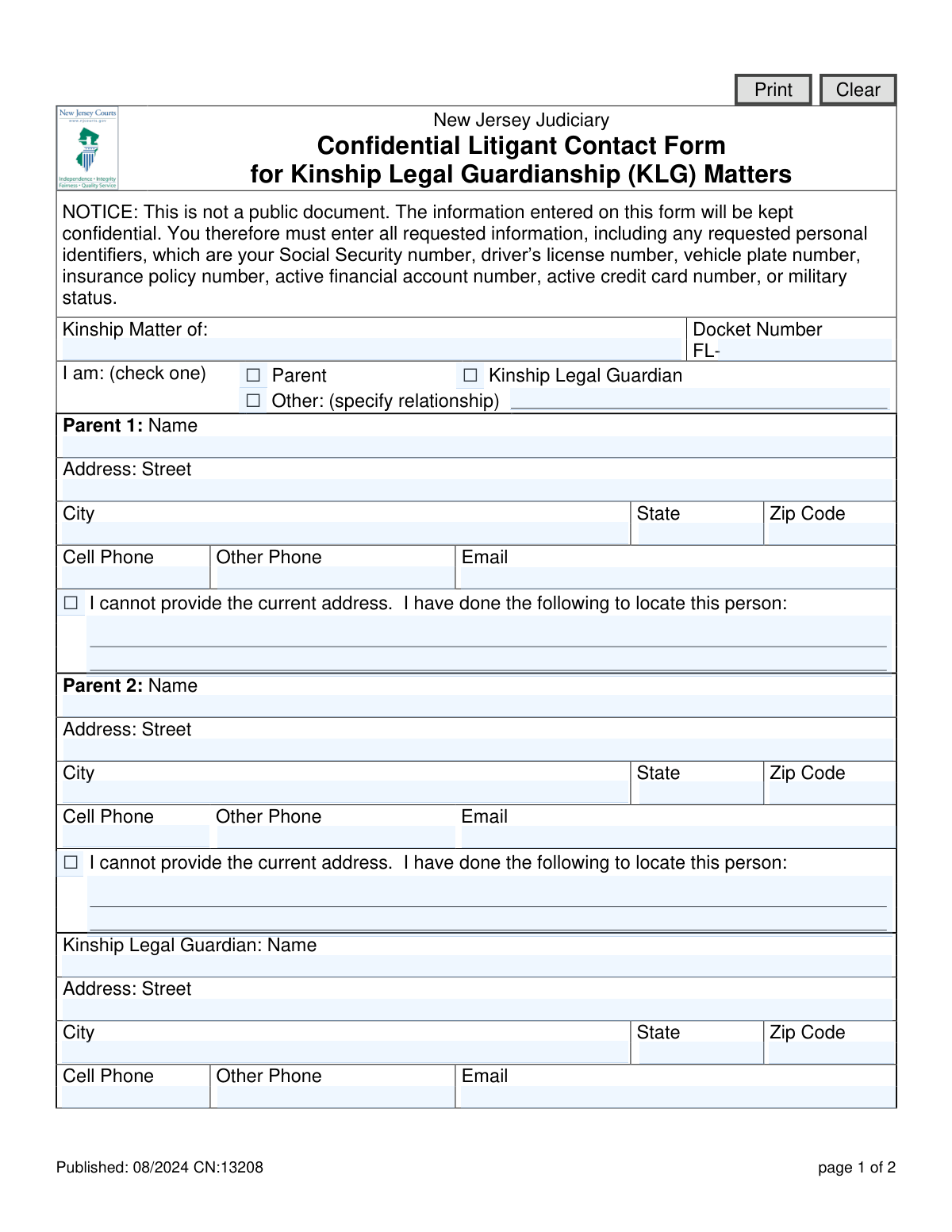
This form is a confidential document required by the New Jersey Judiciary for Kinship Legal Guardianship (KLG) proceedings. Its purpose is to collect private contact information, including addresses, phone numbers, and personal identifiers, for parents, guardians, and other involved parties, which is not disclosed to the public. Today, this form can be filled out quickly and accurately using AI-powered services like Instafill.ai, which can also convert non-fillable PDF versions into interactive fillable forms.
CN:13208 is part of the New Jersey forms category on Instafill.
Our AI automatically handles information lookup, data retrieval, formatting, and form filling.
It takes less than a minute to fill out CN:13208 using our AI form filling.
Securely upload your data. Information is encrypted in transit and deleted immediately after the form is filled out.

Form specifications

Form name: Confidential Litigant Contact form for Kinship Legal Guardianship (KLG) Matters
Number of fields: 41
Number of pages: 1
Language: English
main-image

Instafill Demo: How to fill out PDF forms in seconds with AI

How to Fill Out CN:13208 Online for Free in 2026

Are you looking to fill out a CN:13208 form online quickly and accurately? Instafill.ai offers the #1 AI-powered PDF filling software of 2026, allowing you to complete your CN:13208 form in just 37 seconds or less.
Follow these steps to fill out your CN:13208 form online using Instafill.ai:
  1. 1 Navigate to Instafill.ai and upload or select the Confidential Litigant Contact Form for KLG Matters.
  2. 2 Enter the case name and docket number, then check the box to identify your relationship to the case (Parent, Guardian, or Other).
  3. 3 Use the AI assistant to accurately fill in the name, address, and contact information for Parent 1 and Parent 2.
  4. 4 Provide the complete contact details for the Kinship Legal Guardian.
  5. 5 If applicable, list the names and contact information for any other interested parties.
  6. 6 Review all the entered information for accuracy and completeness.
  7. 7 Certify the form by electronically signing and dating it before submitting it to the New Jersey Judiciary.

Our AI-powered system ensures each field is filled out correctly, reducing errors and saving you time.

Why Choose Instafill.ai for Your Fillable CN:13208 Form?

Speed

Complete your CN:13208 in as little as 37 seconds.

Up-to-Date

Always use the latest 2026 CN:13208 form version.

Cost-effective

No need to hire expensive lawyers.

Accuracy

Our AI performs 10 compliance checks to ensure your form is error-free.

Security

Your personal information is protected with bank-level encryption.

Frequently Asked Questions About Form CN:13208

This form is used by the New Jersey Judiciary to collect private contact information for all parties in a Kinship Legal Guardianship (KLG) case. The court uses this confidential information to send official notices and communications related to the case.

The person initiating the Kinship Legal Guardianship case, typically the prospective guardian, is responsible for completing and filing this form. You must provide contact details for yourself, the child's parents, and any other relevant parties.

No, the form is explicitly marked as not a public document. The information is kept confidential and is only accessible to authorized court personnel for official use.

No, you only need to provide the information specifically requested in the form's fields, such as name, address, phone, and email. The notice about personal identifiers is a standard warning, but this particular form does not ask for SSN or driver's license numbers.

If you cannot provide a current address, check the box that says 'I cannot provide the current address.' You must then use the space provided to describe the efforts you made to try and locate that person.

In this field, you should write the full name of the child or children who are the subject of the guardianship case.

This could be anyone with a significant interest in the child's welfare or the case outcome, such as a grandparent, adult sibling, or another relative involved in the child's life. If you are unsure, you can consult with the court clerk.

This form should be filed with the Family Division of the Superior Court where your KLG case is being handled. It is usually submitted as part of your initial filing packet for the guardianship.

By signing the certification, you are legally affirming that all the information you have provided on the form is true and accurate. Providing willfully false information is a punishable offense under court rules.

Yes, services like Instafill.ai use AI to help you accurately auto-fill form fields. This can save time and help prevent common mistakes.

You can upload the PDF of the form to the Instafill.ai website. The platform will make the form interactive, allowing you to type your information directly into the fields, save your progress, and download the completed document.

If you have a non-fillable or 'flat' PDF, you can use a tool like Instafill.ai. It can convert the document into a smart, fillable form that you can easily complete online.

You should check the box for 'Other' under the 'I am:' section. In the space provided, specify your relationship to the child, such as 'Grandparent' or 'Aunt'.

Compliance CN:13208
Validation Checks by Instafill.ai

1
Validates Docket Number Format
This check ensures the 'docketNum' field begins with the 'FL-' prefix as indicated on the form. The docket number is a unique identifier for a case within the court system, and a correct format is essential for accurate filing and retrieval. A validation failure would prevent the form from being associated with the correct legal matter, causing significant processing delays.
2
Ensures a Single Party Type is Selected
This validation verifies that exactly one option from the 'I am:' checkbox group ('partyType') is selected. This information is mandatory to understand the filer's relationship to the case and their legal standing. If no selection or multiple selections are made, the form is considered incomplete and cannot be processed until the ambiguity is resolved.
3
Requires Explanation for 'Other' Party Type
This check ensures that if the 'Other' option is selected for 'partyType', the corresponding text field ('partyTypeOtherDetails') is not empty. The court needs to know the specific relationship of the filer to the child and the case for legal and procedural reasons. Failure to provide this detail makes the filing ambiguous and may lead to its rejection pending clarification.
4
Conditional Requirement for Parent 1 Address or Explanation
This validation enforces a logical rule: either a complete address for Parent 1 is provided, or the checkbox stating the address is unknown ('parent1CurrAddr') is checked and an explanation is given in 'parent1CurrAddrDetails'. This is vital for due process, ensuring all parties are properly notified or that diligent efforts to notify have been documented. An incomplete submission on this point would be rejected.
5
Conditional Requirement for Parent 2 Address or Explanation
Similar to the check for Parent 1, this ensures that either a full address for Parent 2 is provided or the 'cannot provide' checkbox ('parent2CurrAddr') is selected with a corresponding explanation in 'parent2CurrAddrDetails'. Documenting the ability or inability to contact a parent is a critical legal requirement. Failure to comply will halt the processing of the form.
6
Validates ZIP Code Format
This check verifies that all ZIP code fields ('parent1AddrZip', 'parent2AddrZip', 'klgAddrZip') contain a valid 5-digit or 9-digit (ZIP+4) numeric format. Correct ZIP codes are essential for successful mail delivery of court notifications and for maintaining data integrity. An invalid format would cause a validation error, prompting the user to correct the entry before submission.
7
Validates Phone Number Format
This validation ensures that all phone number fields (e.g., 'parent1Cell', 'parent1PhoneOther') adhere to a standard 10-digit US phone number format. This is important for ensuring the court can successfully contact the parties by phone if needed. An incorrectly formatted number would be flagged, preventing submission until it is corrected to ensure contact information is reliable.
8
Validates Email Address Format
This check confirms that any entered email address (e.g., 'parent1Email', 'klgEmail') follows the standard '[email protected]' format. Valid email addresses are a primary method for electronic communication and service of documents from the court. An invalid email format would prevent the system from accepting the data, ensuring all provided contact information is usable.
9
Ensures Valid and Current Certification Date
This validation checks that the 'sigDt' field contains a valid date in a recognized format (e.g., MM/DD/YYYY) and that the date is not in the future. The signature date legally attests to when the certification was made, and a future date is logically impossible. A form with an invalid or future date would be rejected until a valid, current or past date is provided.
10
Verifies Applicant Signature is Present
This check ensures the 'sigName' field, representing the applicant's signature, is not empty. The signature certifies the truthfulness of the statements under penalty of punishment (Rule 1:4-4(b)), making it a critical legal component of the form. A missing signature renders the entire document invalid and un-submittable.
11
Ensures 'Kinship Matter of' Name is Provided
This validation confirms that the 'klgMatterName' field is filled out. This name identifies the child or children involved in the guardianship case, which is the central subject of the legal matter. Without this information, the form is meaningless and cannot be associated with any case file, making it impossible to process.
12
Validates Two-Letter State Abbreviation
This check ensures that the state fields ('parent1AddrSt', 'parent2AddrSt', 'klgAddrSt') contain a valid two-letter postal abbreviation. Using standardized state codes is crucial for address validation, mail delivery, and maintaining a clean, searchable database. An invalid entry would trigger an error, requiring the user to use the correct format for a valid address.
13
Ensures At Least One Contact Method is Provided
This validation checks that for each party (Parent 1, Parent 2, KLG), at least one method of contact (Cell Phone, Other Phone, or Email) is provided if their address is known. This ensures the court has a reliable way to communicate with all interested parties regarding the case. If no contact information is given for a party with a known address, the form may be flagged for review or rejected.

Common Mistakes in Completing CN:13208

Omitting or Mismatching the Docket Number

Filers often forget to enter the docket number or transcribe it incorrectly from other court documents. This number is the primary identifier for the case, and without it, the clerk's office cannot link the form to the correct legal file, leading to significant processing delays or rejection of the document. To avoid this, carefully copy the full docket number, including the 'FL-' prefix, from an official court notice or prior filing.

Not Identifying Filer's Relationship to the Case

People sometimes overlook the 'I am:' section, failing to check the box for 'Parent,' 'Kinship Legal Guardian,' or 'Other.' If 'Other' is selected, they may forget to specify their exact relationship. This omission leaves the court uncertain of the filer's standing in the matter, which can cause the form to be returned for clarification and delay proceedings.

Insufficient Justification for a Missing Address

A filer may check the 'I cannot provide the current address' box but fail to thoroughly explain the steps taken to locate the person. Simply stating 'I don't know' is insufficient, as the court requires a detailed account of your due diligence (e.g., searching online, contacting mutual friends) to ensure all reasonable efforts were made. Failing to provide this detail can halt the case, as the court cannot proceed without proof of attempted notification.

Missing Signature or Date on Certification

An unsigned or undated form is legally invalid, as the signature certifies the information is true under penalty of punishment. This is a frequent oversight that leads to immediate rejection of the form by the court clerk, requiring you to refile. Always double-check the final page to ensure you have provided both a signature and the current date before submission.

Misidentifying the 'Kinship Matter of'

The 'Kinship Matter of:' field is intended for the name of the minor child who is the subject of the guardianship proceeding, not the filer or parents. Entering the wrong name creates confusion in the case file and can lead to administrative errors and delays. To prevent this, enter the full legal name of the child involved in the KLG case as it appears on other court documents.

Providing Incomplete Contact Information

The purpose of this form is to maintain current contact information, but filers often leave fields like email or a secondary phone number blank. This hinders the court's ability to send notices, potentially violating a party's right to be informed and causing case delays. Ensure every requested field is filled out for each individual, unless the information is truly unknown after diligent search efforts.

Using Nicknames Instead of Full Legal Names

In legal filings, precision is key, but people often use informal names or nicknames (e.g., 'Mike' for 'Michael'). This can create ambiguity and issues with identity verification for official notices and future legal actions. Always use the full, legal names for all individuals as they appear on official documents like birth certificates or driver's licenses.

Address and Phone Number Data Entry Errors

Simple typos in street names, ZIP codes, or phone numbers are common but can cause mailed notices to be returned as undeliverable. These errors prevent the court from making contact, causing critical delays. AI-powered form filling tools like Instafill.ai can help prevent these mistakes by automatically validating and formatting addresses and phone numbers correctly.

Confusing the Party Information Sections

A filer who is also a parent or guardian might enter their own information in the wrong section, creating an inaccurate record. For example, a parent filing the form might accidentally fill out the 'Kinship Legal Guardian' section with their own details. Carefully read the heading for each section (Parent 1, Parent 2, Kinship Legal Guardian) and enter the correct person's information in the corresponding fields.

Providing Vague 'Other Interested Parties' Information

When listing 'Other interested parties,' filers may only provide a name without an address, email, or phone number. This makes the information useless for the court, as they cannot contact the person for official notifications. If you list an interested party, you must include their complete contact details to ensure they can be properly included in the proceedings.
Saved over 80 hours a year

“I was never sure if my IRS forms like W-9 were filled correctly. Now, I can complete the forms accurately without any external help.”

Kevin Martin Green

Your data stays secure with advanced protection from Instafill and our subprocessors

Robust compliance program

Transparent business model

You’re not the product. You always know where your data is and what it is processed for.

ISO 27001, HIPAA, and GDPR

Our subprocesses adhere to multiple compliance standards, including but not limited to ISO 27001, HIPAA, and GDPR.

Security & privacy by design

We consider security and privacy from the initial design phase of any new service or functionality. It’s not an afterthought, it’s built-in, including support for two-factor authentication (2FA) to further protect your account.

Fill out CN:13208 with Instafill.ai

Worried about filling PDFs wrong? Instafill securely fills confidential-litigant-contact-form-for-kinship-legal-guardianship-klg-matters forms, ensuring each field is accurate.