Yes! You can use AI to fill out Consent to Enter Judgment for Possession (Tenant Vacates) - Appendix XI-W
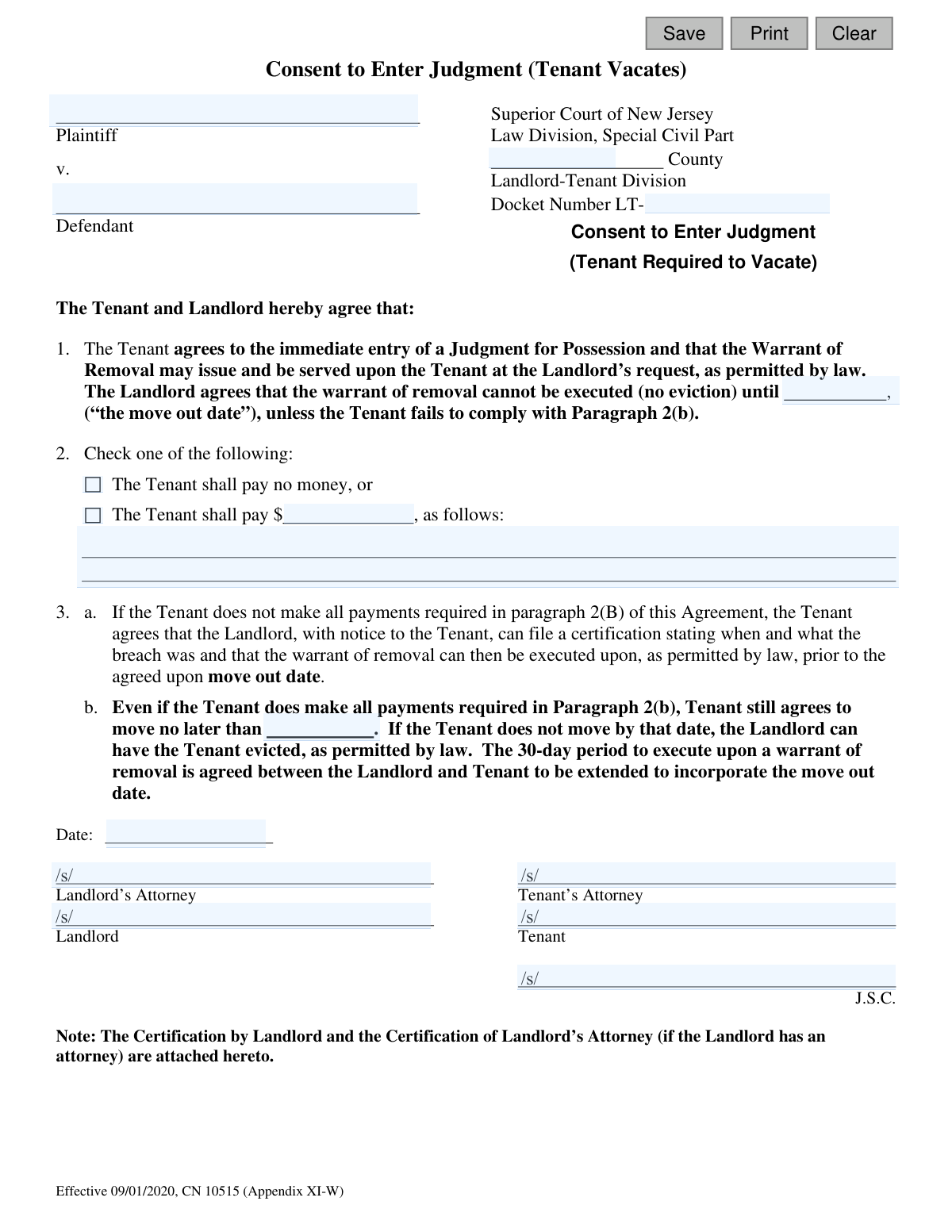
Appendix XI-W, the Consent to Enter Judgment for Possession (Tenant Vacates), is a formal agreement filed in the Superior Court of New Jersey's Landlord-Tenant Division. It documents a tenant's consent to a judgment for possession, establishing a specific move-out date and payment terms, thereby avoiding a trial. This legally binding document allows a landlord to obtain a Warrant of Removal if the tenant fails to vacate as agreed. Today, this form can be filled out quickly and accurately using AI-powered services like Instafill.ai, which can also convert non-fillable PDF versions into interactive fillable forms.
Appendix XI-W is part of the
New Jersey forms category on Instafill.
Our AI automatically handles information lookup, data retrieval, formatting, and form filling.
It takes less than a minute to fill out Appendix XI-W using our AI form filling.
Securely upload your data. Information is encrypted in transit and deleted immediately after the form is filled out.
Form specifications
| Form name: | Consent to Enter Judgment for Possession (Tenant Vacates) - Appendix XI-W |
| Number of fields: | 19 |
| Number of pages: | 1 |
| Language: | English |
Instafill Demo: How to fill out PDF forms in seconds with AI
How to Fill Out Appendix XI-W Online for Free in 2026
Are you looking to fill out a APPENDIX XI-W form online quickly and accurately? Instafill.ai offers the #1 AI-powered PDF filling software of 2026, allowing you to complete your APPENDIX XI-W form in just 37 seconds or less.
Follow these steps to fill out your APPENDIX XI-W form online using Instafill.ai:
- 1 Navigate to Instafill.ai and upload or select the 'Consent to Enter Judgment for Possession (Tenant Vacates) - Appendix XI-W' form.
- 2 Provide the case information, including the Plaintiff (Landlord) and Defendant (Tenant) names, the county, and the court docket number.
- 3 Specify the financial terms of the agreement by checking whether the tenant will pay money and detailing the amount and payment schedule if applicable.
- 4 Enter the critical dates, such as the final move-out date and the earliest date the warrant of removal can be executed.
- 5 Review all the information populated by the AI, carefully checking names, dates, and financial details for complete accuracy.
- 6 Digitally sign the form in the appropriate fields for the Landlord, Tenant, and their respective attorneys if they are involved.
- 7 Download the completed and signed document, ready for filing with the Superior Court of New Jersey.
Our AI-powered system ensures each field is filled out correctly, reducing errors and saving you time.
Why Choose Instafill.ai for Your Fillable Appendix XI-W Form?
Speed
Complete your Appendix XI-W in as little as 37 seconds.
Up-to-Date
Always use the latest 2026 Appendix XI-W form version.
Cost-effective
No need to hire expensive lawyers.
Accuracy
Our AI performs 10 compliance checks to ensure your form is error-free.
Security
Your personal information is protected with bank-level encryption.
Frequently Asked Questions About Form Appendix XI-W
This form is a legally binding agreement between a landlord and a tenant to settle an eviction case. The tenant agrees to move out by a specific date, and in exchange, the landlord agrees not to execute the eviction before that date, provided all conditions are met.
Both the landlord (Plaintiff) and the tenant (Defendant) must agree to the terms and sign the form. It is a mutual agreement that is then submitted to the court for a judge's approval.
By signing, you agree that a Judgment for Possession can be entered against you and that you will move out by the agreed-upon date. If you fail to move or miss any required payments, the landlord can proceed with the eviction.
No, not usually. The landlord agrees to delay the execution of the eviction (the Warrant of Removal) until the 'move out date' specified in the agreement, as long as you follow all the terms.
You will need the names of the landlord and tenant, the county, the court docket number, the agreed-upon move-out date, and details of any payment plan if applicable.
If you miss a required payment, the landlord can file a certification with the court and may be allowed to execute the Warrant of Removal, evicting you before the original move-out date.
No. Even if you make all the required payments, you are still legally obligated to move out by the date specified in the agreement. Failure to do so will result in your eviction.
A Warrant of Removal is a court order that authorizes a law enforcement officer to evict a tenant from a property. This agreement sets the conditions under which the landlord can use the warrant.
The form must be signed by the landlord, the tenant, and their respective attorneys if they have them. It must also be signed by a Superior Court Judge to become an official court order.
After being signed by the landlord and tenant, the form is submitted to the Superior Court of New Jersey, Special Civil Part, in the county where the landlord-tenant case was filed.
Yes, services like Instafill.ai use AI to help you accurately auto-fill form fields with your information, which can save time and help prevent errors.
You can use a service like Instafill.ai to upload the PDF and fill it out on your computer. Their platform allows you to type directly into the fields and prepare the document for electronic or physical signatures.
If you have a non-fillable or 'flat' PDF, you can upload it to a service like Instafill.ai. Their technology can convert the document into an interactive, fillable form that you can complete online.
Compliance Appendix XI-W
Validation Checks by Instafill.ai
Common Mistakes in Completing Appendix XI-W
Users often mistype the docket number or forget to include the 'LT-' prefix, typically due to transcription errors from other court documents. An incorrect docket number will cause the court clerk to reject the filing, delaying the legal process until the error is corrected. To avoid this, carefully copy the number from the original complaint; AI-powered tools like Instafill.ai can also prevent this by auto-filling case information consistently across all related documents.
Entering nicknames, partial names, or failing to list all tenants on the lease under 'Plaintiff' and 'Defendant' is a frequent error. This creates legal ambiguity regarding who is bound by the judgment, potentially making it unenforceable. Always use the full, legal names of the landlord/entity and all tenants as they appear on the original court filings and lease agreement to ensure the judgment is valid.
Forgetting to fill in the 'eviction hold date' in Paragraph 1 or the final 'move out date' in Paragraph 3b is a critical failure. This oversight renders the core terms of the agreement uncertain and unenforceable. The court cannot approve a judgment with missing dates, which nullifies the consent agreement and sends the parties back to square one.
A common point of confusion is setting the final 'move out date' (Paragraph 3b) before the 'eviction hold date' (Paragraph 1). This logical contradiction makes the agreement nonsensical and will cause a court to reject it. To avoid this, ensure the final move-out date is the same as or later than the date until which the eviction is stayed. Using a tool like Instafill.ai can help by flagging inconsistent dates before submission.
When a payment is agreed upon, users may enter the total amount in 'amtDue' but fail to specify the payment schedule in the 'paymentDesc' space. This ambiguity can lead to future disputes over when payments were due, potentially triggering an early eviction based on a misunderstanding. Clearly detail all payment amounts, due dates, and methods to create a clear record and prevent conflict.
Users sometimes check both 'The Tenant shall pay no money' and also fill in a payment amount, or they check neither box. This makes the agreement's financial terms contradictory and legally void. To prevent this, carefully select only one of the two options in Paragraph 2. Smart form-filling tools can enforce rules like selecting only one checkbox in a group, preventing such errors.
In the rush to finalize an agreement, one or more parties may forget to sign or date the document. An unsigned or undated consent form is not a legally binding contract and is worthless for court purposes. Before filing, meticulously check that the landlord, tenant, and any attorneys have all signed and that the date of the agreement is filled in.
The note at the bottom of the form, which requires attaching landlord and attorney certifications, is easily overlooked. Submitting the consent judgment without these required attachments will result in an incomplete filing that the court will reject. Always read all notes on a form and ensure all supplementary documents are completed and included with the submission.
People often download legal forms from unofficial websites, resulting in the use of an outdated version. The form clearly states it is effective 09/01/2020; using an older one will lead to rejection. Always download forms from the official NJ Courts website. If you only find a non-fillable PDF, a tool like Instafill.ai can convert it into a fillable version while helping ensure you have the latest document.
Tenants may sign this form believing it is just an agreement to move out, without realizing they are consenting to an immediate 'Judgment for Possession'. This means a formal judgment is entered on their record, which can impact future housing applications. It is crucial for all parties, especially tenants, to understand that this form finalizes the eviction case in the landlord's favor, with the dates only controlling the timeline.
It is common for a landlord who owns properties in multiple counties, or a tenant unfamiliar with the court system, to enter the wrong county. This results in the form being filed in the wrong jurisdiction, leading to immediate rejection by the court clerk. This causes significant delays and requires the parties to refile in the correct county court, which should match the original complaint.
Saved over 80 hours a year
“I was never sure if my IRS forms like W-9 were filled correctly. Now, I can complete the forms accurately without any external help.”
Kevin Martin Green
Your data stays secure with advanced protection from Instafill and our subprocessors

Robust compliance program
Transparent business model
You’re not the product. You always know where your data is and what it is processed for.
ISO 27001, HIPAA, and GDPR
Our subprocesses adhere to multiple compliance standards, including but not limited to ISO 27001, HIPAA, and GDPR.
Security & privacy by design
We consider security and privacy from the initial design phase of any new service or functionality. It’s not an afterthought, it’s built-in, including support for two-factor authentication (2FA) to further protect your account.
Fill out Appendix XI-W with Instafill.ai
Worried about filling PDFs wrong? Instafill securely fills consent-to-enter-judgment-for-possession-tenant-vacates-appendix-xi-w forms, ensuring each field is accurate.