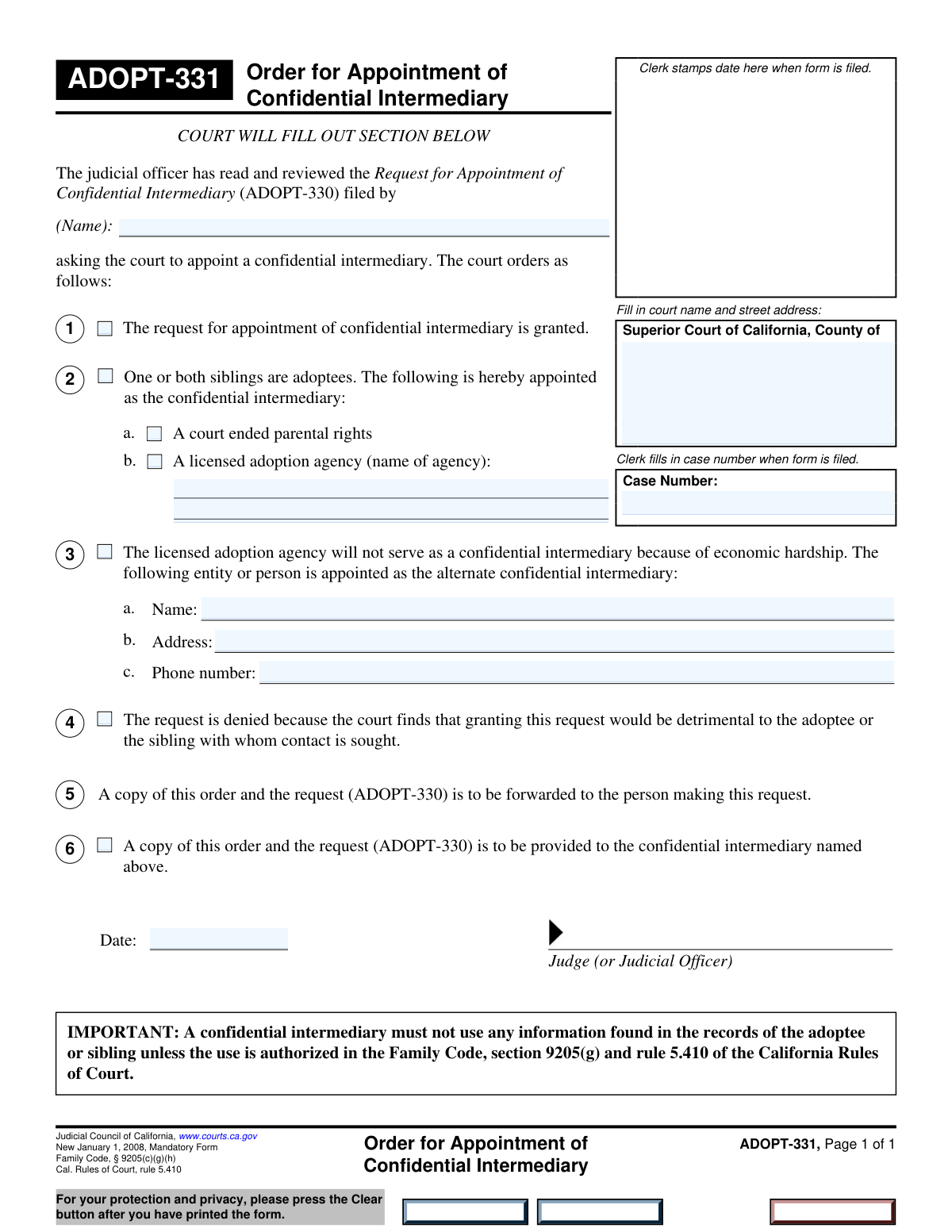
Yes! You can use AI to fill out Form ADOPT-331, Order on Request for Appointment of Confidential Intermediary
Form ADOPT-331, Order on Request for Appointment of Confidential Intermediary, is a legal document issued by the Superior Court of California. It formalizes the court's decision on a request (filed using Form ADOPT-330) to appoint an intermediary to help facilitate contact between siblings separated by adoption or termination of parental rights. This order is crucial as it either authorizes the search and contact process or denies it based on the best interests of the individuals involved. Today, this form can be filled out quickly and accurately using AI-powered services like Instafill.ai, which can also convert non-fillable PDF versions into interactive fillable forms.
Our AI automatically handles information lookup, data retrieval, formatting, and form filling.
It takes less than a minute to fill out ADOPT-331 using our AI form filling.
Securely upload your data. Information is encrypted in transit and deleted immediately after the form is filled out.
Form specifications
| Form name: | Form ADOPT-331, Order on Request for Appointment of Confidential Intermediary |
| Number of fields: | 18 |
| Number of pages: | 1 |
| Language: | English |
Instafill Demo: How to fill out PDF forms in seconds with AI
How to Fill Out ADOPT-331 Online for Free in 2026
Are you looking to fill out a ADOPT-331 form online quickly and accurately? Instafill.ai offers the #1 AI-powered PDF filling software of 2026, allowing you to complete your ADOPT-331 form in just 37 seconds or less.
Follow these steps to fill out your ADOPT-331 form online using Instafill.ai:
- 1 Navigate to Instafill.ai and upload or select Form ADOPT-331.
- 2 Enter the court's name, street address, and the assigned case number in the designated fields.
- 3 Indicate the court's decision by checking the box for either 'Request Granted' or 'Request Denied'.
- 4 If the request is granted, provide the details of the appointed confidential intermediary, including the agency or individual's name and contact information.
- 5 If an alternate intermediary is appointed due to economic hardship, fill in their name, address, and phone number.
- 6 Enter the date the order is being issued.
- 7 Carefully review all entered information for accuracy before saving, printing, or submitting the completed order as directed by the court.
Our AI-powered system ensures each field is filled out correctly, reducing errors and saving you time.
Why Choose Instafill.ai for Your Fillable ADOPT-331 Form?
Speed
Complete your ADOPT-331 in as little as 37 seconds.
Up-to-Date
Always use the latest 2026 ADOPT-331 form version.
Cost-effective
No need to hire expensive lawyers.
Accuracy
Our AI performs 10 compliance checks to ensure your form is error-free.
Security
Your personal information is protected with bank-level encryption.
Frequently Asked Questions About Form ADOPT-331
This form is a court order that documents the judge's decision on a 'Request for Appointment of Confidential Intermediary.' It either grants or denies the request to appoint someone to help facilitate contact between siblings separated by adoption.
A judicial officer, such as a judge, fills out and signs this form. It is the court's official response to a request filed by an individual, not a form for the public to complete.
A confidential intermediary is a person or licensed agency appointed by the court to discreetly search for a sibling involved in an adoption case and inquire about their interest in having contact.
The court will use information from your initial request (Form ADOPT-330), including the case number and your name as the filer. The judge will then make the decision and appoint an intermediary if the request is granted.
If the request is granted, the court will check the 'Request Granted' box and appoint a confidential intermediary, typically a licensed adoption agency, to begin the process of contacting the sibling.
The court may deny the request if it determines that granting contact would be detrimental to the well-being of the adoptee or the sibling with whom contact is sought.
An alternate intermediary is appointed if the licensed adoption agency cannot serve due to economic hardship. The court will then name a different qualified entity or person and list their contact information on the form.
Form ADOPT-330 is the 'Request for Appointment of Confidential Intermediary.' It is the initial application you file with the court to ask for an intermediary to be appointed; this order is the court's decision on that request.
If the request was granted, a copy of this order and your original request will be provided to the appointed confidential intermediary so they can begin their work. You will also receive a copy for your records.
Once the judge signs the order, the court clerk will process it and send a copy to you (the filer) and any other relevant parties, either by mail or through the court's electronic filing system.
Yes, services like Instafill.ai use AI to help you accurately auto-fill your information onto forms, which can save time and help prevent common errors.
You can upload the PDF form to the Instafill.ai platform. Its AI will automatically detect the form fields, allowing you to easily type in your information, save, and print the completed document.
If you have a non-fillable or 'flat' PDF, you can use a tool like Instafill.ai. It can convert the document into an interactive, fillable form that you can complete on your computer.
Compliance ADOPT-331
Validation Checks by Instafill.ai
1
Exclusive Order Outcome Selection
This check ensures that the user has not selected both 'Request Granted' and 'Request Denied' simultaneously. An order cannot be both granted and denied, so selecting both options creates a logical contradiction. If validation fails, the user should be prompted to choose only one of these mutually exclusive options.
2
Mandatory Order Outcome
Validates that at least one of the 'Request Granted' or 'Request Denied' checkboxes has been selected. The purpose of the form is to document a court's decision, so an outcome is required for the form to be complete. A failure to select an outcome would render the document legally incomplete and ambiguous.
3
Court Information Completeness
Ensures the 'Court Name and Street Address' field is not empty. This information is critical for identifying the specific court and jurisdiction handling the case. Without it, the order is not properly associated with a legal venue, making it invalid.
4
Case Number Presence
This validation confirms that the 'Case Number' field has been filled out. The case number is the unique identifier for the legal proceeding within the court system. A missing case number makes it impossible to file or reference the document correctly.
5
Filer's Name Completeness
Verifies that the 'Filer's Name' field is not left blank. This field identifies the individual who initiated the request, which is essential for the legal record. An empty filer name would create ambiguity about the parties involved in the court's order.
6
Conditional Requirement for Adoptee Status
This check enforces that the 'One or both siblings are adoptees' checkbox can only be selected if the 'Request Granted' checkbox is also selected. The appointment of an intermediary is contingent on the request being granted first. This prevents illogical data entry where conditions of a granted request are specified even if the request was denied.
7
Conditional Requirement for Agency Name
Validates that if the 'A licensed adoption agency' checkbox is checked, the 'Licensed Adoption Agency Name' text field must be filled. It is necessary to identify the specific agency being appointed as the intermediary. Failure to provide the name would result in an incomplete and unenforceable appointment.
8
Conditional Requirement for Alternate Intermediary Details
Ensures that if the checkbox for appointing an alternate intermediary is checked, the 'Alternate Intermediary Name', 'Address', and 'Phone Number' fields are all mandatory. Appointing an alternate requires providing their complete contact information for the appointment to be valid and actionable. Incomplete information would prevent contact with the appointed alternate.
9
Alternate Intermediary Phone Number Format
This check verifies that the 'Alternate Intermediary Phone Number' field, if filled, adheres to a standard phone number format (e.g., XXX-XXX-XXXX or (XXX) XXX-XXXX). A valid format ensures the number is legitimate and can be used to contact the intermediary. An improperly formatted number could lead to communication failures.
10
Date Field Validity
Ensures the 'Date' field is not empty and contains a value in a valid date format (e.g., MM/DD/YYYY). The date is a critical legal component of any court order, establishing when it was issued and became effective. An invalid or missing date would compromise the document's legal standing.
11
Conditional Logic for Order Copy
This validation confirms that the 'Provide copy to confidential intermediary' checkbox can only be selected if 'Request Granted' is also checked. It is illogical to send a copy of the order to an intermediary if the request to appoint one was denied. This check prevents contradictory instructions on the form.
12
Data Integrity on Request Denial
If 'Request Denied' is checked, this validation ensures that all fields related to a granted request are cleared or disabled. This includes intermediary appointment checkboxes, names, and addresses. This prevents the submission of conflicting information where details of an appointment are provided for a denied request.
13
Logical Prerequisite for Alternate Appointment
This check ensures the checkbox for appointing an alternate intermediary can only be selected if the 'A licensed adoption agency' checkbox is also selected. The form's structure implies an alternate is only appointed if the primary choice, a licensed agency, is selected but cannot serve. This validation maintains the intended workflow and prevents illogical selections.
Common Mistakes in Completing ADOPT-331
People often use abbreviations for the court name or forget to specify the county, leading to ambiguity and potential misfiling. This error can cause significant delays as the document may be routed to the wrong courthouse or rejected by the clerk's office. To prevent this, always write the full, official name 'Superior Court of California, County of...' and the complete street address as listed on official court websites.
Entering the case number with typos, using an incorrect format, or leaving it blank is a frequent and critical error. The case number is the primary identifier that links your document to the correct legal file. An incorrect number can cause the form to be rejected or lost within the court system, necessitating a time-consuming refiling process.
Filers sometimes mistakenly check the 'Request Granted' or 'Request Denied' boxes, not realizing this section is exclusively for the judge to complete. This invalidates the form because it appears to pre-empt the court's decision, leading to automatic rejection. Filers must leave all sections designated for the court's order completely blank.
The form contains several fields that should only be filled out if a preceding box is checked, such as providing an agency name only after checking the appointment box. People often miss these dependencies, either filling in details for unselected options or skipping required information for selected ones. This creates an inconsistent and invalid form, which can be avoided by carefully reading instructions like 'Fill only if...' for each field. AI-powered tools like Instafill.ai can help by automatically showing or hiding dependent fields based on your selections.
A common oversight is checking the box to appoint 'A licensed adoption agency' but then failing to write the specific name of that agency in the designated field. The court cannot appoint a generic, unnamed entity; the order must identify the specific agency being appointed. This omission makes the order unenforceable and requires correction, delaying the entire process.
When an alternate intermediary is needed due to economic hardship, filers may check the corresponding box but then fail to provide the alternate's full name, address, and phone number. This omission brings the appointment process to a halt, as the court cannot appoint an unidentified or unreachable person. Ensure all three fields—name, address, and phone number—are completed if you select the alternate appointment option.
When providing the Alternate Intermediary's details, users may enter an incomplete address (e.g., missing a ZIP code) or a phone number without an area code. This can make it impossible for the court or other parties to contact the appointed intermediary, causing significant delays. To avoid this, use a standard format like (XXX) XXX-XXXX for phone numbers and include the full street address, city, state, and ZIP code. Using a tool like Instafill.ai can help prevent these errors by validating and formatting data as you type.
Individuals sometimes use nicknames, initials, or an incomplete version of their name instead of the full legal name that appears on other court documents. This can create identity verification issues and inconsistencies in the case file, potentially leading to processing delays or rejection. Always use your full, official legal name to ensure clarity and legal validity.
A user might fill out the details for both the primary 'Licensed Adoption Agency' and the 'Alternate Confidential Intermediary' at the same time. These sections are mutually exclusive; the alternate is only appointed if the primary agency cannot serve. Filling out both creates a direct contradiction that the court cannot resolve, forcing a rejection of the form and requiring you to start over.
Filers may incorrectly check the box to 'Provide copy to confidential intermediary' before the request has been granted, or they may forget to check it after it has been granted. This instruction is only valid after a judge grants the request, authorizing the clerk to send the necessary documents. Checking it incorrectly causes confusion, while forgetting it can delay the intermediary's ability to begin their work. If the form is a non-fillable PDF, a service like Instafill.ai can convert it to an interactive version, making checkboxes and fields easier to manage.
Saved over 80 hours a year
“I was never sure if my IRS forms like W-9 were filled correctly. Now, I can complete the forms accurately without any external help.”
Kevin Martin Green
Your data stays secure with advanced protection from Instafill and our subprocessors

Robust compliance program
Transparent business model
You’re not the product. You always know where your data is and what it is processed for.
ISO 27001, HIPAA, and GDPR
Our subprocesses adhere to multiple compliance standards, including but not limited to ISO 27001, HIPAA, and GDPR.
Security & privacy by design
We consider security and privacy from the initial design phase of any new service or functionality. It’s not an afterthought, it’s built-in, including support for two-factor authentication (2FA) to further protect your account.
Fill out ADOPT-331 with Instafill.ai
Worried about filling PDFs wrong? Instafill securely fills form-adopt-331-order-on-request-for-appointment-of-confidential-intermediary forms, ensuring each field is accurate.