
Instafill.ai
7 days free
AI form filling · 98 fields · 2 pages · done in seconds

Yes! You can use AI to fill out Form CR-110/JV-790, Order for Victim Restitution

Don't type 98 fields by hand. Tell our AI about yourself, or upload a document you already have, and it fills every field in seconds. You check it, then download, print or sign.
7 days free, then $19.99/month · Cancel anytime
AI fills it, no typingEncrypted, never used to train AICancel in two clicks
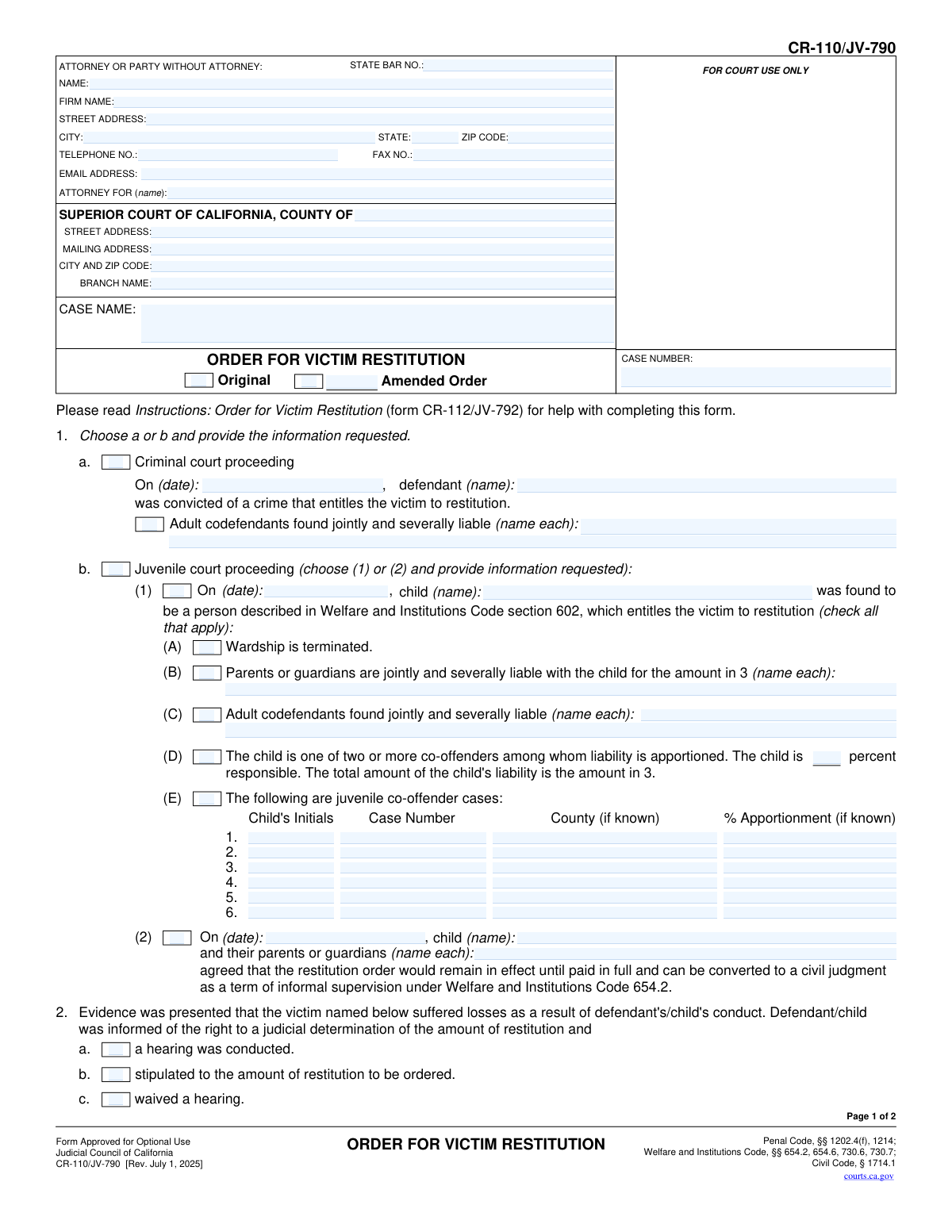
Form CR-110/JV-790, Order for Victim Restitution, page 1
Moderate · 50/100Form Complexity Index

The AI does the filling. You just check it.

No typing into boxes, nothing to install.

Tell the AI about youAnswer a few questions in plain words, or upload a document you already have. That is all the typing there is.
AI fills every field in secondsIt puts each answer in the right box on every page, checkboxes included.
Check it and downloadReview every field, change anything, then download, print or sign the PDF.

What this form asks for

The AI fills all of it, from your answers or your documents.

Form CR-110/JV-790, the Order for Victim Restitution, is a legal document used in California's Superior Courts to officially mandate that a convicted defendant or a juvenile offender pay financial compensation to their victim. This order details the specific amount of restitution for losses such as property damage, medical expenses, and lost wages, making it a critical tool for victim justice. Today, this form can be filled out quickly and accurately using AI-powered services like Instafill.ai, which can also convert non-fillable PDF versions into interactive fillable forms.
Fillable fields98
Pages2
Form Complexity IndexModerate, 50/100

The AI checks your answers before you download

13 checks built for this form, so a wrong date or a missing answer is caught before anyone else sees it.

Ensures Case Number Consistency Across Pages

This validation checks that the 'CASE NUMBER' field is identical on both page 1 and page 2 of the form. This is critical for document integrity and ensures that both pages are correctly associated with the same legal case. A mismatch could lead to filing errors, incorrect record-keeping, and potential legal invalidity of the order.

Validates Selection of a Single Proceeding Type

This validation ensures that the user has selected either option 1a (Criminal court proceeding) or 1b (Juvenile court proceeding), but not both. These options are mutually exclusive and define the legal context of the order. Failure to select exactly one option makes the form logically incomplete and legally ambiguous.

Requires Defendant/Child Name Based on Proceeding Type

Verifies that if either a criminal (1a) or juvenile (1b) proceeding is selected, the corresponding defendant or child name field is populated. This name is fundamental to the order, identifying the individual legally responsible for the restitution. An order without a named responsible party is unenforceable.

Validates Restitution Payee and Corresponding Amount

This check ensures that if a payee is selected in section 3 (e.g., 3a for the victim or 3b for the Victim Compensation Board), the associated monetary amount field is also filled with a valid, non-negative currency value. An order must specify both who is to be paid and how much they are to receive. An incomplete entry would render the restitution order invalid and non-actionable.

Ensures Total Apportioned Liability Does Not Exceed 100%

This rule validates the sum of all apportionment percentages entered in section 1b(1)(D) and the table in 1b(1)(E). The total percentage of liability distributed among all juvenile co-offenders cannot exceed 100%. This prevents ordering restitution that, in aggregate, is more than the total loss, which is legally impermissible.

Requires Selection of Evidence Determination Method

Confirms that exactly one option in section 2 (a. a hearing was conducted, b. stipulated to the amount, or c. waived a hearing) is checked. This information is crucial as it documents the legal basis for how the restitution amount was determined and the defendant's/child's due process rights. The form is incomplete without this procedural detail.

And 7 more checks
  • Requires at Least One Basis for Restitution
  • Requires Specification When 'Other' Basis is Selected
  • Requires Sub-Category Selection for Lost Wages
  • Validates Date Format and Chronology
  • Ensures State Bar Number is Numeric
  • Requires Interest Calculation Start Date
  • Validates Email Address Format

Let AI fill out your CR-110/JV-790

No typing. Every field filled in seconds, checked, ready to sign.

7 days free, then $19.99/month · Cancel anytime

How to Fill Out CR-110/JV-790 Online for Free in 2026

What the AI walks you through.

  1. Navigate to Instafill.ai and upload or select the CR-110/JV-790, Order for Victim Restitution form.
  2. Provide the attorney or party information, including name, address, contact details, and State Bar number.
  3. Enter the specific court and case information, such as the county, branch name, case name, and case number.
  4. Indicate whether the case is a criminal or juvenile proceeding, and input the details of the defendant/child, conviction date, and any co-defendants.
  5. Specify the total restitution amount ordered, to whom it is payable (victim or Victim Compensation Board), and check the boxes corresponding to the types of losses covered.
  6. Let the AI populate all the information into the correct fields, then carefully review the entire completed form for accuracy and completeness.
  7. Download, print, and file the finalized Order for Victim Restitution with the appropriate court.

Common Mistakes in Completing CR-110/JV-790

The ones the AI is built to catch.

Incomplete Header on Page 2
Users frequently fill out the case name and number on the first page but forget to repeat this information in the header of page 2. This omission can cause the second page to become separated or misfiled, rendering the order incomplete and potentially unenforceable. To prevent this, always double-check that all required header fields are completed on every page of the document. AI-powered tools like Instafill.ai can automatically populate recurring information across multiple pages, eliminating this risk.
Incorrect or Ambiguous Proceeding Type Selection
In Section 1, users must choose between a 'Criminal court proceeding' (1a) or a 'Juvenile court proceeding' (1b), but not both. A common error is selecting the wrong type, checking both boxes, or leaving the section blank entirely. This fundamental mistake invalidates the basis of the order and leads to immediate rejection by the court clerk. Carefully review the case details to ensure the correct proceeding type is selected before filling out the corresponding sub-fields.
Failing to Specify Co-defendant Liability
When multiple defendants are involved, the form requires specifying liability, such as naming all adult codefendants found 'jointly and severally liable' (1a) or apportioning percentage liability for juvenile co-offenders (1b(1)(D)). People often leave these fields blank or provide incomplete names, creating ambiguity about who is responsible for paying the restitution. This can lead to significant delays and legal challenges in enforcement. Ensure all responsible parties are clearly listed with their specific liability as determined by the court.
Contradictory Hearing Status
Section 2 requires the user to state whether a hearing was conducted, stipulated to, or waived. A frequent mistake is checking multiple conflicting options (e.g., both 'a. a hearing was conducted' and 'c. waived a hearing') or leaving the section entirely blank. This creates a logical inconsistency regarding the legal basis for the restitution amount and may require clarification or refiling. Always select only one option that accurately reflects the case's procedural history.
Omitting Payee Information in Restitution Amount
In Section 3, users sometimes enter a dollar amount but forget to check the corresponding box to indicate who should be paid—the victim (3a) or the California Victim Compensation Board (3b). They may also forget to write the victim's full name in the space provided. This makes the order unclear and non-actionable, as the paying party does not know where to direct the funds. Always ensure a payee is clearly selected and named for any amount ordered.
Forgetting to Add Statutory Interest
Victims are entitled to 10 percent annual interest on the restitution amount, but this must be explicitly ordered by checking box 3c. Filers often overlook this checkbox, which can result in a significant financial loss for the victim over time. Unless otherwise specified by the court, this box should typically be checked to ensure the victim is fully compensated. Using a tool like Instafill.ai can help by flagging commonly required fields like this to ensure they are not missed.
Incomplete Breakdown of Lost Wages
Section 4d, 'lost wages or profits,' has four specific sub-options clarifying whose wages were lost and for what reason. A common error is to check the main box for 4d without selecting the precise sub-option ((1), (2), (3), or (4)) that applies. This ambiguity can weaken the justification for the amount ordered and may be challenged. It is crucial to select the specific sub-category that corresponds to the evidence presented.
Using 'Other' Without Specification
When a type of loss is not listed, filers can use option 4f, 'Other,' but they frequently check the box without providing a mandatory explanation in the 'specify' field. An unspecified 'Other' amount lacks a legal basis and will likely be disallowed or questioned by the court or the defendant. If using this option, always provide a clear and concise description of the loss being compensated.
Failing to Mark as an 'Amended Order'
If this order is modifying a previously issued restitution order, the 'Amended Order' box at the top of page 1 must be checked. Filers often forget this step, submitting the form as if it were the 'Original' order. This creates confusion in the court record, as there will be two conflicting 'original' orders, leading to administrative delays and potential legal issues in determining which order is currently valid.
Incorrect Case Number Format
Court case numbers follow a specific format that can be complex and vary by jurisdiction. Entering the case number with typos, incorrect spacing, or missing prefixes/suffixes is a very common data entry error. An incorrect case number can cause the document to be rejected by the court's filing system or misfiled in the wrong case, delaying justice for the victim. AI-powered form fillers like Instafill.ai can help by using validation rules to check for common formatting patterns, reducing the chance of such errors.

Frequently Asked Questions About CR-110/JV-790


Is it really free for 7 days?
Yes. You pay $0 today. Cancel before Nov 1 and you are never charged. Keep it, and it is $19.99 a month for 5 fills of your CR-110/JV-790.
Can I fill other forms too?
This plan is for your CR-110/JV-790: your own AI agent fills it as often as 5 times a month. To fill other forms and upload your own, choose a Professional plan from your account.
How do I cancel?
From your account, in two clicks, any time. No email, no call.
How does the AI fill out CR-110/JV-790?
You answer a few questions in plain words, or upload a document you already have. The AI reads what you give it and puts each answer into the right field of CR-110/JV-790, on every page, in seconds. It checks the answers against the form's own rules, and you review and change anything before you download, print or sign.
What happens to my information?
It is encrypted in transit and at rest, and it is never used to train AI.
How complex is CR-110/JV-790 to fill out?
CR-110/JV-790 has a Form Complexity Index of 50 out of 100, in the moderate tier: 98 fillable fields across 2 pages. Instafill.ai's AI fills it in under a minute, with every field there for you to review before you download.
What is the purpose of the CR-110/JV-790 form?
This form is a court order that legally requires a defendant in a criminal case or a child in a juvenile case to pay restitution to a victim for financial losses suffered as a result of the crime.
Who fills out the Order for Victim Restitution form?
This form is an official court order, so it is typically prepared by an attorney or court staff and then signed by a judge. It is not a form for victims to fill out themselves to request restitution.
What is the difference between a criminal proceeding (Section 1a) and a juvenile proceeding (Section 1b)?
A criminal proceeding involves an adult defendant convicted of a crime. A juvenile proceeding involves a minor (child) found to have committed an offense, and may also hold parents or guardians liable for the restitution.
What does 'jointly and severally liable' mean on this form?
This means that when multiple people are responsible for the restitution, the victim can collect the full amount from any one of them or any combination of them until the total debt is paid.
What kinds of losses can be included in the restitution amount?
As shown in Section 4, restitution can cover the value of stolen or damaged property, medical expenses, mental health counseling, and lost wages incurred by the victim or their parent/guardian.
Why would the restitution be paid to the California Victim Compensation Board instead of me?
If the California Victim Compensation Board has already paid you for some of your losses, the court will order the defendant to repay the Board directly for the amount they provided.
As a victim, how do I enforce this restitution order?
The notice on the form explains that the order is enforceable like a civil judgment. You can obtain a certified copy from the court and use it for collection actions, such as garnishing wages or placing a lien on property.
Does this restitution order ever expire?
No, the notice on page 2 clearly states that under Penal Code section 1214(d), this order does not expire. The obligation to pay remains until the amount is paid in full.
What do I need to do after the defendant has paid the full restitution amount?
Once the order is fully paid, you are required to file a 'Satisfaction of Judgment' form with the court to officially close out the debt.
What is 'apportioned' liability in a juvenile case?
If there are multiple juvenile co-offenders, the judge may 'apportion' liability, meaning each child is assigned a specific percentage of the total restitution amount that they are responsible for paying.
Can I use AI tools to help prepare this form?
Yes, services like Instafill.ai use AI to accurately auto-fill form fields, which can save time and reduce errors for attorneys or court staff preparing the document for the judge's signature.
How can I fill out the CR-110/JV-790 form online?
You can upload the form to a platform like Instafill.ai, which will make the document fillable online. Its AI-powered tools can help populate case information before you print the form for filing and signatures.
The PDF version of this form I have is not fillable. What can I do?
If you have a flat, non-fillable PDF, you can use a service like Instafill.ai to convert it into an interactive, fillable form that is easy to complete on a computer.
What happens if the defendant or child disagrees with the restitution amount?
The defendant or child has the right to a court hearing where a judge will determine the final amount of restitution. Alternatively, they can waive the hearing or agree (stipulate) to the amount, as indicated in Section 2.
Encrypted in transit and at restNever used to train AIDelete your forms any time

Get your CR-110/JV-790 filled out by AI

$0 today. Cancel before Nov 1 and you pay nothing.

7 days free, then $19.99/month · Cancel anytime