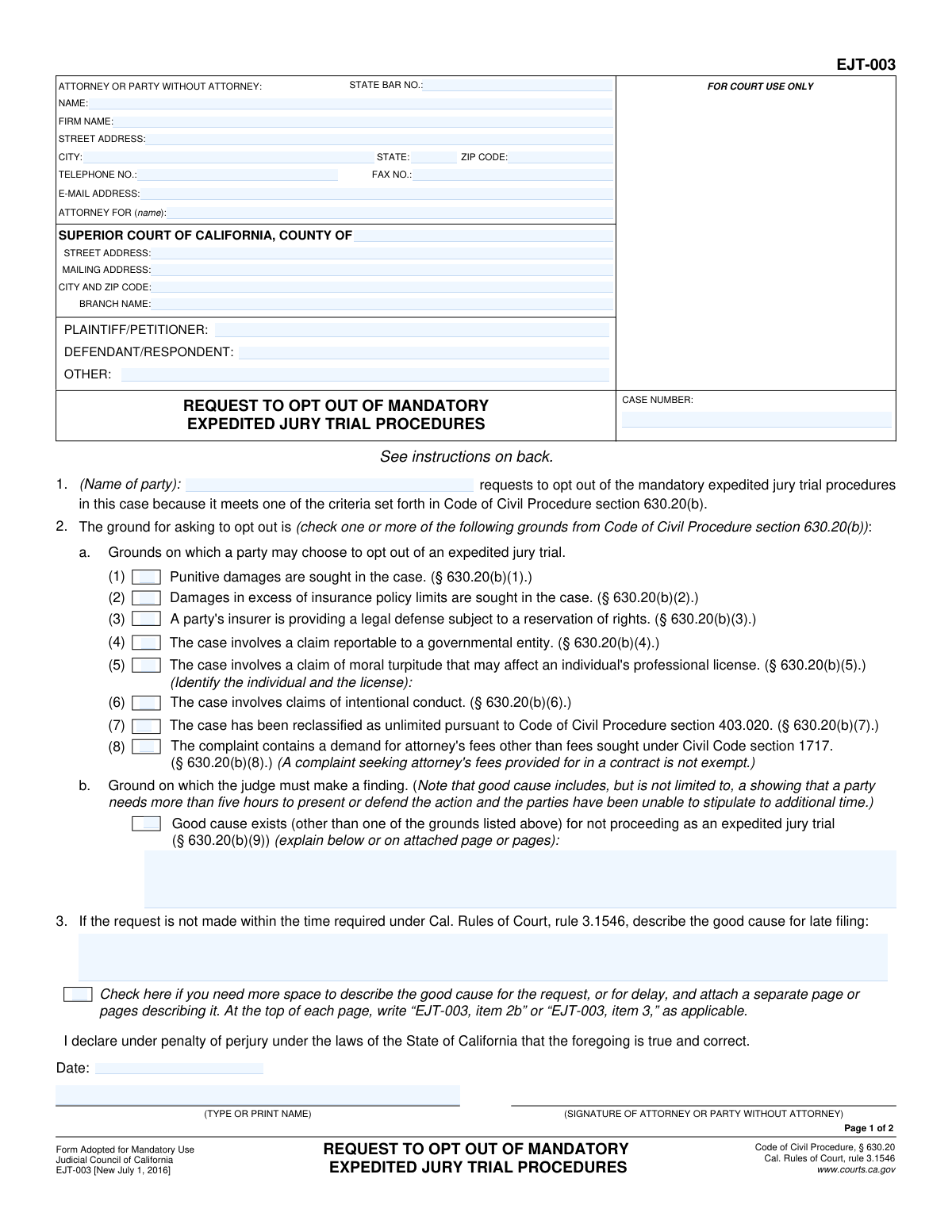
Yes! You can use AI to fill out Form EJT-003, Request to Opt Out of Mandatory Expedited Jury Trial Procedures

Form EJT-003, Request to Opt Out of Mandatory Expedited Jury Trial Procedures, is a legal document filed in a California Superior Court. It allows a party in a limited civil action to formally request that their case not be subject to the faster, more streamlined expedited jury trial process, based on specific legal grounds outlined in the Code of Civil Procedure. Today, this form can be filled out quickly and accurately using AI-powered services like Instafill.ai, which can also convert non-fillable PDF versions into interactive fillable forms.
EJT-003 is part of the California court forms category on Instafill.
Our AI automatically handles information lookup, data retrieval, formatting, and form filling.
It takes less than a minute to fill out EJT-003 using our AI form filling.
Securely upload your data. Information is encrypted in transit and deleted immediately after the form is filled out.

Form specifications

Form name: Form EJT-003, Request to Opt Out of Mandatory Expedited Jury Trial Procedures
Number of fields: 38
Number of pages: 1
Language: English
main-image

Instafill Demo: How to fill out PDF forms in seconds with AI

How to Fill Out EJT-003 Online for Free in 2026

Are you looking to fill out a EJT-003 form online quickly and accurately? Instafill.ai offers the #1 AI-powered PDF filling software of 2026, allowing you to complete your EJT-003 form in just 37 seconds or less.
Follow these steps to fill out your EJT-003 form online using Instafill.ai:
  1. 1 Navigate to Instafill.ai and upload or select Form EJT-003.
  2. 2 Provide the case information, including the court name, county, and case number.
  3. 3 Enter your information as the attorney or party without an attorney, including name, address, and contact details.
  4. 4 In Section 2, check the box that corresponds to the specific legal ground(s) for your request to opt out.
  5. 5 If applicable, provide a detailed explanation for your request or for a late filing in the designated text boxes.
  6. 6 Review all the information populated by the AI for accuracy, then date and e-sign the declaration under penalty of perjury.
  7. 7 Download the completed form to file with the court and serve on all other parties in the case.

Our AI-powered system ensures each field is filled out correctly, reducing errors and saving you time.

Why Choose Instafill.ai for Your Fillable EJT-003 Form?

Speed

Complete your EJT-003 in as little as 37 seconds.

Up-to-Date

Always use the latest 2026 EJT-003 form version.

Cost-effective

No need to hire expensive lawyers.

Accuracy

Our AI performs 10 compliance checks to ensure your form is error-free.

Security

Your personal information is protected with bank-level encryption.

Frequently Asked Questions About Form EJT-003

This form is used by a party in a limited civil case to formally request to opt out of the mandatory expedited jury trial procedures, which are faster and have different rules than standard trials.

Any party (or their attorney) in a limited civil case who believes their case meets one of the specific legal criteria for opting out can file this form. It does not apply to unlawful detainer or eviction cases.

You can request to opt out if your case involves seeking punitive damages, damages exceeding insurance policy limits, a defense under a reservation of rights, or claims of intentional conduct, among other grounds listed in section 2 of the form.

You must file and serve this form on all other parties at least 45 days before the date first set for trial. If you file late, you must provide a good cause explanation in item 3.

No, you are not required to submit documentary evidence with your request, as it is made under penalty of perjury. However, you may attach evidence if you feel it is necessary to support your claim.

After you file, the other parties have 15 days to object. The court will then review the request and any objections and will either grant it, deny it, or set a hearing for further argument.

If you disagree with the request, you must complete and file an 'Objection to Request to Opt Out' (Form EJT-004) within 15 days of being served. You must also serve a copy of your objection on all other parties.

Good cause is a reason for opting out that isn't specifically listed, such as needing more than the allotted five hours to present your case when the other party won't agree to more time.

You must promptly notify the court if the grounds that supported your request to opt out are no longer applicable. The court may then order the case to proceed as an expedited jury trial.

File the original, signed form with the court where your case is being heard, serve a copy on all other parties, and file a proof of service (like Form POS-040) with the court.

Yes, services like Instafill.ai use AI to help you accurately auto-fill form fields with your case and personal information, which saves time and helps prevent errors.

You can use a service like Instafill.ai to fill out the form online. Simply upload the PDF, and the AI will help you populate the fields before you download the completed form for filing.

If you have a non-fillable or 'flat' PDF, you can upload it to a platform like Instafill.ai. The service can convert it into an interactive, fillable form that you can complete on your computer.

Compliance EJT-003
Validation Checks by Instafill.ai

1
Ensures Case Number is Provided
Validates that the 'CASE NUMBER' field is not empty. The case number is a unique identifier essential for the court to correctly file the document and associate it with the proper legal proceeding. A missing case number will result in the form being rejected by the court clerk.
2
Requires Name of Party Opting Out
Verifies that the name of the party requesting to opt out is filled in under item 1. This field is mandatory to identify which plaintiff, defendant, or other party is initiating the request. Failure to provide this name makes the request ambiguous and legally insufficient.
3
Validates At Least One Ground for Opting Out is Selected
Checks that at least one checkbox under item 2 ('The ground for asking to opt out is...') is selected. A reason for the request is legally required by Code of Civil Procedure section 630.20(b). If no ground is selected, the request has no legal basis and cannot be processed.
4
Ensures Details are Provided for Moral Turpitude Claim
If the checkbox for item 2a(5) ('The case involves a claim of moral turpitude...') is selected, this validates that the corresponding text field identifying the individual and their professional license is filled out. This information is necessary for the court to assess the validity of this specific ground. An empty description field will render this reason incomplete.
5
Requires Explanation for 'Good Cause' Ground
If the checkbox for item 2b ('Good cause exists...') is selected, this validation ensures the corresponding text area explaining the good cause is not empty. The court requires a specific, detailed explanation to make a finding of good cause. Without an explanation, the request on this ground is unsubstantiated and will be denied.
6
Validates Signature Date is Present and Not in the Future
This check ensures the 'Date' field in the signature block is filled with a valid calendar date that is on or before the current day. A declaration made under penalty of perjury requires a valid date of signing. A missing, invalid, or future date invalidates the declaration and the entire form.
7
Ensures Signatory's Printed Name is Provided
Verifies that the '(TYPE OR PRINT NAME)' field accompanying the signature is completed. This field identifies the person signing the document, which is crucial for accountability and legal validity. A missing printed name can lead to the document being rejected as improperly executed.
8
Validates Attorney Information Consistency
If a 'STATE BAR NO.' is provided, this check ensures that the 'NAME' (of the attorney) and 'ATTORNEY FOR (name)' fields are also filled. This confirms the identity of the legal counsel and the party they represent. Incomplete attorney information can cause confusion and delays in court processing.
9
Validates E-mail Address Format
Checks that the value entered in the 'E-MAIL ADDRESS' field follows the standard format for an email address, such as '[email protected]'. This is important for ensuring that electronic communications and service from the court and other parties are deliverable. An invalid format will lead to failed communications.
10
Validates Attorney ZIP Code Format
Ensures that the 'ZIP CODE' field for the attorney's address contains a valid 5-digit or 9-digit (ZIP+4) numeric code. A correct ZIP code is essential for the proper delivery of mail by the U.S. Postal Service. An incorrect format can result in returned mail and significant delays.
11
Ensures Plaintiff and Defendant are Identified
This check verifies that the 'PLAINTIFF/PETITIONER' and 'DEFENDANT/RESPONDENT' fields are filled out. Identifying the primary parties in the case caption is fundamental for court records and ensuring all parties are properly named on the filing. Missing party information can lead to the document being rejected for improper captioning.
12
Requires Justification for Late Filing
This check validates that if the form is filed late (less than 45 days before the trial date), the explanation field in item 3 ('describe the good cause for late filing') must be filled. The court rules require a showing of good cause for any late submission. Failure to provide this justification will likely result in the court denying the late request to opt out.

Common Mistakes in Completing EJT-003

Entering Incorrect Case Number or Court Details

Filers often mistype the case number or use a generic court address instead of the specific branch where the case is being heard. An incorrect case number can cause the document to be misfiled or rejected entirely, leading to significant delays and potentially causing a missed deadline. To avoid this, always double-check the case number against other official court documents and verify the exact street address and branch name of the courthouse on the court's website.

Incomplete or Ambiguous Party Identification

People frequently make errors in the top section, such as an attorney writing their own name in the 'ATTORNEY FOR (name)' field instead of their client's name. Similarly, parties representing themselves may be unsure what to enter in the attorney fields. These mistakes can cause confusion and processing delays. Always ensure the 'ATTORNEY FOR' field lists the party you represent, and if representing yourself, clearly state 'Party Without Attorney' or 'Pro Se'.

Failing to Serve the Form and File Proof of Service

A critical and common procedural error is filing this form with the court without properly serving a copy on all other parties in the case. The instructions explicitly require filing a Proof of Service (e.g., form POS-040) along with this request. Failure to do so will render the request invalid and likely result in its denial by the court, wasting valuable time and effort.

Missing the Filing Deadline Without Good Cause

The form must be filed at least 45 days before the first trial date, a deadline that is often missed. Filers then compound the error by failing to provide a compelling, detailed reason for the delay in item 3. Simply being busy or forgetting is not considered 'good cause,' and the court will likely deny a late request that lacks a strong, well-documented justification for the tardiness.

Checking a Box Without Providing Required Details

Several grounds for opting out require more than just a checkmark, but filers often provide incomplete information. For instance, they may check box 2a(5) but forget to identify the individual and professional license, or check box 2b for 'Good cause' without providing a clear and persuasive written explanation. An incomplete justification makes the request deficient and easy for the court to deny. If the original is a non-fillable PDF, AI tools like Instafill.ai can convert it to a fillable version, making it easier to complete all required fields.

Choosing an Invalid or Unsupported Opt-Out Ground

A party might check a box in section 2 that does not accurately reflect the circumstances of the case, either misunderstanding the legal standard or hoping it won't be challenged. This makes the request vulnerable to an objection from the opposing party and scrutiny from the judge. It is crucial to select only grounds that are factually and legally supportable, as making a false statement is done under penalty of perjury.

Submitting Improperly Labeled Attachments

When providing additional information for items 2b or 3 on a separate page, filers often forget to follow the specific labeling instructions. The form requires attachments to be clearly marked at the top with 'EJT-003, item 2b' or 'EJT-003, item 3.' Failing to do so can lead to the attachment being overlooked, misplaced, or disregarded by the court clerk and judge, significantly weakening the request.

Missing Signature, Date, or Printed Name

The declaration 'under penalty of perjury' is legally invalid without a proper signature, the date of signing, and the printed name of the signatory. Filers frequently forget one of these three crucial elements, especially when rushing to file. An unsigned or undated form will be rejected by the court, nullifying the entire request and requiring a corrected submission.

Using Inconsistent Party Names in the Caption

The Plaintiff and Defendant names in the case caption must be spelled out exactly as they appear on the original complaint and other official court documents. Using abbreviations, nicknames, or slightly different spellings can create filing errors and confusion in the court's record-keeping system. AI-powered form-filling tools like Instafill.ai can help prevent this by storing party information and automatically populating it consistently and correctly on every form for a specific case.
Saved over 80 hours a year

“I was never sure if my IRS forms like W-9 were filled correctly. Now, I can complete the forms accurately without any external help.”

Kevin Martin Green

Your data stays secure with advanced protection from Instafill and our subprocessors

Robust compliance program

Transparent business model

You’re not the product. You always know where your data is and what it is processed for.

ISO 27001, HIPAA, and GDPR

Our subprocesses adhere to multiple compliance standards, including but not limited to ISO 27001, HIPAA, and GDPR.

Security & privacy by design

We consider security and privacy from the initial design phase of any new service or functionality. It’s not an afterthought, it’s built-in, including support for two-factor authentication (2FA) to further protect your account.

Fill out EJT-003 with Instafill.ai

Worried about filling PDFs wrong? Instafill securely fills form-ejt-003-request-to-opt-out-of-mandatory-expedited-jury-trial-procedures forms, ensuring each field is accurate.