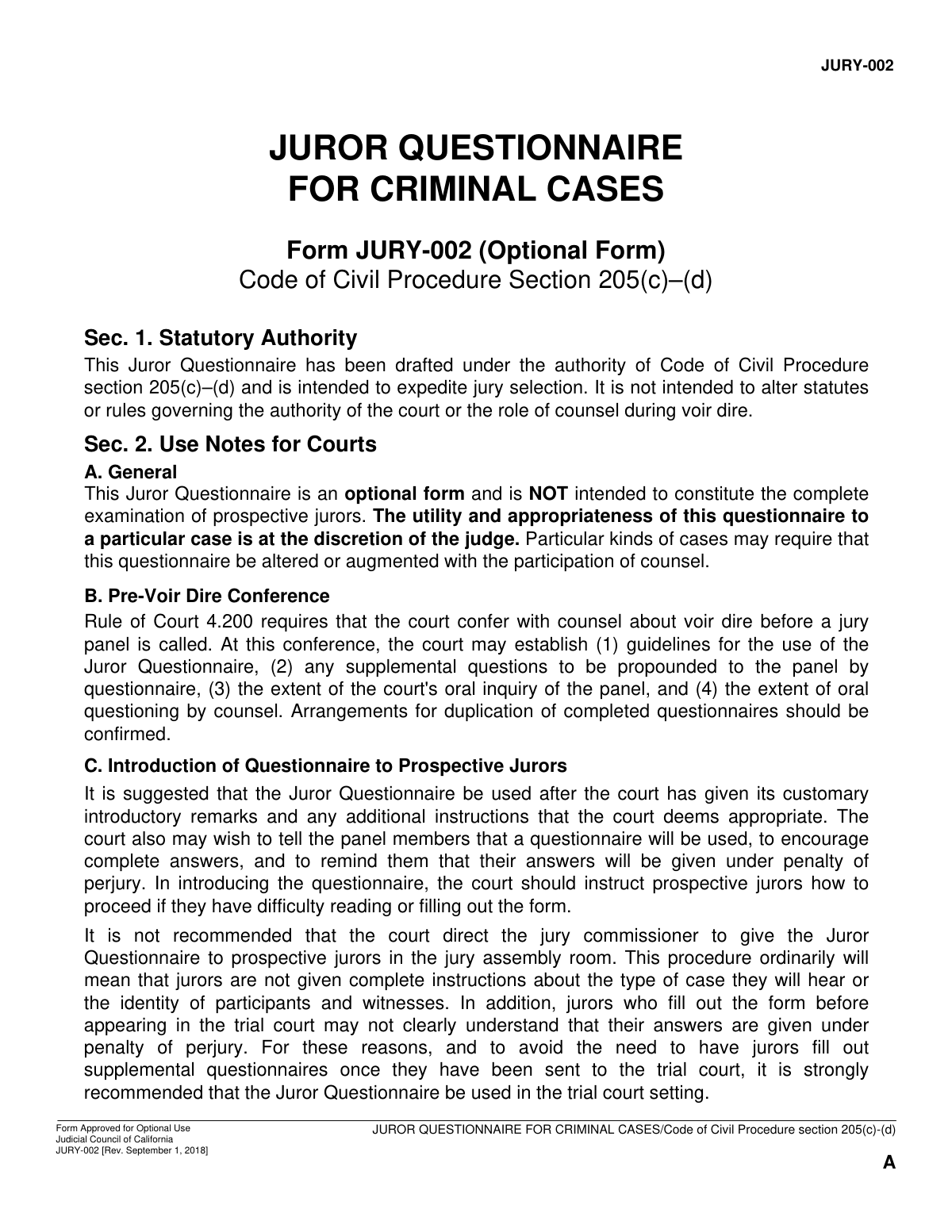
Yes! You can use AI to fill out Form JURY-002, Juror Questionnaire for Criminal Cases/Capital Case Supplement

Form JURY-002 is a Juror Questionnaire for Criminal Cases, including a Capital Case Supplement, used by the Judicial Council of California. Its purpose is to expedite the jury selection process by collecting background information, experiences, and opinions from potential jurors to ensure they can be fair and impartial. Today, this form can be filled out quickly and accurately using AI-powered services like Instafill.ai, which can also convert non-fillable PDF versions into interactive fillable forms.
JURY-002 is part of the California court forms category on Instafill.
Our AI automatically handles information lookup, data retrieval, formatting, and form filling.
It takes less than a minute to fill out JURY-002 using our AI form filling.
Securely upload your data. Information is encrypted in transit and deleted immediately after the form is filled out.

Form specifications

Form name: Form JURY-002, Juror Questionnaire for Criminal Cases/Capital Case Supplement
Number of fields: 229
Number of pages: 1
Language: English
main-image

Instafill Demo: How to fill out PDF forms in seconds with AI

How to Fill Out JURY-002 Online for Free in 2026

Are you looking to fill out a JURY-002 form online quickly and accurately? Instafill.ai offers the #1 AI-powered PDF filling software of 2026, allowing you to complete your JURY-002 form in just 37 seconds or less.
Follow these steps to fill out your JURY-002 form online using Instafill.ai:
  1. 1 Navigate to Instafill.ai and upload or select the JURY-002 Juror Questionnaire.
  2. 2 Provide your personal information, including your juror ID number, case number, age, and any difficulties that may affect your service.
  3. 3 Answer the questions about your educational background, employment history, and any affiliations with social or professional organizations.
  4. 4 Detail your and your family's history with the legal system, including past jury service, interactions with law enforcement, or experiences as a victim or witness to a crime.
  5. 5 If applicable, complete the Capital Case Supplement by answering questions about your beliefs regarding the death penalty and life imprisonment.
  6. 6 Review all the information you have provided for accuracy and completeness before the AI populates the official form.
  7. 7 Electronically sign and date the verification section, confirming your answers are true under penalty of perjury, then download or print your completed questionnaire.

Our AI-powered system ensures each field is filled out correctly, reducing errors and saving you time.

Why Choose Instafill.ai for Your Fillable JURY-002 Form?

Speed

Complete your JURY-002 in as little as 37 seconds.

Up-to-Date

Always use the latest 2026 JURY-002 form version.

Cost-effective

No need to hire expensive lawyers.

Accuracy

Our AI performs 10 compliance checks to ensure your form is error-free.

Security

Your personal information is protected with bank-level encryption.

Frequently Asked Questions About Form JURY-002

This form is used to gather information about your background and views to help the court and lawyers select a fair and impartial jury for a criminal case. It is designed to make the jury selection process more efficient.

Potential jurors who have been called to the trial court for a criminal case must fill out this form. Your honest and complete answers help determine if you can be an unbiased juror for the specific case.

These questions are not meant to invade your privacy, but to ensure you can be a fair juror. Your life experiences shape your attitudes, and the court needs to understand any potential biases you might have related to the case.

This term refers to a former spouse, domestic partner, life partner, or anyone with whom you have an influential or intimate relationship that you would consider important.

If a question asks for sensitive information you are uncomfortable sharing publicly, you can write 'private' next to it. The court may then provide an opportunity for you to answer in a more private setting with only the judge, lawyers, and court reporter present.

No, the information you provide becomes part of the public court record for the case. However, for sensitive questions marked as 'private,' you may be able to discuss them in a less public setting.

This supplement is used in cases where the defendant could face the death penalty. The questions help determine if you can fairly consider both possible sentences—death or life imprisonment without parole—if the defendant is found guilty of first-degree murder with special circumstances.

This means you are making a sworn statement that your answers are true and complete to the best of your knowledge. Intentionally providing false information can have legal consequences.

You should describe any difficulties, such as vision, hearing, or other medical problems, in the space provided in question 1.3. This helps the court understand any potential challenges to your service.

The completed questionnaires are duplicated and given to the judge and the lawyers for both sides. They will review your answers to help them ask more targeted questions during the oral questioning part of jury selection, known as voir dire.

Question 1.37 asks for your general opinions about law enforcement officers. You should provide a complete and honest answer there to ensure your ability to be impartial can be properly assessed.

Yes, services like Instafill.ai use AI to accurately auto-fill form fields, which can help you complete the questionnaire more quickly and efficiently.

You can upload the PDF of the Juror Questionnaire to the Instafill.ai platform. Its AI will make the document interactive, allowing you to type your answers directly into the fields from your computer or mobile device before printing.

If you have a non-fillable or 'flat' PDF, you can use a service like Instafill.ai. It can convert the document into an interactive, fillable form that you can easily complete online.

Compliance JURY-002
Validation Checks by Instafill.ai

1
Juror and Case ID Consistency Across Pages
This check ensures that the 'Juror ID number' and 'Case number' fields are filled out on every page where they appear. It also verifies that the same numbers are used consistently throughout the entire document. This is critical for maintaining the integrity and proper association of all questionnaire pages to the correct juror and case, preventing data mix-ups during processing.
2
Valid Juror Age
This validation verifies that the value entered in the 'AGE' field (1.1) is a positive integer greater than or equal to 18. This is essential to confirm the prospective juror meets the minimum legal age requirement for jury service. If the field is blank, non-numeric, or below the legal age, the form submission should be flagged for review.
3
Conditional Explanation for 'Yes' Responses
For numerous questions (e.g., 1.2, 1.36, 1.38), a 'YES' answer requires a mandatory explanation in a subsequent text field. This check ensures that if 'YES' is selected, the corresponding explanation field is not empty or filled with placeholder text like 'N/A'. This is crucial for the court to understand the context behind the juror's affirmative answer.
4
Logical Consistency of Employment Status
This check validates the selections in the 'PRESENT EMPLOYMENT STATUS' section (1.9). A juror cannot select logically contradictory options, such as being both 'Employed full-time' and 'Unemployed, looking for work'. This rule prevents invalid data combinations and ensures the juror's employment situation is clearly and accurately represented.
5
Completeness of Employment Details
If a juror checks 'Employed full-time' or 'Employed part-time' (1.9), this validation ensures that the related fields for 'Current or most recent occupation' (1.10), 'Name of your current or most recent employer' (1.11), and 'Specific job duties' (1.12) are all completed. This information is vital for the attorneys to assess potential biases or experiences related to the juror's profession.
6
Conditional Supervisory Count
This validation rule applies to question 1.13, 'Does your job involve supervising other people?'. If the juror answers 'YES', the system must verify that the following field, 'Approximately how many?', contains a valid numerical value. An empty or non-numeric entry would render the 'YES' answer incomplete and require correction.
7
Completeness of Prior Jury Service Details
If a juror answers 'YES' to having previously served on a criminal or civil trial jury (1.29), this check ensures all follow-up questions are answered. The fields for where they served, the approximate year, their role (juror/alternate), and the kinds of cases must be filled out. This detailed history is essential for understanding the juror's prior experience with the legal system.
8
Mandatory Details for Crime Victim Experience
This check is triggered if a juror answers 'YES' to question 1.31, indicating they or a close relation have been a victim of a crime. The validation ensures the subsequent fields detailing 'Who?', 'What crime(s)?', 'When?', and 'What happened?' are all completed. Missing this information would leave a critical gap in understanding a potentially significant and biasing life event.
9
Explanation for Disagreement with Legal Principles
This validation focuses on question 1.34 regarding the presumption of innocence. If a juror answers 'NO' to any of the three sub-questions ('Do you understand...', 'Do you agree...', 'Will you follow...'), the system must confirm that the explanation field below is filled out. A 'NO' answer without an explanation is a major red flag for juror qualification and must be clarified.
10
Rationale for Punishment Severity Opinion
In the Capital Case Supplement, question 2.1 asks which punishment is more severe. Regardless of whether the juror chooses 'THE DEATH PENALTY' or 'LIFE IN PRISON WITHOUT PAROLE', this validation ensures the 'WHY?' text field is completed. This provides crucial insight into the juror's reasoning and moral framework regarding punishment.
11
Identification of Automatic Sentencing Bias
This check flags any 'YES' response to questions 2.12 or 2.13, which ask if the juror would automatically vote for life without parole or death, respectively. A 'YES' answer indicates an inability to weigh aggravating and mitigating factors as required by law. The system should treat this as a high-priority alert for immediate review, as it likely disqualifies the juror.
12
Verification Section Completeness and Date Validity
This validation ensures that all fields in the final 'Verification' section are completed: printed name, signature, place, and date. It specifically checks that the 'Date' field contains a valid date that is not in the future. An incomplete or improperly signed verification invalidates the attestation that the answers are true under penalty of perjury.

Common Mistakes in Completing JURY-002

Missing Juror/Case ID on Subsequent Pages

The form requires the Juror ID and Case Number on nearly every page, but people often fill it in on the first page and forget the rest. This happens due to the repetitive nature of the task. This omission creates clerical work for court staff who must manually add the information to keep the document organized and can lead to pages being misplaced, potentially compromising the record.

Leaving Fields Blank Instead of Writing 'N/A'

The instructions explicitly state to write 'N/A' for questions that don't apply, but many people leave them blank out of habit. This creates ambiguity, forcing lawyers and the judge to ask whether the question was missed or was truly not applicable. To avoid this, carefully review each question and use 'N/A' as directed to show you have read and considered the question.

Providing Vague Occupation Details

When asked for job duties (Questions 1.12, 1.20), potential jurors often provide a title like 'Manager' or 'Analyst' without the requested specifics. This happens because people may want to be brief or consider their duties obvious. However, this lack of detail prevents the court from assessing potential biases or expertise related to the case, leading to time-consuming follow-up questions during oral voir dire.

Incomplete Responses to Multi-Part Questions

Sections concerning prior experience as a crime victim (1.31), witness (1.32), or contact with law enforcement (1.33) contain numerous follow-up questions. A common error is to answer 'Yes' to the main question but fail to fill out the required details like 'Who,' 'When,' and 'What happened.' This forces attorneys to question the juror extensively in open court, potentially on sensitive topics, slowing down the selection process for everyone.

Inconsistent Reporting for 'Significant Personal Relationship'

The form defines a 'person with whom you share a significant personal relationship,' but individuals often apply this term inconsistently across different sections. They might list a partner's job in one section but forget to include them in another question about law enforcement contact. This can result from misinterpreting the definition or simply forgetting, leading to an incomplete picture of the juror's potential influences and biases.

Failing to Explain Disagreement with Legal Principles

Question 1.34 asks if the juror understands, agrees with, and will follow the principle of 'presumed innocent.' If a person answers 'No' to any part, they are required to explain why, but this explanation is frequently missed. This is a critical error as it immediately calls into question the juror's ability to be impartial and follow the law, almost guaranteeing a dismissal if not clarified satisfactorily.

Contradictory Answers on Death Penalty Views

In the Capital Case Supplement, jurors may state a strong opposition to the death penalty (2.2) but then claim they can set those views aside and impose it (2.7). This contradiction often arises from a desire to be seen as a 'good' or fair juror, but it creates doubt about their true ability to be impartial. Such answers require extensive follow-up and can lead to disqualification for cause if the juror cannot reconcile their personal beliefs with their legal duty.

Submitting Illegible Handwriting

Despite the instruction to 'PLEASE PRINT ALL ANSWERS LEGIBLY,' many questionnaires are submitted with handwriting that is difficult or impossible to read. This forces court staff and attorneys to guess at answers or spend valuable court time asking the juror to repeat their entire questionnaire orally. Using an AI-powered tool like Instafill.ai can solve this by converting the non-fillable PDF into a typed, perfectly legible document.

Forgetting to Sign or Date the Verification Page

The final verification page, where the juror signs under penalty of perjury, is one of the most critical parts of the form, yet it is commonly left blank. People are often fatigued by the end of the long questionnaire and simply overlook it. An unsigned form is not legally valid and must be returned to the juror for completion, causing delays and administrative hassle.

Incomplete Information in Tables

The table for children's information (1.24) requires five distinct pieces of data for each child, and it is common for jurors to miss columns like 'Occupation' or 'Education,' especially for adult children. This happens when rushing through complex grid-based questions. Incomplete data requires clarification and prevents a full understanding of the juror's family background and potential connections.
Saved over 80 hours a year

“I was never sure if my IRS forms like W-9 were filled correctly. Now, I can complete the forms accurately without any external help.”

Kevin Martin Green

Your data stays secure with advanced protection from Instafill and our subprocessors

Robust compliance program

Transparent business model

You’re not the product. You always know where your data is and what it is processed for.

ISO 27001, HIPAA, and GDPR

Our subprocesses adhere to multiple compliance standards, including but not limited to ISO 27001, HIPAA, and GDPR.

Security & privacy by design

We consider security and privacy from the initial design phase of any new service or functionality. It’s not an afterthought, it’s built-in, including support for two-factor authentication (2FA) to further protect your account.

Fill out JURY-002 with Instafill.ai

Worried about filling PDFs wrong? Instafill securely fills form-jury-002-juror-questionnaire-for-criminal-casescapital-case-supplement forms, ensuring each field is accurate.