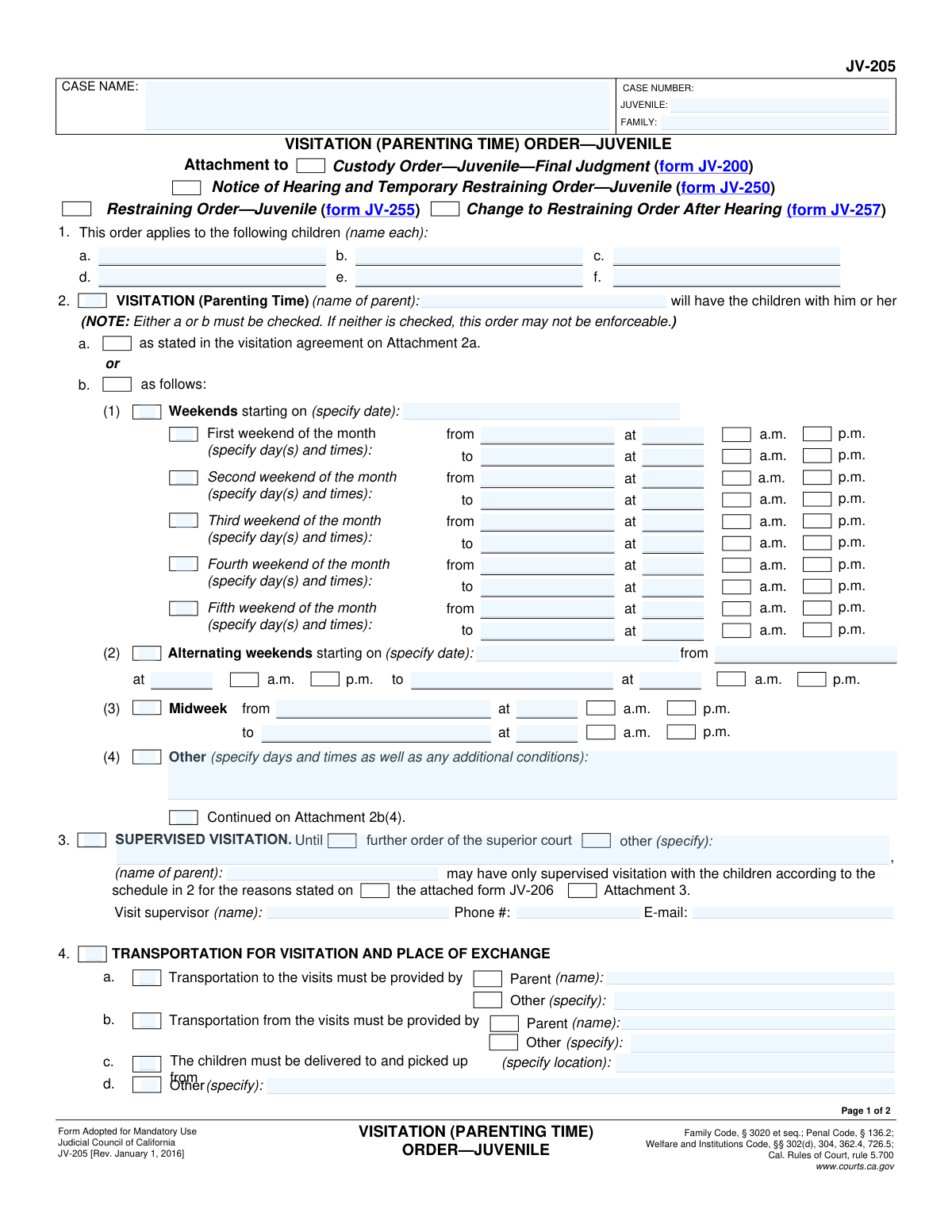
Yes! You can use AI to fill out Form JV-205, Visitation (Parenting Time) Order—Juvenile

The JV-205, Visitation (Parenting Time) Order—Juvenile, is a mandatory California court form that legally defines the schedule and conditions for a parent's visitation with their child in a juvenile case. This order is crucial for creating an enforceable plan for parenting time, specifying if visits must be supervised, and detailing arrangements for transportation and travel. Today, this form can be filled out quickly and accurately using AI-powered services like Instafill.ai, which can also convert non-fillable PDF versions into interactive fillable forms.
JV-205 is part of the California court forms category on Instafill.
Our AI automatically handles information lookup, data retrieval, formatting, and form filling.
It takes less than a minute to fill out JV-205 using our AI form filling.
Securely upload your data. Information is encrypted in transit and deleted immediately after the form is filled out.

Form specifications

Form name: Form JV-205, Visitation (Parenting Time) Order—Juvenile
Number of fields: 129
Number of pages: 1
Language: English
main-image

Instafill Demo: How to fill out PDF forms in seconds with AI

How to Fill Out JV-205 Online for Free in 2026

Are you looking to fill out a JV-205 form online quickly and accurately? Instafill.ai offers the #1 AI-powered PDF filling software of 2026, allowing you to complete your JV-205 form in just 37 seconds or less.
Follow these steps to fill out your JV-205 form online using Instafill.ai:
  1. 1 Navigate to Instafill.ai and upload or select Form JV-205, the Visitation Order—Juvenile.
  2. 2 Enter the case information, including the family and juvenile case numbers, case name, and the names of the children the order applies to.
  3. 3 Define the visitation schedule by checking the appropriate boxes for weekends, midweek, or other arrangements, and fill in the specific days, times, and locations for pickup and drop-off.
  4. 4 If visitation must be supervised, provide the supervisor's name and contact information, and specify the duration and reasons for the supervision.
  5. 5 Detail the transportation arrangements, indicating who is responsible for bringing the children to and from visits and the designated exchange location.
  6. 6 Specify any travel restrictions, such as requiring permission to take the children out of the state or certain counties.
  7. 7 Review all the auto-filled information for accuracy, then download, print, or e-file the completed JV-205 form as directed by the court.

Our AI-powered system ensures each field is filled out correctly, reducing errors and saving you time.

Why Choose Instafill.ai for Your Fillable JV-205 Form?

Speed

Complete your JV-205 in as little as 37 seconds.

Up-to-Date

Always use the latest 2026 JV-205 form version.

Cost-effective

No need to hire expensive lawyers.

Accuracy

Our AI performs 10 compliance checks to ensure your form is error-free.

Security

Your personal information is protected with bank-level encryption.

Frequently Asked Questions About Form JV-205

Form JV-205 is a mandatory California court form used to create a legally enforceable order detailing the visitation schedule, also known as parenting time, for a parent and their child involved in a juvenile court case.

While the parents or their attorneys propose the visitation terms, the form becomes an official order only after it is completed and signed by a judge in a juvenile court proceeding.

You must provide specific days, dates, and times for visits. You can select from options like specific weekends, alternating weekends, or describe a custom schedule under the 'Other' section.

Supervised visitation means a neutral third party, whose name and contact information must be listed on the form, is required to be present during all visits between the parent and child.

Section 4 of the form specifies which parent is responsible for transporting the child to and from visits. It also clearly defines the location where the child will be picked up and dropped off.

You must check Section 5, 'Travel with Children.' This part of the order will state whether you need the other parent's written permission or a separate court order to travel with the child outside of the county or state.

The JV-205 is a legally enforceable court order. If the other parent violates it, you can contact law enforcement for assistance or file a motion with the court to enforce the order's terms.

Page 2 of the form explains the priority of conflicting orders. Typically, a more restrictive order like an Emergency Protective Order (EPO) or a criminal no-contact order will take precedence over the visitation schedule.

A verbal agreement is not legally binding. To make any changes official and enforceable, you must file a request with the court to formally modify the existing JV-205 visitation order.

Yes, services like Instafill.ai use AI to accurately auto-fill form fields with your information, which helps save time and reduce the chance of errors before submitting it to the court.

You can use a service like Instafill.ai to complete the form online. Simply upload the PDF, and the platform allows you to type your information directly into the fields before printing the completed document.

If you have a non-fillable or 'flat' PDF, you can use a tool like Instafill.ai. It can convert the static document into an interactive, fillable form that you can easily complete on your computer.

There is no legal difference; the terms are used interchangeably. 'Parenting Time' is a more modern term used to describe the time a parent spends with their child as outlined in the court order.

Compliance JV-205
Validation Checks by Instafill.ai

1
Case Number Presence
Ensures that the 'CASE NUMBER' field in the header is populated. This number is the primary identifier for the legal case and is essential for filing, tracking, and enforcement. If the case number is missing, the document cannot be correctly associated with its corresponding court file, leading to rejection or processing delays.
2
Child Name Requirement
Validates that at least one child's name is entered in Section 1. A visitation order is not legally meaningful without specifying which child or children it applies to. Failure to list a child means the order's terms would not be enforceable for that child.
3
Mandatory Visitation Schedule Selection
Checks that in Section 2, either the checkbox for a detailed schedule ('as follows') or the checkbox for an attachment ('as stated in the visitation agreement on Attachment 2a') is selected. The form explicitly states the order may be unenforceable if neither is chosen, making this check critical for the document's validity.
4
Supervised Visitation Completeness
If the 'SUPERVISED VISITATION' box (Section 3) is checked, this validates that the parent's name, the supervisor's name, and at least one method of contact for the supervisor (phone or email) are provided. Missing this information would make it impossible to arrange or verify the supervised visits, rendering the order impractical and unenforceable.
5
Supervisor Email Format
Verifies that the value entered into the supervisor's E-mail field in Section 3 follows a standard email format (e.g., '[email protected]'). An incorrectly formatted email address prevents communication and coordination for the supervised visits. This ensures that contact information is actually usable.
6
Supervisor Phone Number Format
Checks that the supervisor's phone number in Section 3 is entered in a valid format (e.g., (xxx) xxx-xxxx or xxxxxxxxxx). This ensures the phone number is legitimate and can be used to contact the supervisor. An invalid number would hinder communication and the execution of the court's order.
7
Conditional Transportation Provider Specification
In Section 4, if 'Transportation to the visits' or 'Transportation from the visits' is assigned to a specific 'Parent' or 'Other', this check ensures the corresponding name or description field is filled. Without this specification, the responsibility for transportation is ambiguous, which can lead to disputes and missed visitations.
8
Conditional Travel Restriction Details
Validates that if a travel restriction in Section 5 is checked for 'the following counties' or 'other places', the corresponding text field specifying those locations is filled. An unchecked box or an empty specification field makes the restriction vague and unenforceable, failing to provide the intended protection or clarity.
9
Logical Time Sequence
For any visitation schedule defined in Section 2b, this check ensures that the 'from' time is chronologically earlier than the 'to' time. An end time that is before the start time is a logical impossibility and would create a legally nonsensical and unenforceable order. This validation prevents errors in the final legal document.
10
Date Field Format Validation
Ensures that all date fields, such as the start date for weekend visitations, are entered in a valid and recognizable date format (e.g., MM/DD/YYYY). Incorrectly formatted dates can lead to misinterpretation of the schedule and disputes between the parties. This check maintains the clarity and precision required for a court order.
11
Time Field and AM/PM Selection
Verifies that for every time entered in the visitation schedule (Section 2b), the corresponding 'a.m.' or 'p.m.' option is also selected. A time without an AM/PM designator is ambiguous by 12 hours, which would make the visitation start and end times unclear and a source of conflict.
12
Header Information Consistency
Checks that the 'CASE NUMBER' and 'CASE NAME' are identical on both Page 1 and Page 2 of the form. This ensures document integrity and confirms that the pages belong to the same order, preventing accidental mixing of pages from different cases during processing or filing.
13
Required 'Other (specify)' Field Population
This validation applies to multiple sections (e.g., 2b(4), 4, 5, 6). If a checkbox or radio button for 'Other' or 'specify' is selected, this rule ensures the associated text field is not left empty. This prevents incomplete entries where a party indicates a custom condition but fails to provide the necessary details, which would make the condition void for vagueness.
14
Parent Name for Visitation Requirement
Ensures the parent's name is filled in Section 2, identifying who is granted the parenting time. The entire purpose of the order is to define visitation rights for a specific parent. If this name is missing, the order has no subject and is fundamentally invalid.

Common Mistakes in Completing JV-205

Incomplete Case Header Information

Users often forget to fill in the Case Name and Case Number at the top of the form, especially on the second page. This happens because they focus on the main content and overlook the repetitive header fields. An incomplete header can lead to the document being misfiled, delayed, or even separated, causing significant processing issues with the court.

Failing to Specify the Visitation Schedule Type

A critical error is neglecting to check either box 2a (for an existing agreement) or 2b (to define a new schedule). The form explicitly states that if neither is checked, the order may be unenforceable. This oversight renders the entire visitation section void, leading to confusion and requiring the parties to refile or amend the order to make it legally binding.

Inconsistent or Illogical Time Entries

In Section 2, users frequently make errors when entering visitation times, such as forgetting to select AM/PM, entering a start time that is later than the end time, or leaving time fields blank. These ambiguities create an unenforceable schedule and are a common source of conflict between parents. To avoid this, double-check all time entries for logical consistency and completeness, ensuring every time has an AM/PM designation.

Using Vague Language in 'Specify' Fields

Many sections, such as 2b(4) 'Other', 4c 'Place of Exchange', and 5c 'Travel', require specific details but are often filled with ambiguous terms like 'as agreed' or 'halfway'. This lack of clarity invites future disputes and makes the order difficult for law enforcement to interpret. Always provide concrete details, such as exact addresses, dates, and conditions, to ensure the order is clear and enforceable.

Omitting Required Supervisor Information

When 'Supervised Visitation' (Section 3) is selected, filers sometimes fail to provide the full name, phone number, and email of the designated supervisor. This omission makes it impossible for the parties or the court to contact the supervisor to arrange or verify visits. To prevent delays, ensure all contact details for the supervisor are entered completely and accurately.

Unclear Transportation and Exchange Arrangements

In Section 4, users may not clearly define who is responsible for transportation or the exact location for exchanges, leading to arguments at every visit. For example, simply stating 'the parent's home' is insufficient if a parent moves. It is crucial to specify the full name of the responsible person and a precise, neutral location for exchanges if necessary.

Failing to List Children's Full Legal Names

In Section 1, people sometimes use nicknames or only first names for the children the order applies to. This can create legal ambiguity, especially if there are other children in the family or if a child has a common name. To ensure the order is legally sound and applies to the correct individuals, always use each child's full legal name as it appears on their birth certificate or other court documents.

Creating Contradictory Schedule Selections

In the detailed visitation schedule under Section 2b, users might check multiple conflicting options, such as selecting both 'Alternating weekends' and a specific 'Third weekend of the month'. This creates a confusing and contradictory schedule that is impossible to follow or enforce. Carefully select only the options that apply and ensure they do not overlap or contradict one another.

Incomplete Travel Restriction Details

When checking a box in Section 5 to restrict a child's travel, it's a common mistake to forget to specify which parent is restricted or the exact geographic limitations (e.g., checking 'the following counties' but not listing them). An incomplete restriction is unenforceable and fails to provide the intended protection. Always complete all parts of this section, naming the parent and defining the specific travel boundaries.

Incorrectly Referencing or Omitting Attachments

The form allows for information to be continued on attachments (e.g., Attachment 2b(4)), but users often check the box without attaching the corresponding document or fail to label the attachment correctly. This results in an incomplete order, as the court and other parties do not have the referenced information. Ensure any referenced attachment is physically included with the submission and clearly labeled to match the section it pertains to.
Saved over 80 hours a year

“I was never sure if my IRS forms like W-9 were filled correctly. Now, I can complete the forms accurately without any external help.”

Kevin Martin Green

Your data stays secure with advanced protection from Instafill and our subprocessors

Robust compliance program

Transparent business model

You’re not the product. You always know where your data is and what it is processed for.

ISO 27001, HIPAA, and GDPR

Our subprocesses adhere to multiple compliance standards, including but not limited to ISO 27001, HIPAA, and GDPR.

Security & privacy by design

We consider security and privacy from the initial design phase of any new service or functionality. It’s not an afterthought, it’s built-in, including support for two-factor authentication (2FA) to further protect your account.

Fill out JV-205 with Instafill.ai

Worried about filling PDFs wrong? Instafill securely fills form-jv-205-visitation-parenting-time-orderjuvenile forms, ensuring each field is accurate.