Yes! You can use AI to fill out Form JV-295, De Facto Parent Request
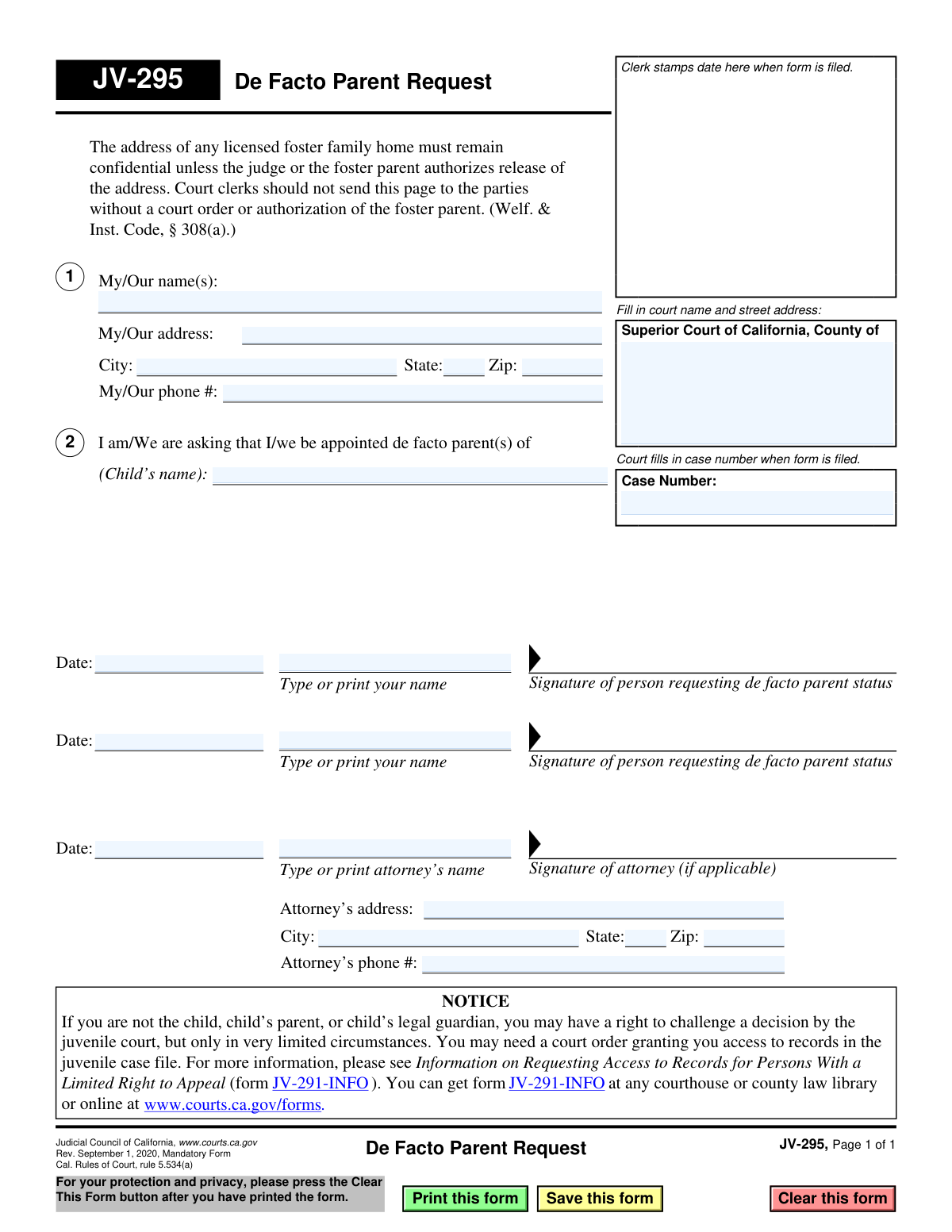
Form JV-295, the De Facto Parent Request, is a legal document filed in the Superior Court of California to ask a judge to recognize an individual as a child's de facto parent. This status is for adults who have assumed a day-to-day parental role for a significant period and grants them the right to participate in juvenile dependency proceedings. Today, this form can be filled out quickly and accurately using AI-powered services like Instafill.ai, which can also convert non-fillable PDF versions into interactive fillable forms.
JV-295 is part of the
California court forms category on Instafill.
Our AI automatically handles information lookup, data retrieval, formatting, and form filling.
It takes less than a minute to fill out JV-295 using our AI form filling.
Securely upload your data. Information is encrypted in transit and deleted immediately after the form is filled out.
Form specifications
| Form name: | Form JV-295, De Facto Parent Request |
| Number of fields: | 27 |
| Number of pages: | 1 |
| Language: | English |
Instafill Demo: How to fill out PDF forms in seconds with AI
How to Fill Out JV-295 Online for Free in 2026
Are you looking to fill out a JV-295 form online quickly and accurately? Instafill.ai offers the #1 AI-powered PDF filling software of 2026, allowing you to complete your JV-295 form in just 37 seconds or less.
Follow these steps to fill out your JV-295 form online using Instafill.ai:
- 1 Navigate to Instafill.ai and upload or select the Form JV-295, De Facto Parent Request.
- 2 Use the AI assistant to automatically fill in the court name, address, and case number at the top of the form.
- 3 Enter the full name of the child for whom you are requesting de facto parent status.
- 4 Provide your personal details, including your full name(s), address, and phone number.
- 5 If you are represented by an attorney, enter their name and contact information in the appropriate section.
- 6 Carefully review all the information you've entered for accuracy and completeness.
- 7 Electronically sign and date the form, then download the completed document to file with the court clerk.
Our AI-powered system ensures each field is filled out correctly, reducing errors and saving you time.
Why Choose Instafill.ai for Your Fillable JV-295 Form?
Speed
Complete your JV-295 in as little as 37 seconds.
Up-to-Date
Always use the latest 2026 JV-295 form version.
Cost-effective
No need to hire expensive lawyers.
Accuracy
Our AI performs 10 compliance checks to ensure your form is error-free.
Security
Your personal information is protected with bank-level encryption.
Frequently Asked Questions About Form JV-295
This form is used to ask a California juvenile court to legally recognize you as a 'de facto parent' for a child involved in a dependency case. This status allows you to participate in the court hearings concerning the child.
A de facto parent is someone who has been the child's primary caregiver on a day-to-day basis, fulfilling their physical and psychological needs. You should fill out this form if you have this kind of parent-like relationship with the child and want to be involved in their court case.
You will need the name of the Superior Court, the juvenile case number, the child's full name, and your own name, address, and phone number. If you have a lawyer, you will also need their contact information.
The case number is assigned by the court and can be found on other official documents related to the child's juvenile case. If you cannot locate it, the court clerk's office may be able to assist you.
Yes, the form allows for up to two people to jointly request de facto parent status. There are separate lines for two individuals to print their names and sign the form.
No, the form includes a specific instruction that the address of a licensed foster family home must remain confidential. The court clerk is not to share this information without a court order or your direct authorization.
You are not required to have an attorney to file Form JV-295. However, juvenile dependency cases can be complex, so legal representation is often recommended.
You must file the completed and signed form with the clerk of the Superior Court in the county where the child's juvenile case is being heard.
After you file the form, the court will review your request and may schedule a hearing. A judge will then decide whether to grant you de facto parent status based on the nature of your relationship with the child.
This notice informs you that if you are not the child's parent or legal guardian, your rights to appeal court decisions are very limited. It also states you may need a separate court order to access records from the juvenile case file.
Yes, services like Instafill.ai use AI to accurately auto-fill form fields, which can save you time and help prevent errors. This is particularly helpful for entering your personal information quickly.
You can use a service like Instafill.ai to complete the form digitally. Simply upload the PDF to the platform, and it will become an interactive form that you can type into, save, and print.
If you have a non-fillable or 'flat' PDF, you can use a tool like Instafill.ai to make it interactive. The service converts the document into a fillable format, allowing you to easily complete it on your computer.
Compliance JV-295
Validation Checks by Instafill.ai
1
Ensures Court Information is Provided
This check verifies that the court name and street address field ('CourtInfo_ft[0]') is not empty. This information is mandatory for the clerk to accept and file the document in the correct courthouse. A submission without this information cannot be processed and would be rejected.
2
Requires Child's Full Name
This validation ensures that the child's name field ('FullName_ft[0]') is filled out. The child is the subject of the de facto parent request, and their identity is fundamental to the legal proceeding. Failure to provide the child's name renders the entire request invalid and unprocessable.
3
Requires Requester's Full Name
This check confirms that the name(s) of the person(s) requesting de facto parent status ('ProtectedFullName_ft[0]') are provided. The court must know the identity of the party or parties making the request. An anonymous or incomplete request would be legally insufficient and immediately rejected.
4
Validates Requester's Address Completeness
This check ensures that if any part of the requester's address (street, city, state, zip) is entered, all other parts are also completed. A complete address is legally required for sending official notices and correspondence. A partial address is unusable and would halt communication, so the form is considered incomplete.
5
Validates Requester's Phone Number Format
This validation checks that the requester's phone number ('ProtectedPhone_ft[0]') is in a valid format, such as (XXX) XXX-XXXX or XXX-XXX-XXXX. This ensures the court and other parties can contact the requester if needed. An invalid format could lead to failed communication attempts and delays in the case.
6
Validates Requester's ZIP Code Format
This check verifies that the requester's ZIP code ('ProtectedZip_ft[0]') is a valid 5-digit or 9-digit (ZIP+4) format. Correct ZIP codes are essential for the mailability and accuracy of legal notices sent to the requester. An incorrect format would cause mail to be delayed or returned.
7
Ensures At Least One Requester Signature
This validation confirms that at least one of the two available requester signature blocks is fully completed (printed name and signature date). A legal request requires a signature to be valid and to attest to the truthfulness of the information provided. The form is legally void without a valid signature from a requesting party.
8
Validates Signature Date Logic
This check ensures that any provided signature date ('PartySignature_dt') is a valid calendar date and is not set in the future. A signature attests to an action taken on a specific day, so the date must be logically sound and reflect the present or past. A future date is invalid and would cause the form to be rejected for clerical or legal error.
9
Verifies Signature and Printed Name Co-dependency
This validation ensures that if a printed name ('PartyName_ft') is provided for a requester, the corresponding signature date ('PartySignature_dt') is also present, and vice-versa. The printed name identifies the signatory, and the date authenticates when the signature was made; both are required for a valid signature block. An incomplete block would render that signature invalid.
10
Validates Attorney Information Completeness
This check verifies that if an attorney's name or signature is provided, their full contact information (address and phone number) is also completed. As the official representative, the attorney's contact details are mandatory for all case communications and service of documents. Incomplete attorney information would prevent proper legal notification.
11
Validates Attorney's Phone Number Format
This validation checks that the attorney's phone number ('ProtectedPhone_ft[1]') adheres to a standard US phone number format. This is critical for ensuring opposing counsel and the court can reliably contact the attorney. An incorrectly formatted number could impede case progress and communication.
12
Validates State Field Format
This check ensures that any state field ('ProtectedState_ft') contains a valid, two-letter US state or territory abbreviation. Using standardized abbreviations is crucial for data integrity and ensuring mail is correctly routed by automated systems. Non-standard entries can cause processing errors and delivery failures.
13
Validates Case Number Format
This check validates that if a Case Number is entered, it conforms to the expected format for the specified court jurisdiction (e.g., specific alphanumeric patterns, length, or characters). This prevents data entry errors when linking the form to an existing case file. An incorrect case number could result in the document being misfiled or rejected.
Common Mistakes in Completing JV-295
Applicants often forget to fill in the full name and street address of the specific Superior Court handling the case, or they list the wrong county. This can cause the filing to be rejected or sent to the wrong courthouse, leading to significant delays in the legal process. To avoid this, you must verify the exact name and address of the Superior Court of California for the county where the child's dependency case is being heard before filling out the form.
A frequent error is using a nickname, an abbreviated name, or misspelling the child's name instead of using their full legal name as it appears on official documents. This creates ambiguity in the legal record and can delay the processing of the request until the child's identity is formally clarified. Always use the child's full, legally registered name to ensure the request is processed correctly.
The form explicitly warns that a licensed foster family home address is confidential. A critical error is writing this address directly in the address fields, which violates confidentiality rules and can have serious safety and legal consequences. If you are a foster parent, you must consult with your attorney or the court clerk on the proper procedure for providing your address confidentially, which often involves a separate, non-public form.
An unsigned or undated request is legally invalid and will be rejected by the court clerk upon submission. This is one of the most common and avoidable reasons for filing delays, as the applicant must resubmit a properly executed form, restarting the process. Always double-check that each applicant has signed and dated the form in the appropriate fields before filing.
The form has separate lines for a signature and for a typed or printed name. Applicants, especially when filling a PDF, often type their name in both places. The signature line requires a legal signature (a wet signature on a printed copy or a valid e-signature), and a typed name is not a valid substitute, which can lead to the form's rejection.
Applicants sometimes try to fill in every box, including those reserved for court use like the 'Case Number' field. This field is meant to be completed by the court clerk upon filing to assign an official case number. Writing in this box can cause confusion and may require the clerk to transfer the information to a clean form, delaying the filing.
When a couple is applying together, they may mistakenly provide only one person's name and signature. The form is designed to accommodate two applicants, with separate lines for each person's name and signature. If filing jointly, both individuals must provide their information and sign the form to be considered as de facto parents.
When the form is printed and filled out by hand, poor handwriting can make names, addresses, and other crucial details unreadable. This can lead to data entry errors by court staff, misdirected mail, and significant delays in processing the request. To prevent this, print clearly in block letters or use a tool like Instafill.ai, which can convert a flat PDF into a fillable version, allowing you to type your information for maximum clarity.
Applicants sometimes leave their own address or phone number fields blank or incomplete. This makes it impossible for the court and other parties to send important notices, hearing dates, or requests for more information. Ensure every field in the applicant section is filled out completely and accurately to avoid missing critical communications about your case.
If an applicant is represented by a lawyer, they or their lawyer may forget to complete the attorney information section at the bottom of the form. This section is mandatory if an attorney is involved, as the court and other parties will direct all official communication to the attorney of record. Failing to provide this information can lead to serious miscommunication and procedural errors.
Saved over 80 hours a year
“I was never sure if my IRS forms like W-9 were filled correctly. Now, I can complete the forms accurately without any external help.”
Kevin Martin Green
Your data stays secure with advanced protection from Instafill and our subprocessors

Robust compliance program
Transparent business model
You’re not the product. You always know where your data is and what it is processed for.
ISO 27001, HIPAA, and GDPR
Our subprocesses adhere to multiple compliance standards, including but not limited to ISO 27001, HIPAA, and GDPR.
Security & privacy by design
We consider security and privacy from the initial design phase of any new service or functionality. It’s not an afterthought, it’s built-in, including support for two-factor authentication (2FA) to further protect your account.
Fill out JV-295 with Instafill.ai
Worried about filling PDFs wrong? Instafill securely fills form-jv-295-de-facto-parent-request forms, ensuring each field is accurate.