Yes! You can use AI to fill out Form MC-030, Declaration

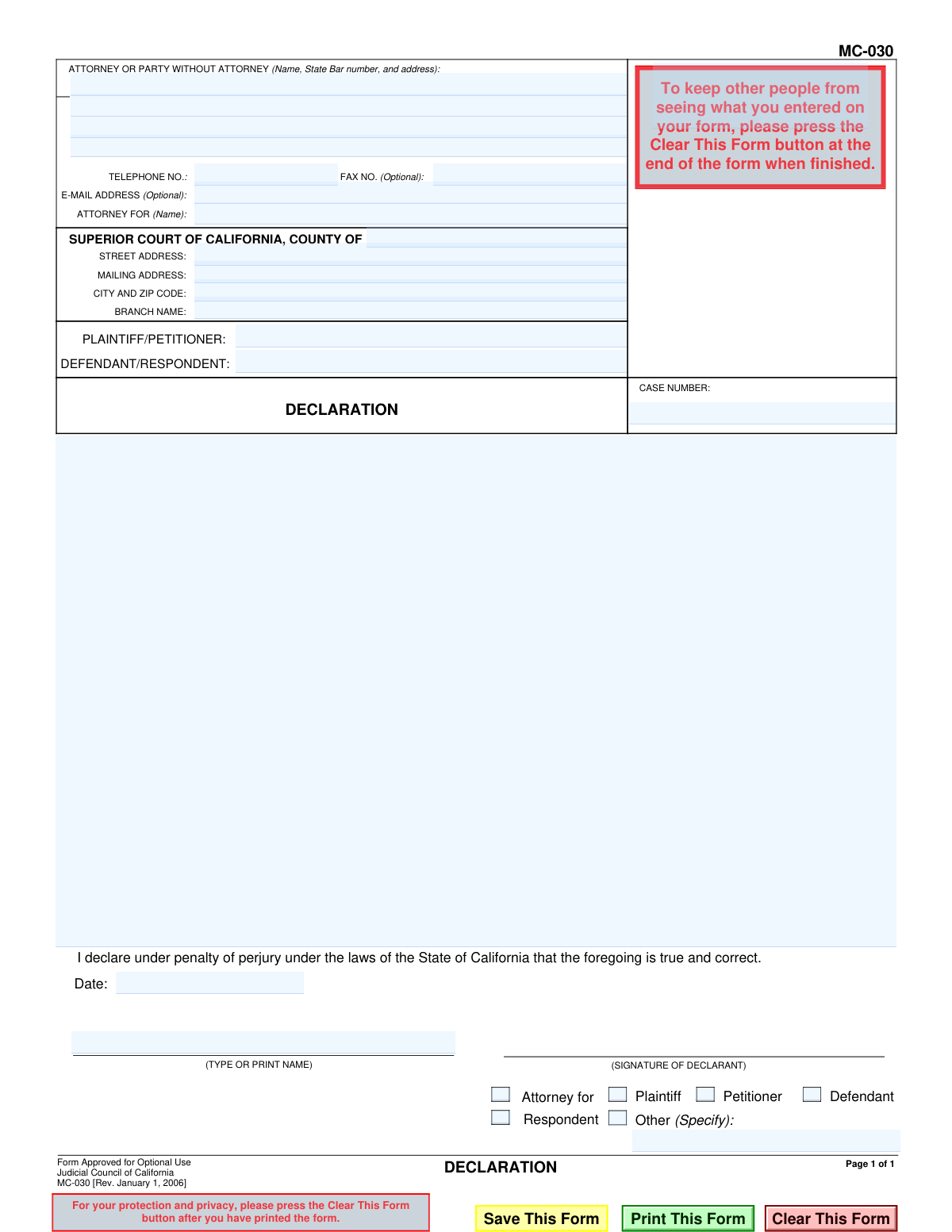
The California Form MC-030, Declaration, is a legal document used in court proceedings to present written testimony. The person signing it (the declarant) swears under penalty of perjury that the statements made are true and correct, giving it the same legal weight as sworn testimony in court. This form is crucial for providing evidence, supporting motions, or offering factual accounts without requiring a live court appearance. Today, this form can be filled out quickly and accurately using AI-powered services like Instafill.ai, which can also convert non-fillable PDF versions into interactive fillable forms.
MC-030 is part of the California court forms category on Instafill.
Our AI automatically handles information lookup, data retrieval, formatting, and form filling.
It takes less than a minute to fill out MC-030 using our AI form filling.
Securely upload your data. Information is encrypted in transit and deleted immediately after the form is filled out.

Form specifications

Form name: Form MC-030, Declaration
Number of fields: 32
Number of pages: 1
Language: English
main-image

Instafill Demo: How to fill out PDF forms in seconds with AI

How to Fill Out MC-030 Online for Free in 2026

Are you looking to fill out a MC-030 form online quickly and accurately? Instafill.ai offers the #1 AI-powered PDF filling software of 2026, allowing you to complete your MC-030 form in just 37 seconds or less.
Follow these steps to fill out your MC-030 form online using Instafill.ai:
  1. 1 Navigate to Instafill.ai and upload the MC-030 Declaration form or select it from their template library.
  2. 2 Provide your attorney or personal contact information in the top section, including name, address, and phone number.
  3. 3 Enter the court details, including the county and branch, along with the names of the plaintiff/petitioner and defendant/respondent.
  4. 4 Input the official case number assigned by the court.
  5. 5 Carefully write or paste the factual statements you are declaring in the main body of the form.
  6. 6 Review all entered information for accuracy, then type your name, date the document, and apply your digital or physical signature as required.
  7. 7 Download the completed form to save for your records or file with the appropriate California Superior Court.

Our AI-powered system ensures each field is filled out correctly, reducing errors and saving you time.

Why Choose Instafill.ai for Your Fillable MC-030 Form?

Speed

Complete your MC-030 in as little as 37 seconds.

Up-to-Date

Always use the latest 2026 MC-030 form version.

Cost-effective

No need to hire expensive lawyers.

Accuracy

Our AI performs 10 compliance checks to ensure your form is error-free.

Security

Your personal information is protected with bank-level encryption.

Frequently Asked Questions About Form MC-030

Form MC-030 is a standard California Judicial Council form used to submit a written statement of facts to the court. By signing it, you are declaring under penalty of perjury that the information you have provided is true and correct.

Any party in a court case (such as a plaintiff, defendant, or witness) who needs to provide a sworn statement can use this form. The person making the statement, known as the 'declarant', is the one who fills it out and signs it.

This large space is for your factual statement. You should write down all the relevant facts you want the court to consider, usually organized in numbered paragraphs for clarity.

If you are representing yourself, you can write "In Pro Per" in the "ATTORNEY FOR (Name):" field. You must still fill out your own name, address, and contact information in the box at the top left.

The Case Number is assigned by the court when a lawsuit is first filed. You can find this number on any official court documents you have already received for your case.

A Plaintiff or Petitioner is the person who initiated the court case. A Defendant or Respondent is the person who is being sued or is responding to the case.

You can use attachment pages. Simply write "See Attached" in the declaration section, and then write your full statement on separate pages, making sure to label each page with the case name and number.

This is a legally binding oath confirming that the statements you have made in the document are true. Knowingly providing false information in a declaration can have serious legal consequences, including fines and jail time.

No, this form does not require notarization. Your signature under the 'penalty of perjury' clause is sufficient to make the document a sworn statement in California courts.

The original, signed form must be filed with the court clerk for the specific court handling your case, as listed at the top of the form. You must also provide copies to all other parties in the case.

Yes, services like Instafill.ai use AI to accurately auto-fill form fields like your name, address, and case information, which saves time and helps prevent errors. However, the actual declaration statement must be written by you.

You can upload the PDF to a platform like Instafill.ai. It will make the form interactive, allowing you to type your information directly into the fields before you print it for signing and filing.

If you have a non-fillable or 'flat' PDF, you can use a service like Instafill.ai. It can convert the document into an interactive, fillable form so you can easily type in your information.

Compliance MC-030
Validation Checks by Instafill.ai

1
Attorney or Party Information Completeness
Verifies that the top section for 'ATTORNEY OR PARTY WITHOUT ATTORNEY (Name, State Bar number, and address)' is not empty. This information is critical for identifying the filer of the document and for all future correspondence. If this section is left blank, the court cannot process the filing as the submitting party is unknown.
2
State Bar Number Format
Checks if the State Bar number, when provided, consists only of numerical digits. This validation ensures that if an attorney is filing the document, their identifying bar number is in a valid format for verification. An invalid format could lead to rejection or delays in processing.
3
Case Number Presence
Ensures the 'CASE NUMBER' field is filled out. The case number is the unique identifier for the legal proceeding, and this declaration must be associated with it. A missing case number would make it impossible for the court clerk to file the document in the correct case file.
4
Party Identification Completeness
Validates that both the 'PLAINTIFF/PETITIONER' and 'DEFENDANT/RESPONDENT' name fields are populated. These fields are essential for correctly identifying the primary parties of the case to which this declaration applies. Failure to identify the parties can lead to the document being rejected.
5
Declarant Role Selection
Checks that at least one of the checkboxes (Plaintiff, Defendant, Petitioner, Respondent, or Other) is selected to identify the declarant. It is legally necessary to know who is making the declaration. If no role is selected, the declaration has no clear author and is invalid.
6
Conditional Requirement for 'Other' Declarant
If the 'Other (Specify)' checkbox is selected, this validation ensures the adjacent text field is not empty. This is important because the court needs to understand the relationship of the declarant to the case if they are not one of the primary parties. An empty specification for an 'Other' declarant makes their role ambiguous.
7
Declaration Body Content Check
Verifies that the main text area for the declaration is not empty. The entire purpose of this form is to submit a statement of facts. An empty declaration serves no purpose and would be rejected as incomplete.
8
Signature Date Validity
Ensures the 'Date' field contains a valid date in a recognized format (e.g., MM/DD/YYYY) and that the date is not in the future. A declaration is signed under penalty of perjury as of a specific moment, so it cannot be post-dated. An invalid or future date would render the signature and the declaration legally void.
9
Printed Name of Declarant Presence
Validates that the '(TYPE OR PRINT NAME)' field accompanying the signature is filled out. This field legibly identifies the person who signed the document, which is crucial for authentication and record-keeping. A missing printed name can create ambiguity about the identity of the signatory.
10
Signature Presence
Checks for the presence of a signature in the '(SIGNATURE OF DECLARANT)' field. The signature is the declarant's formal confirmation that the statements are true and correct under penalty of perjury. A missing signature makes the entire document legally non-binding and invalid.
11
Telephone Number Format
Validates that the 'TELEPHONE NO.' field, if filled, conforms to a standard US phone number format (e.g., XXX-XXX-XXXX or (XXX) XXX-XXXX). This ensures the court has a reliable and correctly formatted contact number for the filing party. An improperly formatted number can hinder communication.
12
Email Address Format
Checks that if the optional 'E-MAIL ADDRESS' field is populated, its value is a valid email format (containing '@' and a domain). While optional, providing an incorrectly formatted email address can lead to missed electronic communications and notices from the court. This check prevents such errors.
13
Court County Validation
Ensures the 'COUNTY OF' field for the Superior Court contains a valid California county name. This is a critical check to prevent the document from being filed in the wrong jurisdiction, which would cause significant delays and require re-filing. The system should check the input against a predefined list of California counties.
14
Logical Consistency of 'Attorney For'
Verifies that the name listed in the 'ATTORNEY FOR (Name)' field matches the name in either the 'PLAINTIFF/PETITIONER' or 'DEFENDANT/RESPONDENT' field. This logical check ensures the attorney is correctly associated with a party in the case caption. A mismatch could indicate a significant clerical error.

Common Mistakes in Completing MC-030

Missing or Incorrect Case Number

Entering the wrong case number or leaving it blank is a frequent and critical error. This often happens due to a simple typo or not having the case file readily available. An incorrect case number can lead to the court clerk rejecting the filing or misfiling the document, causing significant delays and potentially resulting in missed deadlines. Always double-check the case number against official court documents before submission; AI-powered tools like Instafill.ai can help by saving and auto-populating recurring case information to prevent such transcription errors.

Failing to Sign the Declaration

An unsigned declaration is legally invalid and will be rejected by the court, rendering the entire submission useless. People often forget this final step in their haste to complete the form. It is crucial to physically or digitally sign the document in the designated signature box above the printed name. This signature affirms that the statements are made under penalty of perjury.

Improperly Filling the 'Attorney For' Section

This section is frequently misunderstood, especially by individuals representing themselves (pro se litigants). They may leave it blank or write 'N/A'. A pro se litigant should enter their own name or 'In Pro Per', while an attorney must list their client's name. An incorrect entry can cause confusion about who is making the declaration and on whose behalf, potentially delaying the case. Using a guided form-filling tool can help clarify what information is required for each field based on user role.

Incorrect Court and Branch Name Information

Filers often list the main county courthouse address instead of the specific branch where the case is being heard. This can cause the document to be sent to the wrong location, leading to filing delays or rejection. To avoid this, verify the exact street address and branch name for your specific case on the court's website. AI-powered form fillers like Instafill.ai can store correct court addresses, ensuring consistency and accuracy across all documents for a case.

Forgetting to Date and Print Name in the Signature Block

Besides the signature, the signature block requires a date and the declarant's typed or printed name. Omitting either of these can call the document's validity into question, as it makes it difficult to identify the signer and when they signed. The date should be the actual date of signing. Always complete the entire signature block—date, signature, and printed name—to ensure the declaration is accepted by the court.

Illegible Handwriting on Non-Fillable Forms

Many court forms are only available as flat, non-fillable PDFs, forcing users to print and handwrite information. This often results in illegible entries that the court clerk cannot process, leading to rejection. To prevent this, it's best to use a tool that can convert the document into a fillable format. Services like Instafill.ai can make any PDF form fillable, allowing you to type directly into the fields for clear, legible, and professional-looking submissions.

Confusing Plaintiff/Petitioner with Defendant/Respondent

It is common for filers to accidentally switch the names of the plaintiff and defendant, especially if they are the defendant filling out the form. This creates confusion and can lead to the document being rejected for incorrect captioning. The names must be copied exactly as they appear on the initial complaint or petition. Using a tool that saves case party information can prevent this by auto-populating the names correctly on all subsequent forms.

Incorrectly Identifying the Declarant's Role

The form provides checkboxes to identify whether the declarant is the Plaintiff, Defendant, Petitioner, Respondent, or 'Other'. Failing to check the correct box or leaving it blank makes it unclear who is providing the testimony. This can weaken the statement's context and impact. Always check the box that accurately reflects your role in the case as listed in the case caption.

Providing Incomplete 'Attorney or Party' Contact Information

The top-left box requires complete contact information, including name, address, and phone number. Attorneys must also include their State Bar number. Leaving any of this information blank can lead to filing rejections, as the court needs to know who filed the document and how to contact them. Ensure every line in this section is filled out accurately.

Writing Arguments or Opinions Instead of Facts

A declaration's purpose is to present facts based on the declarant's personal knowledge, not to make legal arguments or state opinions. The body of the declaration should contain a numbered list of factual statements (e.g., 'On May 1, 2023, I saw...'). Including arguments or speculation can undermine the credibility of the declaration and may lead to parts of it being disregarded by the judge. Focus only on what you know to be true from your own experience.
Saved over 80 hours a year

“I was never sure if my IRS forms like W-9 were filled correctly. Now, I can complete the forms accurately without any external help.”

Kevin Martin Green

Your data stays secure with advanced protection from Instafill and our subprocessors

Robust compliance program

Transparent business model

You’re not the product. You always know where your data is and what it is processed for.

ISO 27001, HIPAA, and GDPR

Our subprocesses adhere to multiple compliance standards, including but not limited to ISO 27001, HIPAA, and GDPR.

Security & privacy by design

We consider security and privacy from the initial design phase of any new service or functionality. It’s not an afterthought, it’s built-in, including support for two-factor authentication (2FA) to further protect your account.

Fill out MC-030 with Instafill.ai

Worried about filling PDFs wrong? Instafill securely fills form-mc-030-declaration forms, ensuring each field is accurate.