Yes! You can use AI to fill out Form PLD-PI-001(5), Cause of Action—Products Liability
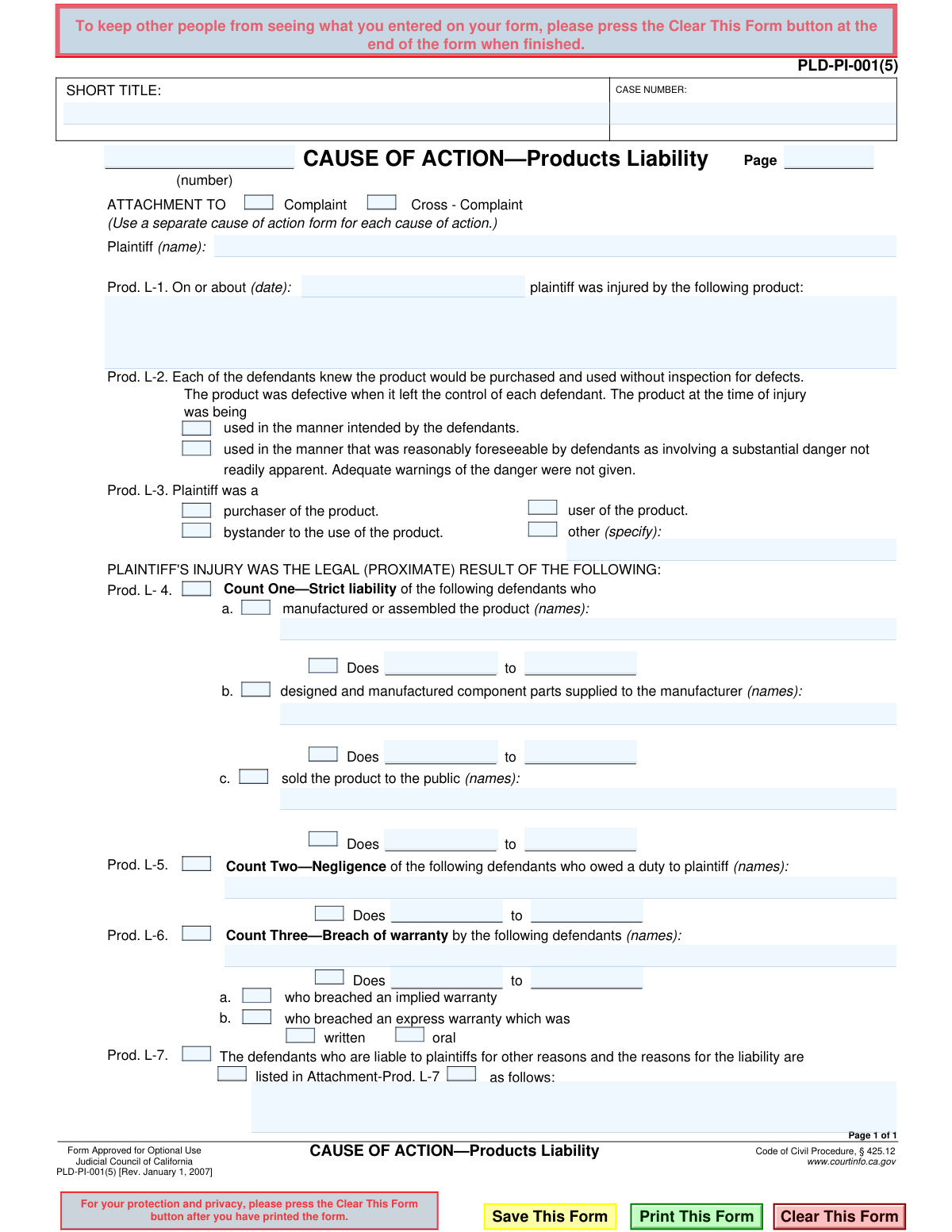
This form, officially titled Cause of Action—Products Liability, is an attachment to a complaint or cross-complaint filed in a California civil court. It is used by a plaintiff to formally allege that they were injured due to a defective product. The form outlines the legal basis for the claim, including counts of strict liability, negligence, and breach of warranty against the product's manufacturer, designer, or seller. Today, this form can be filled out quickly and accurately using AI-powered services like Instafill.ai, which can also convert non-fillable PDF versions into interactive fillable forms.
PLD-PI-001(5) is part of the
California court forms category on Instafill.
Our AI automatically handles information lookup, data retrieval, formatting, and form filling.
It takes less than a minute to fill out PLD-PI-001(5) using our AI form filling.
Securely upload your data. Information is encrypted in transit and deleted immediately after the form is filled out.
Form specifications
| Form name: | Form PLD-PI-001(5), Cause of Action—Products Liability |
| Number of fields: | 56 |
| Number of pages: | 1 |
| Language: | English |
Instafill Demo: How to fill out PDF forms in seconds with AI
How to Fill Out PLD-PI-001(5) Online for Free in 2026
Are you looking to fill out a PLD-PI-001(5) form online quickly and accurately? Instafill.ai offers the #1 AI-powered PDF filling software of 2026, allowing you to complete your PLD-PI-001(5) form in just 37 seconds or less.
Follow these steps to fill out your PLD-PI-001(5) form online using Instafill.ai:
- 1 Navigate to Instafill.ai and upload or select the PLD-PI-001(5) form.
- 2 Enter the case information, including the short title and case number, in the designated fields.
- 3 Provide the plaintiff's name and details about the product that caused the injury, including the date of the incident.
- 4 Specify the plaintiff's relationship to the product (e.g., user, purchaser) and check the boxes corresponding to the legal counts being alleged: Strict Liability, Negligence, and/or Breach of Warranty.
- 5 Use the AI assistant to accurately list the names of the defendants for each count being pursued.
- 6 Carefully review all the information populated by the AI for accuracy and completeness, making any necessary corrections.
- 7 Download the completed form to be attached to your main complaint or cross-complaint for filing with the court.
Our AI-powered system ensures each field is filled out correctly, reducing errors and saving you time.
Why Choose Instafill.ai for Your Fillable PLD-PI-001(5) Form?
Speed
Complete your PLD-PI-001(5) in as little as 37 seconds.
Up-to-Date
Always use the latest 2026 PLD-PI-001(5) form version.
Cost-effective
No need to hire expensive lawyers.
Accuracy
Our AI performs 10 compliance checks to ensure your form is error-free.
Security
Your personal information is protected with bank-level encryption.
Frequently Asked Questions About Form PLD-PI-001(5)
This form is a legal document used in California to state a claim against a company or individual for injuries caused by a defective product. It is filed as an attachment to a main complaint or cross-complaint in a lawsuit.
The plaintiff (the person who was injured by the product) or their attorney should complete this form. It outlines the legal reasons why the defendants are considered responsible for the plaintiff's injuries.
No, this is an attachment form. It must be attached to a primary legal document, such as a Complaint (Form PLD-PI-001) or a Cross-Complaint, to properly state your case.
This refers to 'Doe' defendants, which are placeholders for defendants whose names or identities are unknown at the time of filing. This allows you to add them to the lawsuit later once their identity is discovered.
These are three different legal theories for your claim. Strict liability focuses on the defective nature of the product itself, negligence focuses on the defendant's failure to exercise reasonable care, and breach of warranty focuses on the violation of a promise about the product.
You can still file a claim. Section Prod. L-3 of the form allows you to specify your role, including as a 'bystander to the use of the product'.
An express warranty is a specific guarantee made either in writing or orally. An implied warranty is an unstated guarantee that is assumed by law, such as the product being safe for its intended use.
This means the product was being used in a way the manufacturer should have anticipated, even if it wasn't the exact intended use. This is important for showing the product was dangerously defective under normal or predictable conditions.
Yes, services like Instafill.ai use AI to auto-fill form fields accurately from your saved information. This can save significant time and help reduce errors, especially when filling out multiple legal documents for a case.
You can use a service like Instafill.ai to complete this form digitally. Simply upload the PDF, and the platform will make the fields fillable so you can type your information, save, and print the completed document.
If you have a non-fillable or 'flat' PDF, you can upload it to Instafill.ai. The service's technology can convert it into an interactive, fillable form that you can easily complete on your computer.
In this section, you must provide the specific date on or about when the injury occurred and a description of the product that caused the harm. Be as specific as possible with the product's name, model, and any other identifiers.
Compliance PLD-PI-001(5)
Validation Checks by Instafill.ai
1
Valid Case Number Format
This check verifies that the 'CASE NUMBER' field conforms to the standard format required by the court. Case numbers often have a specific structure of letters, numbers, and separators that identify the court, year, and case type. An invalid format can lead to misfiling or rejection of the document by the court clerk, delaying the legal process.
2
Required Short Title
Ensures the 'SHORT TITLE' field is not empty. The short title is a crucial identifier for the case, used in all subsequent filings and communications. Failure to provide it makes the document difficult to track and associate with the correct legal matter, potentially causing filing errors.
3
Required Plaintiff Name
Validates that the 'Plaintiff (name)' field contains a value. The form is legally meaningless without identifying the party bringing the complaint. This information is fundamental for establishing who the injured party is and for the defendants to prepare a response.
4
Valid and Past Incident Date
This validation confirms that the date provided in 'On or about (date)' is a real, correctly formatted date and occurs on or before the current date. An invalid or future date would be logically impossible for an injury that has already occurred and would invalidate the claim's timeline, which is critical for statutes of limitations.
5
Required Product Identification
Verifies that the field for describing the product that caused the injury is not left blank. To establish a products liability claim, the specific product must be clearly identified. Without this information, the defendants cannot be properly notified of the claim against them and the case cannot proceed.
6
Plaintiff's Relationship to Product Selection
This check ensures that at least one checkbox under 'Prod. L-3' ('user', 'bystander', 'purchaser', or 'other') is selected. The plaintiff's relationship to the product is a key element in a products liability case, as it can affect the legal theories and duties owed. A submission without this selection is incomplete and lacks a required element of the claim.
7
Specification for 'Other' Plaintiff Status
If the 'other (specify)' checkbox is selected in 'Prod. L-3', this validation ensures the corresponding text field is filled in. Simply checking 'other' without an explanation is insufficient and ambiguous. The court and defendants need to understand the plaintiff's specific relationship to the product if it doesn't fit the standard categories.
8
At Least One Count Alleged
This is a global check to ensure that at least one of the main counts (Strict Liability, Negligence, or Breach of Warranty) has been asserted by filling in defendant names. A complaint must allege a specific cause of action against a specific defendant. A form with no counts filled out fails to state a claim and has no legal effect.
9
Defendant Names for Strict Liability
If Count One for strict liability is being used, this check verifies that at least one of the defendant name fields (for manufacturing, component design, or sales) is populated. The plaintiff must specify which defendant(s) they believe are liable under this count. Failure to name a defendant makes the count unenforceable.
10
Defendant Names for Negligence
Validates that if Count Two for negligence is being used, the corresponding defendant names field is populated. A claim of negligence requires the identification of the party or parties who allegedly owed and breached a duty of care. Without naming a defendant, the negligence count is incomplete and legally deficient.
11
Defendant Names for Breach of Warranty
Ensures that if Count Three for breach of warranty is being used, the defendant names field is filled out. A breach of warranty claim must be directed at a specific defendant who made the warranty. The claim is invalid without identifying the party alleged to have breached the warranty.
12
Warranty Type Selection
If a defendant is named under Count Three (Breach of Warranty), this check ensures that at least one type of warranty ('implied' or 'express') is selected. The legal requirements for proving a breach of an implied warranty versus an express warranty are different. The form must specify which type is being alleged for the claim to be clear.
13
Express Warranty Form Specification
This validation checks that if 'express warranty' is selected under Count Three, then either 'written' or 'oral' is also selected. An express warranty must have a form, and the complaint needs to specify whether the plaintiff is relying on a written document or a verbal statement. This detail is necessary for the defendant to prepare a defense.
14
Completeness of 'Other Reasons' Section
For section 'Prod. L-7', this check ensures that if the section is used, it is complete. The user must either check the box indicating the reasons are in an attachment or provide a description in the text field. Leaving both blank while intending to use this section would result in an incomplete and ambiguous allegation.
15
Valid Page Number
Verifies that the 'Page (number)' field contains a positive integer. This is important for document management, especially when the form is part of a larger complaint with multiple attachments. An incorrect or non-numeric page number can cause confusion and issues with document assembly and court filing.
Common Mistakes in Completing PLD-PI-001(5)
Users often enter an incorrect case number due to transposition errors or fail to use the official 'SHORT TITLE' of the case. This can lead to the document being misfiled by the court clerk, causing significant delays or even rejection of the filing. To avoid this, double-check the case number against official court documents and use the exact short title as established in prior filings.
In section Prod. L-1, filers may describe the product too vaguely, such as 'a power tool' instead of 'a Model X123 circular saw, serial number YZ456'. A vague description weakens the complaint by failing to specifically identify the allegedly defective item, which can lead to challenges from the defense. Always provide the most specific identifiers available, including brand, model, and serial number.
In Count One (Prod. L-4), people frequently miscategorize defendants, for example, listing the retail store under 'manufactured or assembled the product' instead of 'sold the product to the public'. This error demonstrates a misunderstanding of the legal claims and can result in parts of the complaint being dismissed. It is crucial to correctly identify each defendant's role in the product's chain of distribution.
Filers often list defendants using common or abbreviated names (e.g., 'Ford') instead of their full, proper legal names (e.g., 'Ford Motor Company'). This is a critical error because legal proceedings require serving the correct legal entity. An incorrect name can invalidate service of process and lead to the dismissal of that defendant from the case.
In section Prod. L-3, users must check a box to define the plaintiff's relationship to the product ('purchaser,' 'user,' 'bystander'). Forgetting to check a box or selecting the wrong one can negatively impact the legal theory of the case. If 'other' is selected, failing to provide a clear specification is a common omission that creates ambiguity.
When alleging a Breach of Warranty in Count Three (Prod. L-6), filers often name the defendants but forget to check the boxes specifying the type of warranty. It is essential to indicate whether the claim is for a 'breach of an implied warranty' or a 'breach of an express warranty' (and if so, whether it was 'written' or 'oral'). Omitting these details makes the allegation incomplete and subject to legal challenge.
In section Prod. L-7, a user might check the box for 'Attachment-Prod. L-7' but then fail to actually attach the referenced document to the filing. This makes the allegation incomplete and nonsensical. Conversely, writing a lengthy explanation in the small space provided instead of using a properly formatted attachment can make the filing look unprofessional and be difficult to read.
At the top of the form, the filer must check a box to indicate if the document is an attachment to a 'Complaint' or a 'Cross-Complaint'. Forgetting to select one of these options creates confusion about the document's legal context and purpose. This simple oversight can cause filing clerks to reject the document or require clarification, delaying the case.
In section Prod. L-1, users may enter the date of injury in an inconsistent or ambiguous format (e.g., 01/02/03) or provide a date that is clearly erroneous. An incorrect date can undermine the credibility of the claim and create issues with the statute of limitations. Always use a clear, unambiguous format like MM/DD/YYYY and verify the date is accurate.
This form is intended to be one page of a larger legal document, as indicated by the 'Page (number)' field. A common mistake is leaving this blank, which disrupts the pagination of the overall complaint. Incorrect or missing page numbers can make a multi-part filing confusing and difficult for the court and opposing counsel to navigate.
Saved over 80 hours a year
“I was never sure if my IRS forms like W-9 were filled correctly. Now, I can complete the forms accurately without any external help.”
Kevin Martin Green
Your data stays secure with advanced protection from Instafill and our subprocessors

Robust compliance program
Transparent business model
You’re not the product. You always know where your data is and what it is processed for.
ISO 27001, HIPAA, and GDPR
Our subprocesses adhere to multiple compliance standards, including but not limited to ISO 27001, HIPAA, and GDPR.
Security & privacy by design
We consider security and privacy from the initial design phase of any new service or functionality. It’s not an afterthought, it’s built-in, including support for two-factor authentication (2FA) to further protect your account.
Fill out PLD-PI-001(5) with Instafill.ai
Worried about filling PDFs wrong? Instafill securely fills form-pld-pi-0015-cause-of-actionproducts-liability forms, ensuring each field is accurate.