Yes! You can use AI to fill out Form PLD-PI-001(6), Exemplary Damages Attachment
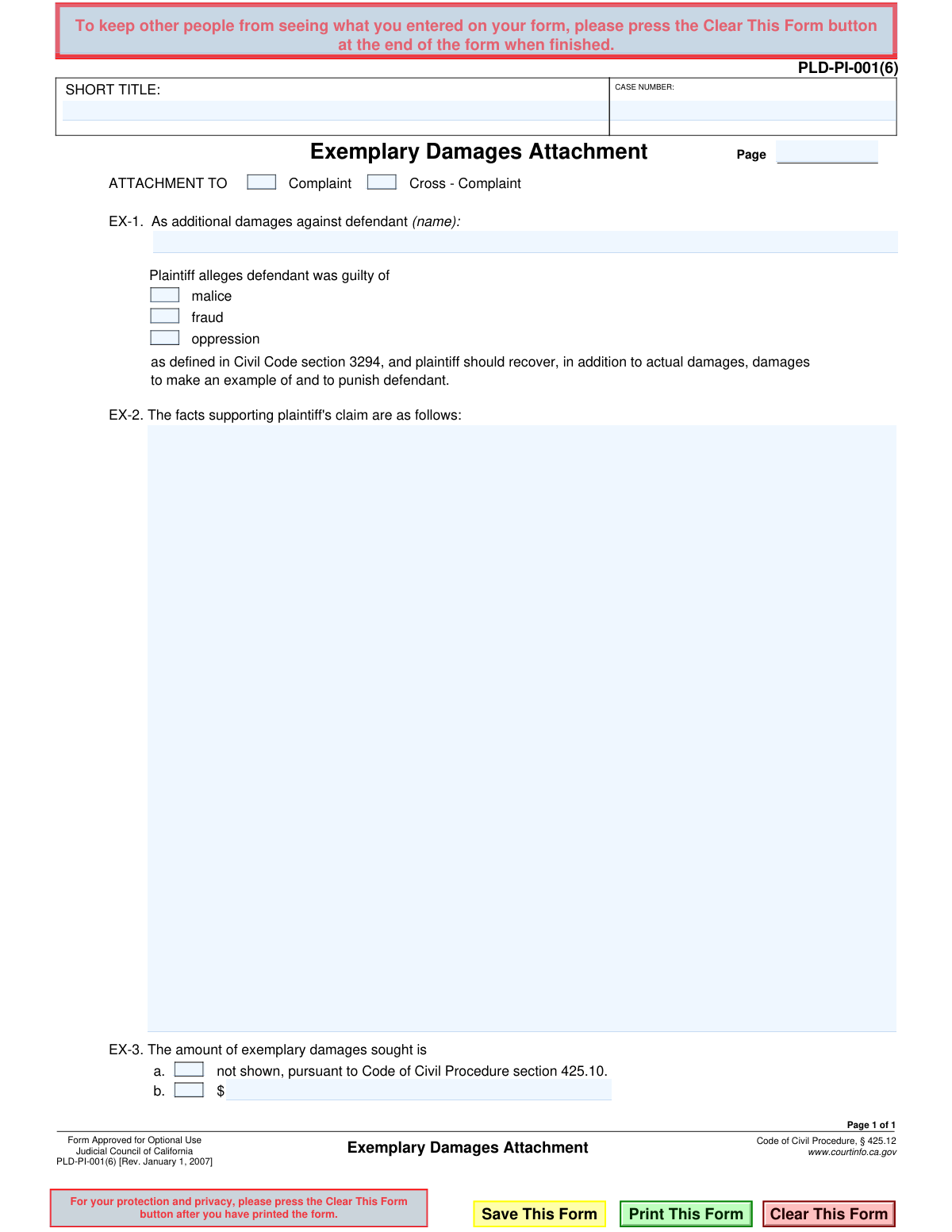
Form PLD-PI-001(6), the Exemplary Damages Attachment, is a legal document used in California courts as an addendum to a complaint or cross-complaint. It is used to formally allege that a defendant acted with malice, fraud, or oppression, which is the legal basis for seeking punitive (exemplary) damages under California Civil Code section 3294. Today, this form can be filled out quickly and accurately using AI-powered services like Instafill.ai, which can also convert non-fillable PDF versions into interactive fillable forms.
PLD-PI-001(6) is part of the
California court forms category on Instafill.
Our AI automatically handles information lookup, data retrieval, formatting, and form filling.
It takes less than a minute to fill out PLD-PI-001(6) using our AI form filling.
Securely upload your data. Information is encrypted in transit and deleted immediately after the form is filled out.
Form specifications
| Form name: | Form PLD-PI-001(6), Exemplary Damages Attachment |
| Number of fields: | 19 |
| Number of pages: | 1 |
| Language: | English |
Instafill Demo: How to fill out PDF forms in seconds with AI
How to Fill Out PLD-PI-001(6) Online for Free in 2026
Are you looking to fill out a PLD-PI-001(6) form online quickly and accurately? Instafill.ai offers the #1 AI-powered PDF filling software of 2026, allowing you to complete your PLD-PI-001(6) form in just 37 seconds or less.
Follow these steps to fill out your PLD-PI-001(6) form online using Instafill.ai:
- 1 Navigate to Instafill.ai and upload or select the PLD-PI-001(6) form.
- 2 Enter the case's short title and case number in the header section.
- 3 In section EX-1, enter the name of the defendant against whom you are seeking damages.
- 4 Check the box(es) in section EX-1 for malice, fraud, or oppression to specify the grounds for your claim.
- 5 In section EX-2, provide a detailed written statement of the facts that support your claim for exemplary damages.
- 6 In section EX-3, either specify the dollar amount of damages sought or check the box indicating the amount is not shown per the Code of Civil Procedure.
- 7 Review the entire attachment for accuracy and completeness before saving, printing, or filing it with the court.
Our AI-powered system ensures each field is filled out correctly, reducing errors and saving you time.
Why Choose Instafill.ai for Your Fillable PLD-PI-001(6) Form?
Speed
Complete your PLD-PI-001(6) in as little as 37 seconds.
Up-to-Date
Always use the latest 2026 PLD-PI-001(6) form version.
Cost-effective
No need to hire expensive lawyers.
Accuracy
Our AI performs 10 compliance checks to ensure your form is error-free.
Security
Your personal information is protected with bank-level encryption.
Frequently Asked Questions About Form PLD-PI-001(6)
This form is used to formally request punitive (or "exemplary") damages from a defendant in a California civil lawsuit. It's an attachment to your main Complaint or Cross-Complaint, alleging that the defendant acted with malice, fraud, or oppression.
The plaintiff (the person filing the lawsuit) or a cross-complainant who believes the other party's conduct was egregious enough to warrant punishment beyond just compensating for actual losses must fill out this form.
Exemplary damages, also known as punitive damages, are a monetary award intended to punish a defendant for extreme misconduct and deter similar behavior in the future. They are awarded in addition to any actual damages for your losses.
No, this is an attachment form that is not filed by itself. It must be attached to and filed along with a Complaint or Cross-Complaint to be valid.
These are legal terms defined in California Civil Code section 3294 that describe conduct deserving of punishment. You should check the box for each one that applies to the defendant's actions in your case.
In section EX-2, you must describe the specific actions by the defendant that you believe demonstrate malice, fraud, or oppression. Be clear and detailed, as these facts are the legal basis for your claim for punitive damages.
In most personal injury or wrongful death cases, you are prohibited from stating the specific amount of punitive damages in the initial complaint, so you should check box EX-3a. For other types of cases, you may be able to state an amount, but it is wise to consult an attorney.
Yes, you can. You should clearly name each defendant you are seeking these damages from in section EX-1 and specify the facts supporting the claim against each one in section EX-2.
The 'Short Title' is a shortened version of the case name (e.g., 'Smith v. Jones'), and the 'Case Number' is assigned by the court when the lawsuit is first filed. Both should be on the main Complaint or other court documents you have filed or received.
Yes, services like Instafill.ai use AI to help you accurately auto-fill form fields like your case number and party names, which can save time and reduce errors. However, AI cannot provide legal advice on the substance of your claims.
You can use a service like Instafill.ai to upload the form and fill it out on your computer. The platform allows you to type directly into the fields, save your progress, and download the completed document for printing and filing.
If you have a non-fillable or 'flat' PDF, you can upload it to a service like Instafill.ai. Their technology can convert it into an interactive, fillable form that you can complete, save, and print from your computer.
Compliance PLD-PI-001(6)
Validation Checks by Instafill.ai
1
Ensures Case Number is Provided
This check verifies that the 'CASE NUMBER' field is not empty. The case number is the primary identifier for a legal proceeding within the court system. Submitting a form without a case number would make it impossible to associate with the correct file, leading to rejection by the court clerk.
2
Validates Case Number Format
This validation ensures the 'CASE NUMBER' field conforms to the expected format for the jurisdiction (e.g., a specific pattern of letters and numbers). An incorrectly formatted case number can cause processing errors in the court's electronic filing system. If the format is invalid, the user should be prompted to correct it before submission.
3
Ensures Short Title is Provided
This check confirms that the 'SHORT TITLE' field has been filled out. The short title provides a human-readable identifier for the case and is used on all subsequent documents. A missing short title can lead to confusion and potential rejection of the filing.
4
Requires Defendant Name in EX-1
This validation ensures that a defendant's name is entered in the 'defendant (name)' field in section EX-1. A claim for exemplary damages must be directed against a specific party. Failure to name a defendant makes the attachment legally deficient and without effect.
5
Requires Selection of Grounds for Damages
This check verifies that at least one of the checkboxes ('malice', 'fraud', or 'oppression') is selected in section EX-1. A claim for exemplary damages must be based on one of these specific grounds as defined by Civil Code § 3294. The form is incomplete and legally insufficient without this selection.
6
Verifies Factual Basis Narrative is Present
This validation ensures the text area in section EX-2, 'The facts supporting plaintiff's claim are as follows', is not empty. A claim for punitive damages requires a supporting statement of facts alleging the defendant's conduct. An empty narrative would result in the claim being dismissed for failure to state a cause of action.
7
Ensures Factual Basis Narrative Minimum Length
This check verifies that the narrative in section EX-2 meets a minimum character count to discourage trivial or incomplete entries. This encourages the filer to provide a substantive description of the facts, which is necessary to properly plead the claim. A submission with an overly brief or nonsensical entry may be deemed insufficient by the court.
8
Validates Mutual Exclusivity of Damages Amount in EX-3
This check ensures that the user does not both enter a dollar amount and check the box for 'not shown' in section EX-3. These two options are mutually exclusive and selecting both creates a contradiction. The system should prevent this state and require the user to choose only one option.
9
Requires a Selection for Damages Amount in EX-3
This validation confirms that the user has made a choice in section EX-3, either by entering a dollar amount or by checking the 'not shown' box. The form requires a clear statement on how the amount of exemplary damages is being pleaded. An omission in this section makes the form incomplete and requires correction.
10
Validates Format of Specified Damage Amount
If a dollar amount is entered in section EX-3b, this check ensures it is a valid numeric or currency format (e.g., '50000.00' or '50,000'). Entering non-numeric text would cause data processing errors and is not a valid monetary amount. The validation should reject any input that cannot be interpreted as a number.
11
Verifies Attachment Type is Specified
This check ensures the user has specified whether the form is an attachment to a 'Complaint' or a 'Cross-Complaint'. This information is critical for the court to correctly file and docket the document as part of the primary pleading. Failure to specify the parent document type can lead to filing errors and delays.
12
Cross-Document Case Information Consistency
This validation compares the 'CASE NUMBER' and 'SHORT TITLE' on this attachment with the parent document (Complaint or Cross-Complaint) it is being filed with. Mismatched information can lead to the document being filed in the wrong case or rejected entirely. This check ensures the entire filing package is consistent and accurate.
Common Mistakes in Completing PLD-PI-001(6)
Filers often forget to enter the 'SHORT TITLE' and 'CASE NUMBER' at the top of the form or enter them incorrectly. This typically happens due to rushing or not having the primary court filing on hand for reference. A missing or incorrect case number can lead to the court clerk misfiling or rejecting the document, causing significant delays and confusion.
In section EX-1, users frequently leave the 'defendant (name)' field blank, especially in cases with multiple defendants. They may incorrectly assume the claim applies to all defendants by default. This makes the claim for exemplary damages legally insufficient, as the court cannot award damages against an unspecified party, rendering the attachment ineffective.
A critical error is providing a weak or non-specific narrative in the 'facts supporting plaintiff's claim' (EX-2) section. Many filers write conclusory statements like 'Defendant acted with malice' instead of detailing specific actions, dates, and circumstances. Such pleadings fail to meet the high legal standard for punitive damages and are likely to be dismissed by the court upon a motion to strike.
A simple but common oversight is failing to check any of the boxes for 'malice,' 'fraud,' or 'oppression' in section EX-1. Without selecting a legal basis, the attachment is defective and fails to state a valid claim under Civil Code section 3294. This forces the court and opposing counsel to guess the grounds for the claim, likely resulting in it being challenged and struck.
Users sometimes check a box in EX-1 (e.g., 'fraud') while the factual description in EX-2 details conduct that legally constitutes a different basis (e.g., 'oppression'). This mismatch occurs from a misunderstanding of the precise legal definitions of these terms. This inconsistency weakens the pleading and gives the opposing party a clear basis to challenge the sufficiency of the claim.
A frequent mistake is entering a dollar amount in section EX-3(b) for a personal injury or wrongful death case. California procedure (CCP § 425.10) prohibits stating the amount of punitive damages in the initial complaint for such cases. This error leads to an immediate motion to strike from the opposing counsel, creating unnecessary legal costs and procedural delays.
Filers sometimes check box EX-3(a) ('not shown') and also fill in a dollar amount in EX-3(b). This happens due to carelessness, as these two options are mutually exclusive. This creates an ambiguous and defective document, forcing the court to seek clarification and delaying the proceedings.
When filling out a non-fillable PDF by hand, handwriting can be illegible, and when typing, text can overflow the designated fields, especially in the large EX-2 section. Illegible information can be misinterpreted or deemed insufficient, and if the case number is unreadable, the clerk may reject the filing. AI-powered tools like Instafill.ai can convert flat PDFs into fillable forms, ensuring all text is neat, legible, and properly contained.
Users often neglect to check the 'Complaint' or 'Cross-Complaint' box at the top of the form to indicate what pleading this document is an attachment to. While a minor clerical error, it can cause confusion for the court clerk and opposing parties. To avoid this, always double-check that the correct parent document is selected before filing.
People may inadvertently use an old version of the form found online or saved from a previous case. Court rules and forms change, and submitting an outdated version like one pre-dating the '[Rev. January 1, 2007]' date can lead to rejection by the court clerk. Always download the most current version from the official Judicial Council website to ensure compliance and avoid filing delays.
An error with severe consequences is misspelling the defendant's name or using an incorrect legal entity (e.g., 'John Smith' instead of 'John Smith, Inc.'). This can invalidate the claim against the intended party, a mistake that may be impossible to fix if the statute of limitations has passed. AI form-filling tools like Instafill.ai can help prevent these errors by validating data and auto-populating correct entity names from a case database.
Saved over 80 hours a year
“I was never sure if my IRS forms like W-9 were filled correctly. Now, I can complete the forms accurately without any external help.”
Kevin Martin Green
Your data stays secure with advanced protection from Instafill and our subprocessors

Robust compliance program
Transparent business model
You’re not the product. You always know where your data is and what it is processed for.
ISO 27001, HIPAA, and GDPR
Our subprocesses adhere to multiple compliance standards, including but not limited to ISO 27001, HIPAA, and GDPR.
Security & privacy by design
We consider security and privacy from the initial design phase of any new service or functionality. It’s not an afterthought, it’s built-in, including support for two-factor authentication (2FA) to further protect your account.
Fill out PLD-PI-001(6) with Instafill.ai
Worried about filling PDFs wrong? Instafill securely fills form-pld-pi-0016-exemplary-damages-attachment forms, ensuring each field is accurate.