Yes! You can use AI to fill out Form SER-001A, Special Instructions for Writs and Levies—Attachment
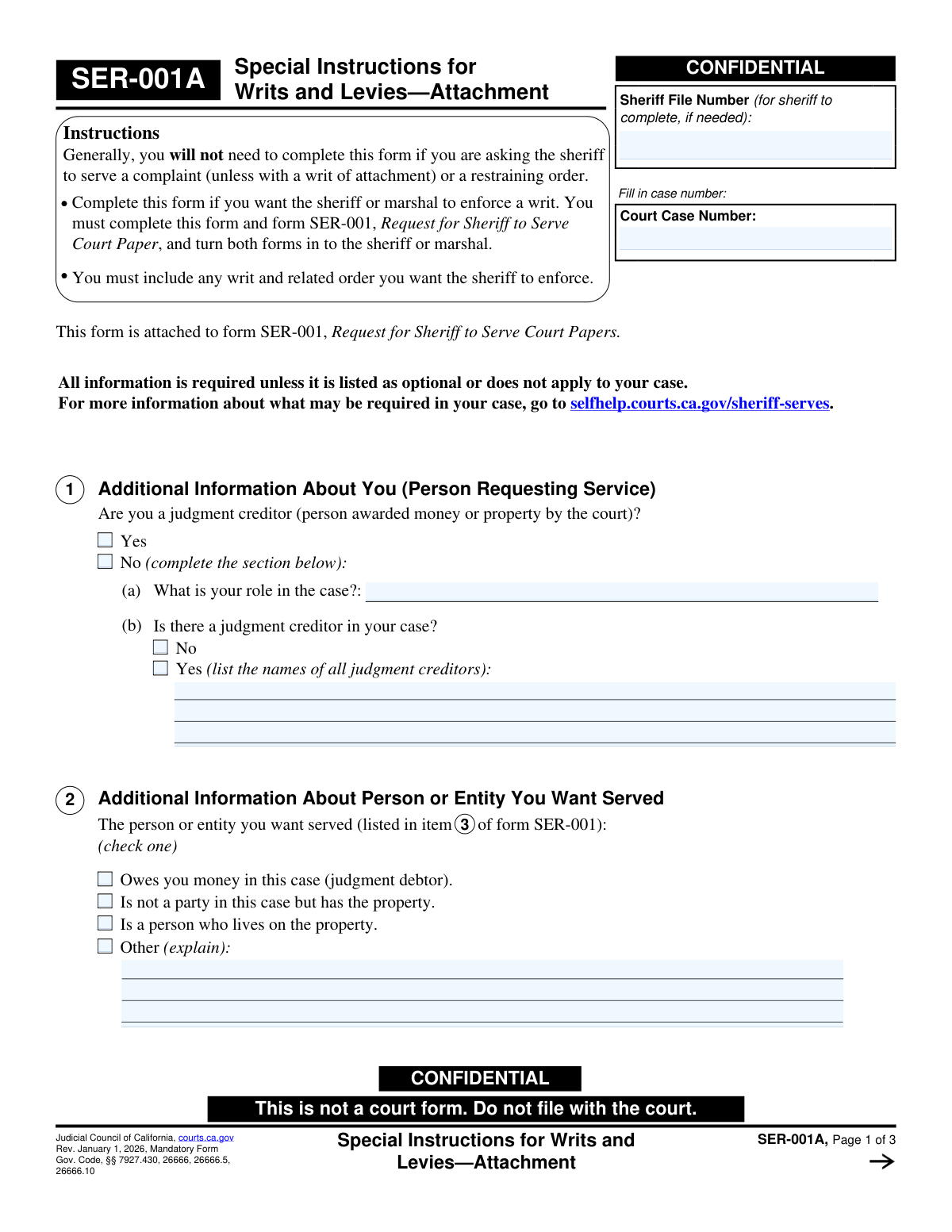
Form SER-001A is a California court form that provides detailed instructions to a sheriff or marshal when you need them to enforce a writ, such as seizing property (a levy) or executing a writ of attachment. It supplements Form SER-001 and is crucial for ensuring the officer has all necessary information about the property, the debtor, and the specific actions required. Today, this form can be filled out quickly and accurately using AI-powered services like Instafill.ai, which can also convert non-fillable PDF versions into interactive fillable forms.
SER-001A is part of the
California court forms category on Instafill.
Our AI automatically handles information lookup, data retrieval, formatting, and form filling.
It takes less than a minute to fill out SER-001A using our AI form filling.
Securely upload your data. Information is encrypted in transit and deleted immediately after the form is filled out.
Form specifications
| Form name: | Form SER-001A, Special Instructions for Writs and Levies—Attachment |
| Number of fields: | 40 |
| Number of pages: | 1 |
| Language: | English |
Instafill Demo: How to fill out PDF forms in seconds with AI
How to Fill Out SER-001A Online for Free in 2026
Are you looking to fill out a SER-001A form online quickly and accurately? Instafill.ai offers the #1 AI-powered PDF filling software of 2026, allowing you to complete your SER-001A form in just 37 seconds or less.
Follow these steps to fill out your SER-001A form online using Instafill.ai:
- 1 Navigate to Instafill.ai and upload or select Form SER-001A, Special Instructions for Writs and Levies—Attachment.
- 2 Enter the Court Case Number and provide information about your role in the case, such as whether you are the judgment creditor.
- 3 Identify the person or entity to be served and their relationship to the case (e.g., judgment debtor).
- 4 Input details about the writ and judgment, including issue dates and the judgment amount if applicable.
- 5 Thoroughly describe the property to be levied, including its location, ownership details, and whether it is a dwelling.
- 6 Use the designated section to write any special instructions for the sheriff regarding the enforcement of the writ.
- 7 Review all the information you've provided for accuracy, then download the completed form to be submitted with Form SER-001 to the sheriff or marshal.
Our AI-powered system ensures each field is filled out correctly, reducing errors and saving you time.
Why Choose Instafill.ai for Your Fillable SER-001A Form?
Speed
Complete your SER-001A in as little as 37 seconds.
Up-to-Date
Always use the latest 2026 SER-001A form version.
Cost-effective
No need to hire expensive lawyers.
Accuracy
Our AI performs 10 compliance checks to ensure your form is error-free.
Security
Your personal information is protected with bank-level encryption.
Frequently Asked Questions About Form SER-001A
This form provides the sheriff or marshal with specific instructions needed to enforce a court-ordered writ, such as seizing property or money from a judgment debtor.
You need to fill out this form if you are asking the sheriff or marshal to enforce a writ, such as a writ of attachment or execution. It is submitted along with form SER-001, 'Request for Sheriff to Serve Court Papers'.
No, this form is confidential and should not be filed with the court. You must turn it in directly to the sheriff or marshal's office that will be enforcing the writ.
You must submit form SER-001 ('Request for Sheriff to Serve Court Papers') and the actual writ and any related court orders you want the sheriff to enforce. For certain personal debt judgments, you may also need to attach form WG-015/EJ-135.
You should be as specific as possible. For example, provide bank account numbers, vehicle license plate numbers and location, or the legal description and assessor's parcel number for real estate.
In Section 4b, you must list the names of the actual owners and explain their interest in the property. You may also need to have those owners served with court papers.
This refers to collecting a debt incurred by an individual for personal, family, or household purposes. If this applies, you must verify the debtor's address and attach a completed 'Declaration of Address Verification' (form WG-015/EJ-135).
You should provide special instructions for non-standard situations, such as asking the sheriff to place a keeper in charge of a business or providing details on how to seize property from a private residence.
Generally, no. The form states you do not need to complete it if you are only asking the sheriff to serve a complaint, unless it is being served along with a writ of attachment.
A judgment creditor is the person or entity that the court has awarded money or property to. A judgment debtor is the person or entity that owes the money or property as ordered by the court.
Yes, services like Instafill.ai use AI to help you accurately auto-fill form fields, which can save you time and help avoid errors.
You can use a service like Instafill.ai to upload the form, which makes it interactive and fillable online. The AI can then assist you in completing the required fields with your case information.
If you have a non-fillable or 'flat' PDF, you can use a service like Instafill.ai. It can convert the flat PDF into an interactive, fillable form that you can complete on your computer.
Compliance SER-001A
Validation Checks by Instafill.ai
1
Consistent Court Case Number
This check verifies that the 'Court Case Number' is identical across all pages of the form (SER-001A[0].Page1[0]...CourtCaseNo[0], SER-001A[0].Page2[0]...CourtCaseNo[0], etc.). Maintaining consistency is critical to ensure all pages of the attachment are correctly associated with a single legal case file. A mismatch could lead to the rejection of the form or incorrect processing by the sheriff's office.
2
Conditional Requirement for Non-Judgment Creditor Role
Validates that if the user selects 'No' for 'Are you a judgment creditor?' (Item 1), the subsequent field 'What is your role in the case?' (Lia[0].Fill1[0]) must be filled out. This information is essential for the sheriff to understand the authority and standing of the person requesting the service. Failure to provide this role will result in an incomplete and potentially rejected request.
3
Conditional Requirement for Listing Other Judgment Creditors
Ensures that if the user answers 'Yes' to 'Is there a judgment creditor in your case?' (Item 1b), the corresponding text field for listing their names (Lib[0].Fill2[0]) is not empty. This is necessary to identify all relevant parties with a financial interest in the judgment. An empty field would contradict the 'Yes' answer and make the form incomplete.
4
Required Explanation for 'Other' Person Served
Checks that if the 'Other' checkbox is selected in Item 2 ('Additional Information About Person or Entity You Want Served'), the accompanying explanation text field (Fill3[0]) is populated. The sheriff requires this explanation to understand the relationship of the served party to the case and property. Without this context, the service cannot be properly and legally executed.
5
Valid and Historical Writ Issue Date
Validates that the 'Date writ was issued' (Item 3a, Date3a[0]) is in a valid date format (e.g., MM/DD/YYYY) and is not a future date. This check ensures data integrity and logical soundness, as a writ cannot be issued in the future. An invalid or future date would halt processing until the user provides a correct and plausible date.
6
Logical Date Sequence for Judgment and Writ
Performs a cross-field validation to ensure that the 'Date judgment was issued' (Item 3c(1), Date3c1[0]) is on or before the 'Date writ was issued' (Item 3a, Date3a[0]). A writ is issued based on a pre-existing judgment, so the judgment date cannot be after the writ date. This check prevents logical impossibilities in the legal timeline and ensures the sequence of events is valid.
7
Required Judgment Details on Affirmative Answer
Verifies that if 'Yes' is selected for 'Has a judgment been issued by the court?' (Item 3c), then the 'Date judgment was issued' field (Date3c1[0]) and the list of judgment debtors (Fill3c[0]) are filled. This information is critical for the sheriff to confirm the validity of the enforcement action. Missing these details makes the request incomplete and unenforceable.
8
Valid Money Judgment Amount Format
Checks that the value entered for the money judgment amount (Item 3c(2), MoneyJudge[0]) is a valid numeric or currency format. This ensures data integrity and allows for correct financial record-keeping by the sheriff's office. Submitting non-numeric characters would cause calculation errors and processing failures.
9
Mandatory Property Description
Ensures that the property description field (Item 4a, Fill4a[0]) is not left empty. This is one of the most critical fields on the form, as the sheriff cannot perform a levy without a clear description of the property to be seized and its location. An empty or insufficient description renders the entire request unenforceable.
10
Required Explanation for Third-Party Property Ownership
Validates that if 'No' is selected for the property being in the judgment debtor’s name (Item 4b), the explanation field (Fill1[0]) must be populated with the actual owner's name and their interest. This information is legally required for the sheriff to proceed, as levying on property owned by a third party has significant legal implications. Failure to provide this will stop the enforcement action.
11
Required Dwelling Type Selection
Checks that if the user answers 'Yes' to levying on a dwelling (Item 4c), they must then select either 'Real property' or 'Personal property'. The legal procedures and requirements for levying on a house versus a mobile home are distinct. This selection is mandatory to guide the sheriff on the correct legal process to follow.
12
Verification of Personal Debt Declaration Attachment
Validates that if the user selects 'Yes' in Item 5, indicating the action relates to a personal debt judgment, the system flags that a 'Declaration of Address Verification' (form WG-015/EJ-135) must be attached. This is a strict legal requirement under the Code of Civil Procedure. The system should prompt the user or processing agent to confirm this attachment is present before the sheriff can proceed.
13
Writ Type Selection Completeness
Verifies that one of the three options in Item 3b, describing the type of writ being submitted (original, electronic copy, or previously given copy), has been selected. This information is crucial for the sheriff's office to manage their records and prevent acting on a duplicate or invalid writ. The form cannot be processed without this selection.
14
Person Served Role Selection Completeness
Ensures that one of the checkboxes in Item 2 has been selected to identify the person or entity being served. This defines the target of the levy and their relationship to the case (e.g., judgment debtor, property holder). Without this selection, the sheriff does not know who to serve or in what capacity, making the instructions incomplete.
Common Mistakes in Completing SER-001A
This form is explicitly marked 'Do not file with the court' and must be delivered to the sheriff or marshal. A common mistake is to file it with the court clerk along with other case documents. This error results in significant delays as the court will reject the document, and the sheriff will never receive the necessary instructions to enforce the writ, halting the entire process.
The form is titled 'Attachment' and the instructions clearly state it must accompany form SER-001, 'Request for Sheriff to Serve Court Papers'. Submitting SER-001A by itself will lead to immediate rejection by the sheriff's office, as it lacks the primary request for service. To avoid this, always ensure both SER-001 and SER-001A are completed and submitted together as a package.
In Section 4, providing a generic description like 'debtor's bank account' or 'the car' is a critical failure. The sheriff requires specific, actionable details to locate and seize an asset, such as a bank name and account number, or a vehicle's license plate number and location. A vague description will result in the sheriff being unable to act, rendering the levy request useless and wasting filing fees.
When enforcing a judgment for personal debt, Section 5 requires attaching a completed 'Declaration of Address Verification' (form WG-015/EJ-135). Filers often check the 'Yes' box but forget to include the separate, mandatory form. The sheriff is legally prohibited from serving the papers without this declaration, bringing the enforcement process to an immediate stop until the omission is corrected.
The 'Court Case Number' field appears at the top of all three pages for a reason. People frequently fill it out on the first page but neglect the subsequent ones. If the pages become separated, the un-numbered pages are impossible to associate with the correct file, leading to incomplete instructions and a failed levy. This simple oversight can cause major processing delays.
The dates and amounts entered in Section 3 must precisely match the official court-issued writ and judgment. Transcribing an incorrect writ issue date, judgment date, or monetary amount can cause the sheriff to question the request's validity and refuse to proceed. To prevent this, carefully double-check all figures against the source documents before submission.
Section 6 is not an optional field if the situation is complex; it is essential for non-standard levies. For example, if you need the sheriff to place a 'keeper' at a business or seize property from a private home, you must provide explicit instructions, often citing the relevant code. Without these instructions, the sheriff will perform a basic levy that may be completely ineffective for your situation.
In Section 4b, filers may incorrectly assume the debtor is the sole owner of the property being levied. If an asset like a car or bank account is jointly owned, this must be disclosed, along with the names of the other owners. Failure to do so can lead to serious legal complications, including claims of wrongful levy, and may invalidate the seizure.
The form states that all information is required unless marked optional. Users may leave a field blank if they are unsure, rather than writing 'N/A' or finding the correct information. An incomplete form, especially with missing information in key sections like the property description or judgment debtor list, will be returned by the sheriff, causing delays. AI-powered tools like Instafill.ai can help prevent this by flagging mandatory fields that have been left empty.
The form requires several dates, and users often write them illegibly or in ambiguous formats (e.g., 01/02/2026). This can lead to confusion and processing errors by the sheriff's office. Always use a clear, standard format like MM/DD/YYYY or write out the month to avoid ambiguity. Using a digital tool to fill the form can ensure dates are legible and consistently formatted.
This form is an instruction sheet that must be accompanied by other critical documents, primarily the writ itself and any related court orders. Users sometimes submit the instruction forms (SER-001/SER-001A) but forget to include the actual writ the sheriff is supposed to enforce. Without the writ, the entire submission is invalid and will be rejected immediately.
Many official forms are only available as flat, non-fillable PDFs, forcing users to print and fill them out by hand. This leads to illegible handwriting, data entry errors, and an unprofessional appearance that can cause processing issues. To avoid this, AI-powered form-filling tools like Instafill.ai can convert any non-fillable PDF into an interactive, fillable form, ensuring all entries are clear, legible, and properly formatted.
Saved over 80 hours a year
“I was never sure if my IRS forms like W-9 were filled correctly. Now, I can complete the forms accurately without any external help.”
Kevin Martin Green
Your data stays secure with advanced protection from Instafill and our subprocessors

Robust compliance program
Transparent business model
You’re not the product. You always know where your data is and what it is processed for.
ISO 27001, HIPAA, and GDPR
Our subprocesses adhere to multiple compliance standards, including but not limited to ISO 27001, HIPAA, and GDPR.
Security & privacy by design
We consider security and privacy from the initial design phase of any new service or functionality. It’s not an afterthought, it’s built-in, including support for two-factor authentication (2FA) to further protect your account.
Fill out SER-001A with Instafill.ai
Worried about filling PDFs wrong? Instafill securely fills form-ser-001a-special-instructions-for-writs-and-leviesattachment forms, ensuring each field is accurate.