Yes! You can use AI to fill out Non-Dissolution (FD) Complex Track Case Management Order
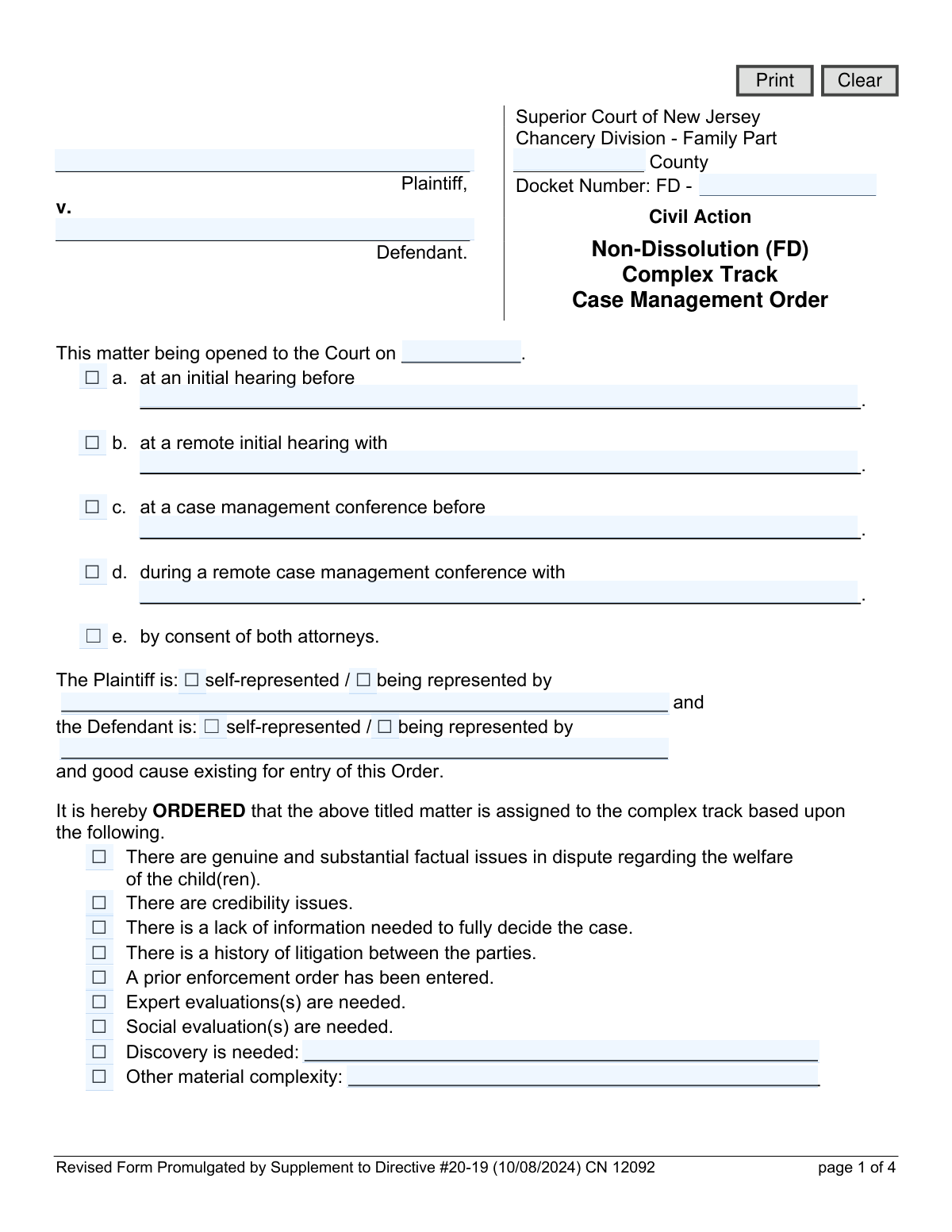
This is an official court order from the Superior Court of New Jersey, Chancery Division - Family Part, for 'Non-Dissolution' (FD) cases assigned to the complex track. It is used to manage family law matters that do not involve the dissolution of a marriage but have substantial factual disputes, require expert evaluations, or have a history of litigation. This order is crucial for establishing a clear schedule for discovery, appraisals, and court conferences to ensure the case progresses efficiently. Today, this form can be filled out quickly and accurately using AI-powered services like Instafill.ai, which can also convert non-fillable PDF versions into interactive fillable forms.
NJ Non-Dissolution (FD) Complex Track Case Management Order is part of the
New Jersey forms category on Instafill.
Our AI automatically handles information lookup, data retrieval, formatting, and form filling.
It takes less than a minute to fill out NJ Non-Dissolution (FD) Complex Track Case Management Order using our AI form filling.
Securely upload your data. Information is encrypted in transit and deleted immediately after the form is filled out.
Form specifications
| Form name: | Non-Dissolution (FD) Complex Track Case Management Order |
| Number of fields: | 184 |
| Number of pages: | 1 |
| Language: | English |
Instafill Demo: How to fill out PDF forms in seconds with AI
How to Fill Out NJ Non-Dissolution (FD) Complex Track Case Management Order Online for Free in 2026
Are you looking to fill out a NJ NON-DISSOLUTION (FD) COMPLEX TRACK CASE MANAGEMENT ORDER form online quickly and accurately? Instafill.ai offers the #1 AI-powered PDF filling software of 2026, allowing you to complete your NJ NON-DISSOLUTION (FD) COMPLEX TRACK CASE MANAGEMENT ORDER form in just 37 seconds or less.
Follow these steps to fill out your NJ NON-DISSOLUTION (FD) COMPLEX TRACK CASE MANAGEMENT ORDER form online using Instafill.ai:
- 1 Navigate to Instafill.ai and upload or select the Non-Dissolution (FD) Complex Track Case Management Order form.
- 2 Enter the case caption information, including the county, docket number, and the names of the plaintiff and defendant.
- 3 Indicate the basis for the hearing and check the boxes specifying the reasons the case is assigned to the complex track and the issues in dispute.
- 4 Fill in the ordered deadlines for discovery procedures, such as filing Case Information Statements (CIS), submitting interrogatories, and completing depositions.
- 5 Detail the requirements and due dates for any necessary appraisals or evaluations (e.g., real estate, custody, business) and specify cost allocation.
- 6 Input the dates and times for scheduled events like consent conferences, mediation, and the next Case Management Conference as directed by the judge.
- 7 Review all entered information for accuracy, then download or print the completed order for attorney consent signatures and filing with the court.
Our AI-powered system ensures each field is filled out correctly, reducing errors and saving you time.
Why Choose Instafill.ai for Your Fillable NJ Non-Dissolution (FD) Complex Track Case Management Order Form?
Speed
Complete your NJ Non-Dissolution (FD) Complex Track Case Management Order in as little as 37 seconds.
Up-to-Date
Always use the latest 2026 NJ Non-Dissolution (FD) Complex Track Case Management Order form version.
Cost-effective
No need to hire expensive lawyers.
Accuracy
Our AI performs 10 compliance checks to ensure your form is error-free.
Security
Your personal information is protected with bank-level encryption.
Frequently Asked Questions About Form NJ Non-Dissolution (FD) Complex Track Case Management Order
This is a court order that outlines the schedule and requirements for a family case that is not a divorce but has been identified as legally or factually complex. It serves as a roadmap for how the case will proceed, detailing deadlines for discovery, evaluations, and future court dates.
Your case was assigned to the complex track for one or more of the reasons checked on the first page of the order. Common reasons include substantial factual disputes, the need for expert evaluations, or a history of litigation between the parties.
This order is typically completed by a judge during or after a hearing or case management conference, often with input from the parties' attorneys. It is an official court order that all parties must follow once signed by the judge.
A Case Information Statement (CIS) is a detailed financial disclosure document required in most New Jersey family law cases. This order specifies the deadline by which you must file your completed CIS with the court.
These are methods of 'discovery,' the formal process of exchanging information. Interrogatories are written questions one party sends to the other to answer under oath, while depositions are interviews where a party or witness answers questions under oath.
Missing a court-ordered deadline can have serious consequences, such as financial penalties or the court making a decision without your information. If you cannot meet a deadline, you must immediately contact your attorney or, if self-represented, inform the court and the other party.
The order specifies who is responsible for the cost of any required appraisals or evaluations, such as for real estate, businesses, or custody. The 'Cost Paid by' column will indicate if the Plaintiff (P), Defendant (D), or both are responsible.
A Guardian ad litem, or GAL, is a neutral person appointed by the court to investigate the facts of a case and report on what is in the child's best interests. The order will state if a GAL is to be appointed and by what date.
The Case Management Conference is a meeting with the judge to review the status of the case and ensure all parties are complying with the discovery schedule. It is an opportunity to address any issues and keep the case moving forward toward a resolution or trial.
Yes, services like Instafill.ai use AI to help manage your case documents. They can accurately auto-fill repetitive information onto forms and help you keep track of the various documents required by this order, saving time and reducing errors.
You can use a service like Instafill.ai to fill out your legal forms online. Simply upload the form, and the AI will create fillable fields, allowing you to complete it quickly and accurately on your computer.
If you have a non-fillable or 'flat' PDF, you can use Instafill.ai to convert it into an interactive, fillable form. This allows you to easily type your information directly into the document before printing or submitting it.
'Custody' refers to the legal authority to make major decisions for a child and where the child primarily lives. 'Parenting Time/Visitation' refers to the specific schedule of time the non-custodial parent spends with the child.
You must carefully read the entire order and make a note of all deadlines and requirements assigned to you. You are legally required to comply with everything in the order, so be sure to provide all requested documents and attend all scheduled events.
Compliance NJ Non-Dissolution (FD) Complex Track Case Management Order
Validation Checks by Instafill.ai
1
Validate Docket Number Format
Checks that the Docket Number follows the standard New Jersey format, which is 'FD-' followed by a two-digit county code and a multi-digit case number (e.g., FD-01-123456). This ensures the document can be correctly filed and retrieved within the court system. An invalid format could lead to filing rejection or misclassification of the case.
2
Ensure Core Case Identifiers are Present
This validation confirms that the Plaintiff's full name, Defendant's full name, and the County are all provided. These fields are essential for identifying the specific legal case to which this order applies. Failure to provide this information would render the order ambiguous and legally unenforceable.
3
Validate Party Representation Status
Checks the logical consistency of party representation. If a party (Plaintiff or Defendant) is marked as 'being represented,' the corresponding attorney name field must be filled. Conversely, if 'self-represented' is checked, the attorney name field should be empty to avoid contradiction.
4
Require Details for 'Other' or 'Discovery' Complexity
This check ensures that if the 'Discovery is needed' or 'Other material complexity' checkbox is selected, the corresponding text field for details is not empty. This is crucial for providing a clear and specific justification for the complex track assignment on the court record. An empty details field would make the reason for the order unclear.
5
Conditional Requirement for Custody Plan Submission Date
Validates that if the 'Custody' checkbox is marked as an issue in dispute, a valid future date is provided for when the Custody/Parenting Time Plan will be submitted. This ensures that a key required document has a clear deadline associated with it, preventing delays in the case. The system should flag if the checkbox is ticked but the date is missing or in the past.
6
Verify All Dates are Valid and in the Future
This validation scans all date fields for deadlines and future events (e.g., 'cisFileDueDt', 'cmcSchedDt') to ensure they are in a valid format (MM/DD/YYYY) and are set for a date in the future. This prevents data entry errors and ensures all deadlines and appointments are scheduled for a valid, achievable time. A past date would render the order nonsensical.
7
Validate Case Information Statement (CIS) Filing Logic
This check ensures logical consistency for the CIS section. If 'Yes' is selected for a party having filed their CIS, the system should not allow a due date to be set for that same party. Conversely, if a due date is set for a party to file their CIS, their status should be 'No', preventing contradictory entries.
8
Ensure Discovery Tasks Have Both Assignee and Due Date
For each discovery task (e.g., Interrogatories, Notice to Produce), this validation verifies that if a due date is entered, at least one party (Plaintiff, Defendant, or Both) is selected as responsible. Similarly, if a party is selected, a due date must be entered. This ensures that all ordered tasks are clearly assigned and have a firm deadline.
9
Validate Appraisal/Evaluation Expert Selection
For each row in the Appraisals/Evaluations table, if a due date is entered, this check confirms that at least one expert type (Joint, Plaintiff's, or Defendant's) is selected. This is important to clarify who is responsible for obtaining the appraisal or evaluation. An entry with a due date but no assigned expert is incomplete and unenforceable.
10
Ensure Trial Date and 'To Be Determined' are Mutually Exclusive
This validation ensures that the user either enters a specific trial date or checks the 'Trial date is to be determined' box, but not both. Allowing both would create a conflicting and ambiguous order. The system should force a choice to ensure the trial status is clear and definite.
11
Verify Completeness of Attorney Contact Information
If an attorney's name is entered in the representation section, this check verifies that their full contact block (Address, Phone, and Email) is also completed. Complete contact information is vital for communication between parties and the court. This validation prevents the submission of an order with missing critical contact details for legal counsel.
12
Validate Attorney Email Address Format
This check confirms that any entered attorney email address follows the standard [email protected] format. This is a crucial data quality check to ensure that electronic communications and service of documents will be successful. An invalid email format could lead to missed notifications and significant delays in the legal process.
13
Require AM/PM Selection for Scheduled Times
This check verifies that for any scheduled event with a time entry (e.g., Consent Conference, Case Management Conference), the corresponding AM/PM selector is also marked. A time like '02:30' is ambiguous without this designation. This validation ensures all appointments are scheduled for a specific, non-ambiguous time of day.
14
Validate Logical Sequence of Discovery Deadlines
This validation checks that discovery deadlines are in a logical order. For example, the due date to 'answer' interrogatories must be on or after the due date to 'submit' them. This check prevents the creation of impossible or illogical timelines within the court order, ensuring the discovery schedule is practical and enforceable.
Common Mistakes in Completing NJ Non-Dissolution (FD) Complex Track Case Management Order
Users often mistype the docket number or use an incorrect format, such as omitting the 'FD' prefix or the year. Since the docket number is the primary identifier for the case file, an error here can lead to the order being misfiled, rejected by the clerk's office, or significantly delayed. To avoid this, always double-check the docket number against existing court documents and ensure it is entered exactly as it appears on the official record.
A common oversight is checking a box like 'Discovery is needed' or 'Other material complexity' without providing the mandatory details in the adjacent text field. This leaves the justification incomplete and may cause the judge to question the complex track assignment, potentially leading to the order being rejected or requiring revision. Always provide a concise but thorough explanation whenever a field requires additional details to substantiate a checked box.
Filers sometimes neglect to check the appropriate box indicating whether a party is 'self-represented' or 'being represented by' an attorney, or they fail to write in the attorney's name. This ambiguity creates confusion for the court and opposing parties regarding who to contact and serve with documents, causing communication breakdowns and potential delays. Ensure that for both the Plaintiff and Defendant, the representation status is clearly marked and attorney information is fully provided if applicable.
When the 'Custody' box is checked as a disputed issue, parties frequently forget to specify who will submit the required Custody/Parenting Time Plan and the corresponding submission date. This is a critical omission as the plan is mandated by court rule (R. 5:8-5) and its absence can halt progress on custody-related matters. If custody is in dispute, always complete this line to create a clear and enforceable deadline for the plan's submission.
In the discovery section, a frequent error is setting a deadline for an action (e.g., 'shall file CIS by') but failing to check which party ('Plaintiff', 'Defendant', or 'Both') is responsible. This renders the directive unenforceable and creates disputes over obligations. To prevent this, meticulously review each row, ensuring that a responsible party is selected for every task and that a clear due date is provided.
Parties often schedule a conference or mediation by entering a date but then forget to specify the exact time or neglect to circle 'a.m.' or 'p.m.'. This seemingly small error can lead to missed appearances, scheduling chaos, and potential sanctions from the court for failing to appear. Always confirm the full date, time, and a.m./p.m. designation to ensure all parties have clear and unambiguous notice.
An error that creates immediate confusion is entering a specific trial date while also checking the box for 'Trial date is to be determined'. This contradiction makes the order unclear and requires clarification, delaying the finalization of the case schedule. Parties must choose one option: either provide a firm date agreed upon or indicate that it remains to be set, but not both.
When filling out the 'Appraisals/Evaluations' grid, users may indicate a required appraisal (e.g., 'Real Estate Appraisals') but leave critical columns like 'Due Date', 'Expert' selection, or 'Cost Paid by' blank. This leaves key terms of the evaluation process undecided, leading to future disputes and delays. Ensure every activated row in the table is fully completed to create a comprehensive and binding order for expert evaluations.
On the final page, attorneys or self-represented litigants sometimes fail to provide a complete mailing address, phone number, or email address. This is a critical mistake as this information is used for official service of documents and all communication. An incorrect or missing email address is particularly problematic in modern practice, as it can lead to missed deadlines and electronic notices. AI-powered tools like Instafill.ai can help by auto-populating and saving this information to prevent repeated data entry errors.
Throughout the document, there are numerous fields for dates, and users often enter them in inconsistent formats (e.g., 10-08-24, 10/8/2024, October 8, 2024). While seemingly minor, this can create confusion and potential ambiguity, especially in a legal order where precision is key. It is best practice to use a consistent MM/DD/YYYY format for all dates to ensure clarity. AI-powered form filling tools like Instafill.ai can help prevent these errors by automatically validating and formatting data correctly.
The form contains several 'Other' fields, such as 'Other Issues' or 'Other Evaluations,' which require a written explanation. A common mistake is to check the 'Other' box but leave the corresponding description line blank, making the entry meaningless and legally ineffective. If you select an 'Other' category, you must provide a clear and concise description. Since this form is a non-fillable PDF, tools like Instafill.ai can convert it into a fillable version, making it easier to type directly into these fields.
Saved over 80 hours a year
“I was never sure if my IRS forms like W-9 were filled correctly. Now, I can complete the forms accurately without any external help.”
Kevin Martin Green
Your data stays secure with advanced protection from Instafill and our subprocessors

Robust compliance program
Transparent business model
You’re not the product. You always know where your data is and what it is processed for.
ISO 27001, HIPAA, and GDPR
Our subprocesses adhere to multiple compliance standards, including but not limited to ISO 27001, HIPAA, and GDPR.
Security & privacy by design
We consider security and privacy from the initial design phase of any new service or functionality. It’s not an afterthought, it’s built-in, including support for two-factor authentication (2FA) to further protect your account.
Fill out NJ Non-Dissolution (FD) Complex Track Case Management Order with Instafill.ai
Worried about filling PDFs wrong? Instafill securely fills non-dissolution-fd-complex-track-case-management-order forms, ensuring each field is accurate.