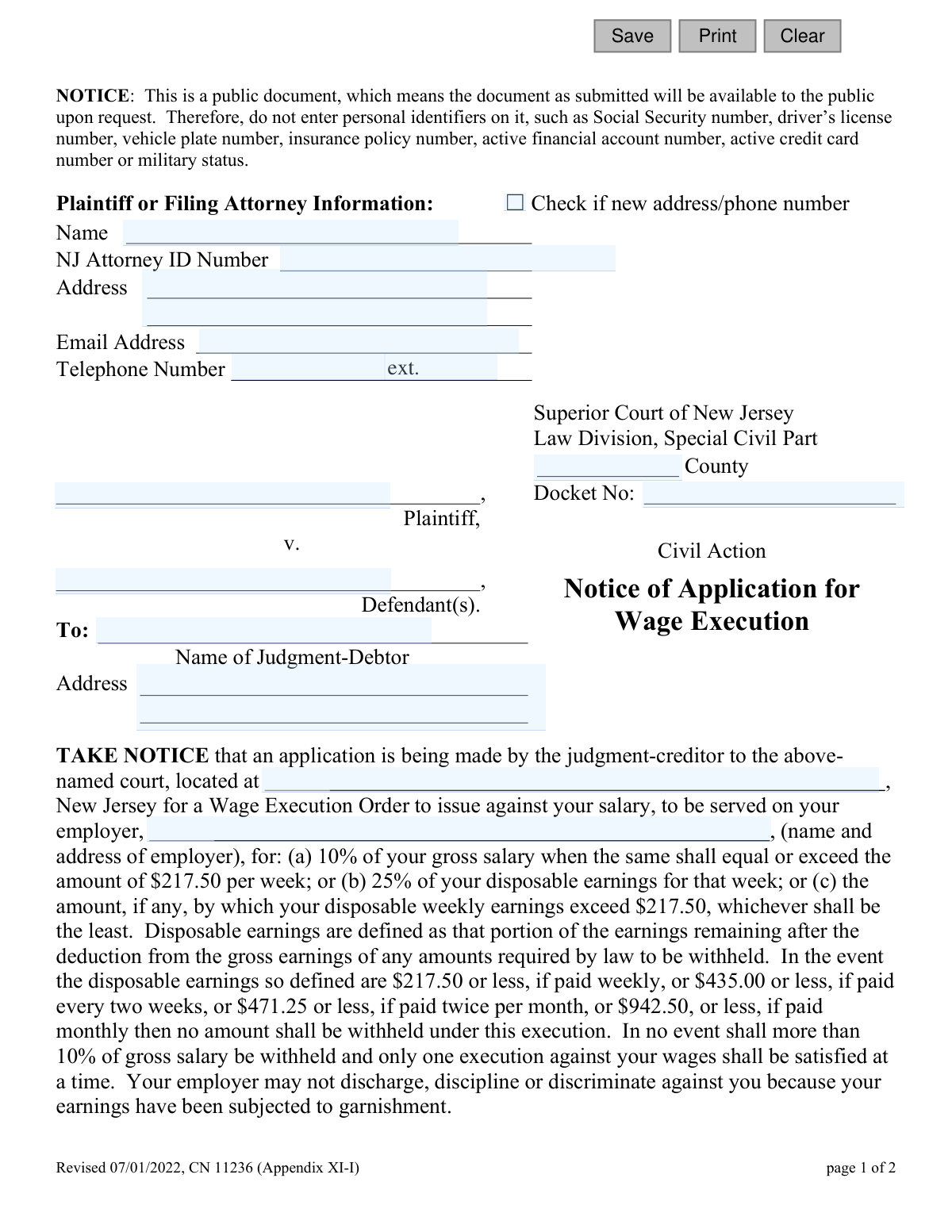
Yes! You can use AI to fill out Notice of Application for Wage Execution - Appendix XI-I
This form, officially titled 'Notice of Application for Wage Execution - Appendix XI-I,' is a legal notice required by the Superior Court of New Jersey. It is sent by a judgment-creditor to a judgment-debtor to inform them that an application is being made to the court for a wage execution order, which would allow the creditor to garnish the debtor's wages. The notice details the potential garnishment amounts and informs the debtor of their right to object within a specific timeframe. Today, this form can be filled out quickly and accurately using AI-powered services like Instafill.ai, which can also convert non-fillable PDF versions into interactive fillable forms.
Appendix XI-I is part of the
New Jersey forms category on Instafill.
Our AI automatically handles information lookup, data retrieval, formatting, and form filling.
It takes less than a minute to fill out Appendix XI-I using our AI form filling.
Securely upload your data. Information is encrypted in transit and deleted immediately after the form is filled out.
Form specifications
| Form name: | Notice of Application for Wage Execution - Appendix XI-I |
| Number of fields: | 21 |
| Number of pages: | 1 |
| Language: | English |
Instafill Demo: How to fill out PDF forms in seconds with AI
How to Fill Out Appendix XI-I Online for Free in 2026
Are you looking to fill out a APPENDIX XI-I form online quickly and accurately? Instafill.ai offers the #1 AI-powered PDF filling software of 2026, allowing you to complete your APPENDIX XI-I form in just 37 seconds or less.
Follow these steps to fill out your APPENDIX XI-I form online using Instafill.ai:
- 1 Navigate to Instafill.ai and upload or select the 'Notice of Application for Wage Execution - Appendix XI-I' form.
- 2 Provide the plaintiff or filing attorney's information, including name, NJ Attorney ID, address, and contact details.
- 3 Enter the case details, such as the county, docket number, and the names of the plaintiff and defendant(s).
- 4 Input the full name and last known address of the judgment-debtor who is receiving the notice.
- 5 Specify the name and address of the judgment-debtor's employer, as this is where the wage execution would be served.
- 6 Complete the 'Certification of Service' section, indicating the date the notice was served upon the judgment-debtor.
- 7 Review all the information populated by the AI for accuracy, then sign and date the certification before filing with the court and serving the debtor.
Our AI-powered system ensures each field is filled out correctly, reducing errors and saving you time.
Why Choose Instafill.ai for Your Fillable Appendix XI-I Form?
Speed
Complete your Appendix XI-I in as little as 37 seconds.
Up-to-Date
Always use the latest 2026 Appendix XI-I form version.
Cost-effective
No need to hire expensive lawyers.
Accuracy
Our AI performs 10 compliance checks to ensure your form is error-free.
Security
Your personal information is protected with bank-level encryption.
Frequently Asked Questions About Form Appendix XI-I
This form is a legal notice sent by a creditor (plaintiff) to a debtor (defendant) to inform them that the creditor is asking the court to garnish the debtor's wages to pay off a judgment.
The judgment-creditor (the person or company who won a lawsuit for money owed) or their attorney must fill out and serve this form to the judgment-debtor.
It means a creditor is seeking a court order to have your employer withhold money from your paycheck. You have a limited time to respond if you wish to object.
The amount will be the least of three calculations, but it will never be more than 10% of your gross salary. No money will be taken if your disposable weekly earnings are $217.50 or less.
You must notify the Clerk of the Court and the creditor's attorney in writing within ten days of receiving this notice. Your written statement should explain why the order should not be issued.
If you do not file a written objection within ten days, you will receive no further notice, and the judge may sign the Wage Execution Order as a matter of course.
No, the form explicitly states that your employer may not discharge, discipline, or discriminate against you because your earnings are being garnished.
As this is a public document, you must not include personal identifiers like Social Security numbers, driver's license numbers, active financial account numbers, or military status.
Yes, you have a continuing right to object or apply for a reduction even after the order is issued. You must file a written statement with the Clerk of the Court and send a copy to the creditor.
The form must be sent simultaneously by both regular mail and certified mail (return receipt requested) to the debtor's last known address.
Yes, services like Instafill.ai use AI to accurately auto-fill form fields from your case files, which can save significant time and help prevent errors.
Simply upload the form to the Instafill.ai platform. The AI will make the document fillable, and you can input your information once to have it automatically populate all the necessary fields.
You can use a service like Instafill.ai, which is designed to convert flat, non-fillable PDFs into interactive, fillable forms that you can easily complete and manage online.
Compliance Appendix XI-I
Validation Checks by Instafill.ai
1
Docket Number Format Validation
This check ensures the 'Docket No' field follows the standard format for New Jersey Special Civil Part cases, which typically includes a prefix and a series of numbers. Validating the format helps prevent submission errors and ensures the document can be correctly filed and tracked by the court system. A failure would prompt the user to correct the docket number before submission.
2
Required Plaintiff or Filing Attorney Name
Verifies that the 'Name' field under 'Plaintiff or Filing Attorney Information' is not empty. This information is essential for identifying the filing party and for all subsequent communication from the court and the defendant. If this field is left blank, the form cannot be processed as the originator of the action is unknown.
3
NJ Attorney ID Number Format
This validation confirms that the 'NJ Attorney ID Number' field, if filled, contains a validly formatted ID. This unique identifier is crucial for verifying the attorney's credentials and standing with the New Jersey State Bar. An invalid format could lead to rejection of the filing or delays in processing.
4
Attorney Email Address Format
Ensures the value entered in the 'Email Address' field is a valid email format (e.g., '[email protected]'). This is critical for electronic service and communication from the court. An invalid email address would prevent the filing attorney from receiving important notices, potentially jeopardizing the case.
5
Attorney Telephone Number Format
Checks that the 'Telephone Number' is in a recognizable format (e.g., XXX-XXX-XXXX or (XXX) XXX-XXXX). A valid phone number is necessary for direct communication and contact verification. If the format is incorrect, it could hinder the court's or defendant's ability to contact the filing party.
6
County Selection Validation
Validates that the 'County' field is filled with one of the official 21 counties of New Jersey. This ensures the application is filed in the correct jurisdiction, as the Special Civil Part is organized by county. An incorrect or misspelled county could result in the application being misfiled or rejected.
7
Judgment-Debtor and Defendant Name Consistency
This check cross-references the 'Name of Judgment-Debtor' field with the 'Defendant(s)' field to ensure the debtor is a named defendant in the civil action. This logical check prevents applications from being filed against incorrect parties. A mismatch would indicate a serious error that must be corrected before the notice is considered valid.
8
Certification Name Consistency Check
Verifies that the name of the judgment-debtor entered in the 'Certification of Service' section exactly matches the name in the 'Name of Judgment-Debtor' field earlier in the form. This is a critical integrity check to confirm that service was certified for the correct individual. A discrepancy could invalidate the certification of service.
9
Employer Information Completeness
Ensures that the field for the employer's name and address is not left blank. This information is the entire basis for a wage execution order, as the order must be served on the employer. Without this information, the application is incomplete and cannot be acted upon by the court.
10
Valid Certification Date
This validation checks that the 'Date' in the 'Certification of Service' section is a valid date and is not set in the future. The date of service is a legally significant event that starts a 10-day clock for the debtor to object. An invalid or future date would make the certification legally deficient and could lead to the dismissal of the application.
11
Prohibited Personal Identifiers Scan
Scans all free-text fields for patterns matching personal identifiers like Social Security numbers, driver's license numbers, or financial account numbers, as explicitly warned against on the form. This is crucial because the document is public, and including such data would create a privacy breach. If found, the system should warn the user to remove the sensitive information before submission.
12
Required Judgment-Debtor Address
Validates that the 'Address' field for the judgment-debtor is complete. Proper service of the notice depends on having the 'last known address', and a missing address makes service impossible to certify. The form submission would be blocked if this critical information is missing.
13
Required Court Location Address
This check ensures the address of the court where the application is being made is filled in. This information is required to inform the judgment-debtor of the specific court location handling their case so they know where to file an objection. An empty field would make the notice incomplete and confusing for the debtor.
14
Required Defendant Name
Verifies that the 'Defendant(s)' name field is not empty. The form is a legal action against a specific party, and the defendant's identity is a fundamental component of the document. The form is invalid without a named defendant.
Common Mistakes in Completing Appendix XI-I
The form header contains a prominent warning against including personal identifiers like Social Security or driver's license numbers, as the document becomes public record. Filers often add this information out of habit, inadvertently exposing the debtor or themselves to identity theft. A submission containing this data may be rejected by the clerk or, if filed, will make the sensitive information publicly accessible. Always review the completed form to ensure no prohibited data is present before submission.
The docket number is the unique identifier that links the application to the correct court case. A single mistyped digit can cause the filing to be rejected, misfiled against the wrong case, or significantly delayed, halting the wage execution process. This error often occurs when manually transcribing the number from other documents. To prevent this, carefully copy the docket number exactly as it appears on the original judgment or other official court records.
The application requires the full, legally correct name and current address of the debtor's employer to serve the wage execution order. Filers often provide a partial name (e.g., 'The Home Depot' instead of 'Home Depot U.S.A., Inc.') or a local store address instead of the corporate address for service. This mistake renders the application ineffective, as the order cannot be legally served, forcing the creditor to start the process over after significant delays.
Proper service of this notice on the judgment-debtor is a constitutional requirement of due process, and it relies on the 'last known address' being accurate. Using an old or incorrect address means the debtor will not be properly notified, which is grounds for the court to deny the application or vacate a resulting order. Before filing, creditors should perform due diligence to verify the debtor's current address to ensure legally valid service by regular and certified mail.
This application must be filed in the Special Civil Part of the Superior Court in the same county where the original judgment was entered. Filers sometimes mistakenly choose the county where the debtor currently lives or works, which is incorrect. Filing in the wrong jurisdiction will lead to an automatic rejection of the application by the court clerk, wasting time and filing fees. Always confirm the original county of judgment from the case docket before filling out this form.
The 'Certification of Service' is a sworn statement confirming the debtor was properly notified as required by law. Common mistakes include forgetting to enter the date of service or failing to accurately name the judgment-debtor being served in the certification text. An incomplete or incorrect certification can invalidate the service, jeopardize the entire wage execution application, and potentially lead to sanctions for filing a false certification.
The small checkbox for 'new address/phone number' is easily overlooked by filing attorneys or pro se plaintiffs. If their contact information has changed since the last filing and they fail to check this box, the court's records will not be updated. Consequently, important future notices from the court could be sent to the wrong address, leading to missed deadlines and potential prejudice to their case.
The names of the plaintiff, defendant, and judgment-debtor must be spelled identically to how they appear on the official court record and the original judgment. Using abbreviations, nicknames, or introducing misspellings can create legal ambiguity and may be grounds for the application to be rejected or later challenged. Always reference the original complaint or judgment to ensure all names are copied with perfect accuracy.
When this form is printed and filled out by hand, illegible handwriting is a frequent cause for rejection by the court clerk. If critical information like the docket number, names, or addresses cannot be clearly read, the document is considered improperly filed. This forces the filer to complete and submit the form all over again, causing unnecessary delays. To avoid this, it is best to use a fillable version of the PDF. If the form is only available as a non-fillable PDF, AI-powered tools like Instafill.ai can convert it into an interactive, fillable version, ensuring all entries are legible.
For filings made by an attorney, the NJ Attorney ID Number is a mandatory field used by the court system to verify the attorney's credentials and link the filing to their record. Attorneys sometimes forget to include this number, leading to processing delays or rejection of the form. While pro se litigants should leave this blank, attorneys must ensure it is present and correct. AI-powered form-filling tools like Instafill.ai can help by saving and auto-populating recurring information like an attorney's ID number, preventing this common oversight.
Saved over 80 hours a year
“I was never sure if my IRS forms like W-9 were filled correctly. Now, I can complete the forms accurately without any external help.”
Kevin Martin Green
Your data stays secure with advanced protection from Instafill and our subprocessors

Robust compliance program
Transparent business model
You’re not the product. You always know where your data is and what it is processed for.
ISO 27001, HIPAA, and GDPR
Our subprocesses adhere to multiple compliance standards, including but not limited to ISO 27001, HIPAA, and GDPR.
Security & privacy by design
We consider security and privacy from the initial design phase of any new service or functionality. It’s not an afterthought, it’s built-in, including support for two-factor authentication (2FA) to further protect your account.
Fill out Appendix XI-I with Instafill.ai
Worried about filling PDFs wrong? Instafill securely fills notice-of-application-for-wage-execution-appendix-xi-i forms, ensuring each field is accurate.