Yes! You can use AI to fill out Notification to Director NJ MVC (SR-39)
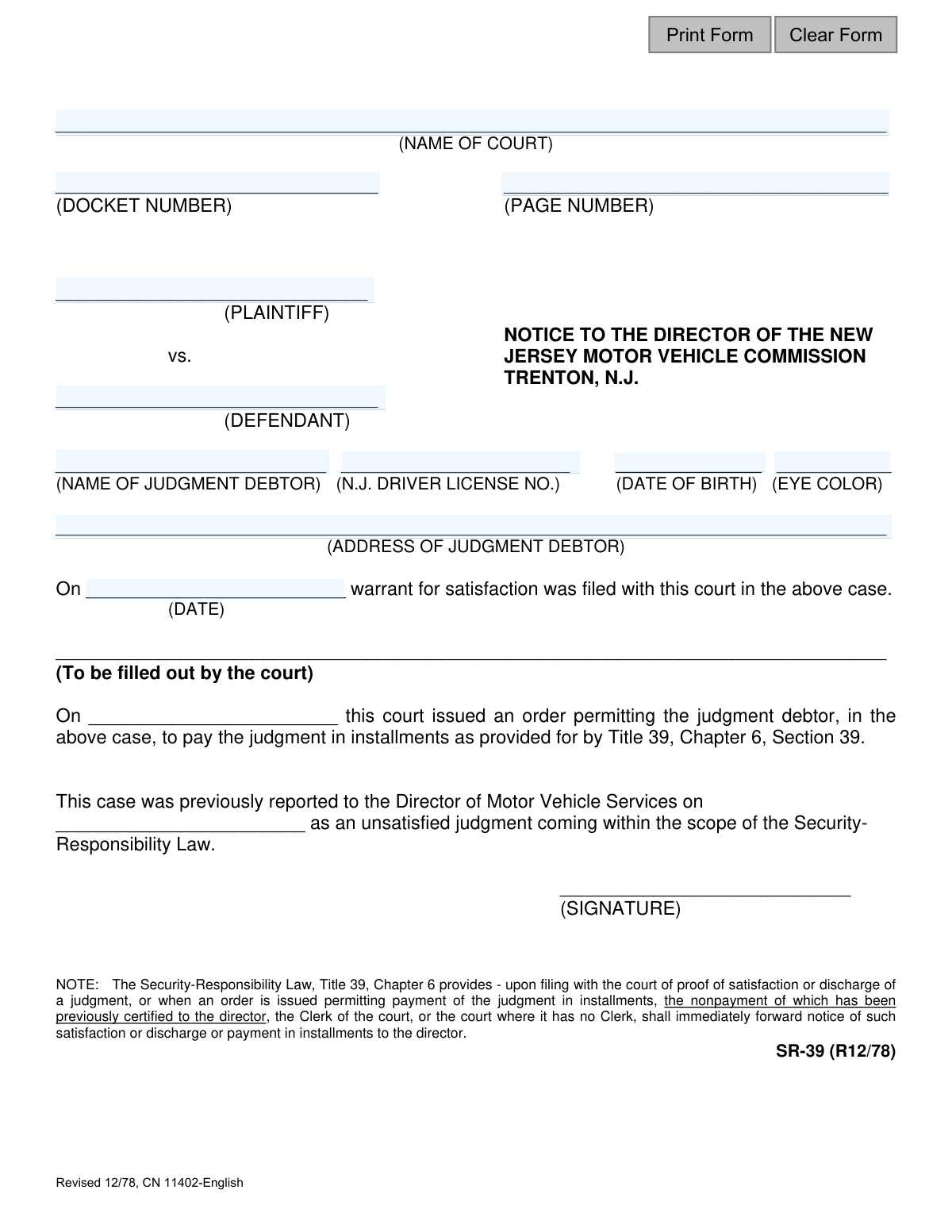
The New Jersey Form SR-39 is a legal notification sent by a court to the Director of the NJ Motor Vehicle Commission. Its purpose is to update the status of a judgment against a driver that was previously reported as unsatisfied under the state's Security-Responsibility Law. This notice confirms that the judgment has been satisfied, discharged, or that an installment payment plan has been approved, which is a critical step for the judgment debtor to potentially restore their driving privileges. Today, this form can be filled out quickly and accurately using AI-powered services like Instafill.ai, which can also convert non-fillable PDF versions into interactive fillable forms.
SR-39 is part of the
New Jersey forms category on Instafill.
Our AI automatically handles information lookup, data retrieval, formatting, and form filling.
It takes less than a minute to fill out SR-39 using our AI form filling.
Securely upload your data. Information is encrypted in transit and deleted immediately after the form is filled out.
Form specifications
| Form name: | Notification to Director NJ MVC (SR-39) |
| Number of fields: | 13 |
| Number of pages: | 1 |
| Language: | English |
Instafill Demo: How to fill out PDF forms in seconds with AI
How to Fill Out SR-39 Online for Free in 2026
Are you looking to fill out a SR-39 form online quickly and accurately? Instafill.ai offers the #1 AI-powered PDF filling software of 2026, allowing you to complete your SR-39 form in just 37 seconds or less.
Follow these steps to fill out your SR-39 form online using Instafill.ai:
- 1 Navigate to Instafill.ai and upload or select the NJ Form SR-39.
- 2 Enter the court information, including the name of the court, docket number, and page number.
- 3 Provide the names of the plaintiff and defendant in the case.
- 4 Input the judgment debtor's personal details: full name, NJ driver's license number, date of birth, eye color, and current address.
- 5 Fill in the relevant dates, such as when the warrant for satisfaction was filed or when the court ordered installment payments.
- 6 Ensure the appropriate court official signs the document to certify the notification.
- 7 Review all entered information for accuracy before the court forwards the completed form to the NJ MVC Director.
Our AI-powered system ensures each field is filled out correctly, reducing errors and saving you time.
Why Choose Instafill.ai for Your Fillable SR-39 Form?
Speed
Complete your SR-39 in as little as 37 seconds.
Up-to-Date
Always use the latest 2026 SR-39 form version.
Cost-effective
No need to hire expensive lawyers.
Accuracy
Our AI performs 10 compliance checks to ensure your form is error-free.
Security
Your personal information is protected with bank-level encryption.
Frequently Asked Questions About Form SR-39
The SR-39 form is used by a New Jersey court to notify the NJ Motor Vehicle Commission (MVC) that a judgment previously reported as unsatisfied has now been paid, discharged, or is being paid in installments.
The Clerk of the Court, or the court itself, is responsible for completing and submitting this form. The judgment debtor (the person who owed the money) does not fill out this form.
This form notifies the NJ MVC that you have addressed the judgment, which is a necessary step to begin the process of restoring your driving privileges suspended under the Security-Responsibility Law.
The court will use case information like the docket number and your personal details, including your name, address, driver's license number, and date of birth, to complete the form.
The 'judgment debtor' is the individual who was ordered by the court to pay money in a lawsuit and whose driving privileges may have been suspended as a result.
Once you provide proof of payment to the court, the court clerk will prepare and send the SR-39 form to the NJ MVC. You should then follow up with the MVC regarding any further steps for license restoration.
This law relates to a driver's financial responsibility for accidents. A judgment resulting from a motor vehicle accident can be reported to the MVC, leading to a license suspension until the judgment is satisfied.
Processing times can vary. After you confirm the court has sent the form, you should contact the NJ MVC directly to check the status and inquire about any other requirements to clear the suspension.
You should contact the Clerk of the Court where your case was heard. Provide your proof of satisfaction and request that they forward the SR-39 notification to the NJ MVC as required.
No, because this form must be completed and submitted by the court. However, services like Instafill.ai are very useful for accurately auto-filling personal forms that you are responsible for completing.
For other forms you need to complete, you can use a service like Instafill.ai. It can convert flat, non-fillable PDFs into interactive forms that you can easily type into online.
Instafill.ai uses AI to accurately auto-fill your information across various forms, saving you time and reducing errors. You simply upload a form, and the tool helps you complete it quickly and efficiently.
Compliance SR-39
Validation Checks by Instafill.ai
1
Ensures NJ Driver's License Number Format is Valid
This check validates that the 'N.J. DRIVER LICENSE NO.' field follows the standard New Jersey format, which is typically a single letter followed by 14 digits. This is critical because the Driver's License number is the primary key used by the Motor Vehicle Commission (MVC) to identify the individual's record. If the format is incorrect, the MVC system will reject the notification, and the driver's record will not be updated.
2
Validates Date of Birth Format and Plausibility
This validation ensures the 'DATE OF BIRTH' is a real, correctly formatted date (e.g., MM/DD/YYYY) and that it is in the past. It also checks that the date indicates the judgment debtor is of a plausible driving age, for example, over 16 years old. An invalid or future date would be nonsensical and would cause an immediate rejection, while an implausible age might indicate a data entry error requiring correction.
3
Verifies Chronological Consistency of Dates
This check compares the date the case was 'previously reported' with the date the 'warrant for satisfaction was filed'. The 'previously reported' date must be earlier than the satisfaction date. This logical validation ensures the sequence of events is correct, as a judgment cannot be satisfied before it has been reported as unsatisfied. An illogical order would indicate a significant clerical error and invalidate the purpose of the form.
4
Confirms Judgment Debtor is a Party to the Case
This validation checks if the 'NAME OF JUDGMENT DEBTOR' is the same as the 'DEFENDANT' listed in the case details. In most scenarios, the defendant is the party who owes the judgment. This check prevents errors where the wrong individual is reported to the MVC, which could lead to incorrect actions being taken against an uninvolved person's driving record.
5
Validates Docket Number Format
This check ensures the 'DOCKET NUMBER' field is not empty and follows a recognized alphanumeric pattern, often including hyphens (e.g., ABC-123456-23). The docket number is the unique identifier for the court case, and an incorrectly formatted or missing number will make it impossible for the MVC to cross-reference the legal action. This would result in the notification being rejected for being unverifiable.
6
Ensures All Required Identifying Fields are Complete
This is a completeness check to ensure that critical identifying fields such as 'Name of Court', 'Plaintiff', 'Defendant', and 'Name of Judgment Debtor' are not left blank. These fields are essential for establishing the legal context and identifying the parties involved. A submission with missing information in these fields is incomplete and cannot be processed by the MVC.
7
Validates Eye Color is from a Predefined List
This check ensures that the value entered for 'EYE COLOR' is one of the standard abbreviations used by the MVC (e.g., BLU, BRO, GRN, HAZ, BLK). Using a controlled vocabulary prevents ambiguity and ensures compatibility with the MVC's database. A non-standard entry could cause data mismatch issues and hinder the verification of the judgment debtor's identity.
8
Verifies Address of Judgment Debtor is Present
This validation confirms that the 'ADDRESS OF JUDGMENT DEBTOR' field is filled out. The address is a key piece of identifying information used by the MVC to confirm the identity of the individual and for any necessary correspondence. A missing address makes the record incomplete and could lead to processing delays or rejection.
9
Ensures Warrant Satisfaction Date is Valid
This check validates that the date on which the 'warrant for satisfaction was filed' is a properly formatted, valid date that is not in the future. This date is the trigger for the notification and establishes the timeline for the MVC's action. An invalid or future date would render the notification logically unsound and would be rejected.
10
Validates Previous Report Date is in the Past
This validation ensures the date provided for when the case was 'previously reported' is a valid date and occurs before the current date. This date provides context for the MVC, linking the current satisfaction notice to a prior unsatisfied judgment report. A future or invalid date would be a logical impossibility and indicate a data entry error.
11
Checks Page Number for Integer Format
This validation ensures that if a 'PAGE NUMBER' is provided, it is a positive integer. The page number helps court clerks and officials locate the specific entry within a larger docket book or file. While potentially optional, if a value is present, it must be in the correct numerical format to be useful and avoid data corruption.
Common Mistakes in Completing SR-39
The Docket Number is the primary identifier for the court case. People often make mistakes by transposing digits, omitting prefixes or suffixes, or writing the number illegibly. An incorrect docket number will prevent the NJ MVC from locating the corresponding case, rendering the notification ineffective and delaying the update to the judgment debtor's driving record.
Filers may use a nickname, an abbreviated name, or fail to include a middle initial for the 'Name of Judgment Debtor'. The MVC's system relies on an exact match to the full legal name on the driver's license to locate the correct record. Any discrepancy can lead to a failed search and the rejection of the form, prolonging the suspension.
This is one of the most critical and common errors, as the driver's license number is the unique key for an individual in the MVC database. Simple transcription errors, like swapping two numbers or misreading a letter, will cause the entire notification to fail. To avoid this, the number should be triple-checked against the physical license or official court documents.
In the stress or haste of filling out legal paperwork, it's easy to mistakenly reverse the names of the Plaintiff and Defendant. This creates significant confusion for the MVC, as it misrepresents the legal facts of the case. This error can lead to the form being rejected or, worse, incorrectly processed against the wrong party's record.
The form requires the specific date the 'warrant for satisfaction was filed' or the date the installment order was issued, not the date the form is being completed. Entering the current date is a frequent mistake that provides incorrect information to the MVC. This can cause discrepancies in the legal timeline and requires referencing the official court order for the correct date.
This form (SR-39 R12/78) is an older, non-fillable PDF that is often printed and completed by hand. Poor or rushed handwriting can make critical data like docket numbers and license numbers impossible to read, leading to data entry errors by the MVC or outright rejection. To prevent this, one should print clearly in block capitals. AI tools like Instafill.ai can also convert such non-fillable PDFs into digital forms, ensuring all entries are typed and perfectly legible.
The form must be signed by an authorized court official, such as the Clerk of the Court, to be valid. A common mistake is either forgetting the signature entirely or having an unauthorized person (like the debtor or their attorney) sign it. An unsigned or improperly signed form is legally invalid and will be immediately rejected by the MVC, causing significant delays.
Filers often write a shortened or informal version of the court's name, such as 'Essex Court' instead of the full 'Superior Court of New Jersey, Law Division, Essex County'. This ambiguity can slow down processing as the MVC may need to verify the originating court. Using the full, official court name as it appears on other legal documents ensures clarity and faster processing.
The Date of Birth is a key piece of identifying information, but it's prone to formatting errors like swapping the month and day (MM/DD/YYYY vs DD/MM/YYYY). Such a mistake can cause a mismatch in the MVC's system when it tries to verify the debtor's identity against other information. Using automated form-filling tools like Instafill.ai can help by standardizing date formats and preventing these common errors.
People sometimes provide an incomplete address, forgetting details like an apartment number, or they provide an outdated address. While the driver's license number is the primary identifier, the address is used for verification and for any potential mail correspondence from the MVC. An incomplete or incorrect address can contribute to processing delays if other identifiers are also ambiguous.
Saved over 80 hours a year
“I was never sure if my IRS forms like W-9 were filled correctly. Now, I can complete the forms accurately without any external help.”
Kevin Martin Green
Your data stays secure with advanced protection from Instafill and our subprocessors

Robust compliance program
Transparent business model
You’re not the product. You always know where your data is and what it is processed for.
ISO 27001, HIPAA, and GDPR
Our subprocesses adhere to multiple compliance standards, including but not limited to ISO 27001, HIPAA, and GDPR.
Security & privacy by design
We consider security and privacy from the initial design phase of any new service or functionality. It’s not an afterthought, it’s built-in, including support for two-factor authentication (2FA) to further protect your account.
Fill out SR-39 with Instafill.ai
Worried about filling PDFs wrong? Instafill securely fills notification-to-director-nj-mvc-sr-39 forms, ensuring each field is accurate.