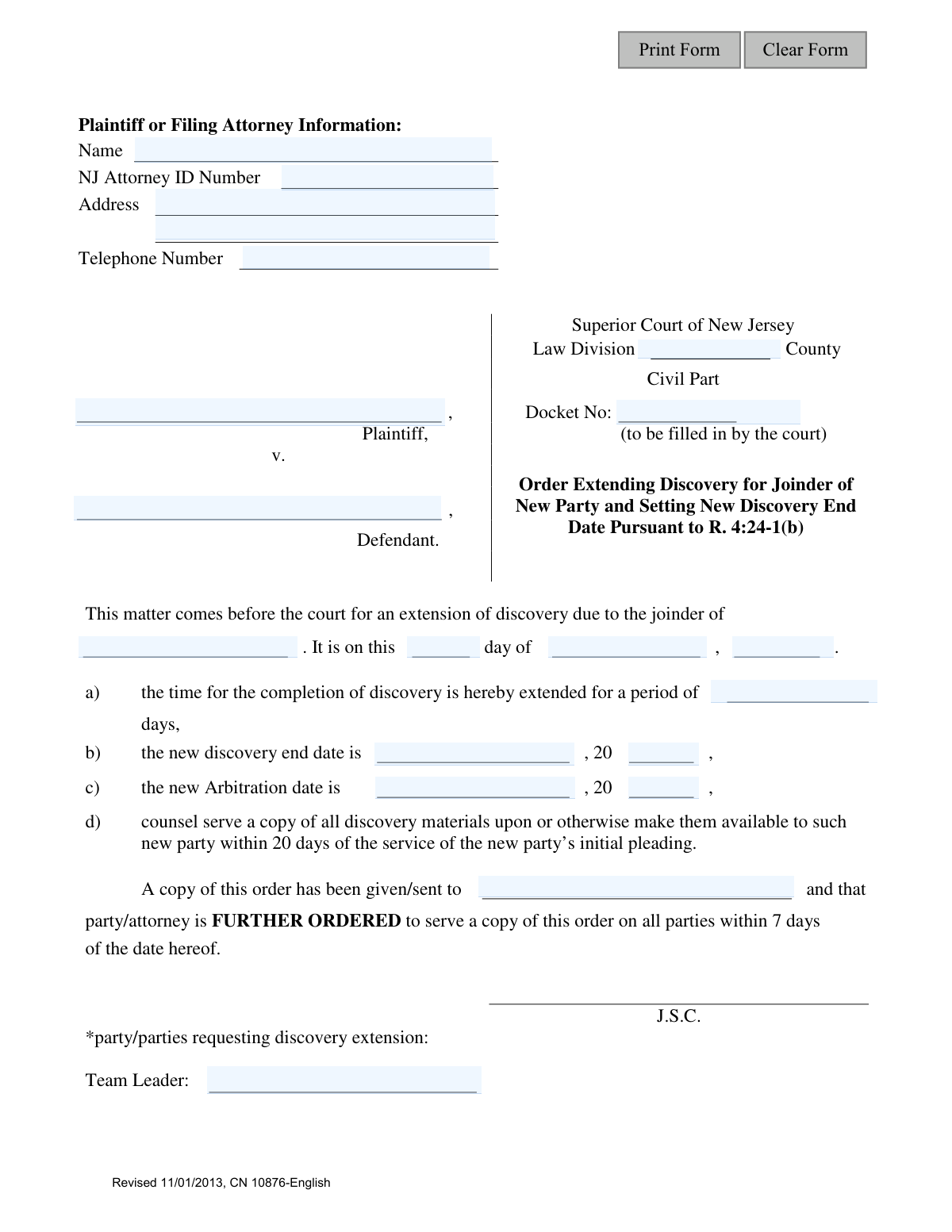
Yes! You can use AI to fill out Order Extending Discovery for Joinder of New Party and Setting New Discovery End Date Pursuant to R. 4:24-1(b)
The Order Extending Discovery (CN 10876-English) is a legal document filed in the Superior Court of New Jersey's Law Division. It is used to formally request and grant an extension of the discovery timeline in a lawsuit, specifically when a new party is added to the case, ensuring they have adequate time to participate. Today, this form can be filled out quickly and accurately using AI-powered services like Instafill.ai, which can also convert non-fillable PDF versions into interactive fillable forms.
CN 10876-English is part of the
New Jersey forms category on Instafill.
Our AI automatically handles information lookup, data retrieval, formatting, and form filling.
It takes less than a minute to fill out CN 10876-English using our AI form filling.
Securely upload your data. Information is encrypted in transit and deleted immediately after the form is filled out.
Form specifications
| Form name: | Order Extending Discovery for Joinder of New Party and Setting New Discovery End Date Pursuant to R. 4:24-1(b) |
| Number of fields: | 21 |
| Number of pages: | 1 |
| Language: | English |
Instafill Demo: How to fill out PDF forms in seconds with AI
How to Fill Out CN 10876-English Online for Free in 2026
Are you looking to fill out a CN 10876-ENGLISH form online quickly and accurately? Instafill.ai offers the #1 AI-powered PDF filling software of 2026, allowing you to complete your CN 10876-ENGLISH form in just 37 seconds or less.
Follow these steps to fill out your CN 10876-ENGLISH form online using Instafill.ai:
- 1 Navigate to Instafill.ai and upload or select the 'Order Extending Discovery' form for New Jersey.
- 2 Provide the case details, including the County, Docket Number, and the names of the Plaintiff and Defendant.
- 3 Enter the filing attorney's information, such as their name, NJ Attorney ID number, address, and telephone number.
- 4 Specify the name of the newly joined party and the number of days you are requesting for the discovery extension.
- 5 Indicate the party or parties requesting the extension at the bottom of the form.
- 6 Review all the information auto-filled by the AI for accuracy, including the new discovery end date and arbitration date.
- 7 Download the completed form to be signed by the judge and served to all relevant parties as per the court's instructions.
Our AI-powered system ensures each field is filled out correctly, reducing errors and saving you time.
Why Choose Instafill.ai for Your Fillable CN 10876-English Form?
Speed
Complete your CN 10876-English in as little as 37 seconds.
Up-to-Date
Always use the latest 2026 CN 10876-English form version.
Cost-effective
No need to hire expensive lawyers.
Accuracy
Our AI performs 10 compliance checks to ensure your form is error-free.
Security
Your personal information is protected with bank-level encryption.
Frequently Asked Questions About Form CN 10876-English
This form is a court order used to officially extend the discovery period in a New Jersey civil lawsuit. It is specifically used when a new party is added to the case, allowing more time for all parties to exchange information.
An attorney or a party involved in the case who is requesting the extension will fill in the case details. However, it is an 'Order,' which means it must be submitted to the court for a judge's signature to become effective.
You should use this form only when you need to extend the discovery deadline because a new plaintiff or defendant has been added to your case, as specified under New Jersey Court Rule 4:24-1(b).
You will need the court county, case docket number, plaintiff and defendant names, the name of the new party being joined, and the proposed length of the extension in days. You must also provide your contact information as the filing attorney or party.
The Docket Number is a unique identifier assigned to your case by the court when it was first filed. You can find it on any previous court documents, notices, or correspondence related to your case.
After a judge signs the order, the party who requested it is required to serve a copy on all other parties in the case within 7 days. You must also provide all existing discovery materials to the newly joined party.
No, this form is specifically for extensions due to the joinder of a new party. For other reasons, such as outstanding discovery or scheduling conflicts, you would need to file a different type of motion or consent order with the court.
In many New Jersey civil cases, arbitration is scheduled after discovery is complete. Since this order extends the discovery period, the original arbitration date is no longer feasible and a new one must be set.
'J.S.C.' stands for Judge of the Superior Court. This signature line is reserved for the judge who approves the order; you should not sign here.
This means you must provide the newly joined party with copies of all evidence and information already exchanged between the original parties. This ensures the new party has all the necessary information to participate in the case.
Yes, services like Instafill.ai use AI to accurately auto-fill form fields with your case information, which helps save time and reduce the risk of errors. This is especially useful for repetitive information like your name, address, and case details.
Simply upload the 'Order Extending Discovery' PDF to the Instafill.ai platform. The AI will identify the fields, allowing you to quickly fill them in online or have the system auto-fill them from your saved profile, then download the completed document.
If you have a flat, non-fillable PDF, you can upload it to a service like Instafill.ai. Its technology can convert the document into an interactive, fillable form that you can complete easily on your computer.
Compliance CN 10876-English
Validation Checks by Instafill.ai
1
Docket Number Structure and Format
Validates that the 'caseDocket' number conforms to the expected format for the specified county's Civil Part, such as 'CTY-L-######-YY'. This check is critical to ensure the order is filed under the correct case within the court's system. An invalid docket number would cause the document to be misfiled or rejected by the court clerk, delaying the legal process.
2
NJ Attorney ID Number Format Validation
Ensures the 'filerIDNumber' field contains a valid New Jersey Attorney ID number format. This ID is the unique identifier for the attorney within the state bar's records, and its accuracy is paramount for official filings. An incorrect ID could lead to misidentification of the filing attorney, rejection of the document, or disciplinary action.
3
Completeness of Filing Attorney Information
Verifies that the attorney's name ('filerName'), NJ Attorney ID ('filerIDNumber'), address ('filerAddr'), and telephone number ('filerPh') are all provided. This contact information is mandatory for court communications and serving legal notices. Missing information can lead to the court being unable to contact the filer, causing significant delays or rejection of the order.
4
Completeness of Core Case Identifiers
Checks that the County ('TypeCounty'), Plaintiff Name ('plaName'), Defendant Name ('defName'), and Docket Number ('caseDocket') are all filled in. These fields are the primary identifiers for the case to which this order applies. Without this complete information, the order is ambiguous and cannot be correctly processed or filed by the court clerk.
5
Chronological Consistency of Dates
Validates that the 'new discovery end date' ('Date2', 'Year2') occurs after the order's effective date ('Date', 'Month', 'Year'). It is logically impossible for a discovery period to end before the order extending it is issued. This validation prevents clerical errors that would render the order nonsensical and legally invalid.
6
Arbitration Date Follows Discovery End Date
Ensures the 'new Arbitration date' is set for a date after the 'new discovery end date'. Arbitration typically occurs after the discovery phase is complete, so scheduling it earlier would be a procedural error. This validation prevents logical impossibilities in the case schedule and ensures the legal process follows the correct sequence.
7
Numeric Value for Extension Period
Verifies that the 'ExtendedPeriod' field, representing the number of days for the extension, contains only a positive integer. The field should not accept text, decimals, or special characters. This ensures the order specifies a clear, unambiguous duration for the extension, preventing confusion and potential disputes over the timeline.
8
Valid Date and Year Format
Checks that all date and year components ('Date', 'Month', 'Year', 'Date2', 'Year2', 'Year3') are valid calendar values (e.g., 'Month' is a real month, 'Date' is between 1-31, 'Year' is a 4-digit number). This prevents impossible dates like 'February 30th'. Correct date formatting is essential for the legal validity and enforceability of the court order.
9
Presence of Joined Party Name
Confirms that the name of the party being joined ('Name'), which is the reason for the extension, is provided. The form explicitly states the extension is 'due to the joinder of' a new party. Leaving this blank makes the primary justification for the order unknown, which could lead to the judge rejecting it for being incomplete.
10
Identification of Party Responsible for Service
Ensures the 'Name2' field, which identifies the party or attorney responsible for serving the order, is not empty. The order explicitly commands this party to serve copies to all others within a specific timeframe. Failing to designate a responsible party makes this part of the order unenforceable and could halt the notification process.
11
US Phone Number Format Validation
Validates that the 'filerPh' field contains a valid 10-digit US phone number, allowing for common formats like (XXX) XXX-XXXX or XXX-XXX-XXXX. A valid phone number is critical for the court or opposing counsel to be able to contact the filing attorney quickly. An invalid number can hinder communication and delay proceedings.
12
Valid New Jersey County Selection
Checks that the value entered in the 'TypeCounty' field corresponds to one of the 21 official counties in New Jersey. This is best enforced using a predefined list or dropdown. This validation ensures the order is directed to the correct court jurisdiction, preventing it from being misrouted or rejected.
13
Order Date Cannot Be in the Future
Validates that the order date ('Date', 'Month', 'Year') is not set to a future date. A court order is a record of a present action by the court and cannot be post-dated. This check prevents clerical errors that would call the timing and validity of the order into question.
14
Consistency Between Extension Period and New End Date
Performs a logical check to see if the 'new discovery end date' is reasonably correlated with the number of extension days ('ExtendedPeriod'). For example, the new end date should be approximately '[order date] + [ExtendedPeriod] days'. A significant discrepancy indicates a data entry error, and this check helps catch typos to ensure the order's terms are internally consistent.
Common Mistakes in Completing CN 10876-English
Users frequently enter the docket number with transposed digits, incorrect prefixes (e.g., L, LT, DC), or an incorrect year suffix. This happens due to manual data entry errors or referencing outdated case documents. An incorrect docket number is a critical failure, as it can cause the filing to be rejected by the clerk's office or, worse, filed in the wrong case, leading to significant delays and potential legal complications. To avoid this, always double-check the docket number against the most recent court communication for that specific case.
A common error is entering the law firm's name or a paralegal's name instead of the specific attorney of record. The form requires the individual attorney's name and their unique 'NJ Attorney ID Number'. This mistake occurs from a misunderstanding of the requirement or when support staff fills out the form. This can lead to rejection or confusion in court communications, as notices may be sent to the wrong individual. Always use the name and ID of the responsible attorney admitted to the NJ Bar.
Filers often make calculation errors where the number of days requested for the extension does not correctly correspond to the proposed 'new discovery end date'. For example, requesting a 60-day extension but setting a new end date that is only 50 days away. This creates an ambiguous and unenforceable order that the court will likely reject. To prevent this, carefully calculate the end date based on the extension period, accounting for weekends and holidays as per court rules. AI-powered tools like Instafill.ai can help automate these date calculations to ensure consistency.
The primary purpose of this specific order is to extend discovery due to the joinder of a new party. A critical mistake is leaving the line 'due to the joinder of ______' blank or filling it with a vague description. This omission makes the basis for the order unclear and can lead to its rejection by the judge. It is essential to clearly and accurately name the new party being brought into the litigation to justify the discovery extension.
When the discovery period is extended, the corresponding arbitration date must also be rescheduled. Filers often forget to fill in the 'new Arbitration date' field, leaving the schedule in limbo and requiring further motions to fix. This oversight disrupts the court's calendar and can cause significant delays. Always coordinate with the court and opposing counsel to set a realistic new arbitration date that follows the new discovery end date.
The form contains fields intended for internal court use, such as 'Team Leader' and the signature block for the Judge ('J.S.C.'). Attorneys or their staff sometimes mistakenly fill in these sections. This can cause confusion for court clerks and may require the form to be resubmitted. Parties should only fill in the sections clearly designated for the plaintiff, defendant, or filing attorney. Modern form-filling tools can help by locking or highlighting fields that should not be edited by the user.
This form is marked 'Revised 11/01/2013'. Courts periodically update their forms to comply with new rules or procedures, and using an outdated version is a frequent cause for rejection. This often happens when firms use old templates saved on their local drives. Before filling out any court form, always check the official judiciary website for the most current version to ensure compliance. This simple step can prevent the wasted time and effort of a rejected filing.
Many court forms are only available as flat, non-fillable PDFs. A common mistake is to print this document and fill it out by hand, often resulting in illegible handwriting that can lead to data entry errors by court staff and processing delays. To avoid this, it is best to use a tool that can convert the document into a fillable format. For instance, Instafill.ai can take a non-fillable PDF, make it interactive, and help you fill it out with clean, legible, typed text, ensuring clarity and professionalism.
In the case caption ('Plaintiff, v. Defendant.'), filers sometimes invert the parties, use vague abbreviations like 'et al.' instead of the lead named party, or misspell names. This can create confusion and indexing errors, especially in complex cases with multiple parties. It is crucial to list the plaintiff and defendant exactly as they appear on the original complaint and all subsequent court documents. AI form-filling tools can help by saving and reusing correct party information across all related case documents.
The form includes a line at the bottom: '*party/parties requesting discovery extension:'. This field is often overlooked and left blank. This omission makes it unclear to the judge and other parties who initiated the request for the extension. For clarity and proper record-keeping, the name of the party or parties making the motion must be clearly stated in this designated space.
Saved over 80 hours a year
“I was never sure if my IRS forms like W-9 were filled correctly. Now, I can complete the forms accurately without any external help.”
Kevin Martin Green
Your data stays secure with advanced protection from Instafill and our subprocessors

Robust compliance program
Transparent business model
You’re not the product. You always know where your data is and what it is processed for.
ISO 27001, HIPAA, and GDPR
Our subprocesses adhere to multiple compliance standards, including but not limited to ISO 27001, HIPAA, and GDPR.
Security & privacy by design
We consider security and privacy from the initial design phase of any new service or functionality. It’s not an afterthought, it’s built-in, including support for two-factor authentication (2FA) to further protect your account.
Fill out CN 10876-English with Instafill.ai
Worried about filling PDFs wrong? Instafill securely fills order-extending-discovery-for-joinder-of-new-party-and-setting-new-discovery-end-date-pursuant-to-r-424-1b forms, ensuring each field is accurate.