Yes! You can use AI to fill out Order for Appointment of Attorney-Trustee (R. 1:20-19)
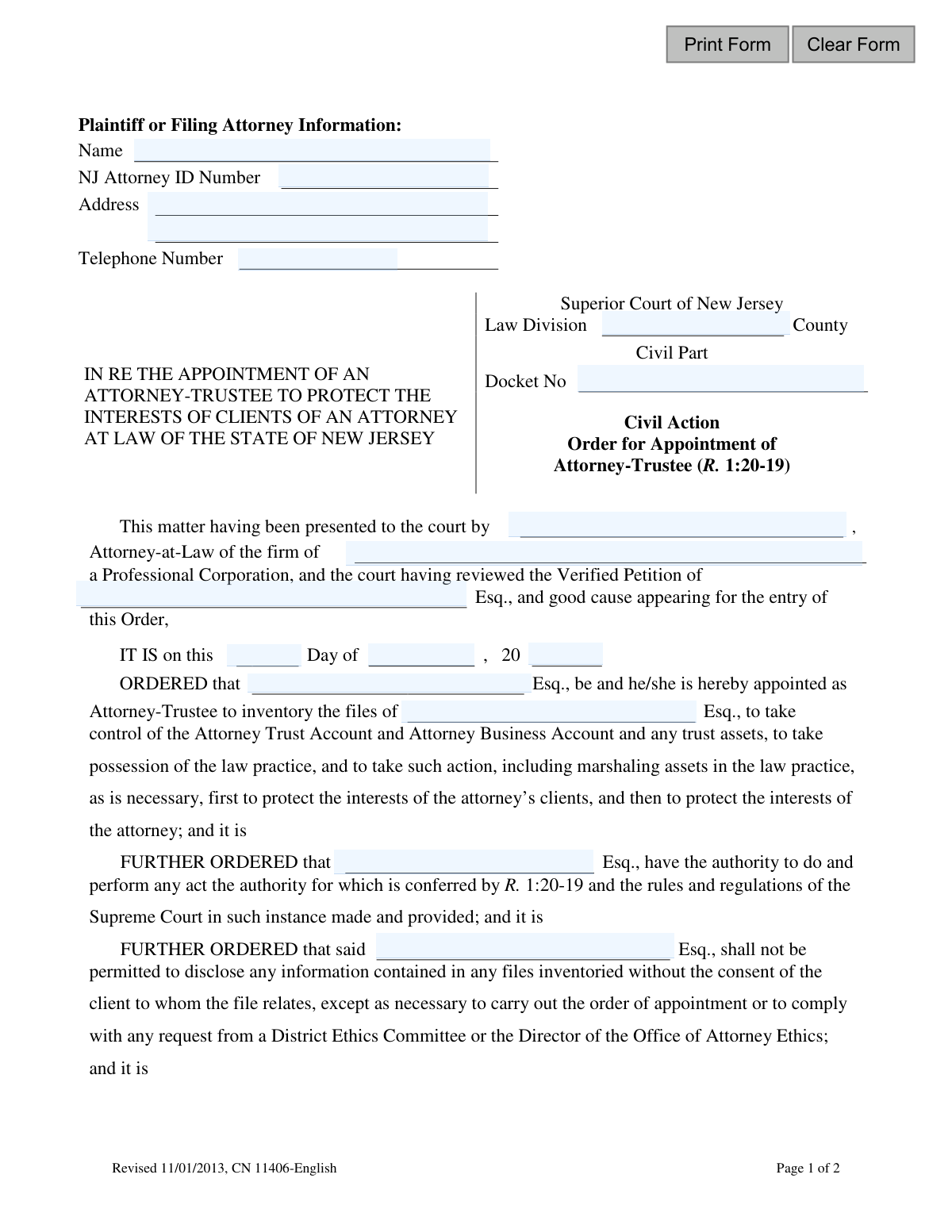
The Order for Appointment of Attorney-Trustee (R. 1:20-19) is a legal document issued by the Superior Court of New Jersey, Law Division. Its purpose is to formally appoint an attorney-trustee to take control of another attorney's law practice, including inventorying files and managing trust accounts, to protect the interests of clients. Today, this form can be filled out quickly and accurately using AI-powered services like Instafill.ai, which can also convert non-fillable PDF versions into interactive fillable forms.
CN 11406 is part of the
New Jersey forms category on Instafill.
Our AI automatically handles information lookup, data retrieval, formatting, and form filling.
It takes less than a minute to fill out CN 11406 using our AI form filling.
Securely upload your data. Information is encrypted in transit and deleted immediately after the form is filled out.
Form specifications
| Form name: | Order for Appointment of Attorney-Trustee (R. 1:20-19) |
| Number of fields: | 22 |
| Number of pages: | 1 |
| Language: | English |
Instafill Demo: How to fill out PDF forms in seconds with AI
How to Fill Out CN 11406 Online for Free in 2026
Are you looking to fill out a CN 11406 form online quickly and accurately? Instafill.ai offers the #1 AI-powered PDF filling software of 2026, allowing you to complete your CN 11406 form in just 37 seconds or less.
Follow these steps to fill out your CN 11406 form online using Instafill.ai:
- 1 Navigate to Instafill.ai and upload or select the 'Order for Appointment of Attorney-Trustee' form.
- 2 Enter the filing attorney's information, including their name, NJ Attorney ID number, address, and telephone number.
- 3 Specify the Superior Court details, including the County, Law Division, Civil Part, and the case Docket Number.
- 4 Input the details of the matter, including the name of the petitioner and their law firm as presented to the court.
- 5 Fill in the date of the order and the full name of the attorney being appointed as the Attorney-Trustee.
- 6 Identify the attorney whose practice the trustee will be taking over and the name of the County Bar Association President.
- 7 Review all entered information for accuracy before the order is presented to the Judge (J.S.C.) for signature.
Our AI-powered system ensures each field is filled out correctly, reducing errors and saving you time.
Why Choose Instafill.ai for Your Fillable CN 11406 Form?
Speed
Complete your CN 11406 in as little as 37 seconds.
Up-to-Date
Always use the latest 2026 CN 11406 form version.
Cost-effective
No need to hire expensive lawyers.
Accuracy
Our AI performs 10 compliance checks to ensure your form is error-free.
Security
Your personal information is protected with bank-level encryption.
Frequently Asked Questions About Form CN 11406
This is a court order used in New Jersey to appoint an attorney (a trustee) to manage the law practice of another attorney. The primary goal is to protect the interests of that attorney's clients when the attorney can no longer manage their practice.
An attorney, referred to as the petitioner, prepares this form and presents it to the Superior Court of New Jersey. A judge (J.S.C.) must sign the order for it to become effective.
The Attorney-Trustee is authorized to inventory client files, take control of the firm's trust and business accounts, and take any necessary action to protect the interests of the clients first, and then the attorney.
You must provide the filing attorney's contact information and NJ Attorney ID, the county and docket number, the name of the attorney being appointed as trustee, and the name of the attorney whose practice is being taken over.
Rule 1:20-19 is the New Jersey Court Rule that establishes the legal authority and procedure for appointing an attorney-trustee. It outlines the trustee's powers and responsibilities in protecting clients' interests.
Yes, but the trustee is legally bound to maintain confidentiality. They cannot disclose information from a client's file without consent, unless it is necessary to carry out the court order or comply with an ethics investigation.
No, the order explicitly states that the Attorney-Trustee is immune from liability for conduct performed as part of their official duties, as provided by Rule 1:20-7(d).
Once signed by the judge, a copy of the order must be sent to the Director of the Office of Attorney Ethics and the President of the local County Bar Association.
J.S.C. stands for 'Judge of the Superior Court'. This is the signature line for the judge who approves and issues the order, making it legally binding.
The Docket Number is assigned by the court when the civil action is first filed. It should be present on the Verified Petition and other official court documents related to this matter.
Yes, services like Instafill.ai use AI to accurately auto-fill form fields from your saved information, which can save time and reduce errors, especially for recurring details like your attorney information.
You can use a service like Instafill.ai to fill out the form online. Simply upload the PDF, and the platform will allow you to type directly into the fields, add signatures, and securely save or share the completed document.
If you have a non-fillable or 'flat' PDF, you can upload it to Instafill.ai. The service can convert it into an interactive, fillable form that you can easily complete on your computer.
Compliance CN 11406
Validation Checks by Instafill.ai
1
Validates NJ Attorney ID Number Format
This check ensures the 'NJ Attorney ID Number' field conforms to the official format required by the New Jersey state bar. It verifies the pattern and length of the ID to ensure it is a plausible identifier. This is crucial for correctly identifying the filing attorney and preventing data entry errors that could lead to misidentification or rejection of the filing.
2
Ensures Docket Number Conforms to Court Standards
This validation verifies that the 'Docket Number' field matches the specific format used by the New Jersey Superior Court, Civil Part (e.g., 'L-#####-##'). Correct formatting is essential for the document to be properly filed and tracked within the court's case management system. An invalid format will cause filing delays or rejection.
3
Verifies County is a Valid New Jersey County
This check confirms that the 'County' field contains one of the 21 official counties of New Jersey. This is important for routing the document to the correct court division and for identifying the correct County Bar Association. An incorrect or misspelled county name could lead to the order being filed in the wrong jurisdiction.
4
Validates the Order Date for Completeness and Plausibility
This validation ensures that the 'Day', 'Month', and 'Year' fields are all filled out and together form a valid calendar date. It also checks that the date is not in the future, as an order cannot be signed on a future date. A complete and accurate date is legally required for the order to be effective and enforceable.
5
Filing Attorney Information Completeness
This check verifies that the 'Name', 'NJ Attorney ID Number', 'Address', and 'Telephone Number' fields for the plaintiff or filing attorney are all completed. This contact information is mandatory for the court to communicate with the filer regarding the petition. Missing information can halt the processing of the order.
6
Required Appointed Trustee Name
This validation ensures that the name of the attorney being appointed as the Attorney-Trustee is provided in the 'ORDERED' clause. The entire purpose of the order is to appoint a specific individual, so this field is mandatory. Failure to name a trustee renders the order ineffective and meaningless.
7
Required Subject Attorney Name
This check verifies that the name of the attorney whose files are being inventoried is explicitly stated in the order. This is the central subject of the legal action, and their identity must be clear for the order to be valid and for the trustee to know which practice to take control of. Ambiguity or omission would make the order unenforceable.
8
Ensures Appointed Trustee is Not the Subject Attorney
This is a critical logical check to ensure the attorney being appointed as trustee is not the same individual whose practice is being taken over. Appointing an attorney to be a trustee for their own practice would defeat the purpose of R. 1:20-19, which is designed for external oversight. A match between these two fields indicates a fundamental misunderstanding or misuse of the form.
9
Validates Telephone Number Format
This check ensures the 'Telephone Number' field is entered in a recognizable U.S. phone number format, typically 10 digits with optional parentheses, spaces, or hyphens. Proper formatting ensures the number is valid and can be used by court staff for communication. It prevents data entry errors like too few or too many digits.
10
Verifies Consistent County Name Throughout the Document
This validation cross-references the 'County' specified in the court heading with the county mentioned for the Bar Association President. These should always match to ensure the correct local bar association is notified. A mismatch suggests a clerical error that could lead to improper notification and procedural defects.
11
Ensures Judge's Name is Provided
This check confirms that the name of the signing Judge of the Superior Court (J.S.C.) is typed or printed on the form. An order from the court is not valid without the clear identification of the judicial officer who issued it. This field is mandatory for the order's authenticity and legal standing.
12
Verifies the Petitioner's Name is Filled
This validation ensures the name of the petitioner, the individual or firm bringing the matter to the court, is provided. The court needs to know who is making the request for the appointment. This information is fundamental to the legal record of the proceeding and must be present for the filing to be accepted.
Common Mistakes in Completing CN 11406
The Docket Number is the unique identifier that links this order to the correct case file. Filers may forget to enter it or copy it incorrectly from other documents, especially in a rush. An incorrect or missing docket number will cause the clerk's office to reject the document or misfile it, leading to significant delays in the appointment of the trustee. Always verify the docket number against the official court record before submission.
People often mistype the NJ Attorney ID Number or leave it blank if they don't have it handy. This ID is a critical identifier for the filing attorney in the New Jersey court system, and an error can lead to the rejection of the filing and difficulty verifying the attorney's standing. To avoid this, attorneys should double-check their ID number before submission. AI-powered form-filling tools like Instafill.ai can store and auto-populate this information accurately every time.
The form requires naming multiple attorneys: the petitioner, the appointed trustee, and the attorney whose practice is being taken over. Filers often enter names inconsistently (e.g., 'J. Smith' vs. 'John A. Smith, Esq.') or place the wrong name in a field, causing confusion and potential legal invalidity of the order. It's crucial to carefully read each field and verify that the correct attorney's full, official name is entered in the appropriate blank to prevent rejection or future legal challenges.
The form is for the Superior Court of New Jersey, but it must be filed in the specific county where the civil action is venued. Filers sometimes forget to fill in the 'County' blank or enter the wrong one, especially if the attorney's practice spans multiple counties. This mistake will result in the form being rejected by the court clerk and requiring refiling in the proper venue, delaying the entire process.
The date line 'IT IS on this __ Day of __, 20__' is meant to be filled in by the court or judge upon signing the order. A common mistake is for the filing attorney to pre-fill this date with the date of submission. This can invalidate the order if it's signed on a different day, requiring the entire process to be restarted. These date fields should always be left blank for the court to complete.
This form is a non-fillable PDF, leading many to print it and complete it by hand. Illegible handwriting, especially for critical information like names and docket numbers, can make the document impossible for the court to process, leading to rejection and delays. To avoid this, it is best to use a tool that can convert the PDF to a fillable format. AI-powered tools like Instafill.ai can convert non-fillable PDFs into fillable versions, ensuring all entries are typed and legible.
The order explicitly requires that a copy be sent to the President of the relevant County Bar Association, and a space is provided for their name. Filers often leave this blank because they are unsure who the current president is or they overlook the requirement. This can result in a failure to comply with the procedural requirements of the order. The filer must identify and enter the name of the current president for the specified county.
The form provides a line for the Judge of the Superior Court (J.S.C.) to sign and a separate line below it to 'Type or Print J.S.C'. Attorneys or their staff sometimes mistakenly type the judge's name on the signature line itself. The signature line must be left blank for the judge's actual signature, while the line below should contain the judge's typed or printed name for clarity.
The order begins by stating 'This matter having been presented to the court by ___, Attorney-at-Law of the firm of ___'. Filers may mistakenly enter only the attorney's name and omit the law firm, or vice versa. This incomplete information can create ambiguity about who is bringing the motion and can lead to the document being returned for correction. Both the full name of the petitioning attorney and their associated firm must be provided.
This form has a revision date of '11/01/2013' in the footer. Court rules and required language can change, leading to form updates. Submitting an outdated version may result in rejection by the court clerk because it might not contain the currently required legal language or formatting. Filers should always ensure they are using the most current version of any official court form, which can usually be found on the state judiciary's website.
Saved over 80 hours a year
“I was never sure if my IRS forms like W-9 were filled correctly. Now, I can complete the forms accurately without any external help.”
Kevin Martin Green
Your data stays secure with advanced protection from Instafill and our subprocessors

Robust compliance program
Transparent business model
You’re not the product. You always know where your data is and what it is processed for.
ISO 27001, HIPAA, and GDPR
Our subprocesses adhere to multiple compliance standards, including but not limited to ISO 27001, HIPAA, and GDPR.
Security & privacy by design
We consider security and privacy from the initial design phase of any new service or functionality. It’s not an afterthought, it’s built-in, including support for two-factor authentication (2FA) to further protect your account.
Fill out CN 11406 with Instafill.ai
Worried about filling PDFs wrong? Instafill securely fills order-for-appointment-of-attorney-trustee-r-120-19 forms, ensuring each field is accurate.