
Yes! You can use AI to fill out Tenancy Summons and Return of Service - Appendix XI-B
Don't type 48 fields by hand. Tell our AI about yourself, or upload a document you already have, and it fills every field in seconds. You check it, then download, print or sign.
The AI does the filling. You just check it.
No typing into boxes, nothing to install.
What this form asks for
The AI fills all of it, from your answers or your documents.
The AI checks your answers before you download
14 checks built for this form, so a wrong date or a missing answer is caught before anyone else sees it.
Scans all user-entered text fields for patterns resembling Social Security numbers, driver's license numbers, financial account numbers, and other personal identifiers mentioned in the form's notice. This is critical because the form is a public document. If a potential identifier is found, the submission is blocked, and the user is prompted to remove the sensitive information to protect privacy and comply with court rules.
This check ensures that the value entered in the 'NJ Attorney ID Number' field (attyIdNo) matches the specific format assigned by the New Jersey state bar. It prevents data entry errors and confirms the attorney's credentials are being recorded correctly. If the filer is an attorney, this field is mandatory and an invalid format will trigger an error message requesting correction.
Verifies that the Name (attyNameFull), Address (attyAddr), and Telephone Number (attyPh) fields for the plaintiff or their filing attorney are not empty. This information is essential for the court and the defendant to communicate with the filing party. A failure in this validation would prevent submission and prompt the user to fill in the required contact details.
Checks that any value entered into an email field (attyEmail, defEmail) conforms to the standard [email protected] format. While these fields may be optional, providing an incorrectly formatted email is useless for communication. This validation helps ensure that if an email is provided, it is syntactically correct, reducing communication failures.
This validation ensures that all telephone number fields (e.g., attyPh, defPh, LglSvcsPh) follow a consistent and valid format, such as (XXX) XXX-XXXX or XXX-XXX-XXXX. Standardizing the format prevents data entry errors and ensures the numbers are usable for contact purposes. An invalid entry would prompt the user to correct the number before proceeding.
Validates that the entry in the 'County' field (typeCounty) is one of the 21 official counties in New Jersey. This is crucial for ensuring the case is filed in the correct jurisdiction. The system should use a predefined list for this check, and an invalid entry would result in an error, possibly suggesting valid county names to the user.
And 8 more checks
- Requires At Least One Plaintiff and One Defendant
- Ensures Defendant Address is Provided for Service
- Enforces Mutually Exclusive Case Reason Selection
- Enforces Mutually Exclusive Property Type Selection
- Validates Court Hearing Date is in the Future
- Ensures Court Hearing Time is Fully Specified
- Validates Docket Number Structure
- Validates Signature Date is Logical
Let AI fill out your Appendix XI-B
No typing. Every field filled in seconds, checked, ready to sign.
How to Fill Out Appendix XI-B Online for Free in 2026
What the AI walks you through.
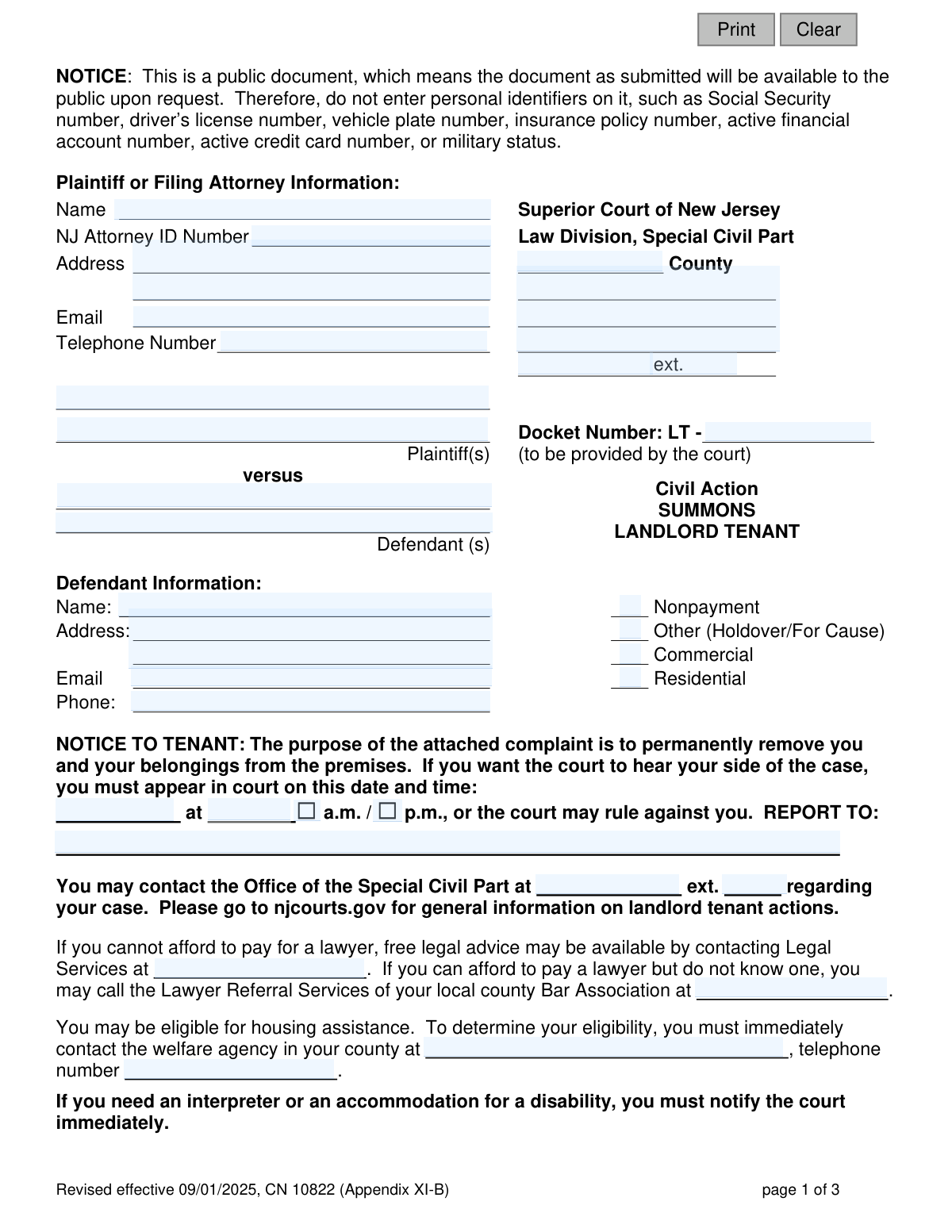
- Navigate to Instafill.ai and upload or select the 'Tenancy Summons and Return of Service - Appendix XI-B' form.
- Provide the Plaintiff or Filing Attorney's information, including name, address, NJ Attorney ID number, and contact details.
- Enter the Defendant's (tenant's) full name, address, and any available contact information.
- Indicate the nature of the action by checking the appropriate boxes, such as 'Nonpayment', 'Other', 'Commercial', or 'Residential'.
- The AI will assist in populating court-specific details like the county and docket number, which are typically provided by the court upon filing.
- Review all auto-filled information for accuracy, including plaintiff and defendant details, then e-sign (if applicable) or download the completed summons for filing with the appropriate New Jersey Superior Court.
- The 'Return of Service' section is to be completed by the court officer after the summons has been served to the defendant and should be left blank by the plaintiff.
Common Mistakes in Completing Appendix XI-B
The ones the AI is built to catch.
Including Prohibited Personal Identifiers
Entering an Incorrect or Incomplete Defendant Address
Failing to Name All Tenants as Defendants
Selecting the Incorrect Case Type
Filing in the Wrong County
Attempting to Fill Out Court-Use-Only Sections
Omitting the Filing Attorney's ID Number
Using Illegible Handwriting on a Paper Form
Forgetting to Provide County-Specific Tenant Resource Numbers
Reversing the Plaintiff and Defendant Roles
Frequently Asked Questions About Appendix XI-B
Is it really free for 7 days?
Can I fill other forms too?
How do I cancel?
How does the AI fill out Appendix XI-B?
What happens to my information?
How complex is Appendix XI-B to fill out?
What is the purpose of the Tenancy Summons and Return of Service form?
I am a tenant and I received this form. What does it mean?
Who needs to fill out this form?
What kind of personal information should I NOT put on this form?
What should I do if I can't afford a lawyer for my court date?
What is the 'Court Officer's Return of Service' section for?
How do I request an interpreter or disability accommodation for court?
The form mentions housing assistance. How can I get help?
What is the difference between a 'Nonpayment' and an 'Other (Holdover/For Cause)' case?
Can AI tools help me fill out this form?
How can I fill out this form online?
The PDF I have isn't fillable. What can I do?
Who should I call if I have questions about my case details?
Get your Appendix XI-B filled out by AI
$0 today. Cancel before Nov 5 and you pay nothing.
Other forms like this one
New Jersey forms: State of New Jersey Alternate Benefit Program Withdrawal Request Acknowledgement Receipt, Horizon Blue Cross Blue Shield of New Jersey Applied Behavior Analysis Supplemental Information Form, State of New Jersey Application for Employment (Form DPF-663), New Jersey Judiciary Plea Form (Plea 01), Supplemental Plea Form for Certain Sexual Offenses: Megan’s Law/Parole Supervision for Life/Community Supervision for Life (Plea 05), Financial Questionnaire to Establish Indigency, New Jersey Judiciary Resource Family Information Form, Foreclosure Case Information Statement (FCIS) - Appendix XII-B2, New Jersey Judiciary Records Request Form, Superior Court of New Jersey, Application for Appeal and Order, FL Certification of Requested Background Checks for Kinship Legal Guardianship, Certification of Caregiver as to Knowledge of Identity and/or Location of Parents, FL Order Judgment for Kinship Legal Guardianship, New Jersey Judiciary Certification of Repair and Plea of Guilty, Uniform Summary Support Order (USSO), New Jersey Judiciary Volunteer Application (CN 10293), Application to Take the New Jersey Court Interpreter Oral Examination, New Jersey Judiciary Attorney Fee Arbitration Request, Order to Show Cause with Temporary Restraints Pursuant to Rule 4:52, Tax Court of New Jersey, State Tax Complaint
Let AI fill out your Appendix XI-B
Your trial starts once a card is added. You pay nothing before Nov 5.
Our AI already knows this form, all 48 fields of it. Skip the typing: tell it about yourself, or upload what you have, and it fills the whole form in seconds.
- AI fills every field on both pages, checkboxes included
- No typing into boxes: answer a few questions, or upload a document you already have, an old copy of this form, a photo of a document
- The AI checks the answers; you review and change anything before you download
- Download the finished PDF, print it, or sign it online
- Encrypted, and never used to train AI
Cancel before Nov 5 and you pay nothing.
A card is needed to start the trial. Cancel in two clicks from your account.
Terms · Privacy