Yes! You can use AI to fill out Voluntary Binding Arbitration Order
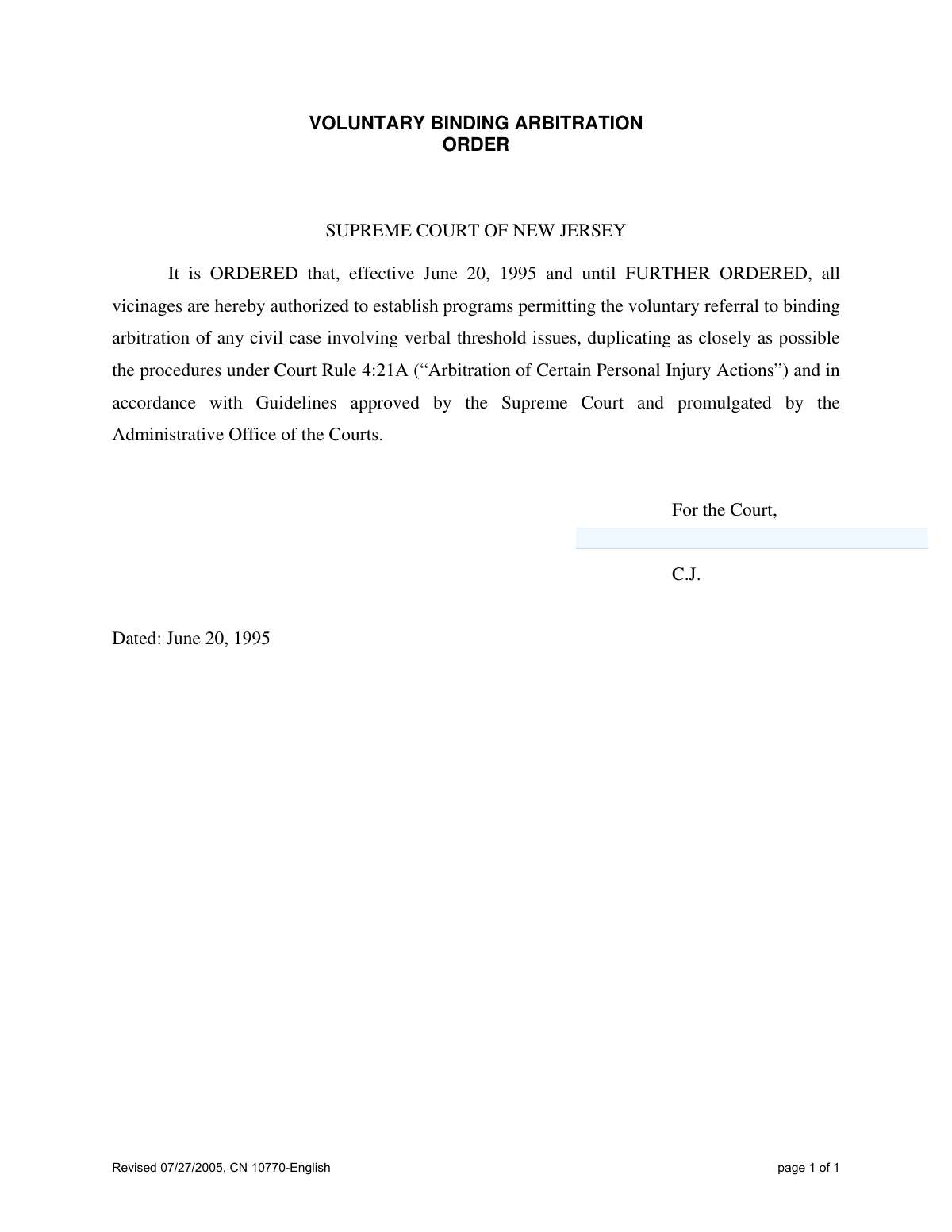
The Voluntary Binding Arbitration Order (CN 10770) is a directive from the Supreme Court of New Jersey that establishes the framework for voluntary arbitration in certain civil cases, particularly those involving verbal threshold issues. This order is crucial as it provides the legal authority and procedural guidelines for these arbitration programs, referencing Court Rule 4:21A. Today, any related legal documents or forms can be filled out quickly and accurately using AI-powered services like Instafill.ai, which can also convert non-fillable PDF versions into interactive fillable forms.
CN 10770 is part of the
New Jersey forms category on Instafill.
Our AI automatically handles information lookup, data retrieval, formatting, and form filling.
It takes less than a minute to fill out CN 10770 using our AI form filling.
Securely upload your data. Information is encrypted in transit and deleted immediately after the form is filled out.
Form specifications
| Form name: | Voluntary Binding Arbitration Order |
| Number of fields: | 1 |
| Number of pages: | 1 |
| Language: | English |
Instafill Demo: How to fill out PDF forms in seconds with AI
How to Fill Out CN 10770 Online for Free in 2026
Are you looking to fill out a CN 10770 form online quickly and accurately? Instafill.ai offers the #1 AI-powered PDF filling software of 2026, allowing you to complete your CN 10770 form in just 37 seconds or less.
Follow these steps to fill out your CN 10770 form online using Instafill.ai:
- 1 Navigate to Instafill.ai and upload the Voluntary Binding Arbitration agreement form or select it from their template library.
- 2 Enter the case information, including the docket number, case caption, and the specific New Jersey vicinage.
- 3 Provide the full names and contact details for all parties (plaintiffs and defendants) agreeing to arbitration.
- 4 Input the names and bar numbers of the attorneys representing each party in the case.
- 5 Carefully review all the information populated by the AI to ensure accuracy before proceeding.
- 6 Electronically sign and date the form to formalize the agreement to enter into voluntary binding arbitration.
- 7 Download the completed document for your records and submit it to the court and opposing counsel as required.
Our AI-powered system ensures each field is filled out correctly, reducing errors and saving you time.
Why Choose Instafill.ai for Your Fillable CN 10770 Form?
Speed
Complete your CN 10770 in as little as 37 seconds.
Up-to-Date
Always use the latest 2026 CN 10770 form version.
Cost-effective
No need to hire expensive lawyers.
Accuracy
Our AI performs 10 compliance checks to ensure your form is error-free.
Security
Your personal information is protected with bank-level encryption.
Frequently Asked Questions About Form CN 10770
This order from the New Jersey Supreme Court authorizes the state's judicial districts to establish programs for voluntary binding arbitration. It is intended for civil cases involving 'verbal threshold issues' as an alternative to a traditional trial.
No, this document is a court order that authorizes arbitration programs; it is not a form for individuals to complete. If you opt for arbitration, you will need to fill out separate forms, such as an agreement to arbitrate.
This order affects parties in certain New Jersey civil lawsuits, specifically personal injury cases with verbal threshold issues. It provides them with the option to resolve their case through binding arbitration instead of a court trial.
'Voluntary' means both parties must agree to participate, and 'binding' means the arbitrator's decision is final and legally enforceable. It serves as a substitute for a court trial with very limited rights to appeal.
These typically arise in personal injury or auto accident lawsuits. The 'verbal threshold' is a legal standard requiring a plaintiff to prove their injury is sufficiently serious to be able to sue for non-economic damages like pain and suffering.
No, participation is completely voluntary. Both parties in the lawsuit must consent to refer their case to binding arbitration.
The process follows the procedures outlined in New Jersey Court Rule 4:21A. This generally involves selecting an arbitrator, presenting evidence, and receiving a final, binding decision.
You and the opposing party must both agree and follow the specific procedures of the local vicinage (judicial district) where your case is filed. Consult with your attorney to formally request referral to the program.
Yes, because the arbitration is 'binding,' the decision is final and carries the same legal weight as a court judgment. The grounds for appealing an arbitration award are very narrow.
Yes, the order states it is effective 'until FURTHER ORDERED' and was revised in 2005, indicating it remains active. These arbitration programs are an established part of the New Jersey court system.
Yes, for any forms you need to complete to enter arbitration, services like Instafill.ai can help. These tools use AI to accurately auto-fill your information, saving time and reducing potential errors.
Simply upload the required arbitration form to the Instafill.ai platform. The AI will identify the fields, allowing you to fill them out online, add a digital signature, and download the completed document.
You can use a service like Instafill.ai to handle this issue. The platform can convert flat, non-fillable PDFs into interactive, fillable forms that you can complete and sign digitally.
Compliance CN 10770
Validation Checks by Instafill.ai
1
Validates Case Docket Number Format
This check ensures the docket number entered matches the standard format for New Jersey Superior Court cases (e.g., 'ATL-L-1234-23'). It is crucial for correctly identifying the case within the court's electronic filing system. A submission with an incorrectly formatted docket number would be rejected or require manual correction, delaying the filing.
2
Ensures County is a Valid NJ Vicinage
This validation confirms that the selected county is a valid, recognized judicial vicinage in New Jersey. It prevents submissions with typographical errors or invalid locations. An invalid county selection would cause the filing to be misrouted or rejected, as jurisdiction is a fundamental component of any legal action.
3
Requires at Least One Plaintiff and One Defendant
The system verifies that the form lists at least one plaintiff and at least one defendant. A legal case requires opposing parties, and submitting a stipulation without them is a logical impossibility. This check prevents the submission of fundamentally incomplete or invalid legal documents.
4
Verifies Attorney ID Format
This check validates that the Attorney ID number provided for each counsel follows the official format issued by the New Jersey State Bar. This ID is the primary key for identifying an attorney, verifying their credentials, and ensuring they are in good standing. An invalid ID would flag the submission for review to confirm the attorney's eligibility to practice.
5
Cross-references Attorney Name and ID
This validation checks an external database to ensure the provided attorney name corresponds to the provided attorney ID. This serves as a secondary check to prevent both data entry errors and potential fraudulent filings. A mismatch would trigger a warning and require manual verification before the submission can be processed.
6
Validates Date of Stipulation Logic
This check ensures the 'Date of Stipulation' is not a future date and is not unreasonably far in the past. It maintains the chronological integrity of the case file. A future date is logically impossible, and an incorrect date could create legal challenges regarding when the agreement was actually made.
7
Confirms Presence of All Required Signatures
The system must confirm that digital signatures or attestations are provided for the attorneys of all listed plaintiffs and defendants. Since arbitration is voluntary, consent from all parties is mandatory for the agreement to be valid. A submission with a missing signature would be considered incomplete and legally unenforceable.
8
Ensures 'Verbal Threshold' Applicability is Indicated
This check requires a mandatory selection (e.g., a checkbox) to confirm that the case involves 'verbal threshold issues,' as this is a specific criterion mentioned in the court order. This confirms the case's eligibility for this particular arbitration program. Failure to confirm this may result in the case being rejected from the program.
9
Mandatory Agreement to Binding Terms
A mandatory checkbox must be ticked, confirming that all parties understand the arbitration is binding and that they are waiving their right to a trial. This is a critical legal safeguard to ensure informed consent. The form cannot be submitted without this explicit acknowledgment, as it affects fundamental legal rights.
10
Verifies Docket Number Prefix Matches County
This check cross-references the county selected from a dropdown list with the three-letter prefix of the docket number (e.g., 'BER' for Bergen County). This is a logical consistency check to catch common data entry errors. A mismatch would trigger an alert, prompting the user to review and correct the information before submission.
11
Prevents Duplicate Submission for a Case
Upon submission, the system checks the docket number to see if a 'Voluntary Binding Arbitration Order' has already been successfully filed for that case. This validation prevents redundant filings and avoids confusion in the official court record. A detected duplicate would be rejected with a notification explaining that the order is already on file.
12
Ensures All Parties Have Legal Representation Listed
This validation verifies that for every plaintiff and defendant named on the form, a corresponding attorney's name and ID (or a clear 'pro se' designation for self-representation) are provided. This ensures all parties are accounted for in the agreement. A submission with a party lacking representation information would be flagged for review.
Common Mistakes in Completing CN 10770
Users often transpose numbers, omit letter prefixes (e.g., 'L' for Law Division), or use an outdated docket number from a previous filing. An incorrect docket number can cause the court clerk to reject the filing or misplace the document, leading to significant delays in the legal process. To prevent this, carefully cross-reference the number with the most recent official court correspondence or pleading. AI-powered tools like Instafill.ai can also help by validating formats and auto-populating correct case information across documents.
While the form may reference the Supreme Court of New Jersey, the actual case is handled at the county level, known as a vicinage. People sometimes forget to specify the county where the case is pending, assuming the state-level form does not require it. This omission makes it impossible to route the document correctly, resulting in its return and delaying the agreement to arbitrate. Always clearly state the full name of the county where the original complaint was filed.
It is common to see misspellings in the names of the plaintiff or defendant, or to see their roles reversed in the case caption. This error creates ambiguity and can undermine the validity of the legal document, potentially requiring a corrected version to be re-filed. To avoid this, meticulously copy the party names and their designations exactly as they appear on the original complaint or other official court documents.
Many court forms are distributed as non-fillable PDFs, leading people to print them and fill them out by hand. Illegible handwriting for critical details like names, addresses, or case numbers can cause the filing to be rejected by court staff. This forces you to redo the paperwork and can cause you to miss important deadlines. To ensure clarity, use tools like Instafill.ai, which can convert flat PDFs into electronically fillable forms, guaranteeing every entry is legible and professional.
Forgetting to date a signature or using an ambiguous format like '2/3/24' can create legal uncertainty about when the agreement was executed. Legal documents require precise dating to establish a clear timeline of events. An undated or improperly dated form may be considered invalid by the court or opposing counsel. Always use the full, unambiguous MM/DD/YYYY format and date the document on the actual day it is signed.
Attorneys or their staff may rush and forget to include their New Jersey Attorney ID number, or they might provide an old firm address or phone number. This prevents the court and other parties from being able to make contact, leading to missed communications and potential prejudice to the client's case. Ensure all attorney details, including name, firm, address, phone, and Bar ID, are current and completely filled in for all parties.
A party, particularly one without legal counsel, might sign the form without fully understanding that 'binding' arbitration severely limits or eliminates their right to appeal the decision in court. This is a conceptual error, not just a data entry mistake, and it stems from not grasping the legal consequences of the document. This can lead to irreversible outcomes, so it is crucial to consult with an attorney to fully understand the rights being waived before signing.
After completing and signing the form, a party might file it with the court but neglect to send a copy (a process called 'service') to the opposing party or their counsel. Proper service is a fundamental legal requirement to ensure all participants in the case are officially notified. Failing to do so can render the filing ineffective, cause delays, and may even lead to sanctions from the court. Always follow the rules of service and complete a Certificate of Service as proof.
Courts periodically update their forms to reflect changes in rules or laws, as indicated by the 'Revised' date on the sample document. Using an obsolete version of a form can lead to an automatic rejection by the clerk's office because it may lack required information or contain outdated legal language. Before filling out any form, always verify on the official judiciary website that you are using the most current version available.
The case caption is the block of text at the top of the first page that identifies the court, parties, and docket number. People often rush and provide an abbreviated or incomplete caption, leaving out essential information. An improper caption can cause filing errors or make it difficult for court staff to associate the document with the correct case file. It is essential to copy the full, official case caption from a prior court filing, such as the complaint, without modification.
Saved over 80 hours a year
“I was never sure if my IRS forms like W-9 were filled correctly. Now, I can complete the forms accurately without any external help.”
Kevin Martin Green
Your data stays secure with advanced protection from Instafill and our subprocessors

Robust compliance program
Transparent business model
You’re not the product. You always know where your data is and what it is processed for.
ISO 27001, HIPAA, and GDPR
Our subprocesses adhere to multiple compliance standards, including but not limited to ISO 27001, HIPAA, and GDPR.
Security & privacy by design
We consider security and privacy from the initial design phase of any new service or functionality. It’s not an afterthought, it’s built-in, including support for two-factor authentication (2FA) to further protect your account.
Fill out CN 10770 with Instafill.ai
Worried about filling PDFs wrong? Instafill securely fills voluntary-binding-arbitration-order forms, ensuring each field is accurate.