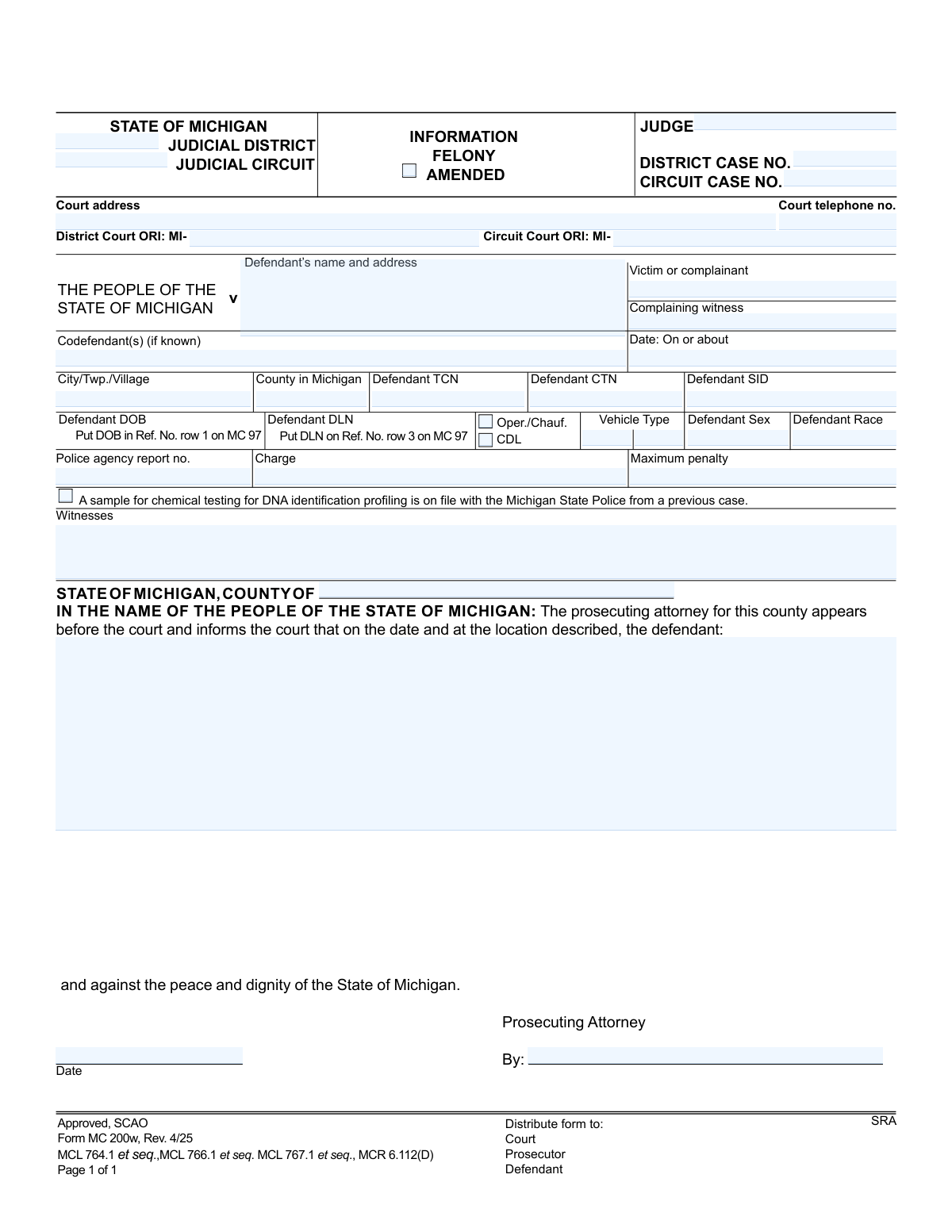
Yes! You can use AI to fill out Form MC 200w, Felony Set, Warrant
Michigan Form MC 200w, also known as the Felony Set, Warrant, is a comprehensive collection of legal documents used to initiate and process felony criminal cases in the state. It includes the official complaint detailing the charges, the warrant authorizing an arrest, and the bindover form for transferring the case to circuit court after a preliminary examination. The accuracy of this form is critical for the proper administration of justice, and today this form can be filled out quickly and accurately using AI-powered services like Instafill.ai, which can also convert non-fillable PDF versions into interactive fillable forms.
MC 200w is part of the
Michigan court forms category on Instafill.
Our AI automatically handles information lookup, data retrieval, formatting, and form filling.
It takes less than a minute to fill out MC 200w using our AI form filling.
Securely upload your data. Information is encrypted in transit and deleted immediately after the form is filled out.
Form specifications
| Form name: | Form MC 200w, Felony Set, Warrant |
| Number of fields: | 201 |
| Number of pages: | 1 |
| Language: | English |
More forms in Michigan court forms
Instafill Demo: How to fill out PDF forms in seconds with AI
How to Fill Out MC 200w Online for Free in 2026
Are you looking to fill out a MC 200W form online quickly and accurately? Instafill.ai offers the #1 AI-powered PDF filling software of 2026, allowing you to complete your MC 200W form in just 37 seconds or less.
Follow these steps to fill out your MC 200W form online using Instafill.ai:
- 1 Navigate to Instafill.ai and upload or select the Form MC 200w, Felony Set, Warrant.
- 2 Allow the AI to scan and identify all the required fields across the different sections of the form, such as the Complaint, Warrant, and Bindover.
- 3 Provide the necessary case information, including defendant details, charges, case numbers, and dates, by answering simple questions.
- 4 Watch as the AI populates the correct information into the corresponding fields, ensuring consistency across all parts of the document set.
- 5 Review the completed form, making any necessary edits or additions directly on the digital document.
- 6 Securely sign (if applicable), download, and print the completed Form MC 200w for filing with the court, prosecutor, and other required parties.
Our AI-powered system ensures each field is filled out correctly, reducing errors and saving you time.
Why Choose Instafill.ai for Your Fillable MC 200w Form?
Speed
Complete your MC 200w in as little as 37 seconds.
Up-to-Date
Always use the latest 2026 MC 200w form version.
Cost-effective
No need to hire expensive lawyers.
Accuracy
Our AI performs 10 compliance checks to ensure your form is error-free.
Security
Your personal information is protected with bank-level encryption.
Frequently Asked Questions About Form MC 200w
This is a multi-part legal document used by Michigan courts to formally charge an individual with a felony. It includes the official complaint, the arrest warrant, and the record of the preliminary examination (bindover).
This form is completed by court officials, including the prosecuting attorney who files the complaint and the judge who issues the warrant. It is not a form for the defendant or the general public to complete.
The 'Complaint' is the formal accusation made by a complaining witness or prosecutor that details the alleged crime. The 'Warrant' is a separate order issued by a judge, based on the complaint, that authorizes law enforcement to arrest the defendant.
This is a legal step where, after a preliminary examination in district court, a judge finds enough evidence (probable cause) to send a felony case to the higher circuit court for trial.
By waiving the preliminary examination, the defendant agrees to skip the hearing where the prosecutor must show probable cause that a crime was committed. The case is then automatically sent ('bound over') to the circuit court for trial.
These sections handle different legal pathways after a preliminary examination. The adult section sends the case to circuit court for trial, while the juvenile section determines if the case will be tried in the adult criminal division or transferred to the family division.
This box is checked to indicate that the Michigan State Police already have a DNA sample from the defendant from a previous case. This avoids the need to collect a new sample for the current charges.
The 'Warrant Return' is completed by the arresting peace officer to officially record the date, time, and place of the defendant's arrest. This document is then returned to the court to become part of the official case file.
As indicated at the bottom of each page, copies of the completed form are distributed to the Court, the Prosecutor, and the Defendant. A copy of the bindover is also sent to the Michigan State Police Criminal Justice Information Center.
Yes, services like Instafill.ai use AI to accurately auto-fill form fields from case management systems or other documents. This saves significant time for legal and court staff and helps ensure accuracy.
Simply upload the MC 200w form to the Instafill.ai platform. The AI will make all fields fillable, allowing you to quickly populate the required information before downloading or printing the completed document.
If you have a non-fillable or 'flat' PDF, you can upload it to Instafill.ai. The service's AI will automatically detect the fields and convert the document into an interactive, fillable form for you to complete online.
Felony cases in Michigan typically start in District Court for initial proceedings. If the case proceeds to trial, it is transferred to Circuit Court and assigned a new case number, and both are tracked on the form.
Compliance MC 200w
Validation Checks by Instafill.ai
1
Ensures Chronological Integrity of Case Dates
This check validates that all dates across the forms follow a logical and legal sequence. For example, the offense date ('date') must occur before or on the warrant authorization date, which must precede the arrest date ('arrestdate'), which in turn must precede any preliminary examination or bindover dates. This is critical for maintaining a valid timeline of events; an illogical sequence could invalidate legal proceedings.
2
Validates Defendant Date of Birth (DOB)
This validation ensures the 'dob' field contains a valid date that is in the past. It confirms the date is formatted correctly and is not a future date. This is essential for correctly identifying the defendant and determining jurisdiction, specifically whether the case should be handled in the adult or juvenile system.
3
Verifies Case Number Consistency Across Forms
This check confirms that the District Case Number ('caseno') and Circuit Case Number ('caseno2') are identical on all associated documents (Information, Complaint, Warrant, Bindover). Maintaining consistent case numbers is fundamental for accurate record-keeping and ensuring all documents are correctly filed and linked to a single legal action. Mismatched numbers can lead to severe administrative errors and lost files.
4
Validates Court ORI Number Format
This check ensures that the District Court ORI ('dori') and Circuit Court ORI ('cori') fields begin with the state prefix 'MI-' followed by the specific agency identifier code. The Originating Agency Identifier (ORI) is crucial for routing documents and statistics to the correct law enforcement and judicial agencies. An incorrect format will cause processing and routing failures.
5
Confirms Presence of Essential Offense Details
This validation ensures that the 'charge', 'county', and offense 'date' fields are not empty on the initial charging documents (Information/Complaint). These three pieces of information are the basis for the entire case, establishing the alleged crime, the jurisdiction of the court, and the timeframe of the offense. Missing information would render the complaint legally insufficient.
6
Validates Attorney Bar Number Format
This check verifies that all bar number fields ('pabarno', 'counselbarno', 'dattorneybarno') adhere to the specific format required by the Michigan State Bar (e.g., a 'P' prefix followed by a set number of digits). This ensures that the attorneys listed are properly identified and licensed. An invalid bar number could call into question whether the defendant or state was represented by qualified counsel.
7
Enforces Mutually Exclusive Examination Status
On the Bindover form, this validation ensures that either the 'Examination was waived' checkbox ('exanwauvedck') or the 'Examination was held' checkbox ('examheldck') is selected, but not both. It also requires the corresponding date field ('waiveddate' or 'helddate') to be filled. This logic prevents contradictory information about the status of the preliminary examination, which is a critical step in the felony process.
8
Checks for Amended Charge Details
This validation rule checks that if the 'amended charge(s)' checkbox ('amendchargesck') is selected on the Bindover form, then the 'amendchargesdescribe' and 'pacccode' fields must be populated with the new charge information. This ensures that when charges are modified, the record clearly and completely reflects the new offenses for which the defendant is being bound over. Failure to provide details would create ambiguity about the active charges.
9
Requires Justification for Arrest Warrant Issuance
This check verifies that on the Warrant form, at least one of the four justification checkboxes ('assaultive', 'noappear', 'pbsafety', 'arrestwar') is selected. A judge must state the probable cause finding and the reason for issuing an arrest warrant instead of a summons. This is a constitutional safeguard, and its absence could render the warrant invalid.
10
Validates Defendant Identifier Formats
This check validates that defendant-specific identifiers like Driver's License Number ('dln'), Tracking Control Number ('tcn'), and State Identification Number ('sid') match their expected state-specific formats. These numbers are key to linking the court case with law enforcement and corrections databases. Incorrectly formatted identifiers can lead to failures in updating a defendant's criminal history.
11
Confirms Presence of Required Signatures and Dates
This validation ensures that legally required signature and date fields are not left blank. Specifically, it checks for the complaining witness's signature ('cwsignature') and date ('cwdate') on the Complaint, and the judge's signature and date on the Warrant. These signatures are what give the documents their legal authority; without them, the documents are void.
12
Ensures Completeness of Bond Information
This check verifies that if a bond amount ('bondamt') is specified, the type of bond ('bondtype') is also selected. This information is critical for the court and jail to correctly process the defendant's release or detention. Incomplete bond information can cause delays in release or incorrect application of release conditions.
13
Verifies Completeness of Defendant Name and Address
This validation ensures the 'dname' field, which includes the defendant's name and address, is not empty. This is the primary identifier for the accused and is legally required for providing notice and for the warrant to be valid. An empty or incomplete field would make the entire set of documents legally deficient.
14
Validates Juvenile Transfer Logic
On the Juvenile Bindover section, if the case is being transferred ('transferck' is checked), this rule ensures that either 'immediately' or 'specificdateck' is also selected. If 'specificdateck' is chosen, the 'specificdate' and 'specifictime' fields must be filled. This prevents ambiguity in the transfer process, ensuring a clear handover of jurisdiction from one court division to another.
Common Mistakes in Completing MC 200w
This form requires multiple unique numbers like District/Circuit Case No., TCN, CTN, and SID. Users often transpose digits or copy numbers into the wrong fields due to the density of information. This can lead to severe administrative delays, misfiling of the case, or incorrectly linking the legal action to the wrong criminal history record. Double-checking each number against the source document is critical; AI-powered tools like Instafill.ai can help by cross-referencing data across fields to flag potential inconsistencies.
Errors in the defendant's name, Date of Birth (DOB), or Driver's License Number (DLN) are common yet critical. A misspelled name or incorrect birthdate can lead to a case of mistaken identity or difficulties in tracking the individual's record. The form has specific instructions to cross-reference the DOB and DLN with another form (MC 97), which are often overlooked. Using a tool like Instafill.ai can help ensure data consistency and proper formatting, preventing these foundational errors.
Staff who work with multiple courts may accidentally enter the wrong Judicial District/Circuit, court address, or ORI code. This mistake can cause the entire case file to be sent to the wrong jurisdiction, resulting in significant delays and potential dismissal for failure to meet procedural deadlines. To avoid this, filers must meticulously verify the jurisdiction for the specific case before filling out the form.
The 'Charge' and 'Maximum penalty' fields, along with the narrative description of the offense, must be precise. Users may cite an incorrect or outdated MCL statute, misstate the maximum penalty, or write an ambiguous narrative. Such errors can form the basis for a legal challenge by the defense, potentially weakening the case or requiring the charges to be amended or re-filed. It is crucial to reference the most current version of the Michigan Compiled Laws.
A complaint, warrant, or bindover is not legally valid without the proper signatures and dates from the complaining witness, prosecuting official, or judge. These are often missed in the rush to process paperwork, rendering the document unenforceable and halting the legal process. This can invalidate an arrest or delay a case's transfer to circuit court. Using a form-filling tool that can highlight required signature fields can help prevent such omissions.
The warrant section requires the court to check a box justifying why an arrest warrant is necessary instead of a summons (e.g., risk to public safety, flight risk). Forgetting to check the appropriate box or lacking the underlying facts in the complaint to support the choice can lead to the warrant being challenged as improperly issued. This is a procedural safeguard that must be deliberately and accurately completed by the judicial officer.
On the Bindover form, there are separate checkboxes to indicate if the defendant waived their preliminary examination or if an examination was held. Clerks or attorneys can easily check the wrong box, misrepresenting a critical stage of the proceedings. This error creates a false record of the case's procedural history, which can cause confusion and require correction upon reaching circuit court.
If a defendant is bound over on charges different from the original complaint, the 'amended charge(s)' field must be filled out completely and accurately. Often, this section is left blank or filled with ambiguous language, creating uncertainty about the exact offenses the defendant will face in circuit court. This can lead to procedural motions and delays as the defense and prosecution seek clarity.
The bindover form requires precise details about the bond, including the amount, type (e.g., cash/surety, 10%), and whether it has been posted. Errors in this section can have immediate consequences for the defendant's liberty, potentially leading to their incorrect release or continued detention. Meticulous accuracy is required to ensure the court's orders regarding pre-trial release are followed correctly.
The final step on the bindover form is the district court clerk's certification that the case file has been transmitted to the circuit court. Forgetting this signature and date can disrupt the chain of custody for the case file and delay its official acceptance and docketing by the higher court. This final administrative check is essential for a smooth transition between courts.
The form explicitly states 'Put DOB in Ref. No. row 1 on MC 97' and 'Put DLN in Ref. No. row 3 on MC 97,' indicating a link to a separate report. Users often ignore these small-print instructions, leading to incomplete or inconsistent records across different court documents. This can complicate sentencing calculations, and AI-powered tools like Instafill.ai can be programmed to recognize and enforce such inter-document dependencies.
This form is often distributed as a non-fillable PDF, forcing users to print and fill it by hand or use clunky annotation tools. This frequently results in illegible handwriting, misaligned text, and incomplete fields, which can cause the document to be rejected by the court clerk. Using a service like Instafill.ai can convert such flat PDFs into smart, fillable forms, ensuring all entries are clear, properly formatted, and legible, thus preventing rejection and delays.
Saved over 80 hours a year
“I was never sure if my IRS forms like W-9 were filled correctly. Now, I can complete the forms accurately without any external help.”
Kevin Martin Green
Your data stays secure with advanced protection from Instafill and our subprocessors

Robust compliance program
Transparent business model
You’re not the product. You always know where your data is and what it is processed for.
ISO 27001, HIPAA, and GDPR
Our subprocesses adhere to multiple compliance standards, including but not limited to ISO 27001, HIPAA, and GDPR.
Security & privacy by design
We consider security and privacy from the initial design phase of any new service or functionality. It’s not an afterthought, it’s built-in, including support for two-factor authentication (2FA) to further protect your account.
Fill out MC 200w with Instafill.ai
Worried about filling PDFs wrong? Instafill securely fills form-mc-200w-felony-set-warrant forms, ensuring each field is accurate.