Yes! You can use AI to fill out Form MC 204, Order for Competency Examination
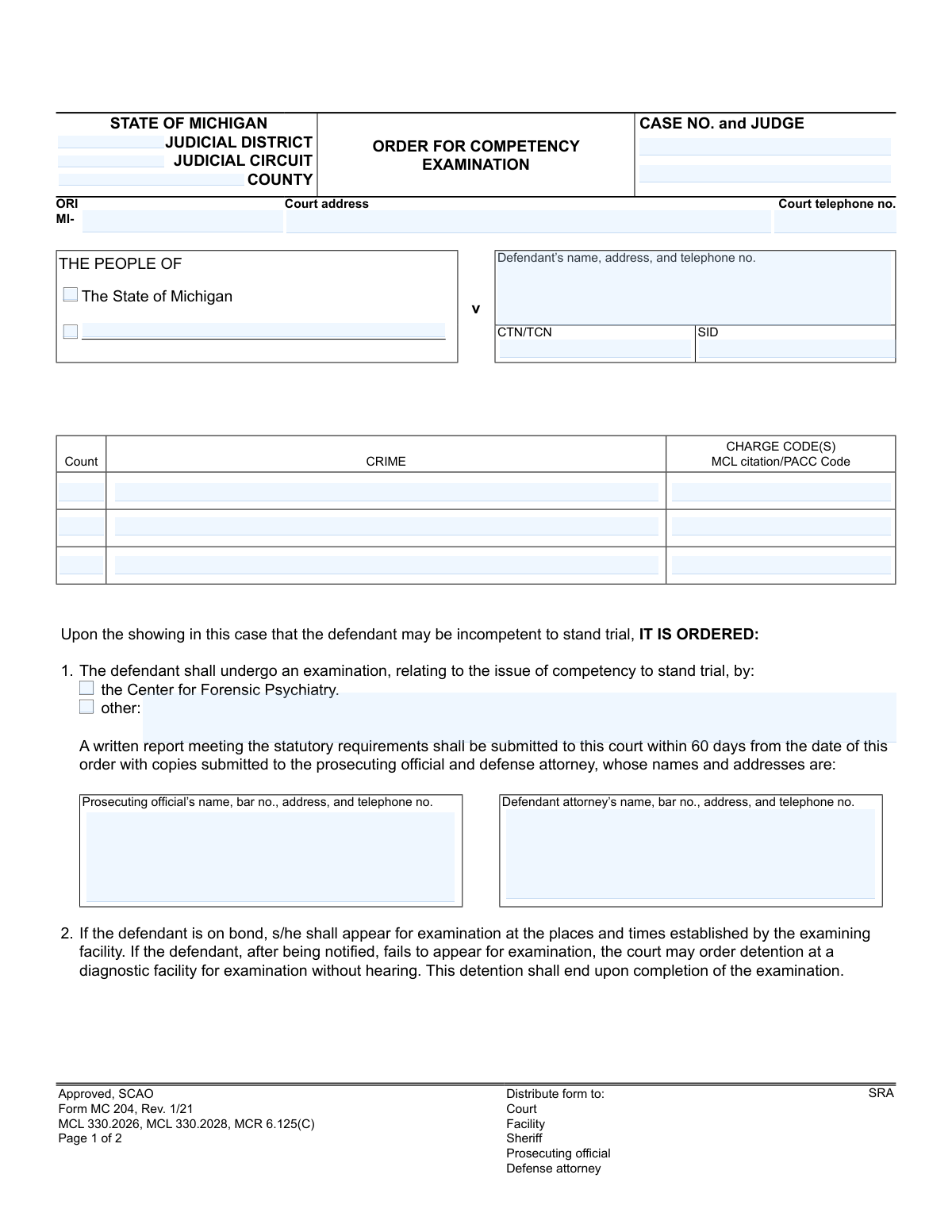
Form MC 204 is a legal document issued by a Michigan court when there is a question regarding a defendant's mental competency to participate in their own defense. This order mandates that the defendant undergo an examination by a designated facility, such as the Center for Forensic Psychiatry, which will then report its findings to the court, prosecution, and defense. Today, this form can be filled out quickly and accurately using AI-powered services like Instafill.ai, which can also convert non-fillable PDF versions into interactive fillable forms.
MC 204 is part of the
Michigan court forms category on Instafill.
Our AI automatically handles information lookup, data retrieval, formatting, and form filling.
It takes less than a minute to fill out MC 204 using our AI form filling.
Securely upload your data. Information is encrypted in transit and deleted immediately after the form is filled out.
Form specifications
| Form name: | Form MC 204, Order for Competency Examination |
| Number of fields: | 30 |
| Number of pages: | 1 |
| Language: | English |
More forms in Michigan court forms
Instafill Demo: How to fill out PDF forms in seconds with AI
How to Fill Out MC 204 Online for Free in 2026
Are you looking to fill out a MC 204 form online quickly and accurately? Instafill.ai offers the #1 AI-powered PDF filling software of 2026, allowing you to complete your MC 204 form in just 37 seconds or less.
Follow these steps to fill out your MC 204 form online using Instafill.ai:
- 1 Navigate to Instafill.ai and upload the MC 204 form or select it from the template library.
- 2 Provide the court and case information, including the judicial district, county, case number, and judge's name.
- 3 Enter the defendant's full name and address, along with the specific criminal charges, MCL citations, and any associated identification numbers (CTN/SID).
- 4 Designate the examining facility (e.g., Center for Forensic Psychiatry) and input the contact details for both the prosecuting and defense attorneys.
- 5 Include any additional specific instructions or orders from the court in the 'Other' section as required.
- 6 Review all the information auto-filled by the AI to ensure accuracy and completeness before the order is presented for the judge's signature.
- 7 Once signed, download the completed form and distribute copies to all required parties, including the court, facility, sheriff, and attorneys.
Our AI-powered system ensures each field is filled out correctly, reducing errors and saving you time.
Why Choose Instafill.ai for Your Fillable MC 204 Form?
Speed
Complete your MC 204 in as little as 37 seconds.
Up-to-Date
Always use the latest 2026 MC 204 form version.
Cost-effective
No need to hire expensive lawyers.
Accuracy
Our AI performs 10 compliance checks to ensure your form is error-free.
Security
Your personal information is protected with bank-level encryption.
Frequently Asked Questions About Form MC 204
This is a court order issued by a judge when there's a concern that a defendant may not be mentally fit to stand trial. It requires the defendant to undergo a psychological examination to determine if they can understand the court proceedings and assist in their own defense.
This form is an official court order, so it is completed by court personnel and signed by the judge presiding over the case. It is not a form for the defendant or attorneys to fill out themselves.
The examination is typically conducted by the Center for Forensic Psychiatry, as indicated on the form. However, the judge can order the examination to be performed by another qualified facility or professional.
The examining facility is required to submit a written report to the court, prosecutor, and defense attorney within 60 days from the date the order is issued.
If a defendant on bond is notified of their appointment but fails to appear, the court may order them to be detained at a diagnostic facility for the examination without a further hearing.
If the defendant is in detention, the facility may perform the examination in the jail. Alternatively, the sheriff will transport the defendant to the facility for the exam and return them to the jail afterward.
The order mandates that the prosecuting official must immediately provide the examining facility with police investigation reports and the defendant's criminal history to aid in the evaluation.
The defense attorney is required to be available for consultation with the facility's personnel during the examination process. They also receive a copy of the final written report.
Copies of the signed order are distributed to the court, the examining facility, the county sheriff, the prosecuting official, the defense attorney, and the SRA (State Court Administrative Office).
After the report is filed, the court will typically hold a competency hearing. The judge will review the report and other evidence to formally rule on whether the defendant is competent to stand trial.
While this specific order is completed by the court, you can use AI for other legal paperwork. Services like Instafill.ai use AI to help you accurately auto-fill form fields from your data, which saves time and reduces errors on complex documents.
With Instafill.ai, you can upload your legal form, and its AI will identify all the fields. You can then fill them out easily online or use the auto-fill feature to populate them with your saved information instantly.
If you have a non-fillable or 'flat' PDF, you can upload it to Instafill.ai. The platform's technology can convert it into an interactive, fillable form that you can complete and manage digitally.
Compliance MC 204
Validation Checks by Instafill.ai
1
Case Number Format and Consistency
This check verifies that the 'Case No.' field follows the standard court format (e.g., YY-######-XX) and is identical on both page 1 and page 2 of the form. Consistency is crucial for document integrity and ensures that all pages of the order are correctly associated with the same legal case. A mismatch or incorrect format could lead to filing errors and legal invalidity of the order.
2
Mandatory Jurisdictional Fields
Ensures that the 'Judicial District', 'Judicial Circuit', and 'County' fields are all completed. These fields are essential for establishing the correct legal jurisdiction under which the order is issued. Failure to provide this information would render the order legally ambiguous and could result in its rejection by the court or receiving facility.
3
Defendant Identification Completeness
Validates that the 'Defendant’s name, address, and telephone no.' field is fully populated. Accurate and complete defendant information is non-negotiable for a legal order, as it ensures the correct individual is identified for the examination. Missing information would make the order unenforceable and could violate the defendant's due process rights.
4
Attorney Bar Number Format
This check validates that the 'bar no.' for both the prosecuting official and the defense attorney follows the required state format (e.g., a 'P' prefix followed by a specific number of digits for Michigan). The bar number is a unique identifier for a licensed attorney, and its correctness is vital for official communication and legal accountability. An invalid format would prevent proper identification of counsel.
5
Charge Information Cohesion
Verifies that for every 'Count' entered (e.g., 'Count 1'), the corresponding 'Crime' and 'Charge Code' fields are also filled out. This ensures that each charge listed is complete and properly described. An incomplete charge entry would create ambiguity and is insufficient for legal documentation, potentially invalidating that part of the case record.
6
Minimum of One Charge Required
This validation ensures that at least one complete charge (including Count, Crime, and Charge Code) is specified on the form. A competency examination order must be tied to at least one active criminal charge. If no charges are listed, the legal basis for the order is missing, and the form submission should be rejected.
7
Examination Facility Selection Logic
Checks that either 'the Center for Forensic Psychiatry' checkbox is selected or the 'other' checkbox is selected, but not both. Furthermore, if 'other' is selected, it validates that the 'other evaluation location description' text field is not empty. This logic ensures a clear, unambiguous designation of the examining facility, which is critical for scheduling and executing the court order.
8
Order Date Validity
Validates that the date entered next to the judge's signature is a valid calendar date and is not set in the future. The date of the order establishes when it becomes effective and starts the 60-day clock for the report. An invalid or future date would make the order's timeline and legal standing void.
9
Court Telephone Number Format
Ensures the 'Court telephone no.' field contains a valid, 10-digit US phone number, allowing for common formats like (XXX) XXX-XXXX or XXX-XXX-XXXX. A valid contact number for the court is necessary for inter-agency communication regarding the case and the examination. An invalid number would hinder communication between the court, attorneys, and the examination facility.
10
Criminal Identifier Format (CTN/SID)
This check validates that the 'CTN/TCN' (Corrections Tracking Number/TCN) and 'SID' (State Identification Number) fields, if provided, adhere to their specific alphanumeric formats and lengths. These numbers are critical for accurately linking the court order to the defendant's statewide criminal and correctional records. Incorrect formats can lead to data mismatches and record-keeping errors.
11
MCL/PACC Code Validation
Verifies that the 'MCL citation/PACC Code' provided for each charge is a valid code within the Michigan Compiled Laws or Prosecuting Attorneys Coordinating Council code system. Using a valid code ensures the charge is cited correctly according to state law. An invalid code would be a significant legal error, potentially requiring the order to be amended and re-filed.
12
Judge's Name Presence
Ensures the 'Judge' field is not empty. An order of the court is not valid unless it is issued by a specific, named judge. The absence of a judge's name would render the document legally powerless and would be immediately rejected during processing.
13
ORI Number Format
Validates that the 'ORI MI-' field follows the standard 9-character alphanumeric format for an Originating Agency Identifier. The ORI is used to identify the specific court or law enforcement agency originating the document for state and national tracking purposes. An incorrect ORI can cause the document to be misrouted or fail processing in state information systems.
14
Required Party Names
This check confirms that the name fields for the Defendant, Prosecuting Official, and Defense Attorney are all filled in. These parties are fundamental to the legal proceeding, and their identification on the order is mandatory. Missing names would make the document incomplete and legally deficient, as it fails to properly name the parties involved in the case.
Common Mistakes in Completing MC 204
Users often transpose digits or omit characters in the 'Case No.', 'CTN/TCN', or 'SID' fields. These long, complex identifiers are prone to human error during manual transcription. An incorrect identifier can lead to a failure to link the order with the correct defendant in court and criminal justice databases, causing significant processing delays and potential legal challenges.
It is a frequent oversight to fill in the 'Case No.' on the first page but forget to repeat it on the second. If the pages of the order become separated, the second page, which contains the judge's signature and further instructions, becomes an orphaned document. This can render the order invalid and require it to be re-issued, halting the competency evaluation process.
Entering incorrect 'Crime' descriptions, 'Charge Code(s)', or 'MCL citation/PACC Code' is a critical error. This often happens when referencing outdated documents or making a clerical mistake. Inaccurate charge information can lead the forensic examiner to assess competency based on the wrong legal standard, potentially invalidating the entire report and requiring a new examination.
The form requires the name, bar number, address, and telephone number for both the prosecuting and defense attorneys, but filers often omit the bar number or provide an old address. This information is essential for official records and for the examining facility to send reports and communicate with counsel. Missing details can cause the form to be rejected by the clerk or lead to critical communication breakdowns.
A common mistake is checking the 'other' box for the examination facility but failing to provide a complete name and address in the designated space. This ambiguity leaves the order without a clear destination for the defendant's evaluation. Consequently, the order cannot be executed, and the process is stalled until a corrected and clarified order is filed with the court.
Filers sometimes enter the wrong 'Judicial District' or 'Judicial Circuit' number, especially when working on multiple cases from different jurisdictions. This seemingly small error can cause the order to be misrouted, filed in the wrong court system, or significantly delayed. To prevent this, always verify the correct jurisdiction from the primary case file before filling out the form.
Spelling the defendant's name incorrectly is a serious error that can create significant confusion and legal problems. It can lead to issues with identity verification at the examination facility and create inaccuracies in the defendant's official court and criminal records. Always double-check the spelling against the official charging documents or other court records to ensure accuracy.
Providing an old 'Court address' or 'Court telephone no.' can prevent the examining facility from contacting the court for clarifications or sending the final report. This mistake happens when staff rely on old templates or memory instead of verifying current information. This can delay the receipt of the competency report, impacting court deadlines and the overall case timeline.
When adding special instructions in the 'Other:' section (item 6), users may write vague or legally imprecise directives. For example, writing "expedite evaluation" without specific parameters is not an enforceable order. Such ambiguity can lead to misinterpretation by the facility or legal challenges from counsel, delaying the examination until the court issues a more specific order.
The 'ORI' (Originating Agency Identifier) is a specific code used for state and federal tracking, and it's easy to mistype or omit. An incorrect ORI can cause failures in data transmission between the court and other justice system agencies. This can delay the updating of state-level records related to the case. AI-powered tools like Instafill.ai can help prevent this by storing and accurately populating correct agency codes.
Saved over 80 hours a year
“I was never sure if my IRS forms like W-9 were filled correctly. Now, I can complete the forms accurately without any external help.”
Kevin Martin Green
Your data stays secure with advanced protection from Instafill and our subprocessors

Robust compliance program
Transparent business model
You’re not the product. You always know where your data is and what it is processed for.
ISO 27001, HIPAA, and GDPR
Our subprocesses adhere to multiple compliance standards, including but not limited to ISO 27001, HIPAA, and GDPR.
Security & privacy by design
We consider security and privacy from the initial design phase of any new service or functionality. It’s not an afterthought, it’s built-in, including support for two-factor authentication (2FA) to further protect your account.
Fill out MC 204 with Instafill.ai
Worried about filling PDFs wrong? Instafill securely fills form-mc-204-order-for-competency-examination forms, ensuring each field is accurate.