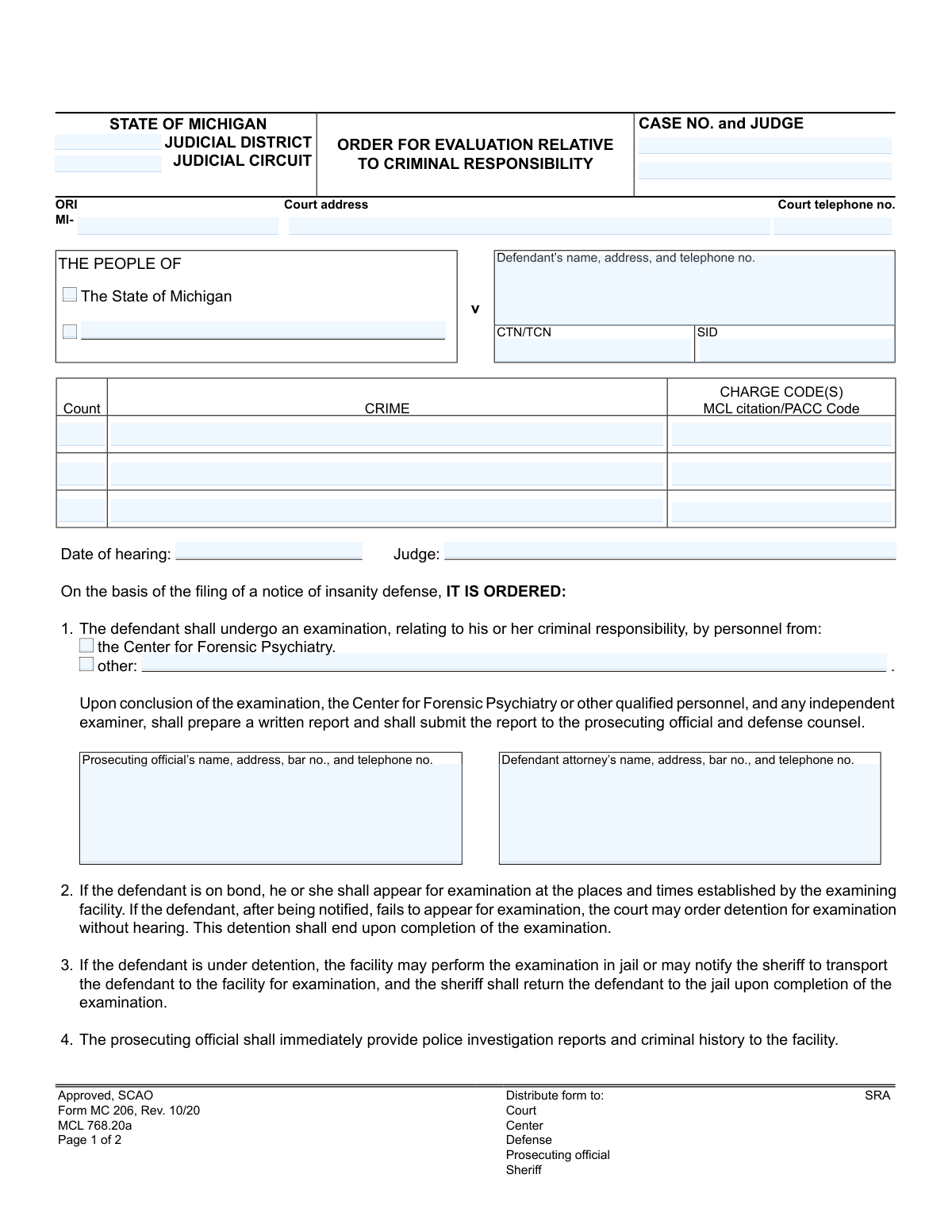
Yes! You can use AI to fill out Form MC 206, Order for Evaluation Relative to Criminal Responsibility
Form MC 206 is a State of Michigan court order used when a defendant raises an insanity defense. The form officially mandates a psychiatric examination of the defendant to assess their criminal responsibility and mental state at the time of the alleged offense. This evaluation is a critical step in the legal process for such cases. Today, this form can be filled out quickly and accurately using AI-powered services like Instafill.ai, which can also convert non-fillable PDF versions into interactive fillable forms.
MC 206 is part of the
Michigan court forms category on Instafill.
Our AI automatically handles information lookup, data retrieval, formatting, and form filling.
It takes less than a minute to fill out MC 206 using our AI form filling.
Securely upload your data. Information is encrypted in transit and deleted immediately after the form is filled out.
Form specifications
| Form name: | Form MC 206, Order for Evaluation Relative to Criminal Responsibility |
| Number of fields: | 31 |
| Number of pages: | 1 |
| Language: | English |
More forms in Michigan court forms
Instafill Demo: How to fill out PDF forms in seconds with AI
How to Fill Out MC 206 Online for Free in 2026
Are you looking to fill out a MC 206 form online quickly and accurately? Instafill.ai offers the #1 AI-powered PDF filling software of 2026, allowing you to complete your MC 206 form in just 37 seconds or less.
Follow these steps to fill out your MC 206 form online using Instafill.ai:
- 1 Navigate to Instafill.ai and upload the MC 206 form or select it from the template library.
- 2 Enter the case information, including the judicial district, circuit, case number, and judge's name.
- 3 Provide the defendant's full name and address, along with the specific charges, including crime and MCL citation.
- 4 Indicate where the examination will be conducted, typically the Center for Forensic Psychiatry or another specified facility.
- 5 Input the names, bar numbers, and contact details for both the prosecuting official and the defense attorney.
- 6 Review all the information auto-filled by the AI for accuracy, making any necessary edits or additions, such as additional orders.
- 7 Download, print, or securely share the completed form for the judge's signature and distribution to all relevant parties.
Our AI-powered system ensures each field is filled out correctly, reducing errors and saving you time.
Why Choose Instafill.ai for Your Fillable MC 206 Form?
Speed
Complete your MC 206 in as little as 37 seconds.
Up-to-Date
Always use the latest 2026 MC 206 form version.
Cost-effective
No need to hire expensive lawyers.
Accuracy
Our AI performs 10 compliance checks to ensure your form is error-free.
Security
Your personal information is protected with bank-level encryption.
Frequently Asked Questions About Form MC 206
This form is a court order that requires a defendant to undergo a psychiatric examination. It is used when a defendant in a criminal case has filed a notice of an insanity defense to determine their mental state at the time of the alleged crime.
A judge issues this order, so it is completed by court personnel under the judge's direction. It is initiated after the defendant's legal team files a notice of intent to use an insanity defense.
The form specifies that the examination will be conducted by personnel from the Center for Forensic Psychiatry or another qualified facility as ordered by the court. The examining facility will establish the specific times and locations.
If a defendant on bond is notified but fails to appear for the examination, the court may order them to be detained for the purpose of completing the evaluation.
The facility may conduct the examination at the jail, or they may notify the sheriff to transport the defendant to the facility for the evaluation. The sheriff will return the defendant to jail upon completion.
The prosecuting official must provide police investigation reports and the defendant's criminal history. The defendant is also ordered to cooperate and provide access to their own medical and psychiatric history.
Upon completion, the examining facility prepares a written report of its findings. This report is then submitted to both the prosecuting official and the defense counsel for their review.
The form specifies distribution to several parties, including the Court, the examining Center, the Defense attorney, the Prosecuting official, the Sheriff, and the SRA (State Repository Agency).
You will need the case number, court address, defendant's name and contact information, and the specific criminal charges, including the MCL citation or PACC Code for each count.
Yes, services like Instafill.ai use AI to accurately auto-fill form fields with case and client data. This can save significant time and help prevent data entry errors for legal professionals.
To fill this form online, you can upload the PDF to Instafill.ai. The platform's AI will automatically detect the form fields, allowing you to quickly and easily type in the required information and save the completed document.
If you have a non-fillable or 'flat' PDF, you can use a service like Instafill.ai. It can convert the static document into an interactive, fillable form that you can complete on your computer.
This section is for the judge to include any specific instructions or conditions related to the evaluation that are not covered in the standard text of the form.
Compliance MC 206
Validation Checks by Instafill.ai
1
Case Number Consistency Across Pages
This check verifies that the 'CASE NO.' field at the top of the form is identical to the 'Case No.' field on the second page. This is a critical consistency check to ensure document integrity, especially if pages are handled separately. A mismatch could lead to incorrect filing or the association of orders with the wrong case file, potentially invalidating the order.
2
Exclusive Plaintiff Selection
This validation ensures that exactly one of the plaintiff checkboxes ('The State of Michigan' or 'The People of') is selected. Furthermore, if 'The People of' is selected, the corresponding text field specifying the municipality must be populated. This rule prevents ambiguity about the prosecuting entity and ensures the form is legally precise and complete.
3
Exclusive Examination Facility Selection
This rule validates that either the 'Center for Forensic Psychiatry' checkbox or the 'other' checkbox is selected, but not both. If the 'other' option is chosen, the corresponding text field specifying the facility's name must be filled. This is critical for ensuring the defendant is sent to the correct location for their evaluation and prevents significant logistical errors and delays.
4
Valid Hearing Date Format and Plausibility
This check verifies that the 'Date of hearing' is a valid calendar date and is formatted correctly (e.g., MM/DD/YYYY). It also confirms that the date is in the past or the present, not in the future, as the order is predicated on a hearing that has already occurred. An invalid or future date would call the legitimacy of the order into question and cause processing failures.
5
Charge Information Integrity
This validation ensures that for every charge count listed (e.g., 'Count1'), the corresponding 'CRIME' and 'MCL citation/PACC Code' fields are also populated. A count number without a description of the crime and its legal citation is incomplete and legally meaningless. This rule enforces the completeness of charge data, which is fundamental to the legal context of the evaluation.
6
Attorney Bar Number Format Validation
This check validates that the bar numbers provided for the prosecuting official and defense attorney follow the expected Michigan State Bar format (e.g., a 'P' prefix followed by a sequence of digits). This helps ensure that the individuals listed are properly licensed attorneys, which is a legal requirement. An invalid format would flag the entry for manual review to verify credentials.
7
Judge Name Consistency
This check ensures that the 'JUDGE' name listed in the case header is identical to the 'Judge' name associated with the hearing date. Consistency is crucial for accurate record-keeping and verifying which judge presided over the hearing that resulted in this order. Discrepancies could invalidate the order or cause administrative delays in processing.
8
ORI Field Format Validation
This check ensures the 'ORI' (Originating Agency Identifier) field conforms to the standard format, which is typically a two-letter state prefix followed by a series of alphanumeric characters (e.g., MIXXXXXXX). This identifier is crucial for law enforcement data systems to track the case's origin correctly. An incorrect format can lead to data rejection or misrouting in state and national crime databases.
9
MCL Citation Format Validation
This validation checks if the 'MCL citation/PACC Code' fields follow the standard Michigan Compiled Laws citation format, which is typically a pattern of numbers separated by periods (e.g., '768.20a'). This ensures the legal basis for the charge is cited accurately and unambiguously. An incorrectly formatted citation could refer to the wrong statute or be considered invalid.
10
Completeness of Core Case Identifiers
This validation confirms that the 'CASE NO.', 'JUDGE', 'JUDICIAL DISTRICT', and 'JUDICIAL CIRCUIT' fields are all populated. These fields are the primary identifiers for the case and are essential for routing the document correctly within the judicial system. Failure to provide this information would render the form unusable and lead to its immediate rejection.
11
Judge's Signature and Date Presence
This check verifies the presence of a signature and a date in the designated area for the judge on page 2. The judge's signature is what gives the order its legal authority and makes it effective. An unsigned or undated order is not legally binding and would be rejected by the receiving facility, requiring the form to be properly executed and resubmitted.
12
CTN/SID Format Validation
This validation verifies that the 'CTN/TCN' (Case Tracking Number) and 'SID' (State Identification Number) fields adhere to their expected formats, which are typically specific sequences of numbers or alphanumeric characters. These numbers are critical unique identifiers within the criminal justice system. Incorrect formats would prevent proper linking of the document to the defendant's electronic record.
Common Mistakes in Completing MC 206
Users often transpose digits or omit prefixes/suffixes when entering the Case Number. Since this number is the primary identifier for the entire legal proceeding, any error can lead to the order being misfiled or rejected, causing significant delays. To avoid this, double-check the number against official court documents before submission. AI-powered tools like Instafill.ai can help by saving and auto-filling previously used case information, reducing the risk of manual entry errors.
The CTN/TCN, SID, and ORI fields are frequently left blank because filers may not have the information readily available or understand its importance. These numbers are crucial for law enforcement and forensic centers to link the order to the correct individual and criminal history. Omitting them forces the receiving facility to perform extra research, delaying the evaluation process. It is essential to locate these numbers on prior case documents before filling out the form.
Failing to provide a complete and current name, address, and telephone number for the defendant is a critical error, especially if they are out on bond. The evaluation facility uses this information to schedule the examination, and missing details can make it impossible to contact the defendant. This can result in a failure to appear, potentially leading to a bond revocation and a warrant for the defendant's arrest.
An entry might list a specific crime (e.g., 'Assault') but provide an incorrect or outdated Michigan Compiled Laws (MCL) citation. This discrepancy creates legal ambiguity and can lead to the evaluation being conducted under the wrong legal standard, potentially jeopardizing the case. Always verify that the crime description and its corresponding MCL code are an exact match as per the official charges.
Entering an incorrect, inactive, or misspelled bar number for the prosecuting or defense attorney is a common oversight. The bar number is a unique professional identifier required for official correspondence and verification of counsel. An error here can cause communication breakdowns, delays in report distribution, and questions about the validity of the filing.
The form requires selecting either 'the Center for Forensic Psychiatry' or 'other'. A common mistake is checking both boxes or checking 'other' without specifying the examiner in the provided text field. This ambiguity makes the order unclear and unenforceable, as it's not certain who is tasked with the evaluation, requiring a corrected order to be issued.
The Case Number is required on both page 1 and page 2, and it's easy to make a typo on one of them, creating an inconsistency. This can cause confusion during filing and processing, making it appear as if the pages belong to different cases. Using a form-filling tool like Instafill.ai can prevent this by automatically populating recurring fields across all pages of a document, ensuring consistency.
The court address and telephone number fields are sometimes left blank, with the filer assuming the information is implicitly known. However, the evaluation facility or other parties may be located in a different jurisdiction and need this information to send reports or ask clarifying questions. Leaving it blank creates an unnecessary communication barrier and can slow down the entire process.
If the judge makes specific verbal rulings during the hearing, such as requiring access to specific medical records or setting a deadline, they must be written in the 'Additional orders' section. People often forget to transcribe these verbal instructions, rendering them non-binding and uncommunicated to the evaluating facility. This omission can compromise the thoroughness and accuracy of the forensic evaluation.
Many court forms are distributed as flat, non-fillable PDFs, leading to illegible handwritten entries and formatting errors. This can cause the form to be rejected by the clerk's office or misinterpreted by the recipient. To avoid this, use a service like Instafill.ai, which can convert any PDF into an interactive, fillable form, ensuring all entries are clean, legible, and correctly placed.
Saved over 80 hours a year
“I was never sure if my IRS forms like W-9 were filled correctly. Now, I can complete the forms accurately without any external help.”
Kevin Martin Green
Your data stays secure with advanced protection from Instafill and our subprocessors

Robust compliance program
Transparent business model
You’re not the product. You always know where your data is and what it is processed for.
ISO 27001, HIPAA, and GDPR
Our subprocesses adhere to multiple compliance standards, including but not limited to ISO 27001, HIPAA, and GDPR.
Security & privacy by design
We consider security and privacy from the initial design phase of any new service or functionality. It’s not an afterthought, it’s built-in, including support for two-factor authentication (2FA) to further protect your account.
Fill out MC 206 with Instafill.ai
Worried about filling PDFs wrong? Instafill securely fills form-mc-206-order-for-evaluation-relative-to-criminal-responsibility forms, ensuring each field is accurate.