
Instafill.ai
7 days free
AI form filling · 52 fields · 2 pages · done in seconds

Yes! You can use AI to fill out Form MC 222, Request for Appointment of Attorney and Order

Don't type 52 fields by hand. Tell our AI about yourself, or upload a document you already have, and it fills every field in seconds. You check it, then download, print or sign.
7 days free, then $19.99/month · Cancel anytime
AI fills it, no typingEncrypted, never used to train AICancel in two clicks
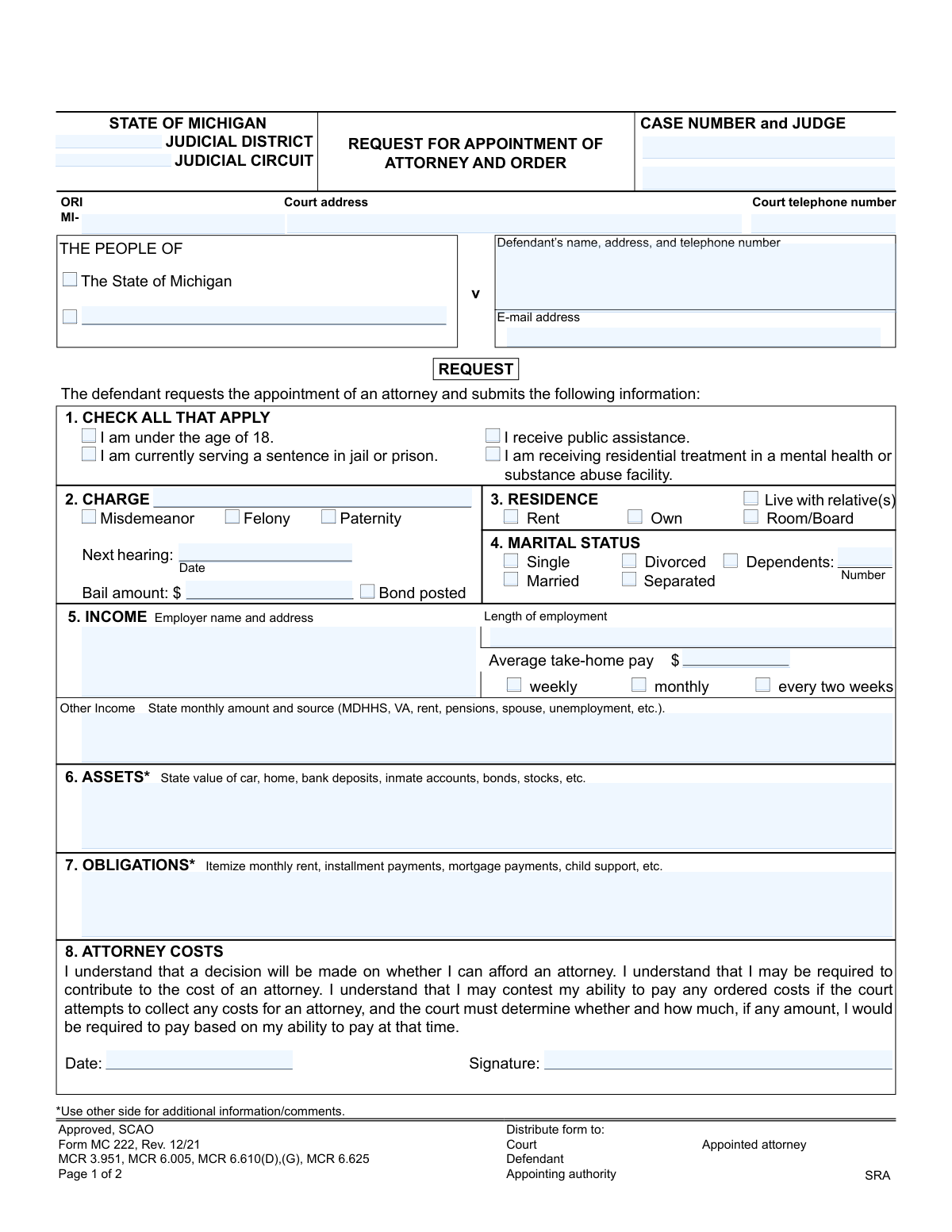
Form MC 222, Request for Appointment of Attorney and Order, page 1
Basic · 36/100Form Complexity Index

The AI does the filling. You just check it.

No typing into boxes, nothing to install.

Tell the AI about youAnswer a few questions in plain words, or upload a document you already have. That is all the typing there is.
AI fills every field in secondsIt puts each answer in the right box on every page, checkboxes included.
Check it and downloadReview every field, change anything, then download, print or sign the PDF.

What this form asks for

The AI fills all of it, from your answers or your documents.

Form MC 222 is a legal document submitted to the Michigan judicial system by individuals who cannot afford to hire their own legal counsel for a pending case. By completing this form, the defendant provides detailed financial information, including income, assets, and obligations, which the court uses to determine their eligibility for a public defender. It is a critical step in ensuring the constitutional right to counsel is upheld for indigent defendants. Today, this form can be filled out quickly and accurately using AI-powered services like Instafill.ai, which can also convert non-fillable PDF versions into interactive fillable forms.
Fillable fields52
Pages2
Form Complexity IndexBasic, 36/100

The AI checks your answers before you download

12 checks built for this form, so a wrong date or a missing answer is caught before anyone else sees it.

Validates Case Number Format

Checks if the Case Number adheres to the standard format used by the Michigan judicial system. This is crucial for correctly filing the document and linking it to the proper legal proceedings. An invalid format could lead to misfiling, rejection of the request, or delays in processing.

Ensures Next Hearing Date is Valid and in the Future

This validation confirms that the 'Next hearing' date is a valid calendar date and is not in the past. An incorrect or past date is logically impossible for a future event and would cause scheduling confusion for the court and the defendant. Failure would require the user to correct the date before submission.

Validates Exclusive Selection of Residence Type

Verifies that the defendant has selected only one option from the 'RESIDENCE' section (Rent, Own, Live with relative(s), Room/Board). A person can only have one primary residence status for the purpose of this form. Selecting multiple options would create ambiguity in assessing their living situation and financial obligations.

Ensures Pay Amount and Pay Frequency are Paired

Validates that if a value is entered for 'Average take-home pay,' one of the corresponding frequency checkboxes (weekly, monthly, every two weeks) must also be selected. Without a frequency, the pay amount is meaningless for calculating monthly income. This check prevents incomplete financial data from being submitted, which is essential for the indigency determination.

Validates Financial Fields are Numeric

This check verifies that the 'Bail amount' and 'Average take-home pay' fields contain only valid numerical or currency values. These figures are fundamental to the financial assessment for appointing an attorney. Non-numeric characters would cause calculation errors and invalidate the defendant's financial profile.

Validates Number of Dependents is a Non-Negative Integer

This check ensures that the value entered for 'Number of Dependents' is a whole number (0 or greater). This number is a key factor in indigency calculations, as it directly impacts the poverty guidelines and the defendant's financial responsibilities. A non-integer or negative value would be invalid and prevent an accurate assessment.

And 6 more checks
  • Ensures at Least One Charge Type is Selected
  • Validates Defendant's Name is Provided
  • Requires Reason for Denial
  • Requires Attorney Details on Appointment
  • Ensures Mutually Exclusive Order Disposition
  • Validates Michigan Attorney Bar Number Format

Let AI fill out your MC 222

No typing. Every field filled in seconds, checked, ready to sign.

7 days free, then $19.99/month · Cancel anytime

How to Fill Out MC 222 Online for Free in 2026

What the AI walks you through.

  1. Navigate to Instafill.ai and upload your MC 222 form, or use the platform's search feature to find the correct version.
  2. Enter your personal details, including your name, address, and the case number in the appropriate fields.
  3. Indicate the charges against you (misdemeanor, felony, or paternity) and provide any known hearing dates or bail information.
  4. Detail your financial situation by providing information on your residence, marital status, dependents, employment, income, assets, and monthly obligations.
  5. Check any boxes that apply to your current situation, such as receiving public assistance or being incarcerated, to provide a complete financial picture.
  6. Carefully review all the information you have entered for accuracy, then electronically sign and date the request section.
  7. Download the completed form for your records and submit it to the court as instructed.

Common Mistakes in Completing MC 222

The ones the AI is built to catch.

Entering Gross Pay Instead of Net 'Take-Home' Pay
The form specifically asks for 'average take-home pay,' but applicants often mistakenly enter their gross salary before taxes and deductions. This inflates their income on paper, which can lead to an incorrect assessment of their financial situation and a potential denial of their request for an attorney. To avoid this, applicants should refer to the 'net pay' amount on their pay stubs and carefully enter that figure.
Omitting All Sources of Income and Public Assistance
Applicants sometimes forget to list all sources of income, such as part-time work, unemployment benefits, or financial support from a spouse or family. They may also fail to check the 'I receive public assistance' box in Section 1, not realizing it includes benefits from MDHHS (like food stamps), which can help establish indigency. Omitting this information can lead to an inaccurate financial picture and potential rejection, or even accusations of providing false information.
Inconsistent Financial Information Across Sections
A frequent error is providing conflicting information between different sections of the form. For example, an applicant might indicate they own a home in Section 3 but fail to list its value as an asset in Section 6, or list three dependents in Section 4 but not include child support payments in their monthly obligations in Section 7. Such inconsistencies raise red flags for the reviewer and can cause delays or denial of the application.
Forgetting to Sign and Date the Form
It is a surprisingly common and critical mistake to leave the signature and date fields blank at the end of the request section. An unsigned form is legally invalid and will be rejected by the court clerk, causing significant delays in the appointment of an attorney. The applicant must then resubmit the entire form, potentially missing crucial deadlines for their case.
Providing Vague or Incomplete Lists of Assets and Obligations
In Sections 6 (Assets) and 7 (Obligations), applicants often provide incomplete or non-specific information. They might forget to list assets like an inmate account or a vehicle, or fail to itemize all monthly obligations such as car payments, medical debt, or court-ordered fines. A complete and detailed list is essential for the court to accurately assess financial hardship; incomplete information weakens the applicant's case for needing a court-appointed attorney.
Incorrectly Calculating Pay Frequency
When reporting income, applicants may enter their pay amount correctly but check the wrong frequency box (e.g., entering a monthly salary but checking the 'weekly' box). This simple error drastically misrepresents their financial situation and will almost certainly lead to the request being denied. It is crucial to double-check that the pay amount and the selected time frame (weekly, monthly, every two weeks) accurately reflect when the income is received.
Leaving Court and Case Information Blank
Applicants who are unfamiliar with the legal system often leave the top section of the form (Case Number, Judge, Judicial District/Circuit) blank because they don't know the information. This forces court clerks to look up the case, delaying the processing of the request. This information can usually be found on other documents related to the case, such as a ticket, bond paperwork, or a notice of hearing.
Overlooking Key Status Checkboxes
In Section 1, the form lists several statuses that can help establish a presumptive need for an attorney, such as being in jail, receiving public assistance, or being in a residential treatment facility. Applicants in a hurry or under stress may overlook these checkboxes. Failing to check an applicable box means the applicant misses a chance to potentially simplify and expedite the approval process.
Using an Unreliable Contact Email Address
Providing an incorrect, inactive, or inaccessible email address is a critical error. The court and the appointed attorney will use this email for time-sensitive communications, including hearing notices and requests for information. Using an unreliable email can lead to missed deadlines and a failure to communicate with legal counsel, jeopardizing the defense. It is vital to provide a personal, active email and check it frequently.
Failing to Distinguish Between Assets and Income
Some applicants get confused between one-time assets and recurring income. For instance, they might list a recent tax refund in the 'Other Income' section instead of as a cash asset in the 'Assets' section. This can make their monthly income appear higher than it actually is, negatively impacting the court's decision. Understanding that income is recurring and assets are things of value one currently possesses is key to filling out the form correctly.

Frequently Asked Questions About MC 222


Is it really free for 7 days?
Yes. You pay $0 today. Cancel before Nov 11 and you are never charged. Keep it, and it is $19.99 a month for 5 fills of your MC 222.
Can I fill other forms too?
This plan is for your MC 222: your own AI agent fills it as often as 5 times a month. To fill other forms and upload your own, choose a Professional plan from your account.
How do I cancel?
From your account, in two clicks, any time. No email, no call.
How does the AI fill out MC 222?
You answer a few questions in plain words, or upload a document you already have. The AI reads what you give it and puts each answer into the right field of MC 222, on every page, in seconds. It checks the answers against the form's own rules, and you review and change anything before you download, print or sign.
What happens to my information?
It is encrypted in transit and at rest, and it is never used to train AI.
How complex is MC 222 to fill out?
MC 222 has a Form Complexity Index of 36 out of 100, in the basic tier: 52 fillable fields across 2 pages. Instafill.ai's AI fills it in under a minute, with every field there for you to review before you download.
What is the purpose of Form MC 222, the Request for Appointment of Attorney?
This form is used to request a court-appointed attorney in Michigan if you are a defendant in a criminal or paternity case and cannot afford to hire one yourself. The court uses the financial information you provide to determine if you are eligible.
Who needs to fill out this form?
Any defendant in a Michigan court case (misdemeanor, felony, or paternity) who believes they cannot afford their own legal representation should complete this form to ask the court for a lawyer.
What information do I need to gather before filling out this form?
You will need details about your case, your personal information, and a complete financial summary. This includes your income, employer details, assets like cars or bank accounts, and monthly obligations like rent or loan payments.
Why does the form ask if I receive public assistance or am in jail?
Checking these boxes in Section 1 helps the court quickly assess your financial need. Being incarcerated, receiving public assistance, or being under 18 can streamline the process of determining your eligibility for a court-appointed attorney.
How should I fill out the 'Assets' and 'Obligations' sections?
In the 'Assets' section (6), list the value of things you own, such as cars, homes, or money in bank accounts. In the 'Obligations' section (7), itemize your regular monthly expenses like rent, mortgage payments, child support, and other installment payments.
What if I am unemployed and have no income?
If you are unemployed, you should still fill out the form completely. You can write "Unemployed" in the employer section and enter "$0" for your take-home pay, but be sure to list any other income sources like unemployment benefits or support from family.
The form says I may have to 'contribute to the cost of an attorney.' What does this mean?
This means that even if the court appoints an attorney for you, you might be ordered to pay back some or all of the legal fees later. This could happen if your financial situation improves or if the court finds you have the ability to pay a portion of the cost.
What happens after I submit the form?
A judge will review your request and the financial information you provided. The judge will then either deny the request, approve it and appoint an attorney, or refer you for further indigency screening to determine eligibility.
Where do I submit the completed Form MC 222?
You should submit the completed and signed form to the court where your case is being heard. The court clerk can provide specific instructions on how to file it.
What should I do if my request for an attorney is denied?
If your request is denied, the order on page 2 will state the reason. You will then be responsible for hiring your own attorney or choosing to represent yourself in court.
Can I use an AI tool to help me fill out this form?
Yes, services like Instafill.ai use AI to help you accurately auto-fill form fields, which can save time and reduce errors. This is especially useful for ensuring all required information is entered correctly.
How can I use Instafill.ai to fill out this form online?
Simply upload the Form MC 222 PDF to the Instafill.ai platform. The service will make the form interactive, allowing you to type your information directly into the fields and use AI-powered assistance to complete it quickly and accurately.
The PDF version of the form I found is not fillable. What can I do?
If you have a non-fillable or 'flat' PDF, you can upload it to a service like Instafill.ai. Their technology can convert it into an interactive, fillable form that you can easily complete, save, and print from your computer.
Encrypted in transit and at restNever used to train AIDelete your forms any time

Get your MC 222 filled out by AI

$0 today. Cancel before Nov 11 and you pay nothing.

7 days free, then $19.99/month · Cancel anytime