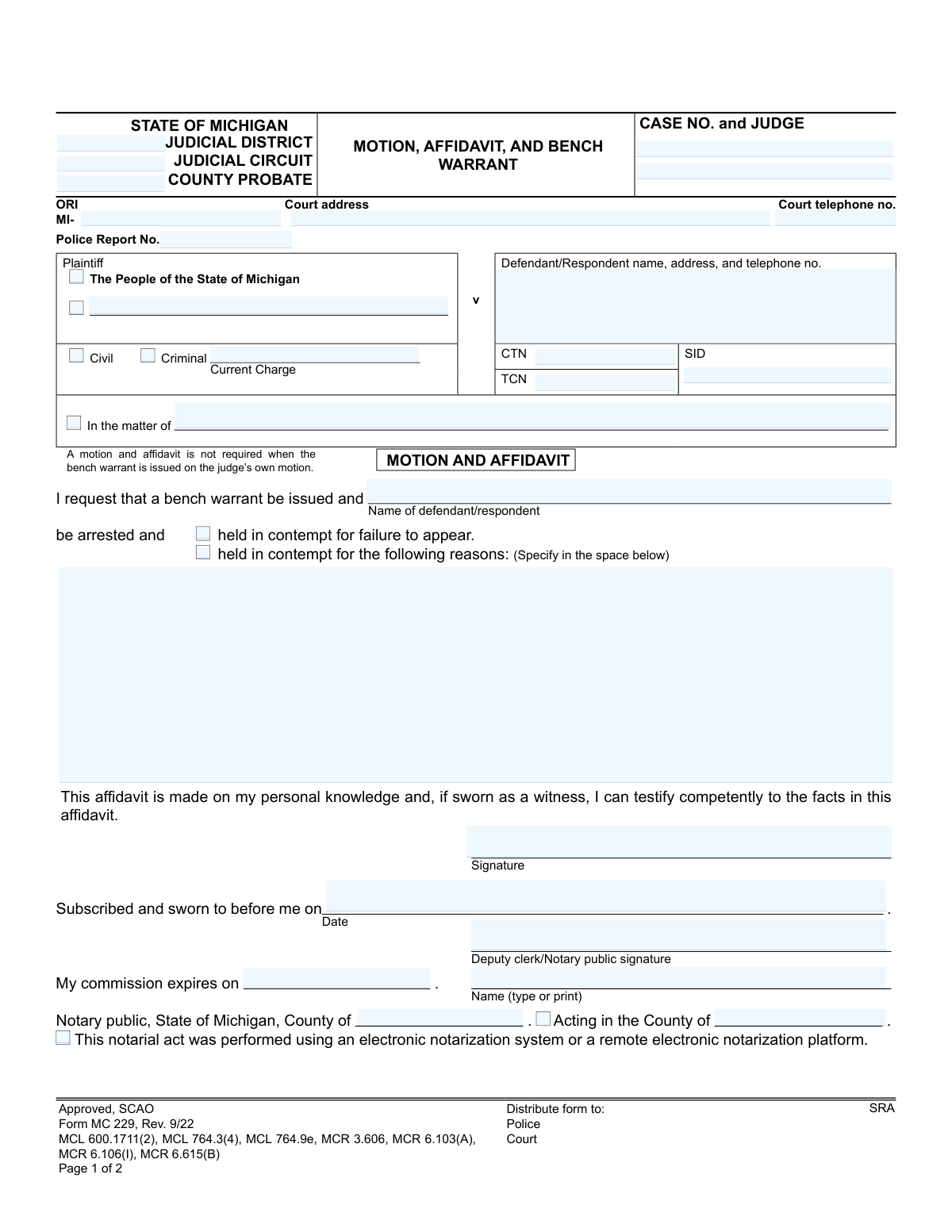
Yes! You can use AI to fill out Form MC 229, Motion, Affidavit, and Bench Warrant

Form MC 229 is a legal document used in Michigan's judicial system to formally request a bench warrant for an individual's arrest. It combines a motion to the court, a sworn affidavit detailing the reasons for the request (such as failure to appear), and the actual warrant for a judge's signature. This form is vital for ensuring compliance with court orders and proceedings. Today, this form can be filled out quickly and accurately using AI-powered services like Instafill.ai, which can also convert non-fillable PDF versions into interactive fillable forms.
MC 229 is part of the Michigan court forms category on Instafill.
Our AI automatically handles information lookup, data retrieval, formatting, and form filling.
It takes less than a minute to fill out MC 229 using our AI form filling.
Securely upload your data. Information is encrypted in transit and deleted immediately after the form is filled out.

Form specifications

Form name: Form MC 229, Motion, Affidavit, and Bench Warrant
Number of fields: 53
Number of pages: 1
Language: English
main-image

Instafill Demo: How to fill out PDF forms in seconds with AI

How to Fill Out MC 229 Online for Free in 2026

Are you looking to fill out a MC 229 form online quickly and accurately? Instafill.ai offers the #1 AI-powered PDF filling software of 2026, allowing you to complete your MC 229 form in just 37 seconds or less.
Follow these steps to fill out your MC 229 form online using Instafill.ai:
  1. 1 Navigate to Instafill.ai and upload or select Form MC 229.
  2. 2 Use the AI assistant to input all relevant case information, including the judicial district/circuit, case number, and judge's name.
  3. 3 Identify the defendant/respondent and specify the reason for the warrant, such as failure to appear or other contemptuous acts.
  4. 4 Complete the affidavit section by providing a sworn statement of facts based on your personal knowledge.
  5. 5 Electronically sign the motion and affidavit section. The AI can guide you on the requirements for notarization if applicable.
  6. 6 Review the entire form, including the warrant section details like bond amount, ensuring all information is accurate before finalization.
  7. 7 Download the completed form to be submitted to the judge for signature and subsequent filing with the court.

Our AI-powered system ensures each field is filled out correctly, reducing errors and saving you time.

Why Choose Instafill.ai for Your Fillable MC 229 Form?

Speed

Complete your MC 229 in as little as 37 seconds.

Up-to-Date

Always use the latest 2026 MC 229 form version.

Cost-effective

No need to hire expensive lawyers.

Accuracy

Our AI performs 10 compliance checks to ensure your form is error-free.

Security

Your personal information is protected with bank-level encryption.

Frequently Asked Questions About Form MC 229

This form is used to formally request that a judge issue a bench warrant for a person's arrest. It combines the request (motion), the sworn statement of facts (affidavit), and the actual warrant for the judge to sign.

The party requesting the warrant, such as a plaintiff or prosecutor, completes the 'Motion and Affidavit' section. A judge must then review and sign the 'Bench Warrant' section to make it a legally enforceable order.

A bench warrant is an arrest warrant issued directly by a judge or court ('the bench'). It is commonly used when a person fails to appear for a scheduled court date or is otherwise held in contempt of court.

You must provide the defendant's full name, date of birth, sex, race, and physical descriptors like height, weight, and eye color. This information is crucial for law enforcement to enter the warrant into the LEIN system for identification.

No. The form specifies that a motion and affidavit are not required when the bench warrant is issued on the judge’s own initiative ('on the judge’s own motion').

Once signed, the bench warrant authorizes any peace officer to arrest the person named. The person will then be brought before the court or may be released upon posting the bond amount specified on the warrant.

The 'Return' section is to be completed by the peace officer after they have made the arrest. It serves as official confirmation to the court that the warrant has been executed and the person is in custody.

Yes, services like Instafill.ai use AI to auto-fill form fields accurately and save time. This is particularly useful for populating the numerous case details and defendant information required on the form.

You can use a service like Instafill.ai to upload the form and fill it out electronically. The platform enables you to type directly into the fields, add necessary signatures, and then download or print the completed document for filing.

If you have a non-fillable or 'flat' PDF, you can upload it to a platform like Instafill.ai. The service can automatically convert the document into an interactive, fillable form that you can complete on your computer.

The 'Motion' is the formal legal request asking the court to issue the warrant. The 'Affidavit' is your sworn statement, made under oath, providing the factual basis and reasons why the warrant should be issued.

Yes, the affidavit must be 'Subscribed and sworn to' before a notary public or a deputy court clerk. This person witnesses your signature and confirms your identity, giving legal weight to your statement.

In this context, being held in contempt means failing to obey a court order. The most common reason cited on this form is 'failure to appear' for a court hearing, but it can also include other specified violations of the court's directives.

The form indicates that after being processed, copies should be distributed to the Police (to execute the arrest), the Court (for its official records), and the Plaintiff (the party who requested the warrant).

Compliance MC 229
Validation Checks by Instafill.ai

1
LEIN Required Fields Check
Validates that the 'Date of birth' (dob), 'Sex' (sex), and 'Race' (race) fields are completed for the person to be arrested. The form explicitly states these are mandatory for entry into the Law Enforcement Information Network (LEIN). Failure to provide this information will result in the warrant being rejected by law enforcement as it cannot be entered into their system for execution.
2
Case Number Format and Completeness
Ensures the 'CASE NO.' field is not empty and follows the standard format for the jurisdiction (e.g., YY-######-XX). This number is the primary identifier for the case within the court system. An incorrect or missing case number will prevent the document from being filed correctly, causing significant delays and potential legal issues.
3
Exclusive Case Type Selection
This validation ensures that either the 'Civil' or 'Criminal' checkbox is selected, but not both. A case must be classified as one or the other for proper processing, jurisdiction, and application of procedural rules. If neither or both are selected, the form is ambiguous and cannot be processed until the case type is clarified.
4
Contempt Reason Specificity
This check verifies that a reason for contempt is provided. If the checkbox for 'held in contempt for the following reasons' is selected, the corresponding text area ('reasonlist') must not be empty. This is crucial for due process, as the defendant has a right to know the specific allegations against them. An incomplete motion lacks the necessary legal foundation and will be rejected by the court.
5
Notary Commission Validity
This validation checks that the notary's commission expiration date ('comissexp') is a valid date and is in the future. A document notarized by someone with an expired commission is legally invalid. This check is essential to ensure the affidavit's legal integrity and prevent the entire motion from being dismissed on a technicality.
6
Affidavit and Notarization Date Consistency
This check compares the date the affiant signed the motion ('date') with the date it was 'Subscribed and sworn to' before the notary. These dates should be identical. A discrepancy could imply the affidavit was signed without the notary present, which would invalidate the oath and render the affidavit legally void.
7
Valid Date of Birth
Ensures the 'Date of birth' (dob) is a valid date formatted correctly (e.g., MM/DD/YYYY) and is a date in the past. This check prevents data entry errors and ensures the identifying information is plausible. An invalid or future date would make the warrant legally questionable and could prevent its entry into law enforcement systems.
8
Return of Service Date Sequence
This validation ensures that the 'Return' date ('returndate') is on or after the date the defendant was taken into custody ('custodydate'). This maintains the logical and chronological accuracy of the officer's report on executing the warrant. A return dated before the custody date would be a logical impossibility and would invalidate the return of service documentation.
9
Jurisdictional Fields Completeness
This check ensures that the 'JUDICIAL DISTRICT', 'JUDICIAL CIRCUIT', and 'COUNTY' fields are all filled out. These fields establish the court's jurisdiction over the matter, which is a foundational requirement for any legal proceeding. Missing jurisdictional information would render the document invalid and un-fileable, as it would be unclear which court has authority.
10
Arrestee Name Consistency Check
This validation compares the name entered in the 'I request that a bench warrant be issued and [arrestname] be arrested' field with the 'Full name' field in the Bench Warrant section. These names must match exactly to ensure there is no ambiguity about who is the subject of the warrant. A discrepancy could lead to legal challenges or the arrest of the wrong person.
11
Bond Amount Format Validation
This validation ensures that if a bond amount ('bondamt') is entered, it is a valid positive numerical or currency value. This is critical for clarity when the arrested individual is given the option to post bond for release. An improperly formatted or ambiguous amount could lead to disputes and delays in the release process.
12
State and ZIP Code Correlation
This check validates that the entered ZIP code ('zip') corresponds to the selected State ('state') in the defendant's address. This is a data quality check that helps ensure the accuracy of the address information. An accurate address is crucial for locating the individual, so preventing such errors is important for the warrant's execution.
13
Required Signature Presence
In a digital submission context, this check ensures that the affiant's signature ('Sig') and the notary's signature ('notpublicsig') fields are not empty. These signatures are legally required to attest to the truthfulness of the affidavit and the validity of the notarization. A submission lacking either signature is incomplete and legally non-binding.

Common Mistakes in Completing MC 229

Omitting Critical LEIN Information

The form explicitly requires the defendant's Date of Birth, Sex, and Race for entry into the Law Enforcement Information Network (LEIN). Filers often overlook the asterisks indicating these mandatory fields or don't have the information available. Without this data, law enforcement cannot enter the warrant into their system, making it completely unenforceable and delaying justice until the form is corrected and resubmitted.

Providing Vague Reasons for Contempt

When not based on a failure to appear, the motion requires a specific, factual description of the contemptuous act. Many filers write vague statements like 'violated court order' without providing dates, specific actions, or referencing the exact order that was violated. This lack of detail gives the judge no legal basis to issue the warrant, leading to an immediate rejection of the motion.

Improper or Incomplete Notarization

The affidavit section must be signed in the physical presence of a notary public or deputy clerk. Common mistakes include signing the document beforehand, the notary forgetting to add their commission expiration date, or failing to indicate the county of notarization. Any error in the notary block can invalidate the entire affidavit, as it means the statement was not properly sworn, requiring the filer to start the process over.

Inconsistent Case Information Across Pages

The Case Number and Judge's name must be entered on both page 1 and page 2. It is a frequent mistake for filers to enter the information on the first page but forget the second, or to make a typographical error on one of the pages. This inconsistency creates administrative confusion, can cause the pages to be separated, and will delay the processing of the warrant until the clerk can reconcile the information.

Incorrectly Identifying the Case Type and Parties

The form provides checkboxes for 'The People of the State of Michigan' (for criminal matters) versus 'In the matter of' (often for civil or probate matters). Filers unfamiliar with legal terminology may select the wrong option or fail to check any box at all. This can lead to the motion being filed under the wrong case type, causing procedural delays and requiring an amended filing.

Providing Incomplete Defendant/Respondent Details

The primary defendant/respondent box requires a name, current address, and telephone number. A frequent error is to provide only a name, or an old, outdated address. Without a valid, last-known address, law enforcement has no starting point to locate the individual and execute the warrant, rendering it ineffective until better information can be provided.

Illegible Handwriting on a Printed Form

Many court forms are still filled out by hand, and illegible handwriting is a primary source of errors. A poorly written name, address, or, most critically, date of birth can be misinterpreted, leading to a warrant with incorrect information. This could result in a failure to identify the correct person or a violation of the wrong person's rights. Since this form is often a non-fillable PDF, using a tool like Instafill.ai to convert it to a fillable version and type the information ensures perfect legibility.

Signing the Affidavit Prematurely

The affidavit section includes the phrase 'Subscribed and sworn to before me,' meaning the signature must be witnessed by the notary. A very common mistake is for the filer to sign the document at home before going to the notary. This invalidates the oath-taking process, and a proper notary will refuse to notarize the pre-signed document, forcing the filer to print and sign a new copy in their presence.

Failure to Properly Distribute Copies

The bottom of page 1 clearly instructs the filer to distribute copies to the 'Police,' 'Court,' and 'Plaintiff.' After getting the warrant signed by a judge, a filer may mistakenly believe the process is complete. However, failing to ensure a copy is delivered to the correct law enforcement agency means the warrant never enters their active queue, and no attempt at arrest will be made. AI-powered tools like Instafill.ai can help by providing clear, step-by-step filing instructions to prevent such procedural errors.
Saved over 80 hours a year

“I was never sure if my IRS forms like W-9 were filled correctly. Now, I can complete the forms accurately without any external help.”

Kevin Martin Green

Your data stays secure with advanced protection from Instafill and our subprocessors

Robust compliance program

Transparent business model

You’re not the product. You always know where your data is and what it is processed for.

ISO 27001, HIPAA, and GDPR

Our subprocesses adhere to multiple compliance standards, including but not limited to ISO 27001, HIPAA, and GDPR.

Security & privacy by design

We consider security and privacy from the initial design phase of any new service or functionality. It’s not an afterthought, it’s built-in, including support for two-factor authentication (2FA) to further protect your account.

Fill out MC 229 with Instafill.ai

Worried about filling PDFs wrong? Instafill securely fills form-mc-229-motion-affidavit-and-bench-warrant forms, ensuring each field is accurate.