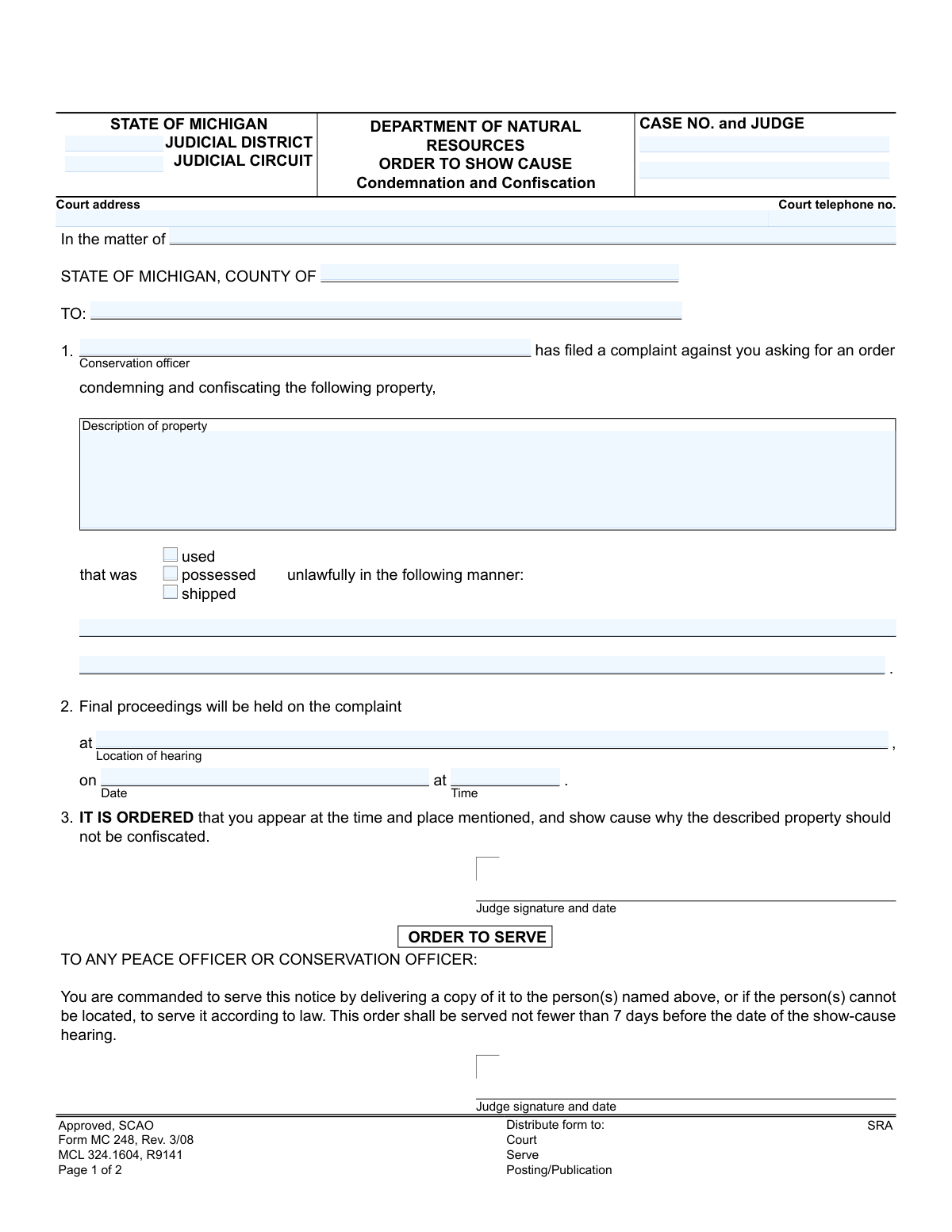
Yes! You can use AI to fill out Form MC 248, Department of Natural Resources, Order to Show Cause, Condemnation and Confiscation

Form MC 248 is a legal document issued by the Michigan Department of Natural Resources (DNR) titled 'Order to Show Cause, Condemnation and Confiscation.' It commands an individual to appear in court to argue why property, seized for being unlawfully used, possessed, or shipped, should not be permanently confiscated by the state. This form initiates the legal process for the final disposition of seized assets. Today, this form can be filled out quickly and accurately using AI-powered services like Instafill.ai, which can also convert non-fillable PDF versions into interactive fillable forms.
MC 248 is part of the Michigan court forms category on Instafill.
Our AI automatically handles information lookup, data retrieval, formatting, and form filling.
It takes less than a minute to fill out MC 248 using our AI form filling.
Securely upload your data. Information is encrypted in transit and deleted immediately after the form is filled out.

Form specifications

Form name: Form MC 248, Department of Natural Resources, Order to Show Cause, Condemnation and Confiscation
Number of fields: 40
Number of pages: 1
Language: English
main-image

Instafill Demo: How to fill out PDF forms in seconds with AI

How to Fill Out MC 248 Online for Free in 2026

Are you looking to fill out a MC 248 form online quickly and accurately? Instafill.ai offers the #1 AI-powered PDF filling software of 2026, allowing you to complete your MC 248 form in just 37 seconds or less.
Follow these steps to fill out your MC 248 form online using Instafill.ai:
  1. 1 Navigate to Instafill.ai and upload or select the Form MC 248.
  2. 2 Provide the court and case information, including the judicial district, circuit, case number, and judge's name.
  3. 3 Enter the details of the individual the order is directed to and the name of the conservation officer who filed the complaint.
  4. 4 Clearly describe the seized property and specify how it was unlawfully used, possessed, or shipped.
  5. 5 Input the location, date, and time for the scheduled show-cause hearing.
  6. 6 Review all the information auto-filled by the AI for accuracy before generating the final document for the judge's signature and subsequent service.
  7. 7 Complete the 'Return of Service' section after the order has been served, detailing the method of service (personal, posting, or publication).

Our AI-powered system ensures each field is filled out correctly, reducing errors and saving you time.

Why Choose Instafill.ai for Your Fillable MC 248 Form?

Speed

Complete your MC 248 in as little as 37 seconds.

Up-to-Date

Always use the latest 2026 MC 248 form version.

Cost-effective

No need to hire expensive lawyers.

Accuracy

Our AI performs 10 compliance checks to ensure your form is error-free.

Security

Your personal information is protected with bank-level encryption.

Frequently Asked Questions About Form MC 248

This is a legal notice from the court, initiated by the Department of Natural Resources (DNR). It orders you to attend a hearing and provide reasons why property seized from you should not be permanently confiscated by the state.

You received this because a conservation officer filed a complaint alleging that your property was used, possessed, or shipped unlawfully. The state is now seeking a court order to permanently take ownership of that property.

To 'show cause' means you must appear in court and present evidence or legal arguments explaining why the judge should not approve the confiscation of your property and should instead order it returned to you.

You must appear at the court hearing at the location, date, and time specified in Section 2 of the form. It is highly recommended that you consult with an attorney before the hearing date.

If you fail to appear at the hearing, the court will likely issue a default judgment in favor of the DNR. This means your property will be automatically and permanently confiscated.

The specific property being considered for confiscation is listed in Section 1 of the form. This can include items like vehicles, boats, equipment, or any other property used in the alleged violation of natural resources laws.

A DNR conservation officer initiates the complaint, and a judge signs the order. The recipient does not fill out this form but must respond to it by attending the court hearing.

The 'Return of Service' is completed by the officer who delivered this order to you. It serves as official proof to the court that you were legally notified of the hearing date and time.

You should immediately contact the court listed at the top of the form to request a postponement (adjournment). Do not simply fail to show up, as this will result in the loss of your property.

While you can represent yourself, it is strongly recommended that you hire an attorney. These are formal legal proceedings, and an attorney can help protect your rights and argue effectively on your behalf.

AI cannot provide legal advice, but if you need to fill out related court forms, services like Instafill.ai can help. They use AI to accurately auto-fill form fields, saving you time and reducing errors on administrative paperwork.

You can upload any fillable PDF forms, such as a motion to adjourn or a request for documents, to Instafill.ai. The service will instantly populate the fields with your saved information, making the process faster and more efficient.

You can use a service like Instafill.ai to handle this issue. It can convert flat, non-fillable PDFs into interactive forms that you can easily type into, save, and print for submission.

Compliance MC 248
Validation Checks by Instafill.ai

1
Case Number Presence and Format
Verifies that the 'caseno' field is not empty and follows the expected format for the judicial district. This is a critical identifier for tracking the case through the legal system. A missing or malformed case number prevents proper filing and retrieval of the document.
2
Hearing Date Validity
Ensures the hearing date ('hdate') is a valid, correctly formatted date that occurs in the future. This prevents scheduling impossible or past hearings. If the date is invalid or in the past, the order is unenforceable and legally unsound.
3
Property Misuse Selection
Checks that at least one of the checkboxes for how the property was used ('usedcheck', 'possessedcheck', 'shipcheck') is selected. This is a required element of the complaint, specifying the nature of the alleged unlawful activity. Failure to select one means the complaint is incomplete and does not state a clear cause for action.
4
Required Complaint Details
Validates that the 'conoff' (Conservation Officer), 'prop' (Description of property), and 'unlawfulmanner1' (description of the unlawful act) fields are all filled. These fields form the core of the complaint against the individual. If any of these are missing, the order lacks the necessary information to be legally sufficient.
5
Service Method Selection
Ensures that on the 'Return of Service' page, at least one method of service ('personalcheck', 'postingcheck', or 'pubcheck') is selected. This certification is required to prove that due diligence was performed to notify the individual of the hearing. Without a selected method, there is no proof of service.
6
Personal Service Completeness
If personal service is indicated ('personalcheck' is true), this validation ensures that the name of the person served ('psname'), date ('psdate'), time ('pstime'), and location ('psloc') are all provided. Omitting any of this information invalidates the proof of personal service. This data is essential for the court to verify that service was properly executed.
7
Service Timing Mandate
Performs a logical check to confirm the date of service (e.g., 'psdate') is at least 7 days before the scheduled hearing date ('hdate'). The form explicitly states this requirement to ensure the recipient has adequate time to prepare. A service date less than 7 days prior makes the notice legally deficient.
8
Posting Service Completeness
If service by posting is indicated ('postingcheck' is true), this check verifies that a reason ('unknowncheck1' or 'unablecheck1') is selected and that all three posting locations ('post1', 'post2', 'post3') are specified. This ensures the alternative service method was executed according to legal requirements for public notice. Incomplete information would nullify the service attempt.
9
Publication Service Completeness
If service by publication is indicated ('pubcheck' is true), this check verifies that a reason ('unknowncheck2' or 'unablecheck2') is selected and that the publication name ('pubname') and dates ('pubdate') are provided. This information is necessary to create a verifiable record that the notice was published as required by law. Missing details would make the service invalid.
10
Signature Date Consistency
Validates that the judge's signature date ('sigdate') is on or before the scheduled hearing date ('hdate'). A judge cannot sign an order for a hearing that has already passed. This check maintains the logical and chronological integrity of the court order.
11
Court Telephone Number Format
Ensures the 'cttelno' field contains a valid telephone number format (e.g., (123) 456-7890). This is important for data quality and ensures that contact information for the court is usable. An invalid format could cause errors in communication or in systems that rely on this data.
12
Service by Mail Logic
Checks for logical consistency between the owner's status and the mailing action. If the owner is marked as 'not known' ('unknowncheck1' or 'unknowncheck2'), the checkbox for sending a copy by registered mail ('mailcheck1' or 'mailcheck2') cannot be selected. It is logically impossible to mail a notice to an unknown owner with no known address.

Common Mistakes in Completing MC 248

Incorrect or Incomplete Court and Case Identifiers

Officers or clerks often enter the wrong Judicial District, transpose digits in the Case Number, or omit the Judge's name due to handling multiple cases. These errors can cause the document to be rejected by the court, misfiled, or delayed, jeopardizing the legal timeline. To prevent this, always double-check identifiers against the official case file. AI-powered tools like Instafill.ai can help by saving and auto-populating correct court profiles, reducing manual entry errors.

Vague or Ambiguous Property Description

The description of property to be confiscated is often too generic (e.g., 'a boat' instead of 'a 14-foot Alumacraft boat, HIN: XYZ123'). This ambiguity creates legal loopholes for the owner to challenge the seizure. A proper description must be unique and detailed, including make, model, and serial numbers. Since this is a non-fillable PDF, using a tool like Instafill.ai to convert it into an interactive form allows for creating templates with placeholder text to guide the user in providing sufficient detail.

Incomplete or Misspelled Recipient Information

In the 'TO:' field, failing to list all known owners or misspelling a name is a frequent mistake that can invalidate the service of the order. The individual can claim they were never properly notified, halting the proceedings. It is crucial to verify the full, correct legal names of all parties with an ownership interest from official records before completing this section.

Insufficient Detail on Unlawful Activity

The section describing how the property was 'unlawfully' used is often filled with conclusory statements rather than specific facts (e.g., 'illegal hunting' vs. 'used to unlawfully take a deer out of season on [Date]'). This lack of factual detail weakens the complaint and can give the recipient grounds to have the case dismissed. Officers should clearly state the actions, dates, and locations that constitute the violation.

Incorrect or Ambiguous Hearing Information

Entering the wrong date, time, or location for the show-cause hearing is a critical error that can lead to an automatic dismissal. Common mistakes include date/month transposition, forgetting to specify AM/PM, or listing an incorrect courthouse address. Using digital tools like Instafill.ai can help prevent these errors by validating date and time formats and allowing for pre-saved, verified location details.

Forgetting the Case Number on the Return of Service

Officers frequently forget to copy the Case Number from the first page to the 'Return of Service' section on page two. This simple oversight causes significant administrative problems, as the clerk's office cannot match the proof of service with the case file. AI form-fillers like Instafill.ai can automatically carry over data like the Case Number from one field to another, even across pages, ensuring consistency.

Improper Documentation of Service by Posting

When personal service is not possible, service by posting has strict legal requirements that are often not met on the form. Officers may fail to list the three distinct public places or omit the specific dates of posting. This procedural failure can invalidate the service, forcing a restart of the notification process. It is essential to be precise and complete when documenting these actions.

Incomplete Publication Details for Service

When service is done by publication, the form requires the name of the publication and the specific dates the notice ran. Officers sometimes forget to write the name of the newspaper or fail to list all required dates. Without this complete information, there is no valid proof of service, which is a fatal flaw that can lead to the case being dismissed for improper notice.

Failure to Attest to Registered Mail Service

For service by posting or publication, the form includes a checkbox to confirm a copy was sent by registered mail to the owner's last-known address. Officers sometimes perform this step but forget to check the box on the form. This omission creates an incomplete record and can be used by the defense to argue that service was defective, even if the mailing actually occurred.

Missing Officer Signature on Return of Service

The serving officer's signature on the 'Return of Service' section is a legal attestation that service was completed as described. Forgetting to sign and date this section is a common and critical mistake, as an unsigned return is legally worthless. It fails to provide the court with valid proof of service, which can halt the entire confiscation proceeding until a properly executed return is filed.
Saved over 80 hours a year

“I was never sure if my IRS forms like W-9 were filled correctly. Now, I can complete the forms accurately without any external help.”

Kevin Martin Green

Your data stays secure with advanced protection from Instafill and our subprocessors

Robust compliance program

Transparent business model

You’re not the product. You always know where your data is and what it is processed for.

ISO 27001, HIPAA, and GDPR

Our subprocesses adhere to multiple compliance standards, including but not limited to ISO 27001, HIPAA, and GDPR.

Security & privacy by design

We consider security and privacy from the initial design phase of any new service or functionality. It’s not an afterthought, it’s built-in, including support for two-factor authentication (2FA) to further protect your account.

Fill out MC 248 with Instafill.ai

Worried about filling PDFs wrong? Instafill securely fills form-mc-248-department-of-natural-resources-order-to-show-cause-condemnation-and-confiscation forms, ensuring each field is accurate.