Yes! You can use AI to fill out Form MC 254, Order for Vehicle Impoundment
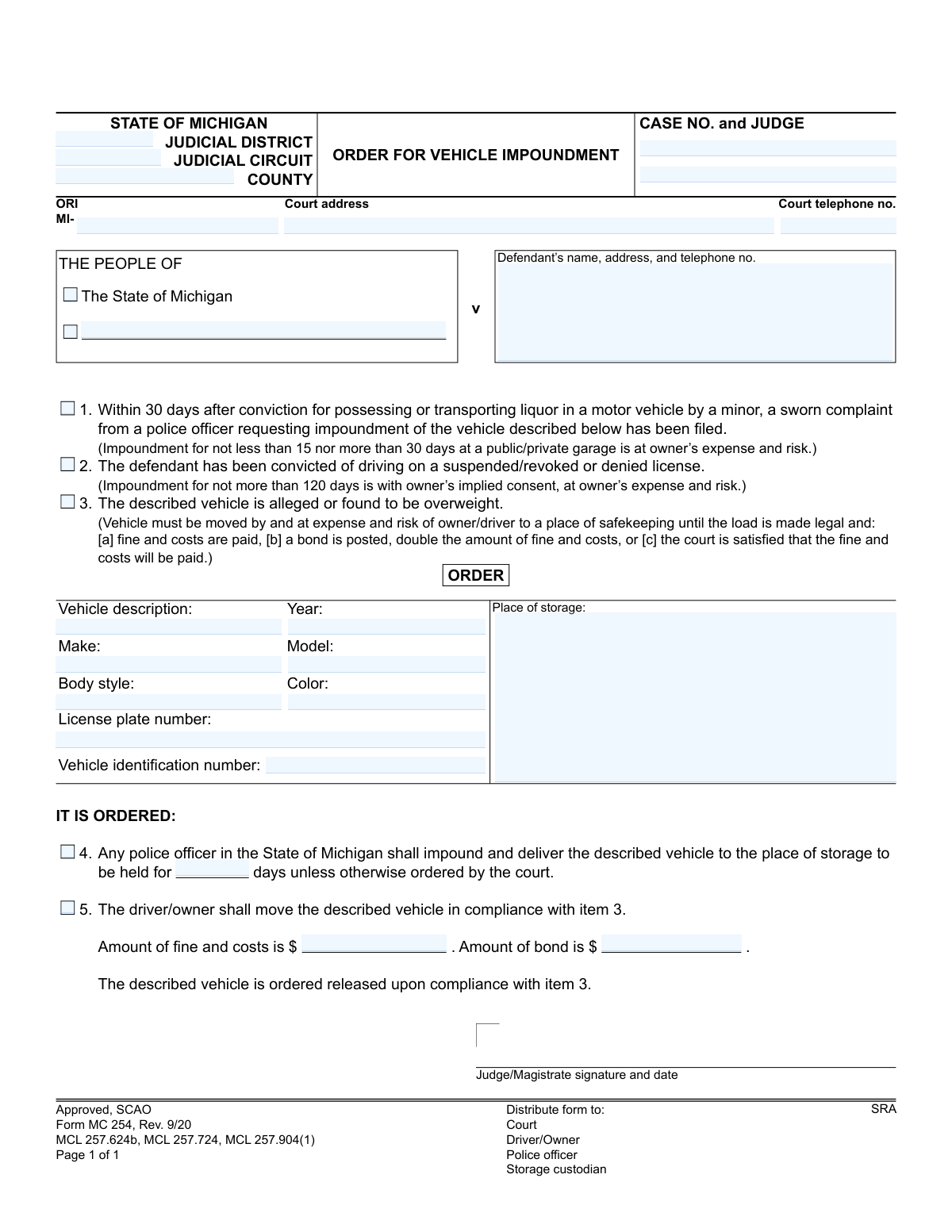
The Michigan Form MC 254, Order for Vehicle Impoundment, is a legal document issued by a judicial district or circuit court. It is used to command the seizure and storage of a vehicle following a conviction for offenses such as a minor possessing liquor in a vehicle, driving on a suspended license, or operating an overweight vehicle. This order details the vehicle information, the reason for impoundment, and the conditions for its release. Today, this form can be filled out quickly and accurately using AI-powered services like Instafill.ai, which can also convert non-fillable PDF versions into interactive fillable forms.
MC 254 is part of the
Michigan court forms category on Instafill.
Our AI automatically handles information lookup, data retrieval, formatting, and form filling.
It takes less than a minute to fill out MC 254 using our AI form filling.
Securely upload your data. Information is encrypted in transit and deleted immediately after the form is filled out.
Form specifications
| Form name: | Form MC 254, Order for Vehicle Impoundment |
| Number of fields: | 29 |
| Number of pages: | 1 |
| Language: | English |
More forms in Michigan court forms
Instafill Demo: How to fill out PDF forms in seconds with AI
How to Fill Out MC 254 Online for Free in 2026
Are you looking to fill out a MC 254 form online quickly and accurately? Instafill.ai offers the #1 AI-powered PDF filling software of 2026, allowing you to complete your MC 254 form in just 37 seconds or less.
Follow these steps to fill out your MC 254 form online using Instafill.ai:
- 1 Navigate to Instafill.ai and upload or select the Form MC 254.
- 2 Provide the court and case information, including the judicial district, county, case number, and judge's name.
- 3 Identify the defendant and check the box corresponding to the legal reason for the impoundment (e.g., driving on a suspended license, overweight vehicle).
- 4 Enter the complete description of the vehicle to be impounded, including its year, make, model, license plate number, and VIN.
- 5 Specify the details of the order, such as the duration of the impoundment, the place of storage, or the fine and bond amount if applicable.
- 6 Review all the information populated by the AI for accuracy and make any necessary edits before finalizing.
- 7 Download, print, and distribute the completed form to the court, driver/owner, police officer, and storage custodian as required.
Our AI-powered system ensures each field is filled out correctly, reducing errors and saving you time.
Why Choose Instafill.ai for Your Fillable MC 254 Form?
Speed
Complete your MC 254 in as little as 37 seconds.
Up-to-Date
Always use the latest 2026 MC 254 form version.
Cost-effective
No need to hire expensive lawyers.
Accuracy
Our AI performs 10 compliance checks to ensure your form is error-free.
Security
Your personal information is protected with bank-level encryption.
Frequently Asked Questions About Form MC 254
This is an official court order from the State of Michigan that authorizes law enforcement to seize and store a vehicle due to specific violations.
A judge or magistrate completes and signs this form to make it a legally binding order. As the defendant or vehicle owner, you will receive a copy but you do not fill it out.
Your vehicle can be impounded for a conviction of driving on a suspended license, a minor possessing or transporting alcohol in the vehicle, or the vehicle being overweight.
The duration depends on the offense: 15 to 30 days for a minor with alcohol violation, and up to 120 days for driving on a suspended license. The exact period will be specified by the judge on the order.
The form clearly states that the impoundment is at the owner's expense and risk, regardless of who was driving the vehicle at the time of the offense.
You must move the vehicle to a designated place of safekeeping until the load is made legal. The vehicle will only be released after the fine and costs are paid or a bond is posted.
The order requires the vehicle's year, make, model, body style, color, license plate number, and Vehicle Identification Number (VIN) to ensure the correct vehicle is seized.
You will need to contact the 'Place of storage' listed on the form, pay all accumulated storage fees, and provide proof of ownership to have your vehicle released.
Once signed, any police officer in Michigan is authorized to impound the specified vehicle and deliver it to the storage location. Copies are then distributed to the court, the driver/owner, the police, and the storage facility.
According to the form, all costs and risks are the responsibility of the vehicle's legal owner, even if they were not the driver involved in the violation.
Since this is a court order completed by a judge, you will not fill it out. However, for managing your records, AI services like Instafill.ai can help you extract data from your copy of the order accurately and save time.
You can upload your PDF copy of the Order for Vehicle Impoundment to Instafill.ai. The platform can read the document and help you easily view, save, or share the key information like case number, impound duration, and storage location.
If you have a flat, non-fillable PDF, you can use a service like Instafill.ai to convert it into an interactive form. This is useful for keeping organized digital records or annotating the document for your reference.
Compliance MC 254
Validation Checks by Instafill.ai
1
VIN Format and Structure Validation
This check verifies that the Vehicle Identification Number (VIN) is exactly 17 characters long and contains only alphanumeric characters (0-9, A-Z, excluding I, O, Q). A valid VIN is crucial for uniquely identifying the specific vehicle to be impounded, preventing errors where the wrong vehicle is seized. If the VIN is invalid, the form submission should be rejected with an error message prompting the user to enter a standard 17-character VIN.
2
Mandatory Case Number
Ensures the 'CASE NO.' field is not empty. The case number is a fundamental piece of information that links the impoundment order to a specific judicial proceeding. Without a valid case number, the order is legally unenforceable and cannot be properly filed or tracked. A failed validation should prevent form submission until a case number is provided.
3
At Least One Reason for Impoundment Selected
Validates that at least one of the checkboxes for the reason for impoundment (items 1, 2, or 3) is selected. The legal basis for the impoundment must be clearly stated on the order. If no reason is selected, the order lacks legal justification and is invalid. The system should display an error message requiring the user to select the appropriate reason before proceeding.
4
Logical Consistency Between Reason and Order
This check ensures the selected 'ORDER' (item 4 or 5) logically follows from the selected 'Reason' (item 1, 2, or 3). Specifically, if reason 1 or 2 is checked, then order 4 (impoundment) must be checked. If reason 3 (overweight) is checked, then order 5 (move vehicle) must be checked. This prevents the creation of a legally nonsensical or contradictory order, ensuring the action taken matches the legal justification.
5
Conditional Requirement for Impoundment Days
Verifies that if the 'impound' order (item 4) is selected, the 'days' field must contain a numeric value. The duration of the impoundment is a critical term of the order. An order to impound without a specified duration is incomplete and unenforceable. Failure to provide a number of days when required should block submission.
6
Impoundment Duration Range Validation
Checks that the number entered in the 'days' field complies with the legal limits based on the reason for impoundment. If reason 1 is selected, the days must be between 15 and 30. If reason 2 is selected, the days must not exceed 120. This validation enforces statutory limits, preventing the issuance of an illegal order with an improper impoundment period.
7
Conditional Requirement for Fine and Bond Amounts
Ensures that if the 'overweight' reason (item 3) is selected, both the 'Amount of fine and costs' and 'Amount of bond' fields are populated. These financial details are essential components of an overweight vehicle order, as release is contingent upon payment or posting bond. The form should not be submittable without these values if the overweight reason is chosen.
8
Vehicle Year Format and Range
This validation confirms that the 'Year' field contains a 4-digit number. It also checks that the year is within a reasonable range, for example, not earlier than 1900 and not later than the current year plus one. This helps prevent typographical errors and ensures the vehicle information is plausible and accurate. An invalid year should trigger an error message.
9
Completeness of Core Vehicle Identifiers
Verifies that the 'Year', 'Make', 'License plate number', and 'Vehicle identification number' fields are all filled out. These four fields together provide a robust method for uniquely identifying the vehicle, which is essential for law enforcement to execute the order correctly. Missing any of these key identifiers could lead to ambiguity or error in seizing the vehicle.
10
ORI Number Format
Checks that the Originating Agency Identifier (ORI) field contains data that follows the expected format, which appears to be a code following the 'MI-' prefix. The ORI is used to identify the specific court or law enforcement agency issuing the order, which is vital for routing, record-keeping, and inter-agency communication. An improperly formatted ORI could cause processing delays or misfiling of the document.
11
Defendant Information Completeness
Ensures the field for the defendant's name, address, and telephone number is not left empty. This information is critical for properly identifying the individual involved in the case and for legal notification purposes. An order without clear defendant information is legally deficient and cannot be properly served or enforced.
12
Court Telephone Number Format
Validates that the 'Court telephone no.' field contains a value that conforms to a standard North American phone number format (e.g., 10 digits, possibly with parentheses, spaces, or hyphens). A valid phone number is important for anyone needing to contact the court regarding the order, such as the vehicle owner or storage facility. This check improves data quality and usability.
13
Monetary Field Format Validation
This check ensures that the 'fine' and 'Bond' fields, when filled, contain valid positive numerical or currency values (e.g., '1500.00' or '1500'). This prevents the entry of non-numeric text or negative numbers into fields intended for financial amounts. Maintaining correct data format is essential for accurate financial processing and record-keeping.
Common Mistakes in Completing MC 254
The 17-character Vehicle Identification Number (VIN) is long and complex, making it highly susceptible to manual entry errors like transposed letters or numbers. An incorrect VIN can lead to the wrong vehicle being identified or impounded, creating significant legal and administrative liabilities. To avoid this, meticulously double-check the VIN against the vehicle's registration and the vehicle itself. AI-powered tools like Instafill.ai can help by validating the VIN's format and checksum, catching errors before submission.
Users often enter the case number incorrectly, omitting prefixes, suffixes, or transposing digits. This happens due to carelessness or misreading handwritten notes. An incorrect case number can cause the impoundment order to be misfiled or prevent it from being linked to the correct court proceeding, leading to major processing delays. Always verify the full, official case number from the court file before entering it.
People may check the wrong box for the impoundment reason (e.g., selecting 'overweight' for a 'suspended license' conviction). This invalidates the legal basis for the order, as the conditions and duration of impoundment are specific to the offense. An order with the wrong justification is legally unenforceable and will be rejected. Carefully review the conviction details and select only the one corresponding checkbox.
A common error is entering a number of days in the 'days' field that falls outside the legal range for the selected offense. For example, ordering a 40-day impoundment for a minor in possession of alcohol, when the law specifies 15-30 days. This makes the order legally invalid and requires it to be corrected and re-issued. Always consult the form's text or the relevant statute (e.g., MCL 257.624b) to ensure the duration is compliant.
Fillers may provide generic information like 'Ford Sedan' instead of the specific Make and Model, or get the color wrong. This occurs when guessing instead of using official documents. A vague description makes it difficult for law enforcement to positively identify the correct vehicle, potentially delaying or preventing the impoundment. Use the vehicle's registration to provide the exact Year, Make, Model, and Body Style.
Often, the person filling out the form completes the vehicle and defendant details but forgets to check a box in the 'IT IS ORDERED' section (e.g., box 4 or 5) or fill in the number of days. This oversight means the document lacks an executable command. Law enforcement cannot act on a form that doesn't explicitly order them to impound the vehicle. A final review is crucial to ensure an operative clause is selected and completed.
The ORI number (MI-XXXXX) directs the order to the correct law enforcement agency, but it's often unknown or guessed by the filler. An incorrect ORI will cause the order to be sent to the wrong jurisdiction or get lost in administrative routing. This results in a failure to execute the impoundment. The correct ORI must be verified with the court or police department handling the case.
The 'Place of storage' field is frequently left empty, creating ambiguity for the impounding officer. Without a designated location, the officer may not know which contracted impound lot to use, causing delays and confusion for the owner when they attempt to retrieve the vehicle. To prevent this, the authorized storage facility's name and address should be clearly specified as per local court procedure.
When the form is only available as a non-fillable PDF, users often print it and fill it out by hand, leading to illegible entries. Poor handwriting for critical data like the VIN, case number, or defendant's name can cause transcription errors by clerks and officers, leading to misidentification or processing failures. If possible, use a fillable version; otherwise, a tool like Instafill.ai can convert the flat PDF into a fillable one to ensure all data is clear and legible.
Saved over 80 hours a year
“I was never sure if my IRS forms like W-9 were filled correctly. Now, I can complete the forms accurately without any external help.”
Kevin Martin Green
Your data stays secure with advanced protection from Instafill and our subprocessors

Robust compliance program
Transparent business model
You’re not the product. You always know where your data is and what it is processed for.
ISO 27001, HIPAA, and GDPR
Our subprocesses adhere to multiple compliance standards, including but not limited to ISO 27001, HIPAA, and GDPR.
Security & privacy by design
We consider security and privacy from the initial design phase of any new service or functionality. It’s not an afterthought, it’s built-in, including support for two-factor authentication (2FA) to further protect your account.
Fill out MC 254 with Instafill.ai
Worried about filling PDFs wrong? Instafill securely fills form-mc-254-order-for-vehicle-impoundment forms, ensuring each field is accurate.