Yes! You can use AI to fill out Form MC 263, Motion/Order of Nolle Prosequi
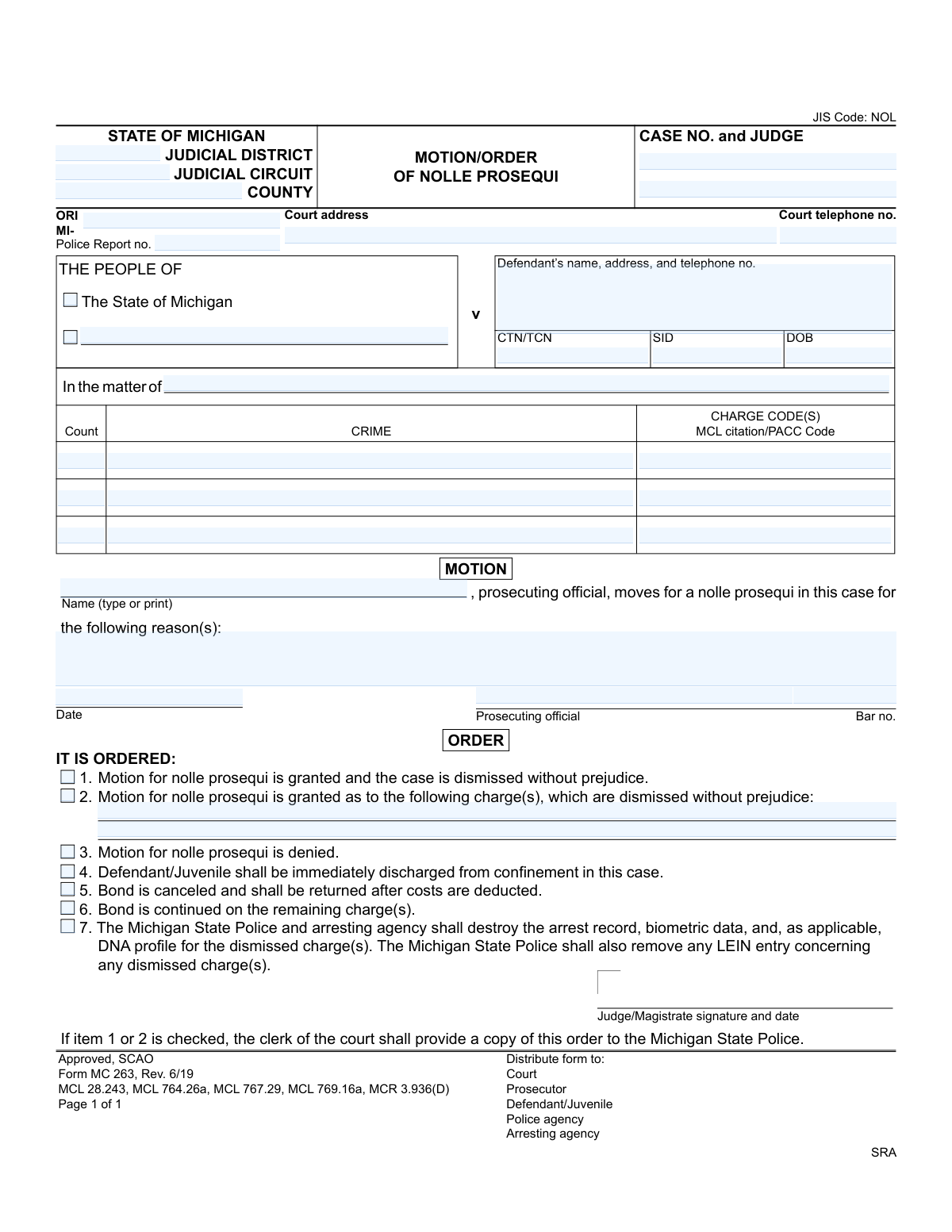
This is a legal document used in the Michigan court system for a prosecutor to formally declare their intention to discontinue a criminal prosecution. The form serves as both the prosecutor's motion and the judge's subsequent order, which can grant or deny the dismissal of charges. Today, this form can be filled out quickly and accurately using AI-powered services like Instafill.ai, which can also convert non-fillable PDF versions into interactive fillable forms.
MC 263 is part of the
Michigan court forms category on Instafill.
Our AI automatically handles information lookup, data retrieval, formatting, and form filling.
It takes less than a minute to fill out MC 263 using our AI form filling.
Securely upload your data. Information is encrypted in transit and deleted immediately after the form is filled out.
Form specifications
| Form name: | Form MC 263, Motion/Order of Nolle Prosequi |
| Number of fields: | 40 |
| Number of pages: | 1 |
| Language: | English |
More forms in Michigan court forms
Instafill Demo: How to fill out PDF forms in seconds with AI
How to Fill Out MC 263 Online for Free in 2026
Are you looking to fill out a MC 263 form online quickly and accurately? Instafill.ai offers the #1 AI-powered PDF filling software of 2026, allowing you to complete your MC 263 form in just 37 seconds or less.
Follow these steps to fill out your MC 263 form online using Instafill.ai:
- 1 Navigate to Instafill.ai and upload or select the Michigan Form MC 263, Motion/Order of Nolle Prosequi.
- 2 Use the AI assistant to automatically populate court and case information, including the judicial district/circuit, case number, and judge's name.
- 3 Enter the defendant's name and other identifying details like CTN, SID, and date of birth.
- 4 Specify the criminal charges, including the count, crime description, and relevant charge codes or MCL citations.
- 5 In the 'MOTION' section, the prosecuting official provides the reason(s) for the nolle prosequi, signs, and dates the form.
- 6 The 'ORDER' section is completed by the judge, who will check the appropriate boxes to grant or deny the motion, and specify further actions regarding the defendant's confinement, bond, or arrest records.
- 7 Review all the information for accuracy before the form is signed by the judge and distributed to the required parties, such as the court, prosecutor, defendant, and police agencies.
Our AI-powered system ensures each field is filled out correctly, reducing errors and saving you time.
Why Choose Instafill.ai for Your Fillable MC 263 Form?
Speed
Complete your MC 263 in as little as 37 seconds.
Up-to-Date
Always use the latest 2026 MC 263 form version.
Cost-effective
No need to hire expensive lawyers.
Accuracy
Our AI performs 10 compliance checks to ensure your form is error-free.
Security
Your personal information is protected with bank-level encryption.
Frequently Asked Questions About Form MC 263
This is a legal form used by a prosecutor to request the dismissal of criminal charges against a defendant. If a judge signs the order, it officially dismisses the case or specific charges.
Nolle prosequi is a Latin term that means 'unwilling to prosecute.' It is a formal notice from the prosecutor that they are dropping the charges in a criminal case.
The prosecuting official initiates the process by filling out the 'MOTION' section to request the dismissal. A judge then reviews the motion and completes the 'ORDER' section to either grant or deny the request.
This means that while the current case is being dismissed, the prosecutor legally reserves the right to refile the same charges in the future. This is different from a dismissal 'with prejudice,' which would permanently prevent the charges from being brought again.
If the judge checks box #7 on the order, the Michigan State Police and arresting agency are ordered to destroy the arrest record and biometric data for the dismissed charges. You should confirm with your attorney that this action has been completed.
The judge's order will specify what happens to your bond. It may be canceled and returned after any costs are deducted, or it could be continued if there are other charges remaining in the case.
A prosecutor might file this motion for many reasons, such as insufficient evidence to proceed, a key witness becoming unavailable, or as part of a plea agreement. The specific reason is often briefly noted on the form.
If the judge checks box #3 and denies the motion, the charges are not dismissed. The criminal case will continue to proceed as it was before the motion was filed.
No, the defendant does not fill out this form. It is initiated by the prosecutor and completed by a judge, but you or your attorney will receive a copy for your records.
Item 1 dismisses the entire case against you. Item 2 is used when you face multiple charges, and the prosecutor is only dropping some of them, while the others remain active.
Yes, legal professionals can use services like Instafill.ai to auto-fill form fields with case, defendant, and court information accurately, which saves time and helps prevent clerical errors.
To fill this form online, you can upload it to Instafill.ai. The AI platform will identify all the fields like 'Case No.' and 'Defendant's name,' allowing you to click and type or connect a data source to populate them instantly.
If you have a flat, non-fillable PDF, you can use a service like Instafill.ai. Simply upload the document, and its AI will convert it into an interactive, fillable form that you can complete and save online.
Compliance MC 263
Validation Checks by Instafill.ai
1
Case Number Format and Existence
Validates that the Case Number field is not empty and conforms to the standard format used by the Michigan judicial system (e.g., YY-######-XX). This is critical for correctly identifying and filing the document within the court's case management system. An invalid or missing case number will cause the document to be rejected or misfiled, delaying legal proceedings.
2
Prosecuting Official's Bar Number Format
Ensures the prosecutor's bar number is present and follows the format required by the State Bar of Michigan (e.g., 'P' followed by five digits). This number uniquely identifies the prosecuting official and confirms their authority to practice law and file such motions. A missing or invalid bar number can invalidate the motion and lead to its rejection by the court clerk.
3
Mutually Exclusive Order Selection
This check verifies that only one of the primary order dispositions is selected: 'granted and case dismissed' (Item 1), 'granted as to specific charges' (Item 2), or 'denied' (Item 3). Selecting conflicting options, such as both granting and denying the motion, creates an ambiguous and unenforceable order. The system should flag this as an error, forcing the user to make a single, clear choice.
4
Conditional Requirement for Dismissed Charges
Validates that if 'Motion... is granted as to the following charge(s)' (Item 2) is selected, the corresponding text field specifying which charges are dismissed is filled out. This is crucial for clarity and legal precision, ensuring there is no ambiguity about which parts of the case are being dropped. Failure to specify the charges renders the order incomplete and ineffective.
5
Defendant's Date of Birth (DOB) Validity
This validation confirms that the Defendant's Date of Birth (DOB) is a valid date in a recognized format (e.g., MM/DD/YYYY) and is a plausible date. It should check that the date is in the past and that the calculated age is reasonable for a defendant (e.g., not over 120 years old). An accurate DOB is essential for correct identification and for cross-referencing with other criminal justice databases.
6
Logical Date Sequence for Motion and Order
Verifies that the date on the signed Order is on or after the date the Motion was filed. A judge cannot rule on a motion before it has been officially submitted. This check prevents chronological impossibilities that would invalidate the legal document and cause confusion in the case record.
7
Required Justification for Nolle Prosequi
This check confirms that the 'reason(s)' text area for the motion is not empty. The prosecuting official must provide a legal or factual basis for requesting the dismissal of charges. Without a stated reason, the motion is incomplete and lacks the necessary justification for a judge to review and approve it.
8
Charge Information Completeness
Ensures that for every Count number entered, the corresponding 'CRIME' description and 'CHARGE CODE(S)' fields are also filled. A count number by itself is meaningless; it must be associated with a specific alleged crime and its legal code for the motion to be legally sound. This prevents incomplete or ambiguous requests for dismissal.
9
ORI Number Format Validation
Validates that the Originating Agency Identifier (ORI) field follows the standard format, which typically starts with 'MI' followed by a specific sequence of numbers and/or letters. The ORI is crucial for routing information correctly, especially for the instruction to provide a copy to the Michigan State Police. An incorrect ORI could lead to critical updates not reaching the intended law enforcement databases.
10
Bond Disposition Logic
This validation checks the logical consistency of the bond-related orders. If the entire case is dismissed (Item 1), the bond should be canceled (Item 5), not continued (Item 6). If only some charges are dismissed (Item 2), the bond may be continued on the remaining charges (Item 6). This check prevents contradictory orders regarding the defendant's bond.
11
MCL Citation/PACC Code Format
Verifies that the Michigan Compiled Laws (MCL) citation or PACC Code entered for a charge follows a recognized legal format (e.g., ###.###a). This ensures the charge is cited with legal precision, which is essential for the accuracy of the court record and for any subsequent actions. An improperly formatted citation can create ambiguity about the specific law in question.
12
Judge's Signature and Date on Order
Verifies that the Judge/Magistrate's signature and the date of the order are present for any order that is granted or denied (Items 1, 2, or 3). An order is not legally effective until it is signed and dated by a judicial officer. This check prevents the processing of incomplete or un-officiated orders.
13
Michigan State Police (MSP) Notification Trigger
This is a system-level check to confirm that if the motion is granted (Item 1 or 2 is checked), a process is triggered to ensure the clerk provides a copy of the order to the Michigan State Police. The form explicitly states this requirement. This validation ensures compliance with state-mandated reporting for criminal history record updates.
Common Mistakes in Completing MC 263
Users frequently mistype the 'CASE NO.', 'Police Report no.', or the 'ORI MI-' number, often due to simple transcription errors from other documents. An incorrect case identifier can lead to the motion being filed in the wrong case, causing significant delays, or even resulting in the dismissal of charges for the wrong individual. To avoid this, meticulously double-check these numbers against official court and police records; AI-powered tools like Instafill.ai can help by cross-referencing and validating data from source documents to ensure accuracy.
A critical error is incorrectly matching the 'CRIME' description with its corresponding 'CHARGE CODE(S)' and 'MCL citation/PACC Code'. This mistake can occur when dealing with multiple counts or complex statutes, leading to ambiguity about which specific charge is being dismissed. The consequence is that the motion may be denied for lack of clarity, or the wrong charge could be inadvertently dismissed. Always verify the exact legal citation and code for each named crime from the original charging documents to ensure perfect alignment.
The 'CTN/TCN', 'SID', and 'DOB' fields are vital for uniquely identifying the defendant within state and national criminal justice databases. These long alphanumeric strings are often transcribed incorrectly, or the user may not know where to find them, leaving them blank. An error here can prevent the dismissal from being correctly recorded in the defendant's criminal history, meaning the charge may still appear on background checks. Ensure these numbers are copied precisely from the defendant's official record; using a form-filling tool can help store and accurately populate this recurring data without manual entry.
The 'reason(s)' field is often filled with vague statements like 'in the interest of justice' without further explanation. Judges require a specific, legally valid reason for dismissing a case, such as insufficient evidence, witness unavailability, or the defendant's completion of a diversion program. A vague justification can lead the judge to deny the motion, forcing the prosecution to either proceed with the case or refile the motion with a more detailed explanation. Provide a clear and concise factual basis for the motion to ensure judicial approval.
Filling out the wrong 'Judicial District', 'Judicial Circuit', or 'County' is a common administrative error, especially for officials who work across multiple jurisdictions. This mistake routes the document to the wrong courthouse, causing it to be rejected and returned, which delays the entire process. The consequences can be particularly severe if there are time-sensitive matters related to the defendant's custody or bond. Always confirm the correct court and county where the case was originally filed before completing this section.
Mistakes in the 'Prosecuting official' section, such as an incorrect 'Bar no.', a missing signature, or a printed name that doesn't match the bar number, can invalidate the entire motion. These errors occur due to oversight or clerical mistakes. An invalid motion is legally ineffective and will be rejected by the court clerk or the judge, requiring the entire form to be corrected and resubmitted. The prosecuting official must carefully review their own information for accuracy before filing.
When the motion is granted for only some charges (Order box 2), a common mistake is failing to clearly list exactly which counts are being dismissed in the space provided. This creates ambiguity and legal uncertainty, leaving it unclear which charges remain active. This can lead to future legal challenges and requires a corrected order to be issued, delaying the final resolution of the case. If box 2 is checked, always explicitly list the dismissed counts and charges.
After the primary motion is granted, it is crucial to address the consequences by checking the appropriate boxes for 'discharged from confinement' (4), 'Bond is canceled' (5), or record destruction (7). Forgetting to check these boxes can have severe real-world impacts, such as a defendant remaining in jail unnecessarily, bond money being held indefinitely, or an arrest record not being expunged as required by law. The filer or judge must review these ancillary orders carefully to ensure the defendant receives the full legal benefit of the dismissal.
When this form is printed and filled out by hand, illegible writing is a frequent problem that can render critical information like names, case numbers, and citations unreadable. This forces court clerks to guess at the information, leading to data entry errors, or to reject the form entirely. Since this is often a non-fillable PDF, using a tool like Instafill.ai to convert it into a digitally fillable version ensures all entries are typed, legible, and professional, preventing rejections and processing errors.
Entering the wrong defendant's name or using an alias without the legal name can cause significant confusion, especially when dealing with common names or when information is copied hastily. The direct consequence is that the legal action might be applied to the wrong person's record or be rejected altogether, requiring correction and refiling. It is essential to use the defendant's full, official legal name as it appears on the original charging documents and to verify it with the 'DOB' and 'SID' numbers.
Saved over 80 hours a year
“I was never sure if my IRS forms like W-9 were filled correctly. Now, I can complete the forms accurately without any external help.”
Kevin Martin Green
Your data stays secure with advanced protection from Instafill and our subprocessors

Robust compliance program
Transparent business model
You’re not the product. You always know where your data is and what it is processed for.
ISO 27001, HIPAA, and GDPR
Our subprocesses adhere to multiple compliance standards, including but not limited to ISO 27001, HIPAA, and GDPR.
Security & privacy by design
We consider security and privacy from the initial design phase of any new service or functionality. It’s not an afterthought, it’s built-in, including support for two-factor authentication (2FA) to further protect your account.
Fill out MC 263 with Instafill.ai
Worried about filling PDFs wrong? Instafill securely fills form-mc-263-motionorder-of-nolle-prosequi forms, ensuring each field is accurate.