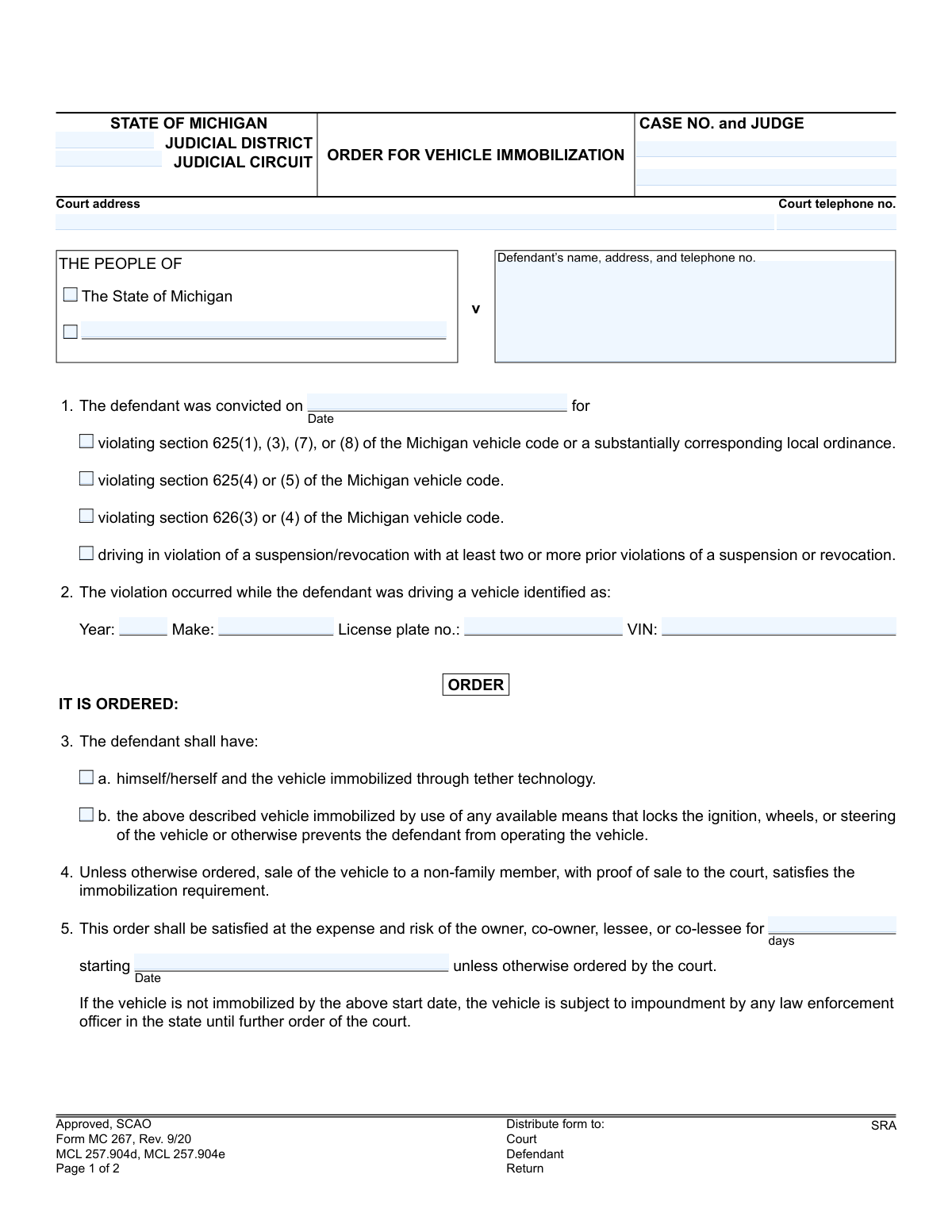
Yes! You can use AI to fill out Form MC 267, Order for Vehicle Immobilization
Form MC 267, the Order for Vehicle Immobilization, is a legal document used by Michigan courts to officially order the immobilization of a vehicle. It is issued after a defendant is convicted of specific traffic violations, such as drunk driving, and specifies the vehicle, the method of immobilization, and the duration. Today, this form can be filled out quickly and accurately using AI-powered services like Instafill.ai, which can also convert non-fillable PDF versions into interactive fillable forms.
MC 267 is part of the
Michigan court forms category on Instafill.
Our AI automatically handles information lookup, data retrieval, formatting, and form filling.
It takes less than a minute to fill out MC 267 using our AI form filling.
Securely upload your data. Information is encrypted in transit and deleted immediately after the form is filled out.
Form specifications
| Form name: | Form MC 267, Order for Vehicle Immobilization |
| Number of fields: | 34 |
| Number of pages: | 1 |
| Language: | English |
More forms in Michigan court forms
Instafill Demo: How to fill out PDF forms in seconds with AI
How to Fill Out MC 267 Online for Free in 2026
Are you looking to fill out a MC 267 form online quickly and accurately? Instafill.ai offers the #1 AI-powered PDF filling software of 2026, allowing you to complete your MC 267 form in just 37 seconds or less.
Follow these steps to fill out your MC 267 form online using Instafill.ai:
- 1 Navigate to Instafill.ai and upload or select the Michigan Order for Vehicle Immobilization, Form MC 267.
- 2 Provide the court and case details, including the judicial district, circuit, case number, and judge's name.
- 3 Enter the defendant's information and specify the conviction details by selecting the relevant violation and date.
- 4 Input the complete details of the vehicle to be immobilized, including its year, make, license plate number, and VIN.
- 5 Indicate the specific terms of the immobilization order, such as the method (tether or other means) and the duration in days.
- 6 Review all the information populated by the AI for accuracy, then have the authorized judge or magistrate e-sign and date the order.
- 7 Download the completed form and distribute copies to the court, the defendant, and other required parties as indicated.
Our AI-powered system ensures each field is filled out correctly, reducing errors and saving you time.
Why Choose Instafill.ai for Your Fillable MC 267 Form?
Speed
Complete your MC 267 in as little as 37 seconds.
Up-to-Date
Always use the latest 2026 MC 267 form version.
Cost-effective
No need to hire expensive lawyers.
Accuracy
Our AI performs 10 compliance checks to ensure your form is error-free.
Security
Your personal information is protected with bank-level encryption.
Frequently Asked Questions About Form MC 267
This is a court order from the State of Michigan that requires a specific vehicle to be made inoperable for a set period. It is issued as part of a sentence for certain driving-related convictions, such as a DUI.
The court fills out and issues the order itself. The defendant is then responsible for having a certified professional immobilize the vehicle and complete the 'Certification of Immobilization' section on the second page.
Immobilization means your vehicle is made undrivable using a court-approved method. This could be through tether technology, an ignition lock, or a device that locks the wheels or steering, as specified in section 3 of the order.
The form states that the immobilization is at the expense and risk of the vehicle's owner or lessee. You are responsible for all costs associated with the installation, maintenance, and removal of the device.
The duration is determined by the judge and will be written in the 'days' field in section 5 of the order. The order also specifies the exact start date for the immobilization period.
If you fail to immobilize the vehicle by the start date listed in section 5, the vehicle can be impounded by any law enforcement officer. It will remain impounded until the court issues a further order.
Yes, section 4 of the form indicates that selling the vehicle to a non-family member can satisfy the order. You must provide the court with proof of the sale.
The order must include the vehicle's year, make, license plate number, and Vehicle Identification Number (VIN). This information is listed in section 2 to identify the specific vehicle that must be immobilized.
No. The form includes a warning that it is a 93-day misdemeanor to purchase, lease, or otherwise obtain another motor vehicle while your vehicle is subject to an immobilization order.
This section serves as proof that you have complied with the court order. The person or company that installs the immobilization device must fill it out, certifying the date and method used, and provide their signature and business details.
The form clearly states that it is a 93-day misdemeanor to tamper with, remove, or bypass a device that has been installed on a vehicle by court order.
Yes, services like Instafill.ai use AI to help you manage and understand the document. AI can accurately extract key information like deadlines and vehicle details, helping you track your obligations and avoid penalties.
You can upload the PDF of your Order for Vehicle Immobilization to Instafill.ai. The platform can help you extract important dates, set reminders for compliance, and securely store a digital copy for your records or for sharing with the immobilization company.
Instafill.ai can convert flat, non-fillable PDFs into interactive, fillable forms. This is particularly useful for the 'Certification of Immobilization' section, allowing the service provider to easily type their information before printing and signing.
Compliance MC 267
Validation Checks by Instafill.ai
1
Case Number Format and Consistency
This check ensures the 'CASE NO.' field is not empty and conforms to the expected format for the judicial district/circuit. It also verifies that the case number entered on page 1 matches the case number on page 2. This is critical for uniquely identifying the legal case and preventing data entry errors that could lead to misfiling or incorrect record association.
2
Conviction Date is a Valid Past Date
Validates that the 'Date' of conviction is a real calendar date and occurs on or before the current date. An order cannot be based on a future conviction. This check prevents illogical or fraudulent data entry and ensures the legal prerequisite for the immobilization order has been met.
3
Mandatory Violation Type Selection
Ensures that at least one of the four checkboxes specifying the violation type (e.g., 'violating section 625(1)...') is selected. The legal basis for the immobilization order must be clearly established. If no violation is selected, the form is incomplete and the order is legally invalid.
4
Vehicle Identification Number (VIN) Structure
This validation confirms the 'VIN' field contains exactly 17 alphanumeric characters, excluding I, O, and Q, as per the standard. A valid VIN is essential for uniquely identifying the vehicle to be immobilized, preventing ambiguity and ensuring the correct vehicle is targeted. An invalid VIN would make the order unenforceable.
5
Logical Vehicle Model Year
Checks that the vehicle 'Year' is a four-digit number within a reasonable range (e.g., 1950 to the current year plus one). This prevents typos like '23' instead of '2023' or nonsensical years. Accurate vehicle information is necessary for law enforcement to correctly identify the vehicle.
6
Complete Vehicle Identification
Verifies that the 'Year', 'Make', 'License plate no.', and 'VIN' fields are all filled out. Incomplete vehicle information could lead to ambiguity and make it impossible for law enforcement or immobilization agents to locate and act on the correct vehicle. All fields are required for positive identification.
7
Immobilization Method Selection
Requires that at least one of the immobilization method checkboxes ('tether technology' or 'locks the ignition, wheels, or steering') is selected. The order must specify the means of immobilization to be valid and clear. Failure to select a method leaves the order ambiguous and potentially unenforceable.
8
Immobilization Duration is a Positive Integer
Ensures the 'days' field for the immobilization period contains a positive whole number. A duration cannot be zero, negative, or a fraction. This validation guarantees the order specifies a clear and valid time period as required by the sentence.
9
Immobilization Start Date Logic
Validates that the immobilization start 'Date' is a valid calendar date and is on or after the 'Date' of conviction. It is logically impossible for the immobilization period to begin before the conviction that ordered it. This check maintains the chronological integrity of the legal process.
10
Conditional 'Other' Field Requirement
This check ensures that if the 'Other' checkbox is selected in section 6, the corresponding text area is not empty. This prevents a situation where special conditions are indicated but not specified. If the box is checked, the user must provide the details of the 'other' order.
11
Court Telephone Number Format
Validates that the 'Court telephone no.' field adheres to a standard North American phone number format (e.g., NPA-NXX-XXXX). This ensures the contact information for the court is usable and correctly formatted. Incorrectly formatted numbers can cause communication failures when parties need to contact the court.
12
Certification Date Sequence
Verifies that the 'Date' in the 'CERTIFICATION OF IMMOBILIZATION' section is on or after the immobilization start 'Date' from the main order. A vehicle cannot be certified as immobilized before the court-ordered start date. This maintains the logical and legal sequence of events.
13
Certification Section Completeness
If the 'Date' of immobilization in the certification section is filled, this validation ensures all other fields in that section (means, signature date, name, business name, telephone, city) are also completed. A partial certification is incomplete and insufficient for court records. This ensures a full and proper record of the immobilization action is captured.
14
Defendant Information Presence
Ensures the field for the defendant's name, address, and telephone number is not empty. An order is legally meaningless if it does not clearly identify the person to whom it applies. This is the most fundamental information required for the document to have any effect.
Common Mistakes in Completing MC 267
The 17-character VIN is a frequent source of error, with users often transposing letters and numbers (like 'O' for '0' or 'I' for '1') or omitting characters. An incorrect VIN legally identifies the wrong vehicle or no vehicle at all, which can render the court order unenforceable and cause major delays. To avoid this, meticulously double-check the VIN against the vehicle's registration and dashboard plate. AI-powered form filling tools like Instafill.ai can also help by validating the VIN's format and checksum digit to catch errors instantly.
This form has a separate field for the 'Case No.' at the top of page 2, which is often overlooked. If the pages are separated and this field is blank, the 'Certification of Immobilization' cannot be linked to the original court order. This critical error means the court will have no proof of compliance, potentially leading to penalties for the defendant for failing to complete the immobilization. Always ensure the case number is duplicated on the second page.
Section 1 requires checking a box for the specific statute the defendant violated. People often guess or check the wrong box, not understanding the legal distinctions between the different subsections of the Michigan vehicle code. This mistake can lead to the application of incorrect penalties or immobilization periods, requiring the order to be amended and re-issued by the court. Always confirm the exact statute of conviction from the official Judgment of Sentence document.
The form explicitly asks for 'CASE NO. and JUDGE,' but filers frequently omit the judge's name or identifying code. This omission forces court clerks to manually search for the information, slowing down processing and increasing the risk of the document being misfiled. An incorrectly filed order can delay enforcement and create administrative confusion. To prevent this, copy the complete case number and judge identifier exactly as they appear on prior court filings.
The entity performing the immobilization often fills out the certification section incompletely. Common mistakes include forgetting a signature, omitting the date of immobilization, or providing a vague description of the 'means' used (e.g., writing 'boot' instead of the specific device type). An incomplete certification is not valid proof of compliance, which can result in the defendant being penalized as if they ignored the court order entirely.
In Section 5, filers may enter a date that has already passed, write vague terms like 'Immediately' or 'ASAP,' or leave the start date blank. This ambiguity makes the order difficult to enforce and can lead to the vehicle being impounded if the start date isn't met. A specific, future calendar date must be entered to create a clear deadline for compliance. AI-powered tools can help by validating date formats and flagging past dates.
The form requires the defendant's current name, address, and phone number. Using old information from a prior case file can lead to a failure to serve the order, meaning the defendant may not even be aware of their obligation to immobilize the vehicle. This can result in non-compliance, impoundment, and even a warrant for arrest. Always verify the defendant's current contact details before completing the form.
Michigan's court system has distinct District and Circuit courts, and filers often enter the wrong court name in the header. Placing the Circuit Court's name in the District Court field (or vice-versa) will cause the form to be rejected by the clerk's office. This requires a time-consuming re-filing in the correct jurisdiction. Carefully check previous case documents to confirm the exact court handling the case.
Section 3 requires the judge or preparer to select the method of immobilization by checking either box 'a' (tether) or 'b' (physical lock). Submitting the form without making this selection leaves a critical part of the order undecided and ambiguous. This will cause the form to be returned for correction, delaying the execution of the sentence. If the form is a non-fillable PDF, a tool like Instafill.ai can convert it to a fillable version to ensure checkboxes aren't accidentally missed.
Saved over 80 hours a year
“I was never sure if my IRS forms like W-9 were filled correctly. Now, I can complete the forms accurately without any external help.”
Kevin Martin Green
Your data stays secure with advanced protection from Instafill and our subprocessors

Robust compliance program
Transparent business model
You’re not the product. You always know where your data is and what it is processed for.
ISO 27001, HIPAA, and GDPR
Our subprocesses adhere to multiple compliance standards, including but not limited to ISO 27001, HIPAA, and GDPR.
Security & privacy by design
We consider security and privacy from the initial design phase of any new service or functionality. It’s not an afterthought, it’s built-in, including support for two-factor authentication (2FA) to further protect your account.
Fill out MC 267 with Instafill.ai
Worried about filling PDFs wrong? Instafill securely fills form-mc-267-order-for-vehicle-immobilization forms, ensuring each field is accurate.