Yes! You can use AI to fill out Form MC 272, Waiver of Disqualification
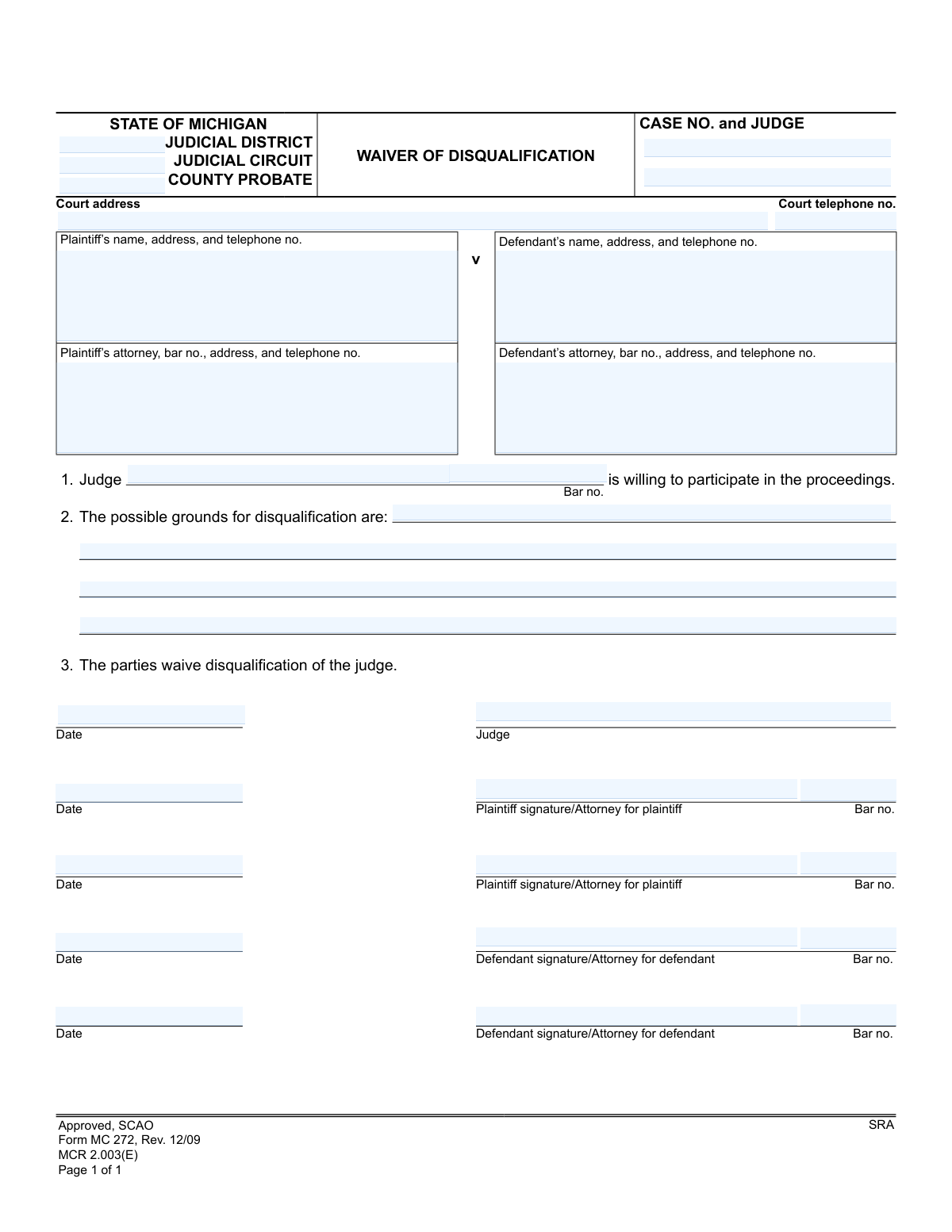
Form MC 272, the Waiver of Disqualification, is a legal document filed in the State of Michigan when all parties in a lawsuit agree to allow a judge to continue presiding over their case, even if there are potential grounds for that judge's disqualification. This form formalizes the consent of the plaintiff and defendant, ensuring the judicial process can proceed with the specified judge. Today, this form can be filled out quickly and accurately using AI-powered services like Instafill.ai, which can also convert non-fillable PDF versions into interactive fillable forms.
MC 272 is part of the
Michigan court forms category on Instafill.
Our AI automatically handles information lookup, data retrieval, formatting, and form filling.
It takes less than a minute to fill out MC 272 using our AI form filling.
Securely upload your data. Information is encrypted in transit and deleted immediately after the form is filled out.
Form specifications
| Form name: | Form MC 272, Waiver of Disqualification |
| Number of fields: | 31 |
| Number of pages: | 1 |
| Language: | English |
More forms in Michigan court forms
Instafill Demo: How to fill out PDF forms in seconds with AI
How to Fill Out MC 272 Online for Free in 2026
Are you looking to fill out a MC 272 form online quickly and accurately? Instafill.ai offers the #1 AI-powered PDF filling software of 2026, allowing you to complete your MC 272 form in just 37 seconds or less.
Follow these steps to fill out your MC 272 form online using Instafill.ai:
- 1 Navigate to Instafill.ai and upload or select the Form MC 272, Waiver of Disqualification.
- 2 Use the AI assistant to input the court information, including the judicial district/circuit, county, court address, and case number.
- 3 Enter the full names, addresses, and telephone numbers for the plaintiff, defendant, and their respective attorneys, including bar numbers.
- 4 Clearly specify the judge's name and the potential grounds for disqualification in the provided section.
- 5 Electronically sign and date the form. The platform will guide the plaintiff, defendant, and/or their attorneys to provide their signatures indicating their agreement to waive the disqualification.
- 6 Review the entire completed form for accuracy, then download the final document to be filed with the appropriate Michigan court.
Our AI-powered system ensures each field is filled out correctly, reducing errors and saving you time.
Why Choose Instafill.ai for Your Fillable MC 272 Form?
Speed
Complete your MC 272 in as little as 37 seconds.
Up-to-Date
Always use the latest 2026 MC 272 form version.
Cost-effective
No need to hire expensive lawyers.
Accuracy
Our AI performs 10 compliance checks to ensure your form is error-free.
Security
Your personal information is protected with bank-level encryption.
Frequently Asked Questions About Form MC 272
This form is used when there's a potential reason a judge should be disqualified from a case, but all parties involved agree to let the judge continue. It serves as a formal record that all parties have 'waived' the potential conflict.
For the waiver to be effective, it must be signed by all parties in the case (plaintiffs and defendants), or their respective attorneys. The judge in question also signs to indicate their willingness to continue presiding over the case.
This refers to the specific reason why the judge could be considered biased or unable to be impartial, as defined by Michigan Court Rule 2.003. Examples include having a financial interest in the case outcome or a close personal relationship with one of the parties or attorneys.
No, you cannot be forced to sign this form. The waiver is only valid if all parties voluntarily agree to it, so your signature must be given willingly.
The case number, court address, and party details can be found on previous documents filed with the court for your case, such as the complaint, summons, or other motions.
Once all required signatures are obtained, the completed form should be filed with the court clerk. This officially places the waiver on the record and allows the judge to proceed with the case.
If any party does not consent and refuses to sign, the waiver is invalid. The issue of the judge's disqualification would then need to be formally decided by the court, which could result in the judge being removed from the case.
Deciding whether to waive a judge's disqualification is a significant legal choice with potential consequences. It is strongly recommended that you consult with your attorney to fully understand the situation and make an informed decision.
Yes, services like Instafill.ai use AI to accurately auto-fill form fields like names, addresses, and case numbers, which saves time and helps prevent errors. However, you should always consult with an attorney about the legal implications of signing the form.
You can use a service like Instafill.ai to complete this form digitally. Simply upload the PDF, and the platform will allow you to type your information directly into the appropriate fields before printing for physical signatures.
If you have a non-fillable or 'flat' PDF, you can use a tool like Instafill.ai. It can convert the static document into an interactive, fillable form that you can easily complete on your computer.
This section should be completed carefully, often with input from the attorneys for all parties, to ensure the reason for the potential disqualification is stated clearly and accurately. All parties must understand what specific issue they are agreeing to waive.
Compliance MC 272
Validation Checks by Instafill.ai
1
Case Number Format and Presence
Verifies that the 'caseno' field is not empty and conforms to the expected format for the specified court jurisdiction. The case number is the primary identifier for a legal proceeding, and its accuracy is paramount for associating this waiver with the correct file. A missing or incorrectly formatted case number will result in the document being rejected or misfiled, causing significant delays.
2
Presence of Disqualification Grounds
Ensures that at least one of the 'grounds' fields (e.g., 'grounds1') is filled out, explaining the reason for potential disqualification. The entire purpose of the form is to waive specific, known issues, making this information mandatory for the waiver's legal validity. If no grounds are listed, the waiver is ambiguous, legally insufficient, and cannot be enforced.
3
Judge Name Presence for Waiver
Validates that the name of the judge whose disqualification is being waived ('Judgename' in section 1) is provided. This field is critical to identify the specific judicial officer the waiver applies to. An omission would make the document void for vagueness, as it would be impossible to determine which judge the parties agreed to waive disqualification for.
4
Attorney and Judge Bar Number Format
Checks that all bar number fields ('barno', 'barno2', etc.) follow the state's official format (e.g., 'P' followed by digits). The bar number uniquely identifies an attorney or judge and confirms their standing to practice law. An invalid format could indicate a typo or, more seriously, an unauthorized individual, jeopardizing the document's legality.
5
Signature and Date Correlation
Confirms that for every signature field that is filled (e.g., 'psig', 'pattysig'), the corresponding date field (e.g., 'date2', 'date3') is also completed. A signature's legal power is tied to the date it was executed, which establishes the timeline of consent. An undated signature can be legally challenged and may invalidate the party's agreement to the waiver.
6
Valid Date Format and Plausibility
Ensures all date fields contain valid, real-world dates (e.g., no '02/30/2023') and are not set in the future. Correct and logical dates are fundamental to the document's integrity and establish a credible timeline of events. An impossible or future date would immediately call the document's authenticity into question and lead to its rejection by the court clerk.
7
Plaintiff Information Completeness
Verifies that if the plaintiff's attorney is involved ('pattyname' or 'pattysig' is filled), then the attorney's name, signature, and bar number are all present. This ensures the person acting on behalf of the plaintiff is clearly identified and authorized. Incomplete information creates ambiguity about who has consented to the waiver, potentially weakening its legal standing.
8
Defendant Information Completeness
Verifies that if the defendant's attorney is involved ('dattyname' or 'dattysig' is filled), then the attorney's name, signature, and bar number are all present. Similar to the plaintiff's side, this is crucial for identifying the authorized representative for the defendant. Missing details could allow the defendant to later challenge the validity of the waiver by questioning their attorney's involvement.
9
Required Party Signatures
Checks that signatures from both the plaintiff's side (either the party or their attorney) and the defendant's side are present. A waiver is a mutual agreement, and its validity depends on the consent of all principal parties to the case. The absence of a signature from one side renders the waiver incomplete and unenforceable against that party.
10
Court Jurisdiction Identification
Ensures that at least one of the primary jurisdictional fields ('district', 'circuit', 'county') is filled in. This information is essential for routing the document to the correct courthouse and associating it with the proper case file. Without clear jurisdiction, the document cannot be processed and will be returned to the filer.
11
Attorney Signature and Name Consistency
Validates that if an attorney signature field ('pattysig' or 'dattysig') is completed, the corresponding attorney name field ('pattyname' or 'dattyname') is also filled. A signature is legally meaningless if the identity of the signer is not clearly stated on the document. This check prevents anonymous or unidentifiable signatures that would invalidate that party's consent.
12
Judge's Bar Number Presence
Confirms that the bar number ('barno') for the judge named in section 1 is provided. The bar number is a unique official identifier that eliminates any ambiguity, especially if multiple judges share a similar name. Omitting the bar number could create confusion and legal challenges regarding which specific judge the waiver applies to.
Common Mistakes in Completing MC 272
Filers often mistype the case number or use an incorrect format, omitting year prefixes or case type codes. This is a critical error because the case number is the primary identifier used by the court to file the document in the correct case record. An incorrect number can lead to the waiver being rejected, lost, or filed in the wrong case, causing significant delays and potentially nullifying the waiver's effect. Always double-check the case number against official court documents before submitting.
In section 2, parties frequently write generic statements like 'conflict of interest' or 'knows the other party' without providing specific details. The purpose of this section is to create a clear record of what potential conflict is being waived. Vague descriptions can render the waiver legally insufficient and open to future challenges, potentially jeopardizing any rulings made by the judge. Be specific about the nature of the relationship or conflict (e.g., 'The judge's cousin is a partner at the defendant's law firm').
The form has a space for the assigned judge in the case caption and a separate line for the judge whose disqualification is being waived (line 1). People often mistakenly enter the same name in both places or leave the second one blank. This creates ambiguity if a different judge is being asked to step in. The name on line 1 is the most critical, as it identifies the judge who is agreeing to preside despite potential disqualification; failing to specify this correctly can invalidate the entire waiver.
This waiver requires signatures from the judge and all parties or their attorneys, each with a corresponding date. It is a common oversight to miss a signature or forget to write the date next to it. An undated signature may be considered invalid by the court, and a missing signature from any required party renders the waiver completely ineffective. Carefully review the form to ensure every signature and date line is properly filled before filing.
The caption at the top of the form requires the full name, address, and telephone number for all parties and their attorneys. This information is often left incomplete, with filers omitting a zip code, phone number, or even a full address. Incomplete contact details can hinder communication from the court or opposing counsel and may lead to the filing being rejected by the clerk for not meeting procedural requirements. AI-powered tools like Instafill.ai can help prevent this by auto-filling and validating contact information.
Attorneys are required to provide their state bar number in multiple locations on the form, but this is frequently forgotten or mistyped. The bar number is used by the court to verify that the individual is a licensed attorney in good standing. Filing a document with a missing or incorrect bar number will cause delays while the clerk's office attempts to verify the attorney's credentials, and can result in the document being returned.
Individuals representing themselves (pro se) often get confused by the signature lines, which provide options for both the party and their attorney. A pro se plaintiff might incorrectly sign on the 'Attorney for plaintiff' line, or sign both. This creates ambiguity regarding their representational status. If you are representing yourself, you should only sign on the 'Plaintiff signature' or 'Defendant signature' line and leave the attorney lines blank.
The form requires the Judicial District, Circuit, and/or County to be identified. Filers who are unfamiliar with the court structure may leave these fields blank or enter incorrect information. This can cause the waiver to be sent to the wrong courthouse or judicial division, leading to significant processing delays or the document being lost in the system. This information should be copied exactly from previous court filings in the same case.
When this form is provided as a flat PDF, it must be filled out by hand, often resulting in illegible handwriting. Key details like names, the case number, and the grounds for disqualification can be easily misread by court clerks, leading to data entry errors or rejection of the form. To avoid this, use clear block lettering or utilize a service like Instafill.ai, which can convert non-fillable PDFs into easy-to-type, fillable forms, ensuring perfect legibility.
Saved over 80 hours a year
“I was never sure if my IRS forms like W-9 were filled correctly. Now, I can complete the forms accurately without any external help.”
Kevin Martin Green
Your data stays secure with advanced protection from Instafill and our subprocessors

Robust compliance program
Transparent business model
You’re not the product. You always know where your data is and what it is processed for.
ISO 27001, HIPAA, and GDPR
Our subprocesses adhere to multiple compliance standards, including but not limited to ISO 27001, HIPAA, and GDPR.
Security & privacy by design
We consider security and privacy from the initial design phase of any new service or functionality. It’s not an afterthought, it’s built-in, including support for two-factor authentication (2FA) to further protect your account.
Fill out MC 272 with Instafill.ai
Worried about filling PDFs wrong? Instafill securely fills form-mc-272-waiver-of-disqualification forms, ensuring each field is accurate.