Yes! You can use AI to fill out Form MC 291, Advice of Rights (Felony Plea)

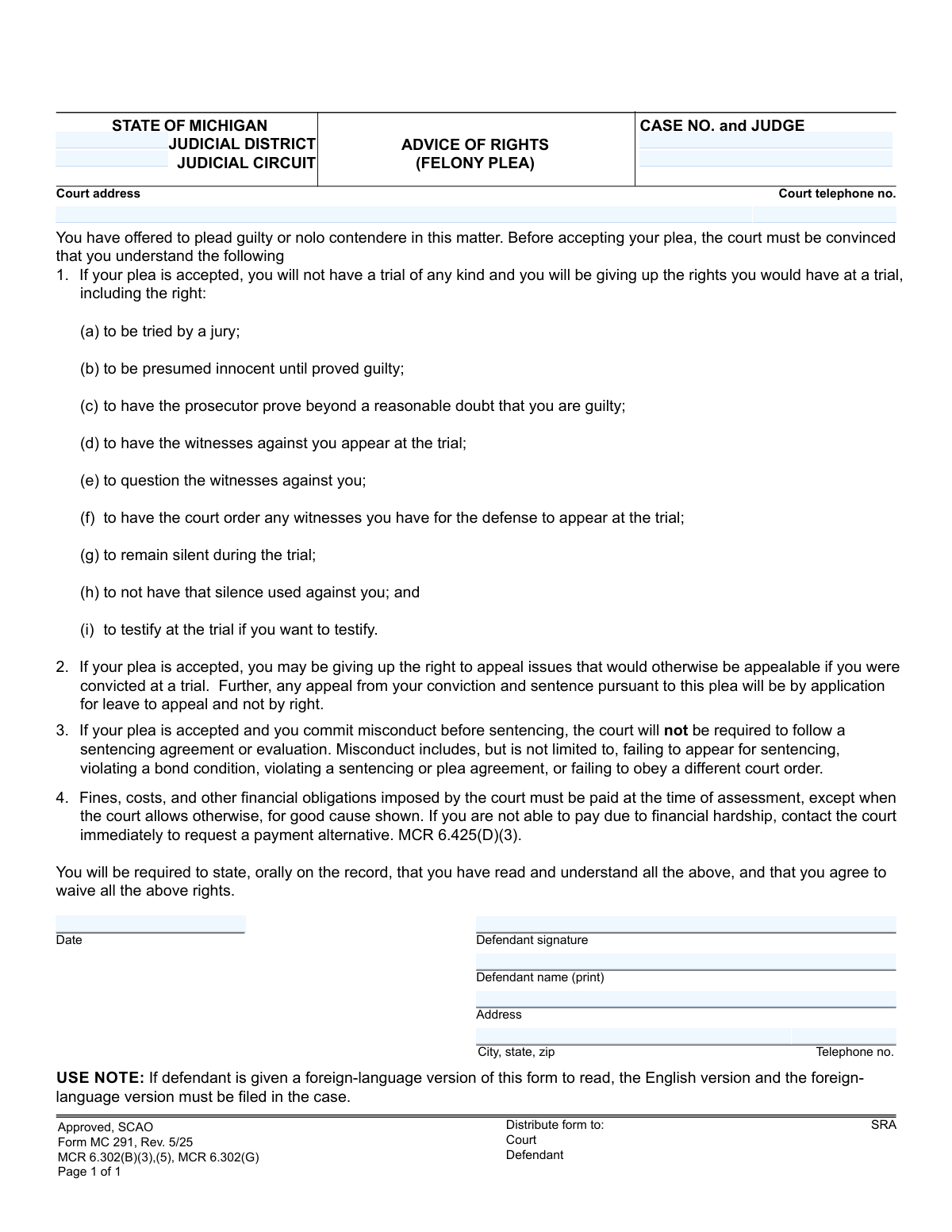
The Advice of Rights (Felony Plea) form, MC 291, is a legal document used in the Michigan judicial system to ensure a defendant's plea is made knowingly and voluntarily. It explicitly lists the trial rights being given up, such as the right to a jury trial, the presumption of innocence, and the right to confront witnesses. This formal acknowledgment is critical for the court to accept the plea and proceed with sentencing. Today, this form can be filled out quickly and accurately using AI-powered services like Instafill.ai, which can also convert non-fillable PDF versions into interactive fillable forms.
MC 291 is part of the Michigan court forms category on Instafill.
Our AI automatically handles information lookup, data retrieval, formatting, and form filling.
It takes less than a minute to fill out MC 291 using our AI form filling.
Securely upload your data. Information is encrypted in transit and deleted immediately after the form is filled out.

Form specifications

Form name: Form MC 291, Advice of Rights (Felony Plea)
Number of fields: 12
Number of pages: 1
Language: English
main-image

Instafill Demo: How to fill out PDF forms in seconds with AI

How to Fill Out MC 291 Online for Free in 2026

Are you looking to fill out a MC 291 form online quickly and accurately? Instafill.ai offers the #1 AI-powered PDF filling software of 2026, allowing you to complete your MC 291 form in just 37 seconds or less.
Follow these steps to fill out your MC 291 form online using Instafill.ai:
  1. 1 Navigate to Instafill.ai and upload or select the MC 291 form.
  2. 2 Enter the court and case information, including the judicial district/circuit, case number, and judge's name.
  3. 3 Carefully read and review each of the rights being waived, as detailed in the numbered sections of the form.
  4. 4 Provide your personal information, including your printed name, address, and telephone number.
  5. 5 Digitally sign and date the form to certify that you have read, understood, and agree to waive the listed rights.
  6. 6 Review all entered information for accuracy before downloading or submitting the completed form to the court.

Our AI-powered system ensures each field is filled out correctly, reducing errors and saving you time.

Why Choose Instafill.ai for Your Fillable MC 291 Form?

Speed

Complete your MC 291 in as little as 37 seconds.

Up-to-Date

Always use the latest 2026 MC 291 form version.

Cost-effective

No need to hire expensive lawyers.

Accuracy

Our AI performs 10 compliance checks to ensure your form is error-free.

Security

Your personal information is protected with bank-level encryption.

Frequently Asked Questions About Form MC 291

This form, MC 291, is used in Michigan courts to ensure that a defendant pleading guilty or nolo contendere to a felony understands the constitutional rights they are giving up. It serves as a formal record that the plea is made knowingly and voluntarily.

Any defendant who has chosen to plead guilty or 'nolo contendere' (no contest) to a felony charge must review and sign this form as part of the plea process in court.

By signing, you are waiving your right to a trial of any kind, including the right to a jury, the presumption of innocence, and the right to have the prosecutor prove your guilt beyond a reasonable doubt.

If you commit misconduct, such as failing to appear for sentencing or violating a court order, the court is no longer bound by any prior sentencing agreement. This could result in a more severe sentence than you originally expected.

Pleading guilty severely limits your appeal options. Any appeal of your conviction or sentence will be by 'application for leave to appeal,' meaning you must ask for permission from a higher court, and it is not guaranteed.

You will need the case number, judge's name, and the court's address and telephone number. This information can typically be found on other legal documents you have received for your case.

After signing, you will be required to state orally in court that you have read, understood, and agree to waive the rights listed on the form. The judge will then question you to confirm your understanding before accepting your plea.

If you cannot pay your fines and costs due to financial hardship, you must contact the court immediately. You can request a payment alternative or a modified payment plan.

The form notes that if you are provided with a foreign-language version, both it and the English version must be filed with the court. You have a right to understand what you are signing, so you should request a translated version or an interpreter.

Yes, services like Instafill.ai use AI to auto-fill form fields like your name, case number, and address, which saves time and helps ensure accuracy. However, AI cannot provide legal advice, and you must personally understand the rights you are waiving.

You can use a service like Instafill.ai to fill out the form digitally. Simply upload the document, and the platform will create fillable fields for you to type in your information before printing for signature.

If you have a non-fillable or 'flat' PDF, you can upload it to Instafill.ai. The service can convert the document into an interactive, fillable form that you can complete on your computer.

A guilty plea is a direct admission of guilt. A 'nolo contendere' or 'no contest' plea means you are not admitting guilt but are accepting the punishment, and it has the same legal effect as a guilty plea for sentencing purposes.

Compliance MC 291
Validation Checks by Instafill.ai

1
Case Number Format Validation
This check ensures the 'caseno' field follows the standard format for Michigan court case numbers. A valid case number is critical for associating the plea form with the correct legal proceeding in the court's filing system. An incorrectly formatted number could lead to the document being rejected, misfiled, or significantly delayed in processing.
2
Defendant Signature Presence
Verifies that the 'dsignature' field is not empty and contains a valid signature, whether digitally captured or as a scanned image. The defendant's signature is the primary indicator of their voluntary agreement to waive their rights, and its absence renders the entire form legally invalid. The plea cannot be accepted without a signature.
3
Signature Date Presence and Plausibility
This check validates that the 'date' field is filled, is in a recognizable format (e.g., MM/DD/YYYY), and is not a future date. The date establishes the exact moment the defendant acknowledged their rights, which is a crucial legal requirement. An invalid, missing, or future date would call the authenticity and timing of the waiver into question, potentially invalidating the plea.
4
Defendant Printed Name Completeness
Ensures the 'dname' field, for the defendant's printed name, is not empty. This field serves to clearly identify the individual who is signing the form, linking the signature to the person named in the case file. A missing printed name makes it difficult to verify the signer's identity, which could lead to the form's rejection.
5
Court Telephone Number Format
Validates that the 'cttelno' field contains a properly formatted 10-digit U.S. telephone number. This ensures that court staff, attorneys, or the defendant can contact the correct court office without issue. An invalid number can hinder communication and cause administrative delays.
6
Defendant Full Address Completeness
This check ensures that the defendant's full address, including 'daddress' and 'city, state, zip', is provided. The court requires a complete and current address for sending official notices, such as sentencing dates or other orders. An incomplete address could result in the defendant missing critical legal communications, leading to severe consequences like a warrant for failure to appear.
7
City, State, and Zip Code Structure
Verifies that the 'city' field contains a city name, a valid two-letter state abbreviation (e.g., 'MI'), and a 5- or 9-digit ZIP code. Correct formatting is essential for the mailability of court documents. An error in this field could cause important legal notices to be returned as undeliverable.
8
Judicial Circuit or District Presence
This check confirms that at least one of the 'district' or 'circuit' fields is filled out. This information is fundamental for routing the document to the correct court jurisdiction within the state of Michigan. Failure to specify the district or circuit would make it impossible for the clerk's office to file the document correctly.
9
Judge Name Presence
Ensures the 'judge' field is completed with the name of the presiding judge. The judge's name is required to link the plea directly to the judicial officer responsible for the case. A missing judge's name can cause processing delays or require manual correction by court staff.
10
Logical Link Between Signature and Date
Validates that if the 'dsignature' field is completed, the 'date' field must also be completed. A signature is legally time-stamped by the date it was made. A dated signature confirms the document was executed properly, whereas a signature without a date is legally incomplete and may be rejected.
11
Defendant Telephone Number Format
Checks that the 'dtelno' field is a valid 10-digit phone number. This number provides a direct and often urgent method for the court or legal counsel to contact the defendant. An invalid or missing number can impede timely communication about case updates or requirements.
12
Court Address Completeness
Verifies that the 'ctaddress' field is filled out, identifying the specific court location. This is important for record-keeping and for parties who may need to physically file documents or appear at that location. Missing this information can create ambiguity, especially in counties with multiple courthouses.
13
Defendant Name and Case Number Cross-Validation
This check performs a logical cross-reference, ideally against a database, to ensure the defendant's name ('dname') is correctly associated with the specified case number ('caseno'). This is a critical integrity check to prevent a plea from being entered for the wrong person or on the wrong case. A mismatch would immediately flag the form for manual review to prevent a serious legal error.

Common Mistakes in Completing MC 291

Entering an Incorrect Case Number

The case number is the primary identifier for the legal proceeding. This mistake often occurs due to typographical errors or by copying the number from outdated documents. An incorrect case number can lead to the plea form being rejected, misfiled with the wrong case, or significant delays in processing, potentially impacting sentencing dates and legal standing. To avoid this, carefully transcribe the full case number, including all letters and hyphens, from the most recent official court document.

Missing or Invalid Defendant Signature

Forgetting to sign the form, or printing a name in the signature box, is a critical error that invalidates the entire document. The signature is the defendant's legal attestation that they have read and understood their rights. An unsigned or improperly signed form will be immediately rejected by the court, halting the plea process. Always review the form one last time to ensure a valid, handwritten signature is in the correct field before submission.

Using an Informal or Incomplete Name

In the 'Defendant name (print)' field, individuals sometimes use a nickname, an initial, or an abbreviated version of their name. Legal documents require the defendant's full legal name as it appears on the case file to ensure proper identification and accurate record-keeping. A name mismatch can cause confusion and administrative issues. Always print your full legal name clearly and legibly to match court records.

Providing an Outdated or Incomplete Address

The court uses the address provided to mail crucial documents, including sentencing information and other legal notices. Providing an old address, or omitting details like an apartment or suite number, can result in missed correspondence. This could lead to unintentionally missing a court date or deadline, which has severe legal consequences. Ensure the address is current, complete, and is a reliable location for receiving mail.

Illegible Handwriting

Many legal forms are still filled out by hand, and rushed or poor handwriting can make critical information unreadable. If a court clerk cannot decipher the case number, name, or address, the form cannot be processed correctly, leading to delays or data entry errors in the court's system. To prevent this, print carefully in all-caps or block letters. If the form is a non-fillable PDF, tools like Instafill.ai can convert it into a fillable version, ensuring all entries are typed and perfectly legible.

Incorrect Date of Signature

The date field must reflect the exact day the defendant signs the document, as it legally marks the moment of their agreement. People may mistakenly enter the current date when filling out the form, even if they plan to sign it later, or use an incorrect format. A wrong date can raise legal questions about when the rights were officially waived. Always fill in the date at the time of signing.

Leaving Court Information Blank

Fields like 'Judicial District,' 'Judicial Circuit,' and 'Judge' are sometimes left blank, with the assumption that a lawyer or court clerk will fill them in. However, an incomplete form may be rejected. It is the responsibility of the person submitting the form to ensure all required information is present. This data can be found on other official case documents and should be filled in accurately.

Confusing Judicial District and Circuit

The Michigan court system has distinct District and Circuit courts, and a felony case will be in the Circuit court. A defendant might not know the difference or may enter the information in the wrong field, causing administrative confusion. This error can slow down the routing and filing of the plea. This information should be copied directly from official court paperwork to ensure accuracy.

Invalid Phone Number Format or Number

Entering an old phone number, a number with transposed digits, or failing to include the area code are common mistakes. The court may need to contact the defendant for scheduling or clarification, and an unreachable number can cause delays or missed communications. Always provide a current, working telephone number and double-check it for accuracy. AI-powered tools like Instafill.ai can help by automatically formatting phone numbers correctly, reducing the chance of error.
Saved over 80 hours a year

“I was never sure if my IRS forms like W-9 were filled correctly. Now, I can complete the forms accurately without any external help.”

Kevin Martin Green

Your data stays secure with advanced protection from Instafill and our subprocessors

Robust compliance program

Transparent business model

You’re not the product. You always know where your data is and what it is processed for.

ISO 27001, HIPAA, and GDPR

Our subprocesses adhere to multiple compliance standards, including but not limited to ISO 27001, HIPAA, and GDPR.

Security & privacy by design

We consider security and privacy from the initial design phase of any new service or functionality. It’s not an afterthought, it’s built-in, including support for two-factor authentication (2FA) to further protect your account.

Fill out MC 291 with Instafill.ai

Worried about filling PDFs wrong? Instafill securely fills form-mc-291-advice-of-rights-felony-plea forms, ensuring each field is accurate.