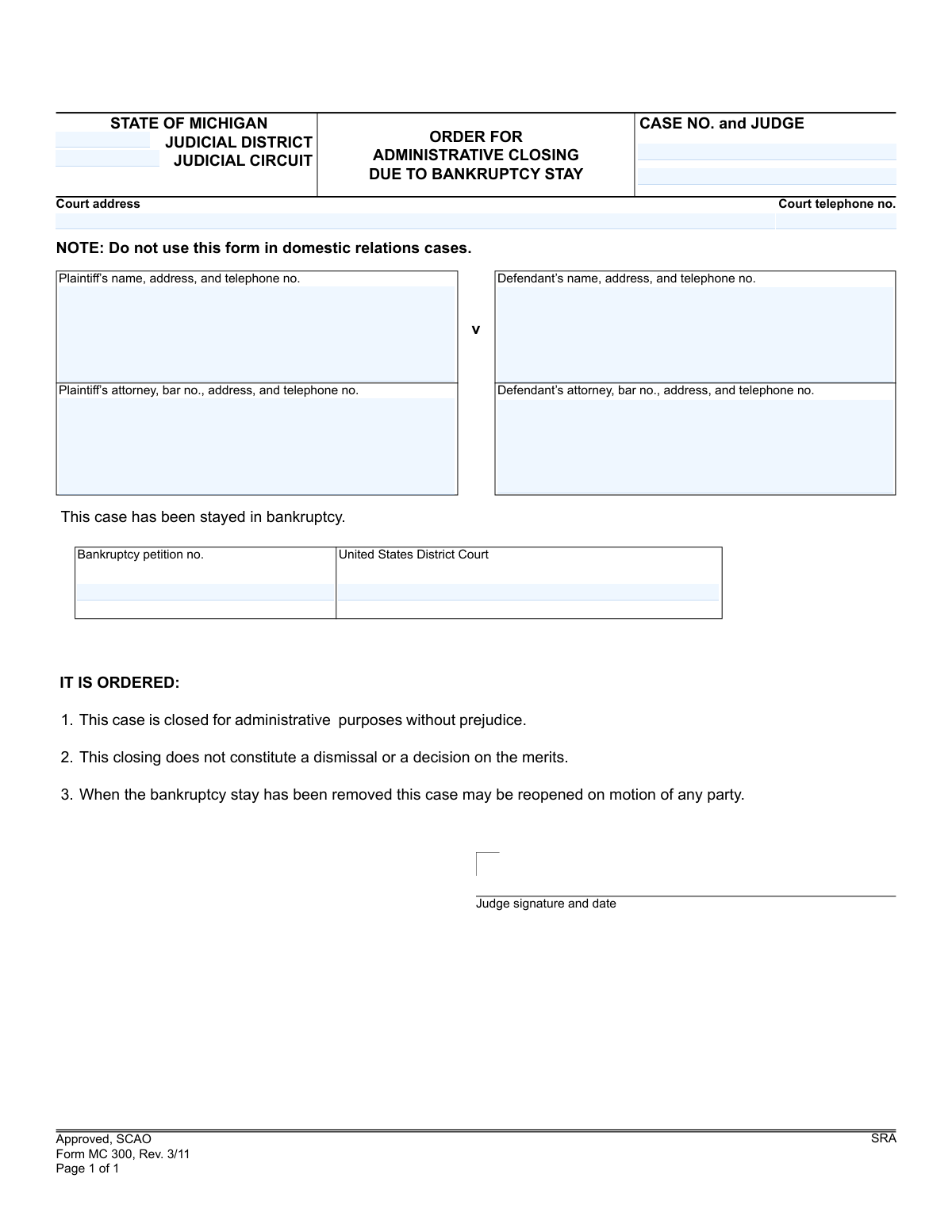
Yes! You can use AI to fill out Form MC 300, Order for Administrative Closing Due to Bankruptcy Stay

Form MC 300, the Order for Administrative Closing Due to Bankruptcy Stay, is a legal document used in Michigan courts to pause a case when a bankruptcy stay is in effect. It is not a dismissal but a temporary administrative closure that can be reversed once the bankruptcy proceedings are resolved. This order ensures compliance with federal bankruptcy law, which automatically halts most civil litigation. Today, this form can be filled out quickly and accurately using AI-powered services like Instafill.ai, which can also convert non-fillable PDF versions into interactive fillable forms.
MC 300 is part of the Michigan court forms category on Instafill.
Our AI automatically handles information lookup, data retrieval, formatting, and form filling.
It takes less than a minute to fill out MC 300 using our AI form filling.
Securely upload your data. Information is encrypted in transit and deleted immediately after the form is filled out.

Form specifications

Form name: Form MC 300, Order for Administrative Closing Due to Bankruptcy Stay
Number of fields: 12
Number of pages: 1
Language: English
main-image

Instafill Demo: How to fill out PDF forms in seconds with AI

How to Fill Out MC 300 Online for Free in 2026

Are you looking to fill out a MC 300 form online quickly and accurately? Instafill.ai offers the #1 AI-powered PDF filling software of 2026, allowing you to complete your MC 300 form in just 37 seconds or less.
Follow these steps to fill out your MC 300 form online using Instafill.ai:
  1. 1 Navigate to Instafill.ai and upload or select the MC 300 form.
  2. 2 Enter the specific judicial district, circuit, court address, and telephone number for the case.
  3. 3 Provide the full case number and the name of the assigned judge.
  4. 4 Input the complete details for the plaintiff and defendant, including names, addresses, and attorney information.
  5. 5 Enter the bankruptcy petition number and the corresponding United States District Court where it was filed.
  6. 6 Review all the information you've provided for accuracy before generating the final document.
  7. 7 Download the completed order, which is now ready for the judge's signature and subsequent filing with the court.

Our AI-powered system ensures each field is filled out correctly, reducing errors and saving you time.

Why Choose Instafill.ai for Your Fillable MC 300 Form?

Speed

Complete your MC 300 in as little as 37 seconds.

Up-to-Date

Always use the latest 2026 MC 300 form version.

Cost-effective

No need to hire expensive lawyers.

Accuracy

Our AI performs 10 compliance checks to ensure your form is error-free.

Security

Your personal information is protected with bank-level encryption.

Frequently Asked Questions About Form MC 300

This form is a court order used in Michigan to administratively close a state court case because a party has filed for bankruptcy. The bankruptcy filing automatically pauses the state case, and this order formally acknowledges that pause for the court's record-keeping.

No, an administrative closing is not a dismissal or a decision on the merits of your case. It is a procedural step to remove the case from the court's active docket while the bankruptcy stay is in effect, essentially putting it on hold.

Closing a case 'without prejudice' means that you do not lose any of your legal rights or claims. You can reopen the case and continue pursuing it once the bankruptcy stay is lifted.

Once the bankruptcy stay has been removed or the bankruptcy case is resolved, any party can file a motion with the court to reopen the state case. The case will then be placed back on the court's active docket to proceed.

This is a court order, so it is ultimately signed by a judge. Typically, an attorney for one of the parties will prepare the proposed order and submit it to the court for the judge's signature.

Domestic relations cases, such as divorce or child support, have specific rules regarding bankruptcy, and some proceedings may not be stayed. These complex cases require different forms and procedures, so this general civil form is not appropriate.

You will need the state court case number, judge's name, party and attorney information, and the bankruptcy petition number. You also need to identify the specific U.S. District Court where the bankruptcy was filed.

The party who filed for bankruptcy receives a 'Notice of Bankruptcy Filing' which contains the case number and court information. This information is also publicly available through the federal court's PACER system.

No, the lawsuit is not over; it is simply paused. The administrative closing allows the court to manage its caseload, but the underlying legal dispute can be revived once the bankruptcy proceedings permit it.

Yes, AI-powered services like Instafill.ai can help you accurately fill out the form fields. Using AI can save time and reduce errors by auto-filling information like party names, addresses, and case details.

Simply upload the MC 300 form to the Instafill.ai platform. The AI will identify all the fillable fields, allowing you to enter the required information directly into the interactive form before printing or saving it.

Services like Instafill.ai can convert flat, non-fillable PDFs into interactive, fillable forms. Just upload your non-fillable version, and the platform will make it easy for you to type your information directly into the correct fields.

Compliance MC 300
Validation Checks by Instafill.ai

1
Case Number Format and Presence
Verifies that the 'Case No.' field is not empty and follows the standard Michigan court case number format (e.g., YY-######-XX). This number is the primary identifier for the case within the court's system. An invalid or missing case number will prevent the order from being filed and associated with the correct legal proceeding, leading to rejection.
2
Judge Name Presence
Ensures the 'Judge' field is populated with a name. An order is not legally valid without the identification of the presiding judge who is issuing it. Submissions lacking a judge's name would be considered incomplete and unenforceable, requiring correction and resubmission.
3
Court Telephone Number Format
Validates that the 'Court telephone no.' field contains a properly formatted 10-digit U.S. phone number, including an area code. This ensures that parties involved in the case can contact the court for information. An incorrectly formatted number could cause communication delays and reflect poorly on the filer's attention to detail.
4
Plaintiff Information Completeness
Checks that the field for 'Plaintiff’s name, address, and telephone no.' is not empty. This information is fundamental for identifying the primary party in the lawsuit and is a mandatory component of any court filing. Omitting this information would lead to the immediate rejection of the form as it fails to identify a key party.
5
Defendant Information Completeness
Ensures the field for 'Defendant’s name, address, and telephone no.' is populated. Properly identifying the defendant is essential for due process and for the order to be legally binding on the correct party. A submission without defendant details is incomplete and cannot be processed by the court.
6
Plaintiff's Attorney Bar Number Validation
Checks that if the 'Plaintiff’s attorney' field is filled, the associated 'bar no.' is also present and follows the Michigan State Bar format (e.g., 'P' followed by numbers). The bar number uniquely identifies the attorney and confirms their authority to practice. Missing or invalid bar numbers can lead to questions about legal representation and cause filing delays.
7
Defendant's Attorney Bar Number Validation
Validates that if the 'Defendant’s attorney' field is populated, the corresponding 'bar no.' is also provided and matches the Michigan State Bar format. This is necessary to verify the attorney's credentials and their standing with the bar. An incorrect or absent bar number for a listed attorney will likely result in the document being flagged for correction.
8
Bankruptcy Petition Number Presence
Verifies that the 'Bankruptcy petition no.' field is filled out, as this is the central justification for the administrative closing. This number links the state case to a specific federal bankruptcy proceeding. Without this number, the legal basis for the order is missing, and the form is fundamentally invalid.
9
Bankruptcy Petition Number Format
Checks the format of the 'Bankruptcy petition no.' to ensure it aligns with standard federal bankruptcy case numbering conventions (e.g., YY-NNNNN-ABC). This validation helps prevent data entry errors and ensures the number can be correctly looked up in the federal PACER system. An incorrectly formatted number could refer to a non-existent case, invalidating the order.
10
U.S. District Court Identification
Ensures the 'United States District Court' field is completed, specifying the district where the bankruptcy was filed (e.g., 'Eastern District of Michigan'). This information is essential for any party wishing to verify the bankruptcy stay or track its status. Omitting the specific district court makes it difficult to locate the relevant bankruptcy case.
11
Judicial District or Circuit Presence
Validates that at least one of the 'Judicial District' or 'Judicial Circuit' fields is completed. Michigan courts are organized into districts and circuits, and a case must belong to one of them to establish jurisdiction. Leaving both fields blank would make it impossible to identify the originating court, causing the form to be rejected.
12
Attorney-Party Association Logic
Verifies that if an attorney's information is provided for either the plaintiff or defendant, the corresponding party's information field is also filled. An attorney must represent a specified party to the case. This check prevents logical inconsistencies where an attorney is listed without a client, which would be an invalid state for a legal filing.

Common Mistakes in Completing MC 300

Incorrect Case Number or Judge Name

Users often enter the case number with an incorrect format, omitting prefixes or suffixes, or they misspell the assigned judge's name. This is a critical error as it can prevent the order from being filed in the correct case docket, causing significant delays and legal complications. To avoid this, double-check the case number against official court documents and verify the judge's full name and title before submission.

Confusing Judicial District and Circuit

The form requires both the Judicial District and Judicial Circuit, which are distinct levels of the Michigan court system. Filers frequently enter the information in the wrong field or only provide one, assuming they are interchangeable. This can lead to the form being rejected or misrouted within the court system, delaying the administrative closing. Always verify the specific district and circuit court numbers for the case before filling out the form.

Transposing Plaintiff and Defendant Information

A surprisingly common mistake is entering the plaintiff's information in the defendant's field and vice versa. This happens due to haste or inattention to the 'v' separator on the form. This error creates a legally incorrect document that will be rejected by the court clerk, requiring the filer to correct and resubmit the form. Carefully read each field label before entering party information.

Entering an Invalid Bankruptcy Petition Number

The entire basis for this order is the bankruptcy stay, making the petition number crucial. Filers sometimes mistakenly enter the state court case number here, use an incorrect format, or omit it entirely. An incorrect or missing bankruptcy petition number will result in the judge refusing to sign the order, as the legal basis for the administrative closing is not established.

Missing or Incorrect Attorney Bar Number

The attorney's bar number (P-number in Michigan) is a unique identifier required for official court filings. Attorneys or their staff may forget to include it or accidentally transpose digits. This can lead to filing rejections or delays as the court clerk must verify the attorney's standing to practice. Always include the full, correct bar number for any listed attorney.

Improper Use for Domestic Relations Cases

The form explicitly states, 'Do not use this form in domestic relations cases.' Despite this clear warning, filers sometimes attempt to use it for stayed divorce or custody matters. This will lead to immediate rejection by the court clerk and wastes time and filing fees. Always read all notes and instructions on a legal form to ensure it is appropriate for your specific case type.

Incomplete Contact Information for Parties/Attorneys

The fields for parties and attorneys require a name, address, and telephone number. Often, filers will leave out the phone number or provide an incomplete address, assuming the name is sufficient. This prevents the court or opposing parties from being able to make contact, which can delay proceedings and cause notices to be missed. Ensure all three components (name, full address, and phone number) are provided for each individual or firm.

Specifying the Wrong Bankruptcy Court

The form requires the filer to name the specific 'United States District Court' where the bankruptcy petition was filed. Michigan is split into Eastern and Western districts, and filers may guess or select the wrong one. This error can make it difficult for the court to verify the bankruptcy stay, potentially leading to a rejection of the order. The correct bankruptcy district court must be identified from the bankruptcy filing documents.

Illegible Handwriting on a Non-Fillable Form

This SCAO form is often available as a flat, non-fillable PDF, leading people to print and fill it out by hand. This frequently results in illegible handwriting, which can cause data entry errors by the court clerk or lead to the form's rejection. To prevent this, the form should be filled out electronically. AI-powered tools like Instafill.ai can convert non-fillable PDFs into fillable versions, ensuring all entries are clear, legible, and professional.

Using an Outdated Version of the Form

This form shows a revision date of 'Rev. 3/11', meaning it is over a decade old. Courts periodically update their forms, and submitting an obsolete version can lead to rejection. A filer might find an old version online or in their files and use it without checking for a more current one. Always check the official court website for the latest version of any form before filling it out.
Saved over 80 hours a year

“I was never sure if my IRS forms like W-9 were filled correctly. Now, I can complete the forms accurately without any external help.”

Kevin Martin Green

Your data stays secure with advanced protection from Instafill and our subprocessors

Robust compliance program

Transparent business model

You’re not the product. You always know where your data is and what it is processed for.

ISO 27001, HIPAA, and GDPR

Our subprocesses adhere to multiple compliance standards, including but not limited to ISO 27001, HIPAA, and GDPR.

Security & privacy by design

We consider security and privacy from the initial design phase of any new service or functionality. It’s not an afterthought, it’s built-in, including support for two-factor authentication (2FA) to further protect your account.

Fill out MC 300 with Instafill.ai

Worried about filling PDFs wrong? Instafill securely fills form-mc-300-order-for-administrative-closing-due-to-bankruptcy-stay forms, ensuring each field is accurate.