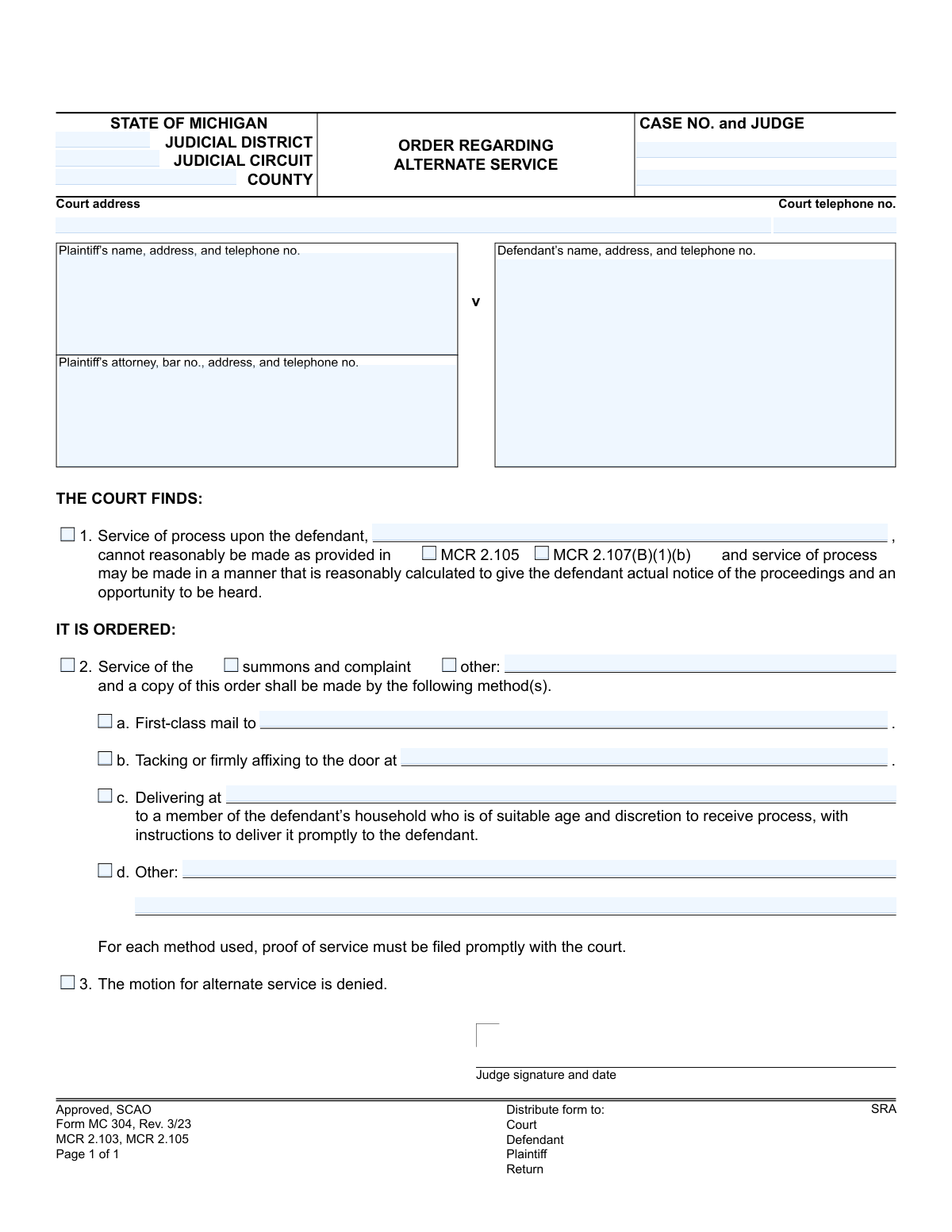
Yes! You can use AI to fill out Form MC 304, Order Regarding Alternate Service
Form MC 304 is a legal document issued by a Michigan court that grants permission to serve a defendant in a lawsuit using methods other than standard personal delivery. It is used when a plaintiff demonstrates to the court that they cannot reasonably serve the defendant through conventional means. This order ensures the legal process can continue by allowing service via mail, tacking the notice to a door, or other court-approved methods. Today, this form can be filled out quickly and accurately using AI-powered services like Instafill.ai, which can also convert non-fillable PDF versions into interactive fillable forms.
MC 304 is part of the
Michigan court forms category on Instafill.
Our AI automatically handles information lookup, data retrieval, formatting, and form filling.
It takes less than a minute to fill out MC 304 using our AI form filling.
Securely upload your data. Information is encrypted in transit and deleted immediately after the form is filled out.
Form specifications
| Form name: | Form MC 304, Order Regarding Alternate Service |
| Number of fields: | 61 |
| Number of pages: | 1 |
| Language: | English |
More forms in Michigan court forms
Instafill Demo: How to fill out PDF forms in seconds with AI
How to Fill Out MC 304 Online for Free in 2026
Are you looking to fill out a MC 304 form online quickly and accurately? Instafill.ai offers the #1 AI-powered PDF filling software of 2026, allowing you to complete your MC 304 form in just 37 seconds or less.
Follow these steps to fill out your MC 304 form online using Instafill.ai:
- 1 Navigate to Instafill.ai and upload or select the Form MC 304, Order Regarding Alternate Service.
- 2 Enter the case information, including the judicial district/circuit, county, case number, and judge's name.
- 3 Provide the complete details for the plaintiff, their attorney (if any), and the defendant, including names, addresses, and phone numbers.
- 4 The judge will mark the appropriate boxes to either grant or deny the motion. If granted, the judge will specify the authorized methods of service (e.g., first-class mail, tacking to a door).
- 5 After service is performed, the process server completes the 'Proof of Service' section, indicating the method used, the date, and the location.
- 6 The process server signs the certificate of service and calculates any applicable service fees.
- 7 Review all entered information for accuracy before the judge signs the order and it is filed with the court and distributed to the parties.
Our AI-powered system ensures each field is filled out correctly, reducing errors and saving you time.
Why Choose Instafill.ai for Your Fillable MC 304 Form?
Speed
Complete your MC 304 in as little as 37 seconds.
Up-to-Date
Always use the latest 2026 MC 304 form version.
Cost-effective
No need to hire expensive lawyers.
Accuracy
Our AI performs 10 compliance checks to ensure your form is error-free.
Security
Your personal information is protected with bank-level encryption.
Frequently Asked Questions About Form MC 304
This form is a court order from a judge that authorizes a new, 'alternate' method for legally notifying a defendant about a lawsuit when standard service methods have failed.
A judge completes and signs the top 'Order' section to approve or deny the request. Afterwards, a process server completes the bottom 'Proof of Service' section once they have delivered the documents as instructed by the judge.
You need this order when you have been unable to serve a defendant with a summons and complaint using standard methods, like personal delivery. This order provides the legal permission needed to use other methods, such as mail or tacking the notice to a door.
You must first file a 'Motion for Alternate Service' with the court, explaining why you cannot serve the defendant through normal means. If the judge agrees, they will sign this 'Order Regarding Alternate Service' form, authorizing your new plan.
The 'Proof of Service' is a sworn statement completed by the process server after they deliver the documents. It provides the court with the official record of when, where, and how the defendant was served according to the judge's order.
You must provide a copy of the signed order, along with the summons and complaint, to your process server. The server will then follow the judge's instructions and file the completed 'Proof of Service' with the court.
If the judge denies your motion, you are not permitted to use the alternate service methods you requested. You will need to continue trying to serve the defendant through standard methods or consult an attorney about other options.
The 'Other' category allows a judge to approve a unique service method, such as delivery via email or even a social media direct message. This must be specifically requested in your motion and approved by the judge as being reasonably likely to notify the defendant.
This order must be served with the documents that initiated the lawsuit, which are typically the summons and complaint. The order itself simply authorizes the method of delivery for those key documents.
Yes, AI-powered services like Instafill.ai can help you accurately fill in case information like names, addresses, and case numbers. This helps save time and reduce errors before the form is submitted to the court or used by a process server.
You can use a service like Instafill.ai to easily complete this form on your computer. Simply upload the form, and the tool will create interactive fields for you to type your information directly into the document.
If you have a flat, non-fillable PDF, you can upload it to Instafill.ai. The platform's AI technology can convert it into an interactive, fillable form that you can complete and save digitally.
Service can be performed by a sheriff, deputy sheriff, bailiff, appointed court officer, or any legally competent adult who is not a party in the case. The person who performs the service must be the one to sign the 'Proof of Service' section.
Compliance MC 304
Validation Checks by Instafill.ai
1
Case Number Format and Presence
This check ensures the 'CASE NO.' field is not empty and follows the standard format for the specified Michigan court. The case number is the primary identifier for a legal proceeding, and its accuracy is critical for filing, tracking, and retrieval. A missing or incorrectly formatted case number will lead to filing rejection and delays in the legal process.
2
Mutually Exclusive Order Decision
Validates that either a method of service is ordered (section 2) or the motion is denied (section 3), but not both. A court order cannot simultaneously approve and deny the same motion. If both are selected, the form is logically inconsistent and legally ambiguous, requiring correction before it can be processed.
3
Conditional Requirement for Service Location
This check ensures that if a method of service is selected in section 2 (e.g., 'First-class mail', 'Tacking'), the corresponding address or location field is filled. An order to serve process is unenforceable without a specified location. Failure to provide the address renders the selected service method void and prevents the order from being executed.
4
Plaintiff's Attorney Bar Number Format
Verifies that the 'Plaintiff’s attorney, bar no.' field, if filled, contains a valid Michigan State Bar number format (e.g., 'P' followed by numbers). This confirms the attorney is licensed and in good standing, which is a requirement for representing a party in court. An invalid bar number could indicate an unauthorized practice of law and will cause the filing to be scrutinized or rejected.
5
Proof of Service Date Validity
Ensures that any date entered in the 'PROOF OF SERVICE' section is a valid calendar date and is not in the future. The date of service is a legally significant event that starts the clock for the defendant's response time. An invalid or future date would invalidate the proof of service and could lead to legal challenges regarding proper notice.
6
Consistency Between Order and Proof of Service
This validation cross-references the method of service checked in the 'IT IS ORDERED' section with the method reported in the 'CERTIFICATE OF SERVICE'. The process server must use a method explicitly authorized by the judge. Reporting a different method of service than what was ordered can invalidate the service and require the process to be repeated.
7
Process Server Status Selection
Verifies that one of the two checkboxes ('I am a sheriff...' or 'I am a legally competent adult...') is selected on the Proof of Service. This declaration establishes the server's legal authority to serve process under court rules. Failure to select a status means the server's capacity is unverified, which can be grounds for challenging the validity of the service.
8
Total Fee Calculation
This check confirms that the value in the 'TOTAL FEE' field is the correct sum of the 'Service fee' and 'Incorrect address fee' line items. Accurate fee calculation is essential for court accounting and for billing the correct amount for the service. An incorrect total can lead to payment disputes and delays in processing the proof of service.
9
Completeness of Party Information
Ensures that the name and address fields for both the plaintiff and defendant are filled out. Identifying all parties to the lawsuit is a fundamental requirement for any court filing. Missing information for either party makes the order incomplete and may prevent the court from processing it, as it's unclear who is involved in the case.
10
Judge's Signature Date Logic
Validates that if a judge's signature is present, the accompanying date is also present and is a valid, non-future date. The judge's dated signature is what gives the order its legal authority and effective date. An unsigned or undated order is not legally binding and cannot be acted upon.
11
Phone Number Format Validation
Checks that all telephone number fields (Court, Plaintiff, Defendant, Attorney) adhere to a standard 10-digit format (e.g., XXX-XXX-XXXX). This ensures that contact information is valid and usable by the court and other parties. Incorrectly formatted numbers can hinder communication and delay proceedings.
12
Acknowledgment of Service Date and Time Presence
If the 'Acknowledgment of Service' section is completed with a signature, this check ensures the 'Date and time' field is also filled. This timestamp officially records when the defendant received the legal documents, which is crucial for calculating response deadlines. A missing date and time makes the acknowledgment incomplete and its legal effect uncertain.
Common Mistakes in Completing MC 304
Plaintiffs or their attorneys often mistakenly fill out the 'Proof of Service' section when they are preparing the initial 'Order Regarding Alternate Service'. This section is only to be completed by the process server *after* the judge has signed the order and service has been successfully executed. Submitting a form with this section pre-filled will lead to immediate rejection by the court clerk, as it demonstrates a fundamental misunderstanding of the legal process.
A common error is confusion between the plaintiff and attorney fields. A self-represented plaintiff might incorrectly fill out the 'Plaintiff’s attorney' section, while an attorney might forget to include their mandatory bar number. This can cause processing delays and rejection by the court clerk. It is crucial to fill out the correct section based on whether you have legal representation.
Users often misunderstand that the 'IT IS ORDERED' section is a *proposed order* for the judge to sign, not a checklist of actions already taken. They might check a box for a service method they have already attempted, rather than the one they are requesting the court to authorize. This makes the document legally nonsensical and will result in the judge denying the motion.
A critical error occurs when the process server, in the 'Proof of Service' section, documents a method of service that differs from the one explicitly authorized by the judge in the 'IT IS ORDERED' section. For example, if the judge ordered service by mail, but the server resorted to tacking it to the door, the service is invalid. This can jeopardize the entire case and may require the process to start over.
The entire premise of alternate service relies on demonstrating that service at the defendant's last known address was not possible. Applicants often provide an incomplete, outdated, or incorrect address in the defendant information and service location fields. This undermines the motion's credibility and can be grounds for the judge to deny the request for alternate service.
The 'Proof of Service' must be completed by a legally authorized individual who is not a party to the case. A frequent mistake is for the plaintiff to serve the documents themselves and sign the proof of service. This invalidates the service, as a party cannot serve another party. The server must correctly check the box indicating they are a sheriff, court officer, or a legally competent adult who is not a party.
Legal forms often require information to be entered in multiple places for clarity and legal formality. On this form, filers frequently forget to re-enter the defendant's name in the line under 'THE COURT FINDS'. While it may seem redundant, omitting this information makes the document incomplete and can lead to rejection by a meticulous clerk or a negative impression on the judge.
The form contains two distinct sections for verifying service: 'Proof of Service' (completed by a process server) and 'Acknowledgment of Service' (signed by the defendant). A common mistake is for the plaintiff or their server to try and fill out the 'Acknowledgment of Service' section. This section is exclusively for the defendant to voluntarily sign, and using it incorrectly will invalidate the filing.
When requesting a non-standard service method under 'Other' (e.g., service via email or social media), filers often provide a vague or legally insufficient description. The request must be specific, detailing the exact method and why it is reasonably calculated to give the defendant notice. A vague request like 'contact via social media' will likely be denied by the judge for lack of specificity.
A Proof of Service is invalid without the process server's signature and the correct date of service. Forgetting to sign the document or entering a date that is inconsistent with the timeline of the case are frequent and fatal errors. These mistakes render the proof of service defective and can nullify the service attempt. AI-powered form filling tools like Instafill.ai can help by flagging empty required signature and date fields.
Errors in the top section of the form, such as an incorrect case number format, a missing judge's name, or the wrong judicial circuit, are extremely common. These details are critical for the court clerk to file the document correctly. An error here can lead to the document being rejected, lost, or misfiled, causing significant delays. Using a tool like Instafill.ai can help auto-populate and validate this information to prevent such errors.
Many court forms are only available as flat, non-fillable PDF documents, leading to handwritten submissions that are often illegible and prone to errors. This can cause rejection or processing delays. To avoid this, users can utilize tools like Instafill.ai, which can convert any non-fillable PDF into an interactive, fillable form, ensuring the final document is clean, professional, and easy to read.
Saved over 80 hours a year
“I was never sure if my IRS forms like W-9 were filled correctly. Now, I can complete the forms accurately without any external help.”
Kevin Martin Green
Your data stays secure with advanced protection from Instafill and our subprocessors

Robust compliance program
Transparent business model
You’re not the product. You always know where your data is and what it is processed for.
ISO 27001, HIPAA, and GDPR
Our subprocesses adhere to multiple compliance standards, including but not limited to ISO 27001, HIPAA, and GDPR.
Security & privacy by design
We consider security and privacy from the initial design phase of any new service or functionality. It’s not an afterthought, it’s built-in, including support for two-factor authentication (2FA) to further protect your account.
Fill out MC 304 with Instafill.ai
Worried about filling PDFs wrong? Instafill securely fills form-mc-304-order-regarding-alternate-service forms, ensuring each field is accurate.