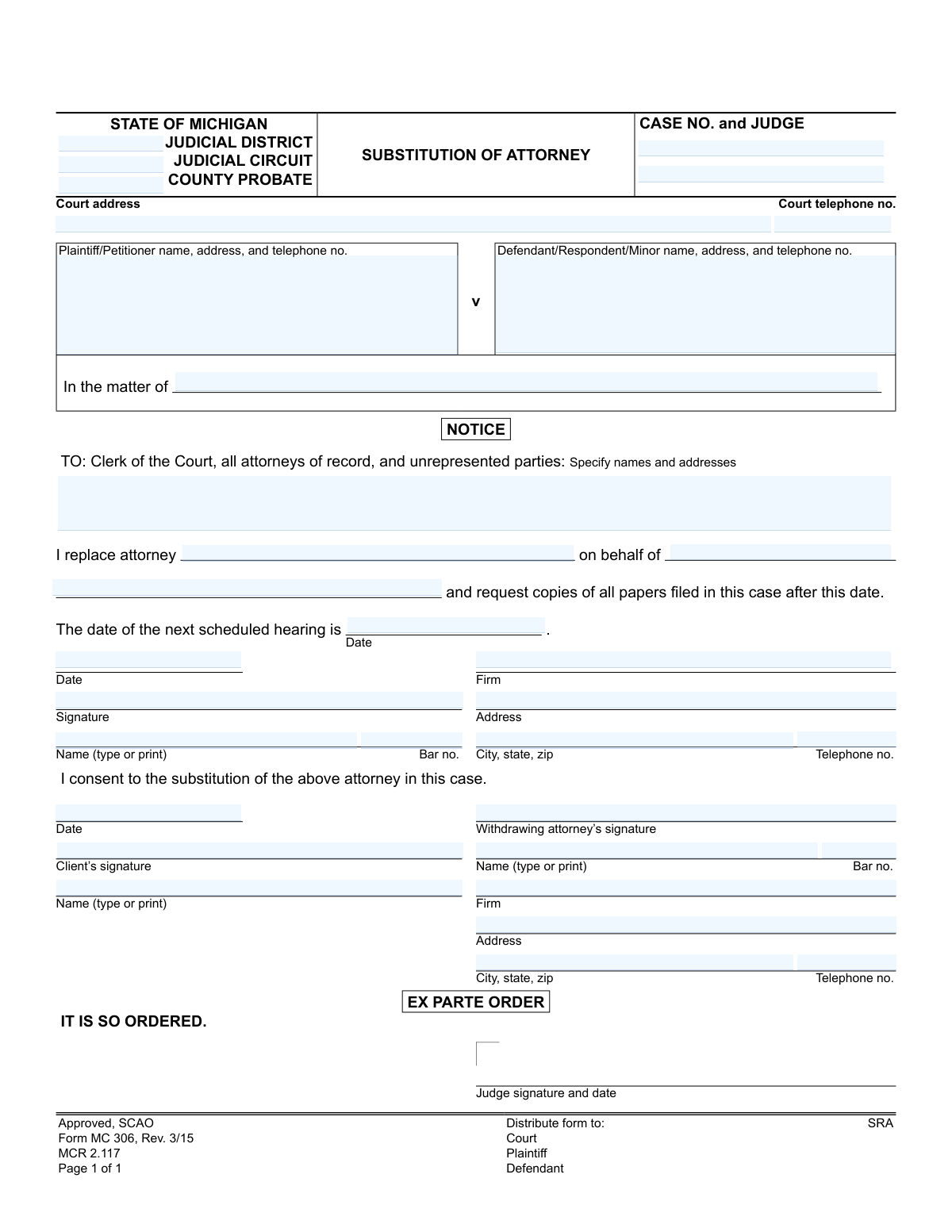
Yes! You can use AI to fill out Form MC 306, Substitution of Attorney

Form MC 306 is a legal document used in Michigan courts to officially notify the court and all involved parties of a change in legal representation. It formalizes the process of a client replacing their current attorney with a new one, requiring signatures from the client and the new attorney to be valid. Today, this form can be filled out quickly and accurately using AI-powered services like Instafill.ai, which can also convert non-fillable PDF versions into interactive fillable forms.
MC 306 is part of the Michigan court forms category on Instafill.
Our AI automatically handles information lookup, data retrieval, formatting, and form filling.
It takes less than a minute to fill out MC 306 using our AI form filling.
Securely upload your data. Information is encrypted in transit and deleted immediately after the form is filled out.

Form specifications

Form name: Form MC 306, Substitution of Attorney
Number of fields: 33
Number of pages: 1
Language: English
main-image

Instafill Demo: How to fill out PDF forms in seconds with AI

How to Fill Out MC 306 Online for Free in 2026

Are you looking to fill out a MC 306 form online quickly and accurately? Instafill.ai offers the #1 AI-powered PDF filling software of 2026, allowing you to complete your MC 306 form in just 37 seconds or less.
Follow these steps to fill out your MC 306 form online using Instafill.ai:
  1. 1 Navigate to Instafill.ai and upload or select the Michigan Substitution of Attorney form (MC 306).
  2. 2 Provide the case information when prompted by the AI, including the court, case number, and judge's name.
  3. 3 Enter the full names and addresses for the plaintiff, defendant, and other parties involved in the case.
  4. 4 Identify the client, the new incoming attorney, and the withdrawing attorney, filling in their respective details such as name, bar number, and firm address.
  5. 5 Review all the information auto-filled by the AI for accuracy, ensuring all required fields are complete.
  6. 6 Electronically sign the document in the designated areas for the client and the new attorney, and add the date.
  7. 7 Download the completed Form MC 306, ready for filing with the court and distribution to all parties.

Our AI-powered system ensures each field is filled out correctly, reducing errors and saving you time.

Why Choose Instafill.ai for Your Fillable MC 306 Form?

Speed

Complete your MC 306 in as little as 37 seconds.

Up-to-Date

Always use the latest 2026 MC 306 form version.

Cost-effective

No need to hire expensive lawyers.

Accuracy

Our AI performs 10 compliance checks to ensure your form is error-free.

Security

Your personal information is protected with bank-level encryption.

Frequently Asked Questions About Form MC 306

This form is used in Michigan courts to formally notify the court and all involved parties that a client is changing their legal representation from one attorney to another in an ongoing case.

The form must be completed and signed by three parties: the client who is changing lawyers, the new attorney who is taking over the case, and the previous attorney who is withdrawing.

You will need the case number, the court's name and address, and the full contact information for yourself, the opposing party, your old attorney, and your new attorney, including their bar numbers.

After it is fully signed, the original form must be filed with the Clerk of the Court. You must also distribute copies to all other attorneys and any unrepresented parties in the case.

The judge's signature on the 'EX PARTE ORDER' section officially approves the change in legal representation. This makes the substitution legally effective and updates the court's official record.

This form is intended for when all parties agree to the change. If your withdrawing attorney will not sign, your new attorney will likely need to file a formal motion with the court to request the substitution.

No, this form is specifically for substituting one attorney with a new one. To represent yourself (pro se), your attorney would typically need to file a 'Motion to Withdraw as Attorney,' which is a different process.

Your case number, judicial district/circuit, and court address can be found on any previous documents filed for your case, like the initial complaint or summons. If you can't find them, contact the clerk's office for the court handling your case.

In the 'TO:' field, you must list the names and addresses of the Clerk of the Court, all attorneys representing other parties in the case, and any individuals who are parties to the case but do not have an attorney.

Yes, services like Instafill.ai use AI to help you accurately auto-fill form fields with your saved information, which saves time and reduces the chance of errors.

Simply upload the MC 306 PDF to the Instafill.ai platform. The service will make the form fillable online, allowing you to click and populate the fields with your case details and contact information before printing.

You can use a tool like Instafill.ai, which can convert flat, non-fillable PDFs into interactive forms. This allows you to easily type your information into the correct fields directly on your computer.

Compliance MC 306
Validation Checks by Instafill.ai

1
Case Number Presence and Format
This check verifies that the 'Case no.' field is not empty and conforms to the standard format for Michigan court cases. The case number is the primary identifier for the legal proceeding, and its absence or incorrect format would make it impossible to file the document correctly. If this validation fails, the system should flag the form for manual review to identify the correct case.
2
Attorney Bar Number Validation
This validation ensures that the 'Bar no.' for both the incoming and withdrawing attorneys is present and follows the Michigan State Bar format (a 'P' followed by a series of digits, e.g., P12345). This is a critical check to verify that the individuals are licensed attorneys in good standing, which is a legal requirement for representation. A failed validation could indicate an unauthorized person is attempting to practice law.
3
Client Name Consistency Across Fields
This check cross-references the client's name across three locations: the case caption (Plaintiff/Petitioner or Defendant/Respondent), the 'on behalf of' line, and the printed name next to the 'Client's signature'. All three names must match to confirm that the person consenting to the substitution is the actual party to the case. A mismatch could invalidate the substitution and indicates a potential clerical error or misunderstanding.
4
Withdrawing Attorney Name Consistency
This validation confirms that the name of the attorney listed in the 'I replace attorney...' sentence matches the printed name next to the 'Withdrawing attorney's signature'. This ensures the attorney being replaced is the same one who is signing off on the substitution. Failure to match could lead to confusion and legal challenges regarding which attorney was officially withdrawn.
5
Completeness of Required Signatures
This check verifies the presence of all three required signatures: the new attorney, the client, and the withdrawing attorney. The consent of all three parties is legally necessary to execute the substitution of attorney. An incomplete form lacking any of these signatures is legally deficient and will be rejected by the court clerk.
6
Valid Date Format for All Date Fields
This validation ensures that all date fields on the form, including signature dates and the hearing date, are entered in a recognizable and valid format (e.g., MM/DD/YYYY). This prevents data ambiguity and ensures an accurate record of when events occurred. An invalid date format would cause processing errors and require manual correction.
7
Logical Hearing Date
This check validates that the 'date of the next scheduled hearing', if provided, is a future date. It is illogical for a hearing date to be in the past. This check helps ensure the new attorney is being made aware of an upcoming, actionable event and prevents errors from typos or misunderstanding.
8
Party Identification Completeness
This validation ensures that the parties to the case are clearly identified. It checks that either the 'Plaintiff/Petitioner' and 'Defendant/Respondent' fields are filled, or the 'In the matter of' field is completed. The form must specify who the legal action involves; if this information is missing, the document has no context and cannot be filed.
9
New Attorney Contact Information Completeness
This check verifies that the new attorney's full contact information, including firm, address, city, state, zip, and telephone number, is provided. The court and other parties need this information to serve official notices and communicate about the case. Missing information would hinder communication and delay the legal process.
10
Court Identifier Presence
This validation ensures that at least one of the court location fields ('Judicial District', 'Judicial Circuit', 'County Probate') is filled out. This information is essential for routing the document to the correct courthouse and jurisdiction. Without it, the form cannot be filed with the appropriate clerk of the court.
11
Standard Telephone Number Format
This check ensures that all telephone number fields on the form are entered in a valid 10-digit format, with or without parentheses and hyphens. This standardization is important for data integrity and ensures that automated systems or court staff can successfully use the number to make contact. An improperly formatted number is likely unusable.
12
Notice Recipient Information Presence
This validation checks that the field for specifying names and addresses of parties to be notified is not blank. Providing notice to all parties of record is a fundamental aspect of due process. Failure to list the parties who need to be notified means the filing party has not certified they will perform this critical step, which could lead to the substitution being challenged or invalidated.

Common Mistakes in Completing MC 306

Incorrect Court Jurisdiction Details

People often get confused between the Judicial District, Judicial Circuit, and County Probate fields, filling in the wrong one or leaving them blank. This error can cause the form to be rejected or filed in the wrong court, leading to significant delays and potential dismissal. To avoid this, carefully check the original case documents for the correct court information before completing this section.

Inaccurate Case Number or Judge Name

The case number is the primary identifier for the legal action, and even a single-digit error can lead to the document being misfiled or rejected. Similarly, omitting or misspelling the assigned judge's name can cause processing delays. Always double-check the case number against official court notices. Using an AI form-filling tool like Instafill.ai can help prevent typos by saving and auto-populating recurring case information accurately.

Failure to Notify All Required Parties

The form requires listing the Clerk of the Court and all attorneys of record and unrepresented parties. A common oversight is forgetting to list an opposing counsel or a co-defendant, which constitutes improper notice. This can lead to the substitution being invalidated and may require refiling and re-serving the document, wasting time and resources.

Missing Required Signatures

This form requires up to three signatures: the new attorney, the client, and the withdrawing attorney. Forgetting any of these signatures, especially the client's consent, will render the substitution invalid. This often happens due to poor coordination and results in the court rejecting the filing until a fully executed form is submitted.

Incorrect or Missing Attorney Bar Number

The attorney's bar number is a unique identifier required by the court for verification. Entering an incorrect number, or omitting it entirely, is a frequent data entry error that can lead to rejection of the filing. AI-powered tools like Instafill.ai can store this information securely and populate it correctly every time, eliminating the risk of manual entry errors.

Ambiguous Client Identification

In the phrase 'I replace attorney... on behalf of...', the name of the client must be clearly and fully stated as it appears in the case caption (e.g., 'John Doe, Plaintiff'). Vague entries like 'the defendant' or using a nickname can create ambiguity. This can confuse the court clerk and opposing parties, potentially delaying the processing of the substitution.

Writing in the 'Ex Parte Order' Section

The section labeled 'EX PARTE ORDER' is reserved exclusively for the judge's signature and date. Filers sometimes mistakenly write or sign in this box, which will cause the form to be immediately rejected by the court clerk. This area must be left completely blank for the court to complete.

Using an Outdated Form Version

The provided form is marked 'Rev. 3/15,' indicating it's from 2015. Courts frequently update their forms to reflect changes in rules or laws, and submitting an obsolete version can lead to automatic rejection. Always check the official court website for the most current version of any legal form before filling it out.

Illegible Information on a Non-Fillable Form

Many court forms are distributed as non-fillable PDFs, forcing users to print and fill them out by hand. Illegible handwriting, especially for critical information like case numbers and names, is a primary reason for rejection. If you encounter a non-fillable PDF, tools like Instafill.ai can convert it into a fillable version, allowing you to type information clearly and avoid legibility issues.

Incorrect Next Scheduled Hearing Date

The form asks for the date of the next scheduled hearing, which is crucial for all parties. People may leave this blank, guess the date, or enter an old date, causing confusion and potentially leading to missed court appearances. It is essential to verify the next hearing date from the court's official docket before filling out this field.
Saved over 80 hours a year

“I was never sure if my IRS forms like W-9 were filled correctly. Now, I can complete the forms accurately without any external help.”

Kevin Martin Green

Your data stays secure with advanced protection from Instafill and our subprocessors

Robust compliance program

Transparent business model

You’re not the product. You always know where your data is and what it is processed for.

ISO 27001, HIPAA, and GDPR

Our subprocesses adhere to multiple compliance standards, including but not limited to ISO 27001, HIPAA, and GDPR.

Security & privacy by design

We consider security and privacy from the initial design phase of any new service or functionality. It’s not an afterthought, it’s built-in, including support for two-factor authentication (2FA) to further protect your account.

Fill out MC 306 with Instafill.ai

Worried about filling PDFs wrong? Instafill securely fills form-mc-306-substitution-of-attorney forms, ensuring each field is accurate.