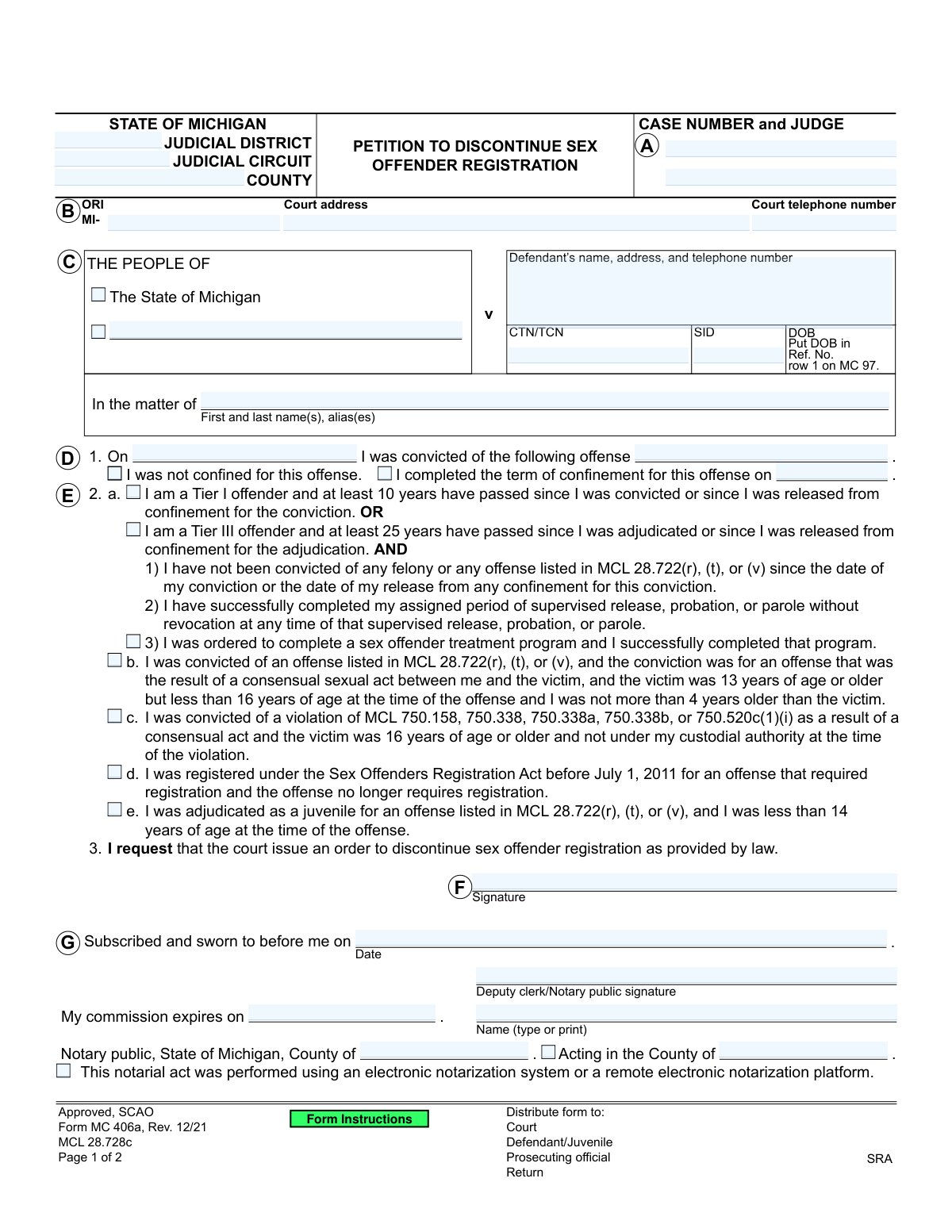
Yes! You can use AI to fill out Form MC 406a, Petition to Discontinue Sex Offender Registration
Form MC 406a, Petition to Discontinue Sex Offender Registration, is a formal request submitted to a Michigan court by an individual seeking to be removed from the state's sex offender registry. The petitioner must meet specific legal criteria, such as the passage of a certain amount of time without reoffending and the successful completion of any required treatment programs. Today, this form can be filled out quickly and accurately using AI-powered services like Instafill.ai, which can also convert non-fillable PDF versions into interactive fillable forms.
MC 406a is part of the
Michigan court forms category on Instafill.
Our AI automatically handles information lookup, data retrieval, formatting, and form filling.
It takes less than a minute to fill out MC 406a using our AI form filling.
Securely upload your data. Information is encrypted in transit and deleted immediately after the form is filled out.
Form specifications
| Form name: | Form MC 406a, Petition to Discontinue Sex Offender Registration |
| Number of fields: | 43 |
| Number of pages: | 1 |
| Language: | English |
More forms in Michigan court forms
Instafill Demo: How to fill out PDF forms in seconds with AI
How to Fill Out MC 406a Online for Free in 2026
Are you looking to fill out a MC 406A form online quickly and accurately? Instafill.ai offers the #1 AI-powered PDF filling software of 2026, allowing you to complete your MC 406A form in just 37 seconds or less.
Follow these steps to fill out your MC 406A form online using Instafill.ai:
- 1 Navigate to Instafill.ai and upload or select the Michigan Form MC 406a.
- 2 Provide your personal information, including your name, address, and date of birth, along with the court and case details.
- 3 Enter the specifics of the conviction for which you are registered, including the date and the term of confinement, if any.
- 4 Carefully review and select the appropriate checkboxes that establish your eligibility to have your registration discontinued, based on criteria like your offender tier, time elapsed, and completion of required programs.
- 5 Review all the information automatically populated by the AI to ensure its accuracy and completeness.
- 6 Sign the petition. Note that this form requires your signature to be subscribed and sworn before a notary public or deputy clerk.
- 7 Download the completed form to file with the court and serve a copy to the prosecuting official as required.
Our AI-powered system ensures each field is filled out correctly, reducing errors and saving you time.
Why Choose Instafill.ai for Your Fillable MC 406a Form?
Speed
Complete your MC 406a in as little as 37 seconds.
Up-to-Date
Always use the latest 2026 MC 406a form version.
Cost-effective
No need to hire expensive lawyers.
Accuracy
Our AI performs 10 compliance checks to ensure your form is error-free.
Security
Your personal information is protected with bank-level encryption.
Frequently Asked Questions About Form MC 406a
This form, MC 406a, is a legal petition used to formally request a Michigan court to terminate your legal requirement to register as a sex offender.
Individuals who have completed their required registration period (e.g., 10 years for Tier I) and meet other specific legal criteria, such as having no new felony convictions, are eligible to file.
You will need details of your original conviction, including the date, the specific offense, and the date you were released from confinement. You will also need your personal information and case number.
These 'Tiers' refer to Michigan's classification system for sex offenders, which dictates the length of the registration period. You must select the correct tier and verify that the required time has passed to be eligible.
After filing, the court will schedule a hearing on your petition. The date, time, and location of this hearing will be recorded in the 'Notice of Hearing' section of the form.
Yes, you must sign the petition in the presence of a notary public or a deputy court clerk. They will complete the sworn statement section to officially witness your signature.
You must file the petition with the judicial circuit or district court where you were originally convicted. The court's address should be listed at the top of the form.
Yes, you are required to mail a copy of the petition and the Notice of Hearing to the prosecuting official and then sign the 'Certificate of Mailing' on the form.
The form includes a specific provision (Section 2e) for individuals who were adjudicated as a juvenile. If you were under 14 at the time of the offense, you may be eligible to petition for discontinuation.
Yes, services like Instafill.ai use AI to help you accurately auto-fill form fields with your information, which saves time and helps prevent errors.
Simply upload the PDF of the form to the Instafill.ai platform. You can then fill out all the fields directly on your computer or use the AI auto-fill feature before downloading the completed document.
If you have a non-fillable or 'flat' PDF, you can upload it to Instafill.ai. The platform's technology will convert it into an interactive, fillable form that you can complete and save online.
In addition to the time requirement, you generally must not have any new felony convictions, must have successfully completed probation or parole, and must have finished any court-ordered sex offender treatment program.
The form has specific clauses (2b and 2c) for individuals whose convictions resulted from certain consensual acts. You should review these sections carefully with legal counsel to see if your specific situation applies.
Compliance MC 406a
Validation Checks by Instafill.ai
1
Case Number and Judge Completeness
This check verifies that the 'CASE NUMBER and JUDGE' field is not empty and that the case number conforms to the expected format for the specified Michigan judicial circuit. A valid and correct case number is essential for routing the petition to the correct court file and judge. Failure to provide a valid case number will result in processing delays or rejection of the petition.
2
Conviction and Confinement Date Logic
Validates the chronological order of dates in Section 1. The 'Completed Term Date' must be on or after the 'Conviction Date'. This ensures the timeline of events is logical and accurate, which is fundamental for calculating eligibility periods. An illogical date sequence would invalidate the petition's factual basis.
3
Mutually Exclusive Confinement Status
This check ensures that in Section 1, the petitioner selects either 'I was not confined for this offense' OR 'I completed the term of confinement for this offense', but not both. These two options are mutually exclusive and selecting both creates a logical contradiction. The form should be rejected for clarification if both are checked.
4
Conditional Confinement Date Requirement
Verifies that if the 'I completed the term of confinement for this offense' checkbox is selected, the corresponding date field is filled out. The date of release from confinement is a critical piece of data for calculating the eligibility waiting period. An incomplete entry prevents the court from verifying if the statutory time requirement has been met.
5
Tier Eligibility Timeframe Calculation
This is a critical logical check on the claims made in Section 2a. It calculates the time elapsed between the conviction/release date and the petition date, ensuring it is at least 10 years for Tier I offenders or 25 years for Tier III offenders. This validation directly confirms if the petitioner meets the core statutory waiting period required to file the petition.
6
Exclusive Basis for Petition Selection
This validation ensures that the petitioner selects one, and only one, of the primary grounds for the petition listed in sections 2a, 2b, 2c, 2d, or 2e. These sections represent different legal arguments for discontinuing registration, and selecting multiple conflicting grounds can make the petition ambiguous. The system should enforce the selection of a single, clear basis for the request.
7
Petitioner Signature and Date Presence
Confirms that the petitioner's signature and the date of signing in Section F are both present. The petitioner's sworn signature is what makes the document a legal petition. A missing signature or date renders the document invalid and it cannot be legally processed by the court.
8
Notary Commission Expiration Date
This check validates that the notary's commission expiration date in Section G is a date in the future. A notarization performed by a notary with an expired commission is legally invalid. This check is crucial to ensure the affidavit is properly executed and will be accepted by the court.
9
Notarization and Petitioner Date Consistency
Verifies that the notarization date ('Subscribed and sworn to before me on') is on or after the petitioner's signature date. A notary cannot legally witness a signature that has not yet occurred. This chronological check ensures the proper legal procedure for notarization was followed.
10
Future Hearing Date Requirement
Ensures that the 'Date and time' for the hearing in Section H is set to a future date and time. Scheduling a hearing for a past date is a logical impossibility and indicates a data entry error. This validation prevents the issuance of invalid hearing notices and ensures proper scheduling.
11
Defendant Identification Completeness
This check ensures that the defendant's full name, address, and telephone number are provided in section C. This information is essential for the court and other parties to identify and communicate with the petitioner. Incomplete identification can lead to misidentification or an inability to serve required notices.
12
Telephone Number Format Validation
Validates that the 'Court telephone number' and the 'Defendant’s telephone number' adhere to a standard 10-digit phone number format. Proper formatting ensures that the data is clean and usable by automated systems for communication or record-keeping. It prevents errors that could arise from invalid or incomplete numbers.
13
Certificate of Mailing Date Logic
This check ensures the 'Date' in the Certificate of Mailing section is on or after the petitioner's signature date. The act of mailing a document to the prosecutor would logically happen after the petition has been completed and signed. This validation upholds the logical sequence of events in the filing process.
Common Mistakes in Completing MC 406a
Petitioners often sign the document in section F before taking it to a notary public. The phrase 'Subscribed and sworn to before me' in section G means the signature must be witnessed by the notary. Signing beforehand invalidates the notarization, leading to the court rejecting the petition and requiring the entire process to be restarted. To avoid this, do not sign the petition until you are physically in the presence of the deputy clerk or notary public who will then officially witness your signature.
In section 2a, petitioners frequently misidentify themselves as a Tier I or Tier III offender or miscalculate the required waiting period (10 or 25 years). This often happens due to a misunderstanding of their original conviction or a simple miscalculation of dates from their conviction or release. An incorrect selection makes the entire petition invalid from the start, causing immediate dismissal. It is crucial to verify your tier status and confirm the exact dates from official court records before filling out this section.
In section D, individuals may use approximate dates for their conviction or release from confinement, or confuse the two. The court verifies these dates against official records, and any discrepancy will cause delays or rejection of the petition. These dates are critical for establishing eligibility under the timeframes in section 2. Always consult your official judgment of sentence or contact the Department of Corrections for the exact dates before completing this section.
Petitioners may fail to list all aliases or forget to include crucial identifiers like the SID or CTN/TCN numbers in section C. These numbers are the primary way the court and law enforcement track case history, and their omission can lead to processing delays while the clerk searches for the correct records. To prevent this, gather all your original court documents which list these numbers and ensure every name you have legally used is included.
The Certificate of Mailing in section I is a sworn statement that the petitioner has sent a copy to the prosecuting official. Common mistakes include signing and dating it before actually mailing the documents, or failing to send it to the correct address as defined by court rules. This procedural error can lead to the hearing being canceled or the petition being dismissed for failure to provide proper notice. Always mail the copy first, then sign and date the certificate on the day of mailing.
Petitioners sometimes attempt to fill out the 'Notice of Hearing' section (H) themselves, setting their own date and time. This section is exclusively for the court clerk to complete upon filing the petition. Writing in this section can cause confusion and will be disregarded, but it reflects a misunderstanding of the court process. Leave this section completely blank; the court will provide you with the completed hearing information after you file the petition.
In section D, a person might check the box for 'I was not confined for this offense' and also provide a date for 'I completed the term of confinement on...'. This creates a direct contradiction that makes the petition logically inconsistent and will lead to it being questioned or rejected. Carefully read each option and select only one of the two choices regarding confinement to ensure your statement is clear and accurate.
Section 2 (parts a through e) contains highly specific legal conditions for removal from the registry. Petitioners may check a box that seems close to their situation but isn't an exact match, such as the specific age requirements in 2b or the list of offenses in 2c. Checking the wrong box constitutes a false claim and will result in the petition being denied. If you are unsure which, if any, of these specific circumstances apply, it is essential to consult with an attorney.
The top section of the form requires specific information like the 'CASE NUMBER', 'JUDGE', and 'ORI' number. Petitioners often leave this information blank because they don't have it readily available. A petition filed without a case number cannot be correctly docketed, causing it to be rejected by the clerk's office. This information must be copied exactly from previous court documents related to the case. AI-powered tools like Instafill.ai can help by storing and auto-filling this repetitive information accurately across all related legal forms.
Often, the only version of a form available online is a flat, non-fillable PDF scan, which forces the petitioner to print it and fill it out by hand. This leads to illegible handwriting, which can cause data entry errors by the court clerk, or mistakes and cross-outs by the petitioner. To ensure clarity and professionalism, tools like Instafill.ai can convert such non-fillable PDFs into interactive, fillable forms, allowing you to type your answers cleanly and avoid legibility issues.
Saved over 80 hours a year
“I was never sure if my IRS forms like W-9 were filled correctly. Now, I can complete the forms accurately without any external help.”
Kevin Martin Green
Your data stays secure with advanced protection from Instafill and our subprocessors

Robust compliance program
Transparent business model
You’re not the product. You always know where your data is and what it is processed for.
ISO 27001, HIPAA, and GDPR
Our subprocesses adhere to multiple compliance standards, including but not limited to ISO 27001, HIPAA, and GDPR.
Security & privacy by design
We consider security and privacy from the initial design phase of any new service or functionality. It’s not an afterthought, it’s built-in, including support for two-factor authentication (2FA) to further protect your account.
Fill out MC 406a with Instafill.ai
Worried about filling PDFs wrong? Instafill securely fills form-mc-406a-petition-to-discontinue-sex-offender-registration forms, ensuring each field is accurate.