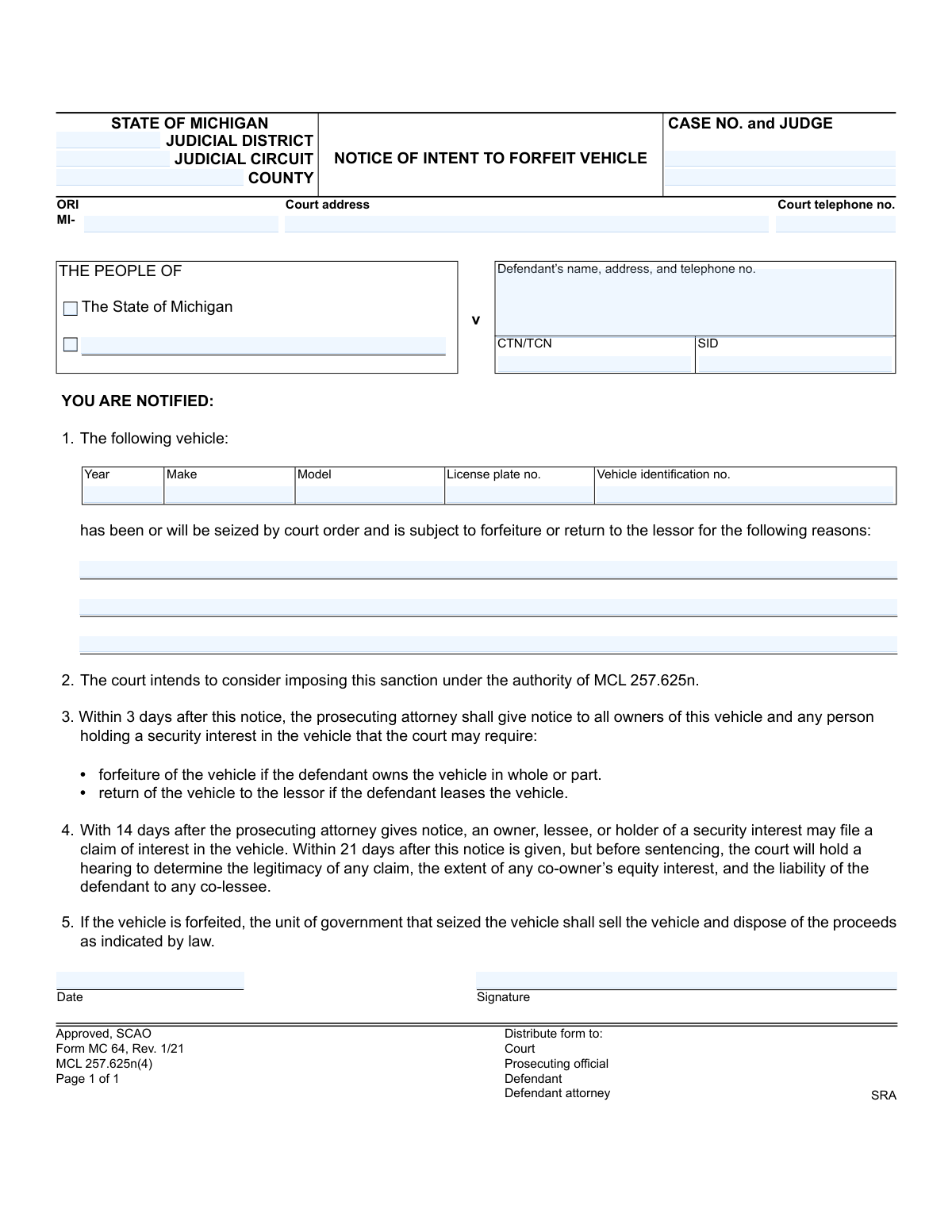
Yes! You can use AI to fill out Form MC 64, Notice of Intent to Forfeit Vehicle
Form MC 64 is a State of Michigan court form used to officially notify a defendant and other interested parties that a vehicle is subject to forfeiture, typically in connection with a criminal offense like a DUI, under MCL 257.625n. It details the vehicle information, the reason for the seizure, and the legal process for owners or lienholders to file a claim of interest. Today, this form can be filled out quickly and accurately using AI-powered services like Instafill.ai, which can also convert non-fillable PDF versions into interactive fillable forms.
MC 64 is part of the
Michigan court forms category on Instafill.
Our AI automatically handles information lookup, data retrieval, formatting, and form filling.
It takes less than a minute to fill out MC 64 using our AI form filling.
Securely upload your data. Information is encrypted in transit and deleted immediately after the form is filled out.
Form specifications
| Form name: | Form MC 64, Notice of Intent to Forfeit Vehicle |
| Number of fields: | 24 |
| Number of pages: | 1 |
| Language: | English |
More forms in Michigan court forms
Instafill Demo: How to fill out PDF forms in seconds with AI
How to Fill Out MC 64 Online for Free in 2026
Are you looking to fill out a MC 64 form online quickly and accurately? Instafill.ai offers the #1 AI-powered PDF filling software of 2026, allowing you to complete your MC 64 form in just 37 seconds or less.
Follow these steps to fill out your MC 64 form online using Instafill.ai:
- 1 Navigate to Instafill.ai and upload or select the Michigan Form MC 64, Notice of Intent to Forfeit Vehicle.
- 2 Provide the court and case information, including the judicial district/circuit, county, case number, and judge's name.
- 3 Enter the defendant's full name, address, and telephone number, along with any identifying numbers like CTN or SID.
- 4 Input the specific details of the vehicle being seized, including the year, make, model, license plate number, and Vehicle Identification Number (VIN).
- 5 Clearly state the reasons for the seizure and forfeiture as per the court order and legal authority (MCL 257.625n).
- 6 Review all the information auto-filled by the AI for accuracy, ensuring all case details and vehicle information are correct.
- 7 Date and sign the form, then distribute copies to the court, prosecuting official, defendant, and other required parties as indicated.
Our AI-powered system ensures each field is filled out correctly, reducing errors and saving you time.
Why Choose Instafill.ai for Your Fillable MC 64 Form?
Speed
Complete your MC 64 in as little as 37 seconds.
Up-to-Date
Always use the latest 2026 MC 64 form version.
Cost-effective
No need to hire expensive lawyers.
Accuracy
Our AI performs 10 compliance checks to ensure your form is error-free.
Security
Your personal information is protected with bank-level encryption.
Frequently Asked Questions About Form MC 64
This form is an official court notice informing a defendant that a vehicle associated with their case has been seized and may be permanently taken by the government as a penalty for an offense, under the authority of Michigan law MCL 257.625n.
You likely received this notice because you are the defendant in a court case where the listed vehicle was involved in an offense, often related to driving. The court is now formally considering the forfeiture of this vehicle as part of the potential sanctions.
Forfeiture means the government will legally take permanent ownership of your vehicle. The seizing government agency will then sell the vehicle and distribute the proceeds as required by law.
You should immediately consult with an attorney to understand your rights and options. There are strict deadlines, as you or other interested parties only have 14 days after the prosecutor's notice to file a claim of interest in the vehicle.
As a co-owner, you have the right to file a 'claim of interest' with the court within 14 days of being notified. The court will then hold a hearing to determine the extent of your ownership equity and the legitimacy of your claim.
The hearing allows the court to review any claims of interest filed by owners, co-owners, or lienholders. The judge will determine the legitimacy of these claims before making a final decision on whether to forfeit the vehicle.
The lender (or holder of the security interest) must also be notified and has the right to file a claim within 14 days. The court will consider their financial interest in the vehicle during the forfeiture hearing.
This form is an official court document prepared and issued by the prosecuting attorney's office or a court official. It is not a form for the defendant to fill out, but rather to receive as a notification.
These are unique identification numbers used by the Michigan criminal justice system to track cases and individuals. CTN is the Charge Tracking Number, TCN is the Tracking Control Number, and SID is the State Identification Number.
If you fail to respond or file a claim of interest within the legal timeframe, you will likely lose your right to challenge the forfeiture. The court may proceed with permanently taking the vehicle.
Yes, AI-powered services like Instafill.ai can help you accurately complete related documents, such as a claim of interest form. These tools auto-fill form fields, saving you time and helping to prevent errors.
You can use a service like Instafill.ai to fill out your claim form online. Simply upload the PDF, and the AI will make it interactive so you can type your information directly into the fields before printing it for submission.
Tools like Instafill.ai can convert flat, non-fillable PDFs into interactive, fillable forms. This allows you to easily complete the form on your computer, ensuring it is neat and legible.
Compliance MC 64
Validation Checks by Instafill.ai
1
Vehicle Identification Number (VIN) Format Validation
This check verifies that the Vehicle Identification Number (VIN) field contains exactly 17 alphanumeric characters, excluding 'I', 'O', and 'Q'. A valid VIN is crucial for uniquely identifying the specific vehicle subject to forfeiture and preventing errors in legal records. An incorrect or incomplete VIN could lead to the wrong vehicle being targeted or the notice being legally invalid.
2
Case Number Format and Completeness
This validation ensures the 'case no' field is populated and follows the standard Michigan court case number format (e.g., YY-######-XX). This is critical for correctly filing the notice and associating it with the proper legal proceedings in the court's system. An invalid or missing case number would prevent the document from being processed and could delay legal action.
3
Date Field Format and Plausibility
This check validates that the 'date' field is entered in a recognized format (e.g., MM/DD/YYYY) and represents a real, non-future date. This is essential for establishing the official date of the notice, which triggers legal timelines for responses from owners and lienholders. An invalid or future date would make the notice legally defective and unenforceable.
4
Vehicle Year Logical Range Check
This validation ensures the 'vehicle year' is a four-digit number that falls within a logical range, such as not being in the future or before a reasonable historical year like 1900. This check prevents common data entry errors and ensures the vehicle information is plausible. An illogical year could cause confusion and require manual correction, delaying the forfeiture process.
5
ORI Number Prefix and Format
This validation confirms that the Originating Agency Identifier (ORI) number begins with the 'MI-' prefix as indicated on the form and is followed by the correct number of alphanumeric characters. The ORI is critical for routing the document to the correct law enforcement or court agency. A missing or malformed ORI would result in the notice being sent to the wrong jurisdiction or being rejected by the system.
6
Required Fields Completeness Check
This check ensures that critical fields such as 'case no', 'defendant name address telephone', 'VIN', and 'date' are not left blank. These fields are fundamental to the purpose of the notice, identifying the legal case, the individual involved, and the property in question. A submission with missing core information is incomplete and cannot be processed, halting the legal forfeiture action.
7
Defendant Information Block Completeness
This check verifies that the 'defendant name address telephone' field contains sufficient information to properly identify and contact the defendant. This is critical for ensuring the defendant is properly served with the notice, a fundamental requirement of legal due process. Incomplete information could lead to a failure to notify, potentially invalidating the entire forfeiture proceeding.
8
Forfeiture Reason Completeness
This validation ensures that at least one of the 'reasons' fields is filled out, explaining the legal basis for the vehicle seizure under MCL 257.625n. The notice is legally insufficient without a stated reason, as it fails to inform the owner why their property is being targeted. This is a due process requirement, and its absence would invalidate the notice.
9
Court Telephone Number Format
This validation verifies that the 'court telephone no' is in a standard US phone number format, such as (XXX) XXX-XXXX or XXX-XXX-XXXX. A correctly formatted phone number is essential for enabling communication between the defendant, their attorney, and the court. An improperly formatted number could hinder communication and delay proceedings.
10
Judicial Information Consistency Check
This check verifies that the specified 'judicial district' and 'judicial circuit' are logically consistent with the provided 'county'. In Michigan's court system, districts and circuits have specific geographic boundaries tied to counties. This validation prevents jurisdictional errors, ensuring the case is filed in the correct court with proper authority over the matter.
11
CTN/TCN/SID Field Format Validation
This validation checks if the Complaint Tracking Number (CTN), Transaction Control Number (TCN), and State Identification Number (SID) fields adhere to their expected alphanumeric formats. These numbers are crucial for linking the forfeiture action to the defendant's criminal case and record within various state and local databases. Incorrectly formatted identifiers can cause data mismatches and administrative delays.
12
Vehicle Make and Model Completeness
This validation ensures that both the 'vehicle make' (e.g., Ford, Toyota) and 'vehicle model' (e.g., Explorer, Camry) fields are filled in. Along with the year and VIN, these details provide a complete description of the vehicle, reducing the risk of misidentification. Omitting this information makes the notice less precise and could create ambiguity in legal records.
13
Signature Presence Check
This validation confirms that the 'signature' field is not empty, indicating that an authorized official has signed the document. A signature is required to attest to the authenticity and authority of the notice, making it a legally binding document. A missing signature would render the notice invalid and unenforceable.
Common Mistakes in Completing MC 64
A Vehicle Identification Number (VIN) is a unique 17-character code, and typos are extremely common due to its length and complexity, such as confusing the letter 'O' with the number '0'. An incorrect VIN legally identifies the wrong vehicle, which can invalidate the entire forfeiture notice and create grounds for legal challenges. Always double-check the VIN against the official vehicle registration, and consider using AI-powered form fillers like Instafill.ai that can help validate the format of the VIN to catch potential errors.
The case number is the primary identifier that links this notice to the correct court proceeding. People often mistype the number, omit parts of it, or leave it blank entirely, causing the notice to be misfiled or rejected by the court clerk. This error halts the forfeiture process until a corrected notice is filed. To prevent this, carefully transcribe the complete case number exactly as it appears on official court documents.
Michigan's court system has distinct District and Circuit courts, and filers often incorrectly enter the same information for both or confuse which court has jurisdiction over the forfeiture. This common mistake can cause the notice to be filed with the wrong judicial body, leading to immediate rejection and significant delays. It is essential to verify the correct court with jurisdiction for the forfeiture action from the primary case documents before filling out the form.
The Complaint Tracking Number (CTN), Transaction Control Number (TCN), and State Identification Number (SID) are crucial for linking the forfeiture to the defendant's criminal record. These long numeric codes are prone to transcription errors or are sometimes left blank due to carelessness. Inaccuracies can hinder the prosecutor's ability to connect the forfeiture to the underlying criminal case, causing administrative and processing delays.
The form requires a specific explanation for why the vehicle is being seized under the authority of MCL 257.625n. Filers often make the mistake of providing overly brief or generic reasons like 'DUI offense,' which lacks the necessary legal detail. This can result in the notice being deemed legally insufficient, giving the defendant or owner grounds to challenge the forfeiture. The reason should clearly state the connection between the vehicle and the specific qualifying offense.
The form requires the defendant's complete name, address, and telephone number for proper legal notification. Filers frequently omit the phone number or provide only a partial address, which is insufficient for legal service. This failure can lead to successful claims of improper notice, delaying or even invalidating the forfeiture proceedings. Always provide the most complete and current contact information available for the defendant.
This notice is often provided as a non-fillable PDF, forcing users to complete it by hand, where poor handwriting is a frequent problem. Unclear writing of critical data like the VIN, case number, or defendant's name can lead to data entry errors by court clerks and potential rejection of the form. To avoid this, a service like Instafill.ai can convert the flat PDF into an electronically fillable form, ensuring all entries are clear and legible.
An unsigned or undated notice is legally invalid and will be rejected immediately by the court. This is a common oversight that occurs when rushing to complete paperwork, rendering the document unofficial and unenforceable. This mistake requires the entire form to be re-issued and re-served, wasting significant time and resources. Always perform a final review to ensure all signature and date fields are properly completed.
The ORI (Originating Agency Identifier) number is a unique code that identifies the law enforcement agency seizing the vehicle. Filers who are unfamiliar with this code may leave the 'ORI MI-' field blank or enter an incorrect value. An absent or incorrect ORI can cause administrative delays and problems with tracking and processing the forfeiture within the state's system. This number should be obtained from the seizing agency's official records and entered correctly.
While the VIN is the most critical identifier, errors in the make, model, year, or license plate number create inconsistencies that can be used to challenge the notice. These mistakes often happen due to haste or trying to fill the form from memory instead of using official documents. All vehicle details should be carefully verified against the registration or seizure report to ensure the information is entirely accurate and consistent.
Saved over 80 hours a year
“I was never sure if my IRS forms like W-9 were filled correctly. Now, I can complete the forms accurately without any external help.”
Kevin Martin Green
Your data stays secure with advanced protection from Instafill and our subprocessors

Robust compliance program
Transparent business model
You’re not the product. You always know where your data is and what it is processed for.
ISO 27001, HIPAA, and GDPR
Our subprocesses adhere to multiple compliance standards, including but not limited to ISO 27001, HIPAA, and GDPR.
Security & privacy by design
We consider security and privacy from the initial design phase of any new service or functionality. It’s not an afterthought, it’s built-in, including support for two-factor authentication (2FA) to further protect your account.
Fill out MC 64 with Instafill.ai
Worried about filling PDFs wrong? Instafill securely fills form-mc-64-notice-of-intent-to-forfeit-vehicle forms, ensuring each field is accurate.