Yes! You can use AI to fill out Form MC 66, Order on Motion for Return of Vehicle Pending Forfeiture Proceedings
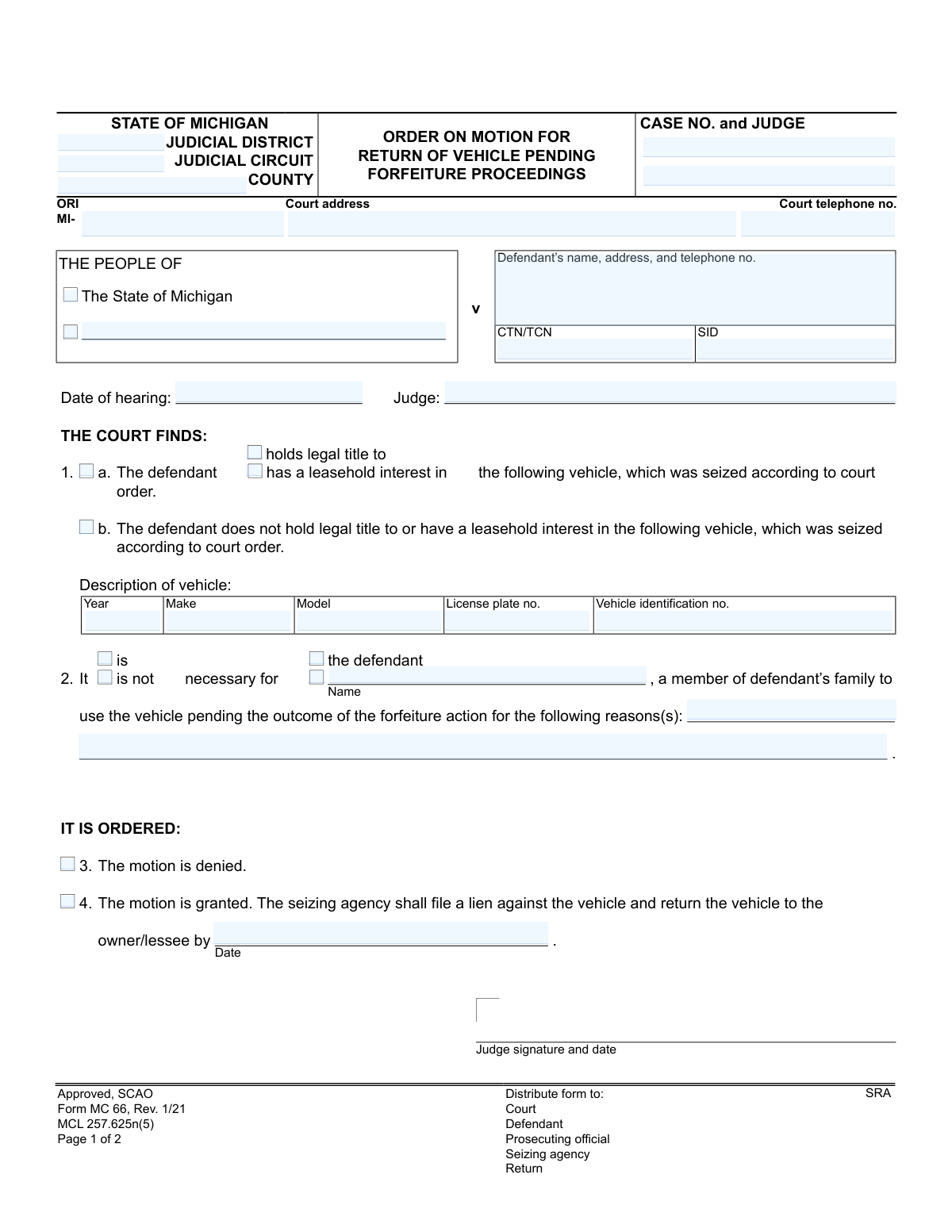
This form, officially titled 'Order on Motion for Return of Vehicle Pending Forfeiture Proceedings,' is a legal document used in the Michigan judicial system. It records a judge's decision regarding a defendant's request to have their seized vehicle returned to them before the conclusion of a forfeiture case. Today, this form can be filled out quickly and accurately using AI-powered services like Instafill.ai, which can also convert non-fillable PDF versions into interactive fillable forms.
MC 66 is part of the
Michigan court forms category on Instafill.
Our AI automatically handles information lookup, data retrieval, formatting, and form filling.
It takes less than a minute to fill out MC 66 using our AI form filling.
Securely upload your data. Information is encrypted in transit and deleted immediately after the form is filled out.
Form specifications
| Form name: | Form MC 66, Order on Motion for Return of Vehicle Pending Forfeiture Proceedings |
| Number of fields: | 42 |
| Number of pages: | 1 |
| Language: | English |
More forms in Michigan court forms
Instafill Demo: How to fill out PDF forms in seconds with AI
How to Fill Out MC 66 Online for Free in 2026
Are you looking to fill out a MC 66 form online quickly and accurately? Instafill.ai offers the #1 AI-powered PDF filling software of 2026, allowing you to complete your MC 66 form in just 37 seconds or less.
Follow these steps to fill out your MC 66 form online using Instafill.ai:
- 1 Navigate to Instafill.ai and upload or select the Form MC 66.
- 2 Enter the court and case details, including the judicial district/circuit, county, case number, and judge's name.
- 3 Provide the defendant's information and a complete description of the seized vehicle, including its year, make, model, and VIN.
- 4 Document the court's findings regarding the defendant's legal title or leasehold interest and the necessity of vehicle use pending the forfeiture action.
- 5 Indicate the court's final order by checking whether the motion is granted or denied. If granted, specify the date by which the vehicle must be returned.
- 6 The judge will sign and date the order. Subsequently, the seizing official will complete the 'Return of Property' section upon the vehicle's return.
- 7 Review all entered information for accuracy before finalizing, printing, and distributing the completed form to the court, defendant, prosecuting official, and seizing agency.
Our AI-powered system ensures each field is filled out correctly, reducing errors and saving you time.
Why Choose Instafill.ai for Your Fillable MC 66 Form?
Speed
Complete your MC 66 in as little as 37 seconds.
Up-to-Date
Always use the latest 2026 MC 66 form version.
Cost-effective
No need to hire expensive lawyers.
Accuracy
Our AI performs 10 compliance checks to ensure your form is error-free.
Security
Your personal information is protected with bank-level encryption.
Frequently Asked Questions About Form MC 66
This form is a legal document issued by a judge that states the court's decision on whether to temporarily return a seized vehicle to its owner while forfeiture proceedings are ongoing.
A judge fills out and signs this order after a hearing. While you or your attorney would file the initial 'Motion' to request the vehicle back, this specific 'Order' form is completed by the court.
This means the legal process to determine if the government can permanently keep your seized vehicle has begun but is not yet complete. This order addresses the temporary use of the vehicle during that period.
If the motion is granted, the seizing agency is ordered to file a lien against the vehicle and return it to the owner or lessee by a specific date. You can then use the vehicle while the main forfeiture case continues.
A lien is a legal claim on the property, which prevents you from selling or transferring the vehicle's title. It serves as security for the seizing agency until the forfeiture case is fully resolved.
If the motion is denied, the seizing agency will continue to hold the vehicle until the forfeiture proceedings are concluded. The vehicle will not be returned to you at this time.
The court evaluates whether the defendant or a family member has a critical need for the vehicle for essential activities like getting to work, school, or medical appointments, and lacks reasonable alternative transportation.
The order must include a detailed description of the vehicle, including its year, make, model, license plate number, and Vehicle Identification Number (VIN).
The form allows the judge to specify if the defendant has a leasehold interest or if another person holds the legal title. The court's decision will be based on the specific facts presented during the hearing.
After the judge signs the order, copies are officially distributed to the court file, the defendant, the prosecuting official, and the seizing agency that has the vehicle.
This section is a certification completed by the seizing agency. An official signs it to confirm that they have complied with the court's order by returning the vehicle and filing the required lien.
While a judge completes this 'Order' form, AI services like Instafill.ai can help you accurately fill out the initial 'Motion' form you must file with the court to request your vehicle's return.
You can upload your motion form to Instafill.ai, which uses AI to identify all the fields. You can then type your information directly into the interactive fields, download the completed form, and print it for filing.
Services like Instafill.ai can solve this problem. Upload the non-fillable PDF, and the platform will automatically convert it into an interactive, fillable form that you can complete on your computer.
Compliance MC 66
Validation Checks by Instafill.ai
1
Validates Vehicle Identification Number (VIN) Format
This check ensures the 'Vehicle identification no.' field contains a valid 17-character alphanumeric string, excluding the letters I, O, and Q. It is critical for uniquely identifying the vehicle in question for legal and administrative purposes, such as filing a lien. An invalid or incorrect VIN could render the court order unenforceable or lead to actions against the wrong vehicle.
2
Ensures Mutually Exclusive Order Selection
This validation verifies that only one of the two main order options, '3. The motion is denied' or '4. The motion is granted', is selected. The court's decision must be unambiguous. If both or neither are selected, the form is logically inconsistent and cannot be processed, as the outcome of the motion is unclear.
3
Conditional Requirement for Vehicle Return Date
If the 'motion is granted' checkbox is selected, this validation ensures that the 'return the vehicle to the owner/lessee by' date field is populated. This date is a mandatory component of a granted motion, as it provides a specific deadline for the seizing agency to comply with the court's order. Failure to provide this date would make the order incomplete and difficult to execute.
4
Ensures Mutually Exclusive Findings on Vehicle Interest
This check validates that only one of the two findings in section 1 is selected: either 1a (defendant has title/lease) or 1b (defendant does not have title/lease). These two statements are contradictory, and selecting both would create a legal ambiguity in the court's findings. The system must enforce the selection of only one to ensure the finding is clear and legally sound.
5
Validates Logical Date Sequence
This check ensures that all dates on the form follow a logical progression. Specifically, the 'return vehicle date' (in the order) and the judge's 'Signature date' must be on or after the 'Date of hearing'. An illogical date sequence, such as an order being signed before the hearing, would invalidate the document's timeline and legal standing.
6
Conditional Requirement for Necessity Justification
If the finding in section 2 indicates that it 'is' necessary for the defendant or family to use the vehicle, this validation requires the 'reasons' field to be filled out. This justification is legally required to support the court's finding of necessity. An empty reasons field would make the finding unsubstantiated and potentially subject to appeal.
7
Validates Vehicle Model Year Range
This check ensures the 'Year' field for the vehicle description is a valid 4-digit number within a plausible range (e.g., from 1900 to the current year plus two). This prevents data entry errors such as typos or nonsensical values. Accurate vehicle information is essential for proper identification and lien processing.
8
Ensures Case Number Consistency Across Pages
This validation confirms that the 'Case No.' entered at the top of page 1 matches the 'Case No.' at the top of page 2. This is a critical integrity check to ensure that pages of the legal document are not mismatched during processing, filing, or distribution. A mismatch could lead to the wrong information being associated with a case.
9
Conditional Requirement for Family Member's Name
In section 2, if the finding states it is necessary for 'a member of defendant’s family' to use the vehicle, this validation ensures the corresponding 'Name' field is completed. This is crucial for identifying the specific individual authorized to use the vehicle. Without a name, the order is too vague and could lead to unauthorized use or disputes.
10
Validates ORI Number Format
This check verifies that the 'ORI' (Originating Agency Identifier) field follows the correct format for Michigan, which is 'MI' followed by a 7-character alphanumeric code. The ORI is essential for routing the document to the correct law enforcement and court systems. An incorrectly formatted ORI will cause routing failures and processing delays.
11
Completeness of Seizing Official Information
If the 'RETURN OF PROPERTY' section is filled out (e.g., a 'return date actual' is entered), this check ensures that the 'Name of seizing official', 'Title', and 'Unit of government' fields are also completed. This information is required for accountability and creates a clear record of who returned the property and under what authority. Incomplete information compromises the chain of custody record.
12
Logical Consistency of Vehicle Return Dates
This validation compares the date in the judge's order ('return the vehicle... by' date) with the date in the 'RETURN OF PROPERTY' section ('returned to the owner/lessee on' date). The actual return date must be on or before the court-ordered deadline. This check ensures compliance with the court order is accurately documented.
Common Mistakes in Completing MC 66
Users often transcribe the case number incorrectly or forget to enter it on the second page. The case number is the primary identifier for the entire legal action, and it appears on both pages of this form. An incorrect or missing number can cause the document to be misfiled, rejected by the clerk, or lead to the second page being lost, delaying the entire motion process.
The 17-character VIN is long and complex, making it easy to transpose letters or numbers during manual entry. An incorrect VIN legally misidentifies the property in question, which can lead to the motion being denied or create significant legal and administrative problems with the seizing agency when attempting to process the return. Always double-check the VIN against official registration documents.
In Section 1, filers mistakenly check both boxes for 'holds legal title' and 'has a leasehold interest,' or they fail to check either box 1a or 1b. This creates a logical contradiction or leaves the defendant's relationship to the vehicle undefined, making the finding unclear. The form will likely be returned for correction, causing unnecessary delays.
When filling out Section 2, people provide weak or generic reasons like 'need for work' instead of specific, compelling details. The judge needs sufficient information to determine if returning the vehicle is truly necessary pending the outcome of the forfeiture. A vague justification will likely fail to meet the legal standard, resulting in the denial of the motion.
In Section 2, if the vehicle is needed by a family member, filers may check the appropriate box but forget to write the person's name in the designated space. This omission makes it impossible for the court to evaluate the claim of necessity for that specific person. The motion may be denied due to this incomplete information.
A common error is for the filer to check the 'motion is denied' or 'motion is granted' box (Sections 3 and 4). This section is exclusively for the judge to fill out to indicate their ruling. Pre-filling this section is improper, may be viewed negatively by the court, and will cause the form to be rejected or returned.
The defendant or their representative incorrectly fills out the 'Return of Property' section on page 2. This section is to be completed only by the seizing law enforcement official after the vehicle has actually been returned as ordered. Filling this out prematurely is incorrect and causes confusion for the agency responsible for executing the court's order.
Filers often leave the ORI, CTN/TCN, or SID fields blank because they don't know what they are or where to find them. These numbers are crucial for routing the order to the correct law enforcement agency and linking the action to the defendant's record. Missing identifiers can cause major administrative delays and communication breakdowns between the court and the seizing agency.
This form is often available as a non-fillable PDF, leading people to print it and fill it out by hand. Illegible handwriting can cause clerks to misinterpret critical information like names, case numbers, or the VIN, leading to data entry errors in the official record or outright rejection of the form. To avoid this, AI-powered tools like Instafill.ai can convert the document into a fillable version, allowing you to type information clearly and professionally.
Saved over 80 hours a year
“I was never sure if my IRS forms like W-9 were filled correctly. Now, I can complete the forms accurately without any external help.”
Kevin Martin Green
Your data stays secure with advanced protection from Instafill and our subprocessors

Robust compliance program
Transparent business model
You’re not the product. You always know where your data is and what it is processed for.
ISO 27001, HIPAA, and GDPR
Our subprocesses adhere to multiple compliance standards, including but not limited to ISO 27001, HIPAA, and GDPR.
Security & privacy by design
We consider security and privacy from the initial design phase of any new service or functionality. It’s not an afterthought, it’s built-in, including support for two-factor authentication (2FA) to further protect your account.
Fill out MC 66 with Instafill.ai
Worried about filling PDFs wrong? Instafill securely fills form-mc-66-order-on-motion-for-return-of-vehicle-pending-forfeiture-proceedings forms, ensuring each field is accurate.