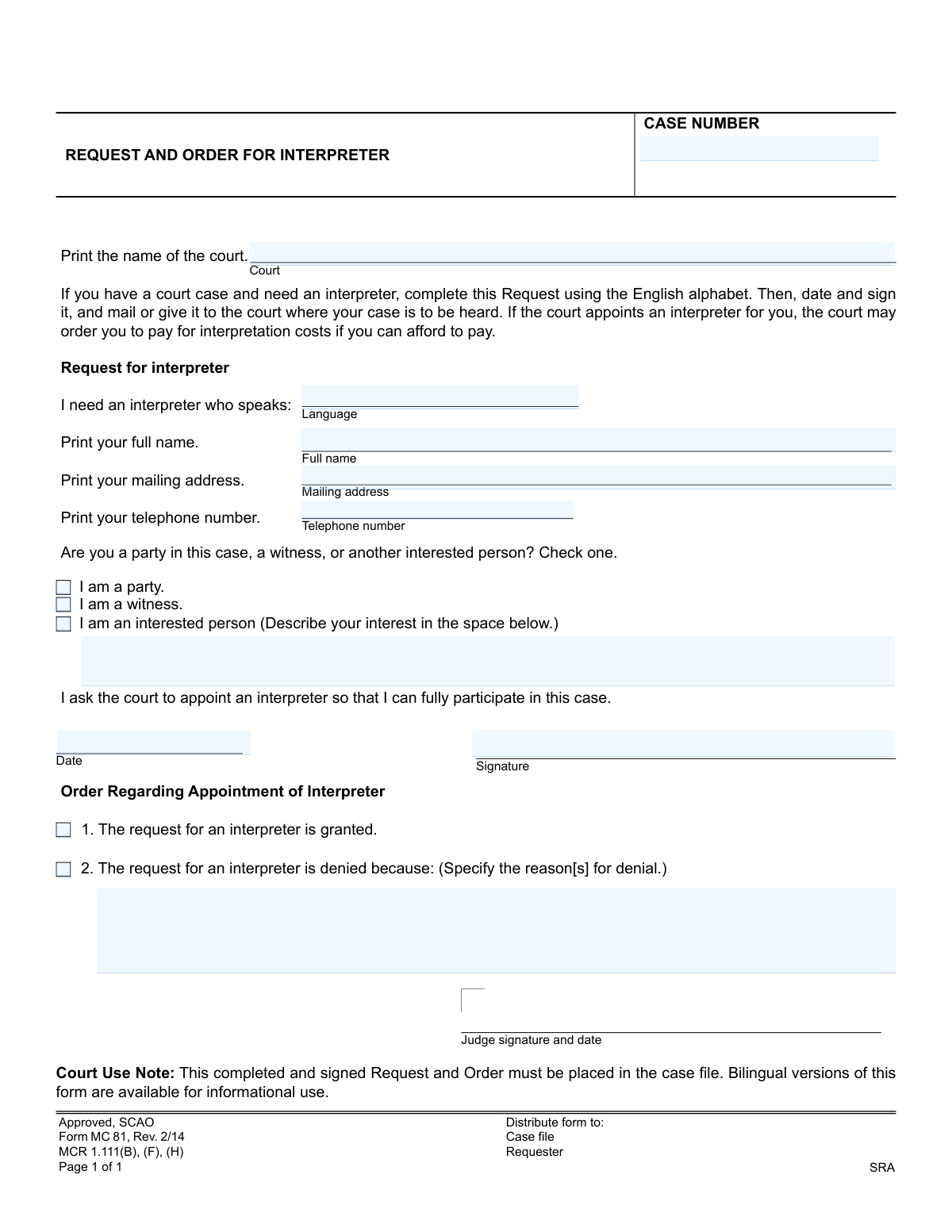
Yes! You can use AI to fill out Form MC 81, Request and Order for Interpreter
Form MC 81, the Request and Order for Interpreter, is a state court administrative office (SCAO) form used by individuals involved in a court case (as a party, witness, or other interested person) to formally ask the court to provide an interpreter for a specific language. The form includes sections for the requester's information and a section for the judge to grant or deny the request. Today, this form can be filled out quickly and accurately using AI-powered services like Instafill.ai, which can also convert non-fillable PDF versions into interactive fillable forms.
MC 81 is part of the
Michigan court forms category on Instafill.
Our AI automatically handles information lookup, data retrieval, formatting, and form filling.
It takes less than a minute to fill out MC 81 using our AI form filling.
Securely upload your data. Information is encrypted in transit and deleted immediately after the form is filled out.
Form specifications
| Form name: | Form MC 81, Request and Order for Interpreter |
| Number of fields: | 15 |
| Number of pages: | 1 |
| Language: | English |
More forms in Michigan court forms
Instafill Demo: How to fill out PDF forms in seconds with AI
How to Fill Out MC 81 Online for Free in 2026
Are you looking to fill out a MC 81 form online quickly and accurately? Instafill.ai offers the #1 AI-powered PDF filling software of 2026, allowing you to complete your MC 81 form in just 37 seconds or less.
Follow these steps to fill out your MC 81 form online using Instafill.ai:
- 1 Navigate to Instafill.ai and upload the MC 81 form or select it from their template library.
- 2 Provide your personal information, including your full name, mailing address, and telephone number, letting the AI populate the correct fields.
- 3 Clearly specify the language for which you require an interpreter.
- 4 Indicate your role in the case by checking the appropriate box: party, witness, or interested person. If you are an interested person, provide a brief description of your interest.
- 5 Review all the information automatically filled in by the AI to ensure it is accurate and complete.
- 6 Electronically date and sign the request section of the form.
- 7 Download the completed form to mail or deliver it to the appropriate court.
Our AI-powered system ensures each field is filled out correctly, reducing errors and saving you time.
Why Choose Instafill.ai for Your Fillable MC 81 Form?
Speed
Complete your MC 81 in as little as 37 seconds.
Up-to-Date
Always use the latest 2026 MC 81 form version.
Cost-effective
No need to hire expensive lawyers.
Accuracy
Our AI performs 10 compliance checks to ensure your form is error-free.
Security
Your personal information is protected with bank-level encryption.
Frequently Asked Questions About Form MC 81
This form is used to officially ask a court to appoint an interpreter for you if you are involved in a court case and need help understanding or speaking English during the proceedings.
Anyone involved in a court case—including parties, witnesses, or other interested persons—who requires an interpreter to fully participate should complete and submit this form.
It is possible. The form states that the court may order you to pay for the interpretation costs if it determines that you can afford to pay.
Your case number is a unique identifier for your court proceedings. You can find it on any official court documents or notices you have received regarding your case.
An 'interested person' is someone who is not a direct party (like a plaintiff or defendant) or a witness, but has a legitimate reason to be involved in the case. If you select this option, you must briefly explain your connection to the case.
After completing and signing the form, you must mail it or deliver it in person to the court where your case is scheduled to be heard.
A judge will review your request and will either grant or deny it by completing the 'Order' section of the form. The completed form is then placed in your official case file.
Bilingual versions of this form are available for informational purposes in languages like Spanish, Arabic, and Chinese to help you understand the questions. However, you must fill out the official form using the English alphabet.
If your request is denied, the judge must state the reason for the denial on the form. You should review this reason and may want to seek legal advice on what to do next.
Yes, services like Instafill.ai use AI to accurately auto-fill form fields with your information, which can save time and help prevent errors.
You can use a service like Instafill.ai to fill out the form on your computer. Simply upload the form to their platform, and it will become an interactive document you can type into.
If you have a non-fillable PDF, you can upload it to a service like Instafill.ai. Their technology can convert flat PDFs into interactive, fillable forms that you can complete online before printing.
You will need the name of the court, your case number, the specific language you need, and your personal contact information (full name, mailing address, telephone number).
Compliance MC 81
Validation Checks by Instafill.ai
1
Validates Case Number Format
This check ensures the 'Case number' field conforms to the court's standard alphanumeric format. A valid case number is critical for correctly associating the interpreter request with the proper case file in the court's system. An incorrectly formatted number could lead to significant delays or the request being misfiled and lost.
2
Ensures Court Name is Provided
This validation verifies that the 'Name of court' field is not empty. The court name is essential for routing the form to the correct jurisdiction and courthouse for processing. A submission without a court name is un-routable and will be rejected or returned to the requester.
3
Verifies a Valid Language is Specified
This check confirms that the 'Language' field contains a recognized and specific language or dialect, not a generic term like 'foreign'. This is the most critical piece of information for fulfilling the request, as it determines which interpreter to appoint. An ambiguous or missing language will result in the request being denied or returned for clarification.
4
Requires Requester's Full Name
This validation ensures the 'Full name' field is completed. The requester's identity is necessary for the court to verify their connection to the case and to address them in the official order. A form without a name cannot be processed, as the court cannot identify who is making the request.
5
Ensures Exclusive Role Selection
This validation verifies that only one of the checkboxes ('I am a party,' 'I am a witness,' or 'I am an interested person') is selected. A person's standing in the case must be clearly and singularly defined to assess the request properly. Selecting multiple roles would create ambiguity and require clarification, delaying the appointment process.
6
Requires Description for 'Interested Person' Role
This is a conditional check that ensures if the 'I am an interested person' checkbox is selected, the corresponding description field is filled out. The court needs to understand the person's specific interest to determine if providing an interpreter is justified and necessary. A request from an 'interested person' without a description is incomplete and will likely be denied.
7
Validates Telephone Number Format
This check ensures the 'Telephone number' is entered in a recognizable format (e.g., 10 digits, with or without parentheses and hyphens). A valid format prevents data entry errors and ensures the court clerk can successfully contact the requester if needed for clarification. An invalid number could lead to critical communication failures.
8
Validates Request Date Plausibility
This validation confirms that the 'Date' field contains a valid date in a standard format (e.g., MM/DD/YYYY) and is not a date in the future. The date establishes a formal record of when the request was made. An invalid or future date can cause processing errors and may lead to the form being rejected for correction.
9
Verifies Requester's Signature is Present
This check confirms that the 'Signature' field has been completed, either digitally or physically. A signature serves as a legal attestation that the information provided is true and that the request is authentic. An unsigned form is not legally valid and will be rejected by the court.
10
Ensures Mutually Exclusive Order Decision
This validation applies to the court-use section and ensures that either 'Request granted' or 'Request denied' is selected, but not both. This logic prevents the issuance of a contradictory and invalid order. A form with both options checked would be considered a clerical error and would need to be corrected by the judge or court staff.
11
Requires Reason for Denial
This is a conditional check for the court-use section, ensuring that if the 'Request denied' checkbox is selected, the 'Reasons for denial' text field is also completed. Providing a reason is a matter of due process, allowing the requester to understand the court's decision. A denial without a stated reason is improper and would be returned for completion by the judge.
12
Ensures at least one Role is Selected
This validation verifies that the requester has selected at least one of the available roles ('Party', 'Witness', or 'Interested person'). The requester's role is fundamental information that helps the court assess the necessity and urgency of providing an interpreter. A form submitted without any role selected is incomplete and cannot be properly evaluated.
13
Validates Basic Mailing Address Structure
This validation performs a high-level check on the 'Mailing address' field to ensure it contains basic structural elements like a street, city, and state. While not a full verification, it helps catch obviously incomplete or nonsensical entries. An invalid address prevents the court from mailing the official order or other important correspondence to the requester.
Common Mistakes in Completing MC 81
Requesters often mis-transcribe or omit the case number because they don't have it readily available. Without the correct case number, the court clerk cannot link the interpreter request to the proper legal proceeding, which will cause the request to be rejected or severely delayed. To avoid this, carefully copy the full case number, including all letters, numbers, and dashes, from official court documents.
As the final step on the page, the signature and date lines are frequently overlooked. An unsigned or undated request is legally invalid and will be immediately rejected by the court, forcing the applicant to start the process over and potentially miss their hearing date. Always perform a final review of the form before submission, specifically checking that you have provided a valid signature and the current date.
Applicants may write a general language like 'Chinese' or 'Arabic' without specifying the required dialect, such as Mandarin, Cantonese, or a specific regional Arabic dialect. This can lead to the court appointing an interpreter who cannot effectively communicate with the individual, defeating the purpose of the request. It is crucial to be as specific as possible about the exact language and dialect needed to ensure effective communication during the court proceeding.
When an individual is not a direct party or a witness, they may check the 'I am an interested person' box but forget to fill in the required description of their interest. The court cannot evaluate the necessity of the request without understanding the person's role and connection to the case, leading to an automatic denial for being incomplete. If you select this option, you must provide a clear and concise explanation of your involvement in the case.
People sometimes write a general court name, such as 'County Court,' instead of the full, specific name like '17th Circuit Court of Kent County.' This ambiguity can cause the form to be misrouted or delayed, especially in jurisdictions with multiple court locations. To prevent this, use the complete and official name of the court as it appears on other legal notices related to your case.
Despite the form's instruction, some requesters fill it out using their native script, especially if they are referencing one of the bilingual informational versions. Court administrative staff cannot process forms written in non-English characters, resulting in immediate rejection. All information, including names and addresses, must be written using English letters to ensure the form is processed correctly.
A common error is omitting an apartment number, using an old address, or making a typo in the street name or ZIP code. An incorrect address means the court cannot send you the official order regarding your request or other critical case-related documents, causing you to miss important information. Double-check that your address is current and complete, and consider using a tool like Instafill.ai, which can help auto-populate and validate address information to prevent errors.
Applicants may habitually write a nickname or a shortened version of their name instead of the full legal name that appears on the case file. This creates a mismatch in court records, causing confusion and delays while the clerk attempts to verify the requester's identity. Always use your full legal name exactly as it is listed on other official court documents for your case.
Information that is hastily or poorly written can be easily misinterpreted by court staff, leading to errors in critical fields like the case number, name, or language required. This can result in the wrong interpreter being assigned or the request being denied due to unreadable information. To avoid this, print clearly in block letters. Since this form is often a non-fillable PDF, an AI tool like Instafill.ai can convert it into a fillable version, allowing you to type your responses for perfect legibility.
Forgetting to include the area code or writing a number that is hard to read can prevent the court from contacting the requester. The court clerk or interpreter coordinator may need to call for clarification or to confirm scheduling details. Without a valid contact number, these questions go unanswered, potentially delaying the appointment of an interpreter until it is too late.
Saved over 80 hours a year
“I was never sure if my IRS forms like W-9 were filled correctly. Now, I can complete the forms accurately without any external help.”
Kevin Martin Green
Your data stays secure with advanced protection from Instafill and our subprocessors

Robust compliance program
Transparent business model
You’re not the product. You always know where your data is and what it is processed for.
ISO 27001, HIPAA, and GDPR
Our subprocesses adhere to multiple compliance standards, including but not limited to ISO 27001, HIPAA, and GDPR.
Security & privacy by design
We consider security and privacy from the initial design phase of any new service or functionality. It’s not an afterthought, it’s built-in, including support for two-factor authentication (2FA) to further protect your account.
Fill out MC 81 with Instafill.ai
Worried about filling PDFs wrong? Instafill securely fills form-mc-81-request-and-order-for-interpreter forms, ensuring each field is accurate.