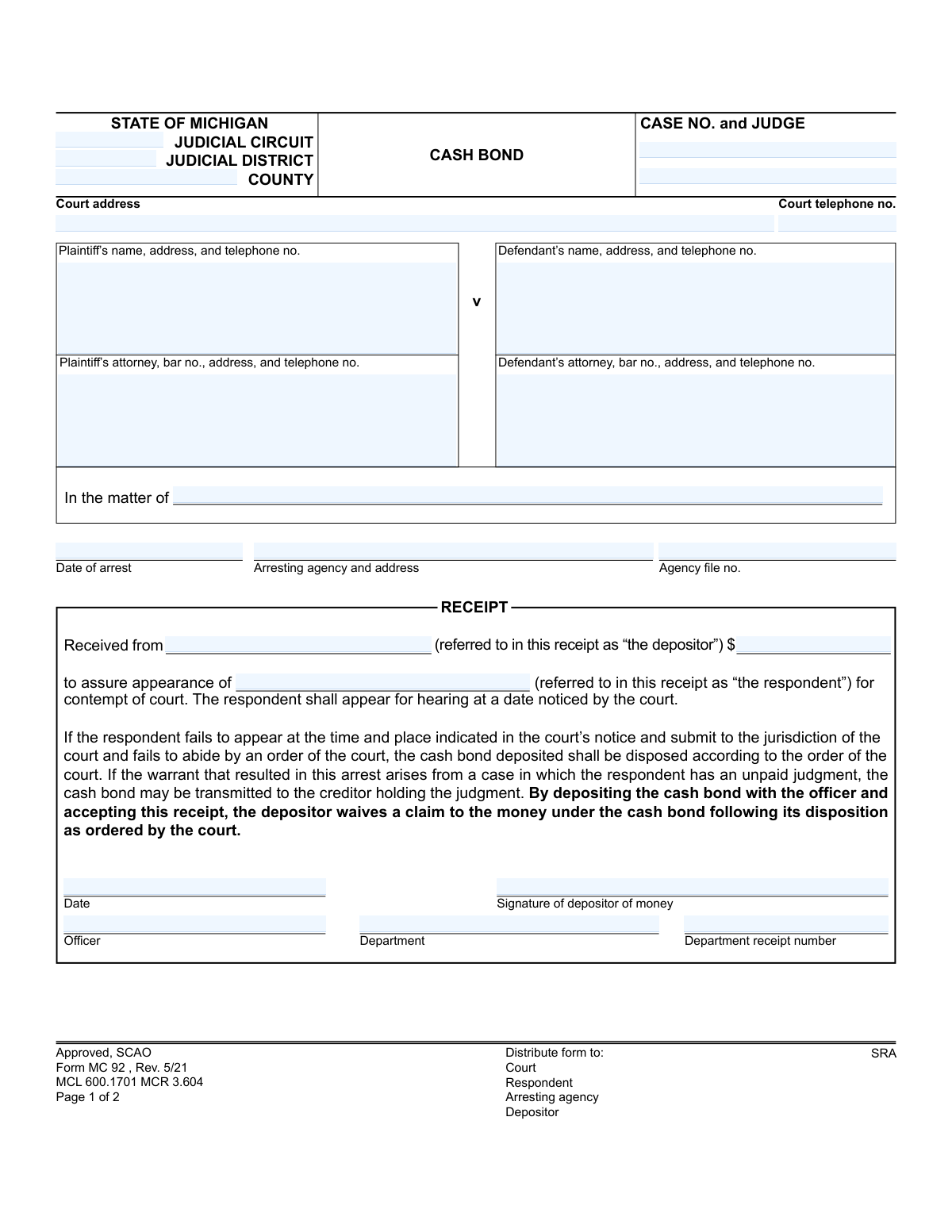
Yes! You can use AI to fill out Form MC 92, Cash Bond

Form MC 92 is a legal document used in the State of Michigan judicial system to serve as a receipt and agreement for a cash bond. It is posted to secure a respondent's appearance for a contempt of court hearing and outlines the terms, conditions, and potential forfeiture of the bond money. Today, this form can be filled out quickly and accurately using AI-powered services like Instafill.ai, which can also convert non-fillable PDF versions into interactive fillable forms.
MC 92 is part of the Michigan court forms category on Instafill.
Our AI automatically handles information lookup, data retrieval, formatting, and form filling.
It takes less than a minute to fill out MC 92 using our AI form filling.
Securely upload your data. Information is encrypted in transit and deleted immediately after the form is filled out.

Form specifications

Form name: Form MC 92, Cash Bond
Number of fields: 31
Number of pages: 1
Language: English
main-image

Instafill Demo: How to fill out PDF forms in seconds with AI

How to Fill Out MC 92 Online for Free in 2026

Are you looking to fill out a MC 92 form online quickly and accurately? Instafill.ai offers the #1 AI-powered PDF filling software of 2026, allowing you to complete your MC 92 form in just 37 seconds or less.
Follow these steps to fill out your MC 92 form online using Instafill.ai:
  1. 1 Navigate to Instafill.ai and upload or select the Michigan Cash Bond (Form MC 92).
  2. 2 Use the AI assistant to input the court and case details, including the judicial circuit/district, county, case number, and judge's name.
  3. 3 Enter the full names, addresses, and contact information for the plaintiff, defendant, and their respective attorneys.
  4. 4 Provide the arrest information, including the date of arrest, arresting agency, and agency file number.
  5. 5 Specify the bond details, including the dollar amount received, the name of the depositor, and the name of the respondent for whom the bond is posted.
  6. 6 The depositor and respondent must review the terms and conditions, then provide their signatures, dates, and contact/employer information in the designated fields.
  7. 7 Review all entered information for accuracy with the AI-powered tool before finalizing and downloading the completed form for distribution to the court, respondent, arresting agency, and depositor.

Our AI-powered system ensures each field is filled out correctly, reducing errors and saving you time.

Why Choose Instafill.ai for Your Fillable MC 92 Form?

Speed

Complete your MC 92 in as little as 37 seconds.

Up-to-Date

Always use the latest 2026 MC 92 form version.

Cost-effective

No need to hire expensive lawyers.

Accuracy

Our AI performs 10 compliance checks to ensure your form is error-free.

Security

Your personal information is protected with bank-level encryption.

Frequently Asked Questions About Form MC 92

This form acts as a receipt for a cash bond paid to secure a person's release from custody for contempt of court. It also documents the released person's promise to appear at their future court hearing.

The 'depositor' is the person who physically pays the money for the bond. The 'respondent' is the person who was arrested and is being released from custody.

The arresting officer, the person paying the bond (depositor), and the person being released (respondent) all have sections to complete or sign. The officer typically fills in the case and arrest details.

Not necessarily. The court will decide how the bond money is used; it may be returned to you, or it could be applied to any unpaid judgments the respondent has in the case.

If the respondent does not appear, the court will issue a bench warrant for their arrest. The cash bond money may be forfeited or applied to any outstanding judgment in the case as ordered by the court.

By signing, you acknowledge paying the bond and you waive your claim to the money once the court orders its disposition. This means you accept the court's final decision on where the money goes.

The respondent promises to personally appear in court when directed and to immediately notify the court in writing of any change in their address or telephone number.

The form requires case and court information, plaintiff and defendant details, arrest information, and the respondent's personal and employer information. The arresting officer will provide the agency file and receipt numbers.

After the form is completed and signed, copies are distributed to the court, the respondent (the person released), the arresting agency, and the depositor (the person who paid the bond).

Yes, the form states that if the arrest is related to a case with an unpaid judgment, the bond money may be transmitted to the creditor holding that judgment as ordered by the court.

Yes, services like Instafill.ai use AI to auto-fill form fields accurately and save time, which is helpful for ensuring all required information is entered correctly.

You can use a service like Instafill.ai to upload the PDF form. Their platform allows you to fill it out electronically, then download the completed document for printing and signing.

If you have a non-fillable or 'flat' PDF, you can use a tool like Instafill.ai. It can convert the document into an interactive, fillable form that you can easily complete on your computer.

Compliance MC 92
Validation Checks by Instafill.ai

1
Case Number Consistency Across Pages
This validation ensures that the 'Case No.' field on page 1 is identical to the 'Case No.' field on page 2. This is critical for document integrity, confirming that both pages belong to the same legal case. A mismatch would indicate a potential scanning or data entry error, leading to the rejection of the form for manual review.
2
Michigan Case Number Format
Verifies that the 'Case No.' field follows the standard Michigan court case number format (e.g., YY-######-XX). This format validation helps ensure the case number is syntactically correct and can be successfully looked up in court systems. An invalid format would prevent the bond from being correctly filed against the case.
3
Logical Date Chronology
This check confirms the logical sequence of dates on the form: the 'Date of arrest' must be on or before the depositor's signature date, which in turn must be on or before the respondent's signature date. It also ensures no dates are in the future. This validation prevents illogical or impossible timelines, which would invalidate the legal standing of the document.
4
Bond Amount Validity
Ensures the 'amount received' field contains a positive, non-zero numeric value, formatted as currency. A bond cannot be for a zero or negative amount. This check is crucial for financial auditing and to confirm that a valid financial transaction has occurred, failing which the receipt is considered invalid.
5
Respondent Signature Requirement
Validates that the 'Signature of respondent' field is not empty and contains a signature. The respondent's signature signifies their understanding and agreement to the terms and conditions of release, including their promise to appear in court. Without this signature, the agreement is not legally binding, and the form must be rejected.
6
Depositor Signature Requirement
Checks for the presence of a signature in the 'Signature of depositor of money' field. The depositor's signature is proof that they have paid the bond and waive any claim to the money as ordered by the court. An absent signature makes the receipt and the associated waiver of funds unenforceable.
7
Respondent and Defendant Name Consistency
This validation cross-references the name of the person the bond is for ('to assure appearance of') with the 'Defendant’s name'. These names should match to ensure the bond is correctly applied to the intended individual in the case. A mismatch could result in the bond being misapplied or rejected, causing significant legal complications.
8
Attorney Bar Number Format
Verifies that the 'bar no.' for both the plaintiff's and defendant's attorneys follows the official Michigan State Bar format (e.g., a 'P' followed by a series of numbers). This ensures the attorney listed is a valid, registered member of the bar. An invalid number would require manual verification of the attorney's credentials.
9
Receipt Information Completeness
This check ensures that all three key fields in the receipt section are filled: 'Received from' (the depositor), the dollar amount, and 'to assure appearance of' (the respondent). An incomplete receipt is ambiguous and legally insufficient. Failure to populate all three fields requires the form to be returned for completion.
10
Respondent Address Completeness
Validates that the respondent's full address, including 'Address of respondent', 'City, state, zip', is completely filled out. This information is critical for the court to send official notices regarding hearing dates. An incomplete address would prevent proper notification and could lead to the respondent inadvertently failing to appear.
11
Court Telephone Number Format
Ensures the 'Court telephone no.' field adheres to a standard North American phone number format (e.g., XXX-XXX-XXXX or (XXX) XXX-XXXX). Correct formatting is essential for system processing and for individuals who need to contact the court. An improperly formatted number would be flagged for correction.
12
Arresting Agency and Department Name Consistency
This check compares the 'Arresting agency' name with the 'Department' name listed in the officer signature section. These should typically be the same or closely related, as the officer receiving the bond is usually from the arresting agency. A discrepancy could indicate an error and may require clarification to ensure proper chain of custody for the funds.

Common Mistakes in Completing MC 92

Confusing the 'Depositor' and 'Respondent' Roles

The form distinguishes between the 'depositor' (the person paying the money) and the 'respondent' (the person whose appearance the bond secures). People often mistakenly enter the respondent's name in the 'Received from' field, especially when the respondent is paying for their own bond. This can create confusion about who is legally entitled to any returned funds and cause delays in processing. To avoid this, carefully read each field; if you are paying the bond for yourself, your name should appear in both the 'Received from' and 'to assure appearance of' fields.

Entering an Incomplete or Inconsistent Case Number

The case number is a critical identifier required on both page 1 and page 2. Filers often forget to enter it on the second page, or they write it incorrectly, leading to the pages being separated or misfiled. An incorrect case number can cause significant processing delays and prevent the bond from being correctly associated with the legal proceedings. Always double-check that the full, correct case number is written identically in all required fields on every page of the form.

Missing Signatures or Signing in the Wrong Location

The form requires two different signatures in two different places: the depositor signs the receipt on page 1, and the respondent signs the terms and conditions on page 2. It is a very common error to miss one of these signatures or for one person to sign in both places. An unsigned or incorrectly signed form is invalid and will be rejected, potentially delaying the respondent's release. Carefully review both pages to ensure the correct person signs and dates their respective section.

Omitting the Attorney's Bar Number

When listing attorney information, the bar number is a required and unique identifier, not just optional contact information. People often forget to include it or don't have it readily available, leading them to leave the field blank. This omission forces court clerks to spend extra time looking up the attorney, delaying the processing of the bond. Before filling out the form, ensure you have the complete contact details for all attorneys, including their official bar number.

Providing Vague or Incomplete Employer Information

The respondent is required to list their employer and its full address on page 2. Many people are hesitant to provide this information or only give a partial name (e.g., 'Walmart') and no address. This information is used by the court to establish community ties and as a potential point of contact, so incomplete details can be viewed as non-compliance. Provide the full, formal name of your employer and its complete mailing address to avoid complications.

Using Informal Names Instead of Full Legal Names

Legal documents like a cash bond require the full, legal names of all parties involved, including the plaintiff, defendant, depositor, and respondent. Using nicknames, abbreviations, or informal versions of a name can create ambiguity and lead to record-matching failures in the court's system. This can cause serious issues, such as the bond payment not being correctly credited to the case. Always use the full legal name as it appears on government-issued identification.

Incorrectly Identifying the Arresting Agency

The form asks for the 'Arresting agency and address,' which needs to be specific (e.g., 'Michigan State Police, Lansing Post,' not just 'State Police'). People often provide a generic name or confuse the arresting agency with the county jail or the court itself. This error can hinder the proper routing of documents and communication between agencies. Be sure to enter the full, official name and address of the specific law enforcement agency that made the arrest.

Illegible Handwriting Leading to Data Entry Errors

This form is often filled out by hand, sometimes in stressful situations, leading to poor handwriting. Illegible names, addresses, and especially case numbers can make it impossible for court staff to process the document correctly, resulting in misapplied funds or rejected forms. It is crucial to print clearly in all capital letters. To avoid this, use a tool like Instafill.ai, which can convert this non-fillable PDF into a fillable format, ensuring all entries are typed and perfectly legible.

Entering Incorrect Dates or Using Ambiguous Formats

The form requires multiple dates: a 'Date of arrest' on page 1 and signature dates on both pages. A common mistake is to enter the current date for the arrest date, or to use ambiguous formats like '2/3/24.' This can create legal and administrative problems regarding timelines. Always use the full, accurate date for each specific field (e.g., MM/DD/YYYY) and double-check that you are entering the arrest date, not the date you are filling out the form, in the appropriate field. AI-powered form fillers like Instafill.ai can help standardize date formats to prevent such errors.

Incomplete Address or Contact Information

The form requires full addresses and telephone numbers for multiple parties, including the respondent on page 2. It's common for people to forget a ZIP code, apartment number, or phone number, assuming it's not important. However, this information is critical for the court to send official notices. Missing information can lead to a missed court date and forfeiture of the bond. Always provide complete and current contact information and notify the court in writing of any changes, as promised in the terms.
Saved over 80 hours a year

“I was never sure if my IRS forms like W-9 were filled correctly. Now, I can complete the forms accurately without any external help.”

Kevin Martin Green

Your data stays secure with advanced protection from Instafill and our subprocessors

Robust compliance program

Transparent business model

You’re not the product. You always know where your data is and what it is processed for.

ISO 27001, HIPAA, and GDPR

Our subprocesses adhere to multiple compliance standards, including but not limited to ISO 27001, HIPAA, and GDPR.

Security & privacy by design

We consider security and privacy from the initial design phase of any new service or functionality. It’s not an afterthought, it’s built-in, including support for two-factor authentication (2FA) to further protect your account.

Fill out MC 92 with Instafill.ai

Worried about filling PDFs wrong? Instafill securely fills form-mc-92-cash-bond forms, ensuring each field is accurate.