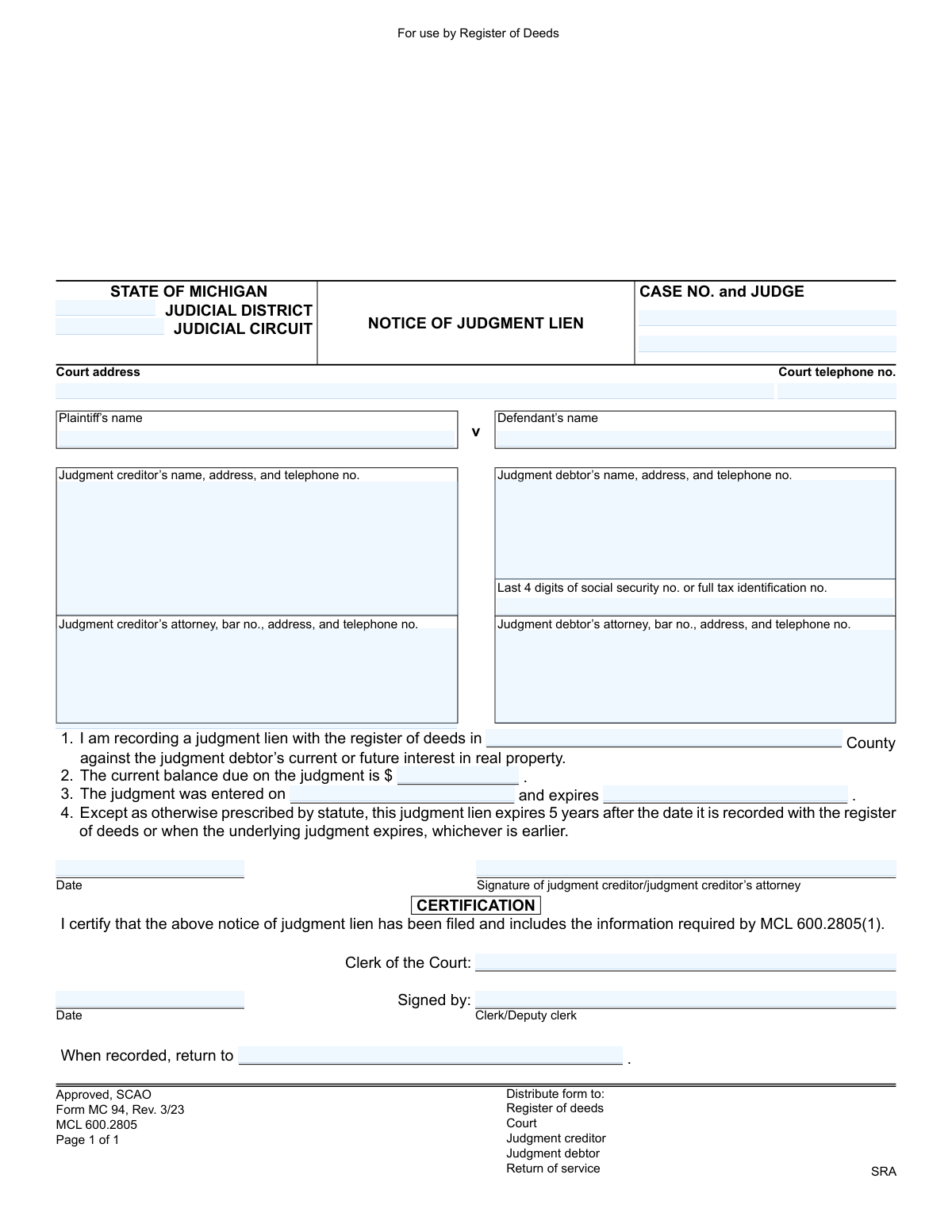
Yes! You can use AI to fill out Form MC 94, Notice of Judgment Lien

Form MC 94 is a legal document filed in the State of Michigan to create a public record of a lien against a judgment debtor's current or future interest in real property. This action secures the debt awarded by a court, giving the judgment creditor a claim on the property until the judgment is paid. Completing this form accurately is crucial for enforcing the judgment. Today, this form can be filled out quickly and accurately using AI-powered services like Instafill.ai, which can also convert non-fillable PDF versions into interactive fillable forms.
MC 94 is part of the Michigan court forms category on Instafill.
Our AI automatically handles information lookup, data retrieval, formatting, and form filling.
It takes less than a minute to fill out MC 94 using our AI form filling.
Securely upload your data. Information is encrypted in transit and deleted immediately after the form is filled out.

Form specifications

Form name: Form MC 94, Notice of Judgment Lien
Number of fields: 46
Number of pages: 1
Language: English
main-image

Instafill Demo: How to fill out PDF forms in seconds with AI

How to Fill Out MC 94 Online for Free in 2026

Are you looking to fill out a MC 94 form online quickly and accurately? Instafill.ai offers the #1 AI-powered PDF filling software of 2026, allowing you to complete your MC 94 form in just 37 seconds or less.
Follow these steps to fill out your MC 94 form online using Instafill.ai:
  1. 1 Navigate to Instafill.ai and upload or select the Michigan Notice of Judgment Lien (Form MC 94).
  2. 2 Provide the court information, including the judicial district/circuit, case number, and judge's name.
  3. 3 Enter the full names, addresses, and contact details for the judgment creditor, judgment debtor, and their respective attorneys if applicable.
  4. 4 Input the specific details of the judgment, such as the current balance due, the date the judgment was entered, and its expiration date.
  5. 5 Specify the county where the judgment lien is to be recorded with the Register of Deeds.
  6. 6 Review all the information auto-populated by the AI for accuracy, then e-sign and date the form as the judgment creditor or their attorney.
  7. 7 Download the completed MC 94 for filing with the court, recording with the Register of Deeds, and serving to the judgment debtor.

Our AI-powered system ensures each field is filled out correctly, reducing errors and saving you time.

Why Choose Instafill.ai for Your Fillable MC 94 Form?

Speed

Complete your MC 94 in as little as 37 seconds.

Up-to-Date

Always use the latest 2026 MC 94 form version.

Cost-effective

No need to hire expensive lawyers.

Accuracy

Our AI performs 10 compliance checks to ensure your form is error-free.

Security

Your personal information is protected with bank-level encryption.

Frequently Asked Questions About Form MC 94

This form is used by a judgment creditor in Michigan to place a legal claim, or lien, on a judgment debtor's current or future real property. It provides public notice that the property is being used as security for a court-ordered debt.

The judgment creditor, who is the person or entity that won the court case and is owed money, or their attorney, is responsible for completing and filing this form.

The judgment creditor is the person or company who won the lawsuit and is owed money. The judgment debtor is the person or company who lost the lawsuit and is legally obligated to pay the judgment.

You will need the judgment debtor's full name and address, as well as the last 4 digits of their social security number or their full tax identification number (for businesses).

First, the form must be certified by the clerk of the court that issued the judgment. Then, you must record the certified notice with the Register of Deeds in the county where the debtor's real property is or may be located.

Yes, you are required to serve a copy of the notice on the judgment debtor. The 'Proof of Service' section must be completed and filed with the court to prove that you have notified them.

The judgment lien expires 5 years after the date it is recorded with the Register of Deeds, or when the underlying judgment itself expires, whichever date is earlier.

Yes, if the judgment is for $25,000 or more, the law requires that the Notice of Judgment Lien be served on the debtor personally by a process server, rather than by mail.

If your PDF is not interactive, you can use a service like Instafill.ai. It can convert flat, non-fillable PDFs into interactive forms that you can easily complete online.

Yes, services like Instafill.ai use AI to accurately auto-fill form fields with your case and personal information, which can save time and help reduce errors.

You can use a service like Instafill.ai to upload the MC 94 form and fill it out on your computer. The platform guides you through the required fields, making the process faster and more convenient than filling it out by hand.

The court clerk's certification verifies that the information on the notice, such as the case number and judgment amount, is accurate and matches the official court record. This step is mandatory before you can record the lien with the Register of Deeds.

If service is unsuccessful, the process server must document the failed attempts on the 'Proof of Service' form and return it to the court clerk. You may need to seek legal advice on alternative methods for completing service.

Compliance MC 94
Validation Checks by Instafill.ai

Common Mistakes in Completing MC 94

Filing in the Wrong County

A frequent and critical error is recording the lien in the county where the judgment was issued, rather than the county where the debtor owns or may acquire real property. A judgment lien on real estate is only effective in the county where it is recorded with the Register of Deeds. This mistake renders the lien useless for properties outside the county of filing. To avoid this, research the debtor's property holdings and file a notice in every county where they own or may own property.

Incorrect Debtor Identification (SSN/TIN)

Entering the wrong last four digits of the debtor's Social Security Number or an incorrect Tax ID number is a common data entry error. This identifier is crucial for distinguishing the debtor, especially if they have a common name. An incorrect number can prevent the lien from properly attaching to the property's title, making it unenforceable. Using a tool like Instafill.ai can help by storing and accurately populating this sensitive information, reducing the risk of typos.

Miscalculating the Current Judgment Balance

Creditors often state an incorrect amount in the 'current balance due' field. This happens by either forgetting to add accrued post-judgment interest and costs, or failing to subtract payments the debtor has already made. Overstating the debt can lead to legal challenges and sanctions, while understating it means leaving money on the table. Always perform a precise calculation and maintain a clear ledger before filling out this field.

Using an Improper Service Method

The form's Proof of Service section requires personal service for judgments of $25,000 or more. A common mistake is using certified mail for these larger judgments, which is legally insufficient. Improper service violates the debtor's due process rights and gives them grounds to have the lien invalidated by a court. Always verify the judgment amount and select the service method that complies with legal requirements.

Omitting Critical Judgment Dates

Filers sometimes leave the 'judgment was entered on' or 'judgment expires' date fields blank. The lien's lifespan is directly tied to these dates, as it expires 5 years after recording or when the underlying judgment expires, whichever is earlier. Missing dates can lead to the form's rejection or create fatal ambiguity about the lien's validity period. AI-powered form fillers can flag empty required date fields to prevent this omission.

Forgetting the 'Return To' Address

It is surprisingly common to leave the 'When recorded, return to' field blank. The Register of Deeds uses this address to mail the official, recorded document back to the filer. Without this information, receiving the processed document can be severely delayed, or it may be lost entirely, leaving the creditor without the necessary proof that their lien was successfully recorded. This is a simple but costly oversight.

Bypassing the Court Clerk Certification

A fatal error is submitting the form to the Register of Deeds without first obtaining the required certification from the Clerk of the Court. The clerk's signature in the 'CERTIFICATION' block verifies that the lien information is consistent with the official court record. A lien recorded without this certification is invalid and will either be rejected by the Register of Deeds or can be easily voided later.

Incomplete or Unsigned Proof of Service

The process server, or the person completing service, often fails to fill out the Proof of Service section with the required level of detail. This includes omitting the specific date, time, and place of service, or forgetting to sign the declaration. A defective Proof of Service can be challenged by the debtor, jeopardizing the legal standing of the entire notice of judgment lien.

Confusing Judgment Creditor and Debtor Information

In the rush of filling out paperwork, individuals may inadvertently transpose the information for the judgment creditor (the winner) and the judgment debtor (the loser). This involves putting the creditor's name and address in the debtor's fields and vice versa. This fundamental error makes the document nonsensical and will cause its immediate rejection by the court clerk or Register of Deeds. Using a tool like Instafill.ai, which can convert flat PDFs to fillable forms and save party profiles, helps prevent such mix-ups.
Saved over 80 hours a year

“I was never sure if my IRS forms like W-9 were filled correctly. Now, I can complete the forms accurately without any external help.”

Kevin Martin Green

Your data stays secure with advanced protection from Instafill and our subprocessors

Robust compliance program

Transparent business model

You’re not the product. You always know where your data is and what it is processed for.

ISO 27001, HIPAA, and GDPR

Our subprocesses adhere to multiple compliance standards, including but not limited to ISO 27001, HIPAA, and GDPR.

Security & privacy by design

We consider security and privacy from the initial design phase of any new service or functionality. It’s not an afterthought, it’s built-in, including support for two-factor authentication (2FA) to further protect your account.

Fill out MC 94 with Instafill.ai

Worried about filling PDFs wrong? Instafill securely fills form-mc-94-notice-of-judgment-lien forms, ensuring each field is accurate.