Yes! You can use AI to fill out Form MC 96, Judgment of Contempt

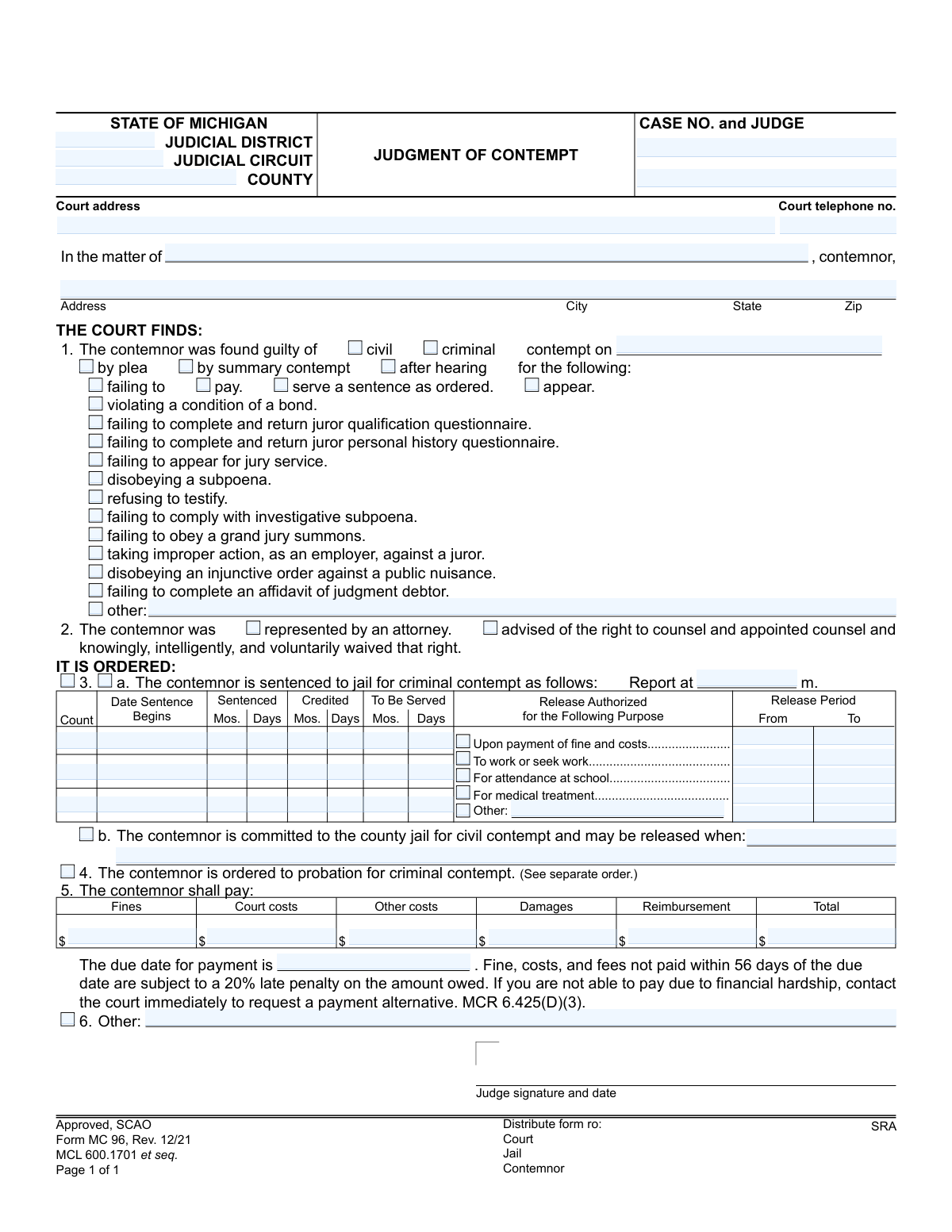
Form MC 96, Judgment of Contempt, is an official Michigan court document used to record a judge's ruling when an individual is found guilty of disobeying a court order or showing disrespect to the court. This form is crucial as it specifies the type of contempt (civil or criminal), the basis for the finding, and the exact penalties imposed, such as jail time, probation, or financial sanctions. Today, court staff and legal professionals can fill out this form quickly and accurately using AI-powered services like Instafill.ai, which can also convert non-fillable PDF versions into interactive fillable forms.
MC 96 is part of the Michigan court forms category on Instafill.
Our AI automatically handles information lookup, data retrieval, formatting, and form filling.
It takes less than a minute to fill out MC 96 using our AI form filling.
Securely upload your data. Information is encrypted in transit and deleted immediately after the form is filled out.

Form specifications

Form name: Form MC 96, Judgment of Contempt
Number of fields: 90
Number of pages: 1
Language: English
main-image

Instafill Demo: How to fill out PDF forms in seconds with AI

How to Fill Out MC 96 Online for Free in 2026

Are you looking to fill out a MC 96 form online quickly and accurately? Instafill.ai offers the #1 AI-powered PDF filling software of 2026, allowing you to complete your MC 96 form in just 37 seconds or less.
Follow these steps to fill out your MC 96 form online using Instafill.ai:
  1. 1 Navigate to Instafill.ai and upload the MC 96 form or select it from the template library.
  2. 2 Provide the case information, including the judicial district/circuit, case number, judge, and the contemnor's name and address.
  3. 3 Indicate the court's findings by selecting the type of contempt (civil or criminal), the date, and the specific reason for the contempt ruling, such as 'failing to appear' or 'disobeying a subpoena'.
  4. 4 Specify the contemnor's legal representation status as noted in the court proceedings.
  5. 5 Detail the sentence ordered by the judge, entering information for jail time, probation, or the conditions for release from civil contempt.
  6. 6 Enter the specific amounts for any fines, court costs, damages, or other financial penalties, and note the payment due date.
  7. 7 Review all auto-filled information for accuracy, make any final adjustments, and then download the completed Form MC 96 for the judge's signature and official filing.

Our AI-powered system ensures each field is filled out correctly, reducing errors and saving you time.

Why Choose Instafill.ai for Your Fillable MC 96 Form?

Speed

Complete your MC 96 in as little as 37 seconds.

Up-to-Date

Always use the latest 2026 MC 96 form version.

Cost-effective

No need to hire expensive lawyers.

Accuracy

Our AI performs 10 compliance checks to ensure your form is error-free.

Security

Your personal information is protected with bank-level encryption.

Frequently Asked Questions About Form MC 96

This is an official court document issued by a judge in Michigan. It formally states that a person has been found guilty of contempt of court and details the specific penalties or sentences they must serve.

A judge or an authorized court official completes and signs this form. The person found in contempt, referred to as the 'contemnor', receives a copy but does not fill it out.

A 'contemnor' is the legal term for a person or entity who has been found guilty of disobeying a court order or showing disrespect to the court, an act known as contempt.

Section 1 of the form details the reason for the contempt finding. The judge will check a box next to the specific violation, such as 'failing to appear,' 'disobeying a subpoena,' or another reason written in the 'other' field.

Criminal contempt is a punishment for a past act of disobedience, resulting in a fixed sentence like jail time or a fine. Civil contempt is meant to compel a person to follow a court order, and the penalty, such as jail, usually ends once the person complies.

The form states that payments not made within 56 days are subject to a 20% late penalty. If you are unable to pay due to financial hardship, you should contact the court immediately to request a payment alternative.

This means you are being sent to jail not for a fixed sentence, but until you comply with a specific court order. The form will state what you must do, such as pay a fine or provide testimony, in order to be released.

This indicates that the judge has approved your temporary release from jail for specific, pre-approved reasons, such as going to work, attending school, or receiving medical treatment. The form will specify the authorized times for these releases.

You must carefully read the entire form to understand the court's orders and your obligations. It is crucial to comply with all instructions, such as reporting to jail or paying fines by the deadline, to avoid further legal trouble.

Failure to comply with the orders detailed in this judgment can lead to additional charges, a warrant for your arrest, and more severe penalties from the court.

Yes, while you don't fill out this specific form, services like Instafill.ai can help you manage and understand legal documents. Its AI can help you organize your legal paperwork and quickly find key information.

For other court forms that you need to complete, you can use a service like Instafill.ai. It allows you to upload a PDF, and its AI can accurately auto-fill your information, saving you time and reducing errors.

If you have a 'flat' or non-fillable PDF form, a tool like Instafill.ai can convert it into an interactive, fillable form. This allows you to easily type your answers directly into the document on your computer.

Compliance MC 96
Validation Checks by Instafill.ai

1
Exclusive Contempt Type Selection
This validation ensures that either the 'Civil' or 'Criminal' contempt checkbox is selected, but not both. This is a critical distinction as it determines the nature of the offense and the subsequent legal pathways, such as sentencing versus commitment. If neither or both are selected, the form is ambiguous and cannot be processed correctly.
2
Reason for Contempt Completeness
Verifies that at least one checkbox under section 1, detailing the reason for the contempt finding (e.g., 'failing to appear', 'disobeying a subpoena'), is selected. A judgment of contempt must be based on a specific action or inaction. Failure to provide a reason invalidates the judgment's legal standing.
3
Conditional 'Other' Reason Specification
Checks that if the 'other:' checkbox for the reason for contempt is selected, the corresponding text field is filled with a specific explanation. This is important for ensuring the record is clear and the reason for contempt is not vague. An empty field when 'other' is checked would create an incomplete and legally insufficient record.
4
Exclusive Representation Status
Ensures that exactly one of the two options in section 2 ('represented by an attorney' or 'advised of the right to counsel and knowingly...waived that right') is checked. The contemnor's legal representation status is a fundamental right and must be clearly and unambiguously recorded. Selecting both or neither creates a legal contradiction.
5
Sentence Calculation Logic
Validates the arithmetic in the criminal sentencing table (section 3a). It confirms that for each count, the 'To Be Served' time (months and days) is the correct result of 'Sentenced' time minus 'Credited' time. This prevents mathematical errors in legal documents that dictate a person's liberty, ensuring the sentence is calculated as intended by the court.
6
Financial Penalty Total Calculation
This check ensures the 'Total' field in section 5 is the exact sum of the individual financial penalties: 'Fines', 'Court costs', 'Other costs', 'Damages', and 'Reimbursement'. This automated check prevents clerical errors in financial judgments, ensuring accuracy for both the court's accounting and the contemnor's obligation. An incorrect total could lead to billing disputes and collection issues.
7
Payment Due Date Chronology
Validates that the 'Due date for payment' in section 5 is a valid date and is not in the past. A due date must be set for the present or future to be legally enforceable and give the contemnor a reasonable opportunity to pay. An invalid or past date would make the payment terms nonsensical and unenforceable.
8
Case Number Presence and Format
Verifies that the 'Case No.' field is not empty and, if possible, matches the expected format for the judicial district. The case number is the primary identifier for the legal proceeding and is essential for filing, tracking, and retrieving the document. A missing or malformed case number can lead to the document being lost or misfiled.
9
Contempt Date Validity
Ensures the 'Contempt Date' in section 1 is a valid, fully-formed date (e.g., MM/DD/YYYY) and is not a future date. The date of the finding is a critical piece of the legal record, establishing when the event occurred. A future date is logically impossible and would invalidate the document.
10
Conditional Sentencing Sections
This validation checks that the criminal sentencing section (3a) is only filled out if 'Criminal' contempt is checked, and the civil commitment section (3b) is only filled out if 'Civil' contempt is checked. This maintains logical consistency and prevents contradictory orders on the same form. Filling out the wrong section would create ambiguity about the court's actual order.
11
Civil Commitment Release Condition
If the checkbox for civil contempt commitment (section 3b) is selected, this validation ensures the corresponding text field explaining the release conditions is not empty. For civil contempt, the contemnor 'holds the keys to their own cell,' and the conditions for their release must be explicitly stated. Without this information, the commitment order is incomplete and legally flawed.
12
Exclusive Contempt Finding Method
This check verifies that only one method of finding contempt ('by plea', 'by summary contempt', or 'after hearing') is selected. These are distinct procedural events, and only one can be the basis for the finding. Selecting multiple methods would create a confusing and contradictory record of the court's procedure.

Common Mistakes in Completing MC 96

Incorrect Case or Court Identifiers

Users often mistype the 'Case No.', 'Judicial Circuit', or 'County' due to simple transposition errors or referencing the wrong file. An incorrect case number can lead to the judgment being filed in the wrong case, causing significant administrative delays and potential legal invalidity until a corrected order is filed. To avoid this, always double-check the case number and court details against the official case file. AI-powered tools like Instafill.ai can help by saving and auto-filling correct case information across related documents.

Ambiguous or Conflicting Contempt Type

A common error is failing to select either the 'civil' or 'criminal' checkbox, or incorrectly selecting both. The distinction is legally significant, as it dictates the nature of the penalty and the conditions for release. An ambiguous form is unenforceable and will be rejected by the court clerk or challenged later. Always ensure that one, and only one, of these two boxes is checked to clearly define the judgment. Since this form is a non-fillable PDF, a tool like Instafill.ai can convert it to a smart, fillable version with validation rules to prevent such conflicting selections.

Incorrect Calculation of Jail Time

This form requires calculating the 'To Be Served' time by subtracting 'Credited' time from the total 'Sentenced' time. Manual calculation errors are frequent and have severe consequences, potentially leading to a person being incarcerated for an incorrect duration, which can result in legal challenges. It is critical to carefully calculate and verify the months and days in each column. Using a form-filling tool like Instafill.ai can prevent this by automating the calculations, ensuring the 'To Be Served' field is always accurate.

Financial Miscalculation in Fines and Costs

Users often make mistakes when manually adding up the 'Fines', 'Court costs', 'Other costs', 'Damages', and 'Reimbursement' to arrive at the 'Total'. An incorrect total can lead to confusion, payment disputes, and delays in closing the matter, requiring further court action to correct. To prevent this, use a calculator to verify the sum before entering the final amount. Advanced form fillers like Instafill.ai can automatically calculate the total as you enter the individual costs, eliminating manual errors.

Incomplete or Inaccurate Contemnor Information

Entering a misspelled name or an incomplete or outdated address for the contemnor is a frequent mistake. This information is crucial for properly identifying the individual and for serving the judgment. An incorrect address can lead to failed service, delaying the enforcement of the order and potentially violating the contemnor's due process rights. Always verify the spelling of the name and the current address from official court records.

Omitting Critical Dates or Using Incorrect Formats

Forgetting to enter the 'Contempt Date' or the 'Due Date for Payment' is a common oversight that can make parts of the order invalid or unenforceable. People also use inconsistent formats (e.g., MM-DD-YY vs. MM/DD/YYYY), which can cause confusion. A missing payment due date, for example, makes it impossible to apply the 20% late penalty mentioned on the form. Ensure all date fields are filled and use a clear, consistent format like MM/DD/YYYY. AI form fillers can automatically insert the current date where appropriate and enforce a standard format.

Vague or Unclear Language in 'Other' Fields

When the specific reason for contempt is not listed, users must fill in the 'other' text field. A common mistake is to write something vague like 'violated order' without specifying which order and how. This ambiguity can make the judgment legally insufficient and subject to appeal. The description must be specific, clear, and contain enough detail to be understood by all parties, including enforcement officers. Always state the specific act or omission that constitutes contempt.

Contradictory Sentencing Selections

This form has mutually exclusive sections, such as the jail sentence for criminal contempt (3a) and the release conditions for civil contempt (3b). A frequent error is to fill out details in both sections, creating a contradictory and confusing order. For example, sentencing someone to a fixed jail term for criminal contempt while also stating they can be released upon a specific action (a civil contempt remedy). Carefully read each section and only complete the parts that apply to the selected contempt type. Smart digital forms, which can be created by tools like Instafill.ai, can help by disabling irrelevant sections based on initial selections.

Incomplete Release Authorization Details

In Section 3a, if a release is authorized for work or school, the user must check the box and specify the exact release period in the 'From' and 'To' fields. A common oversight is checking the box but leaving the time period blank. This makes the authorization useless for the jail staff, who need precise instructions to release and return the inmate. This failure can deny the contemnor their authorized release, leading to complaints and potential legal issues. Always ensure that if a release purpose is checked, the corresponding time or conditions are fully detailed.
Saved over 80 hours a year

“I was never sure if my IRS forms like W-9 were filled correctly. Now, I can complete the forms accurately without any external help.”

Kevin Martin Green

Your data stays secure with advanced protection from Instafill and our subprocessors

Robust compliance program

Transparent business model

You’re not the product. You always know where your data is and what it is processed for.

ISO 27001, HIPAA, and GDPR

Our subprocesses adhere to multiple compliance standards, including but not limited to ISO 27001, HIPAA, and GDPR.

Security & privacy by design

We consider security and privacy from the initial design phase of any new service or functionality. It’s not an afterthought, it’s built-in, including support for two-factor authentication (2FA) to further protect your account.

Fill out MC 96 with Instafill.ai

Worried about filling PDFs wrong? Instafill securely fills form-mc-96-judgment-of-contempt forms, ensuring each field is accurate.