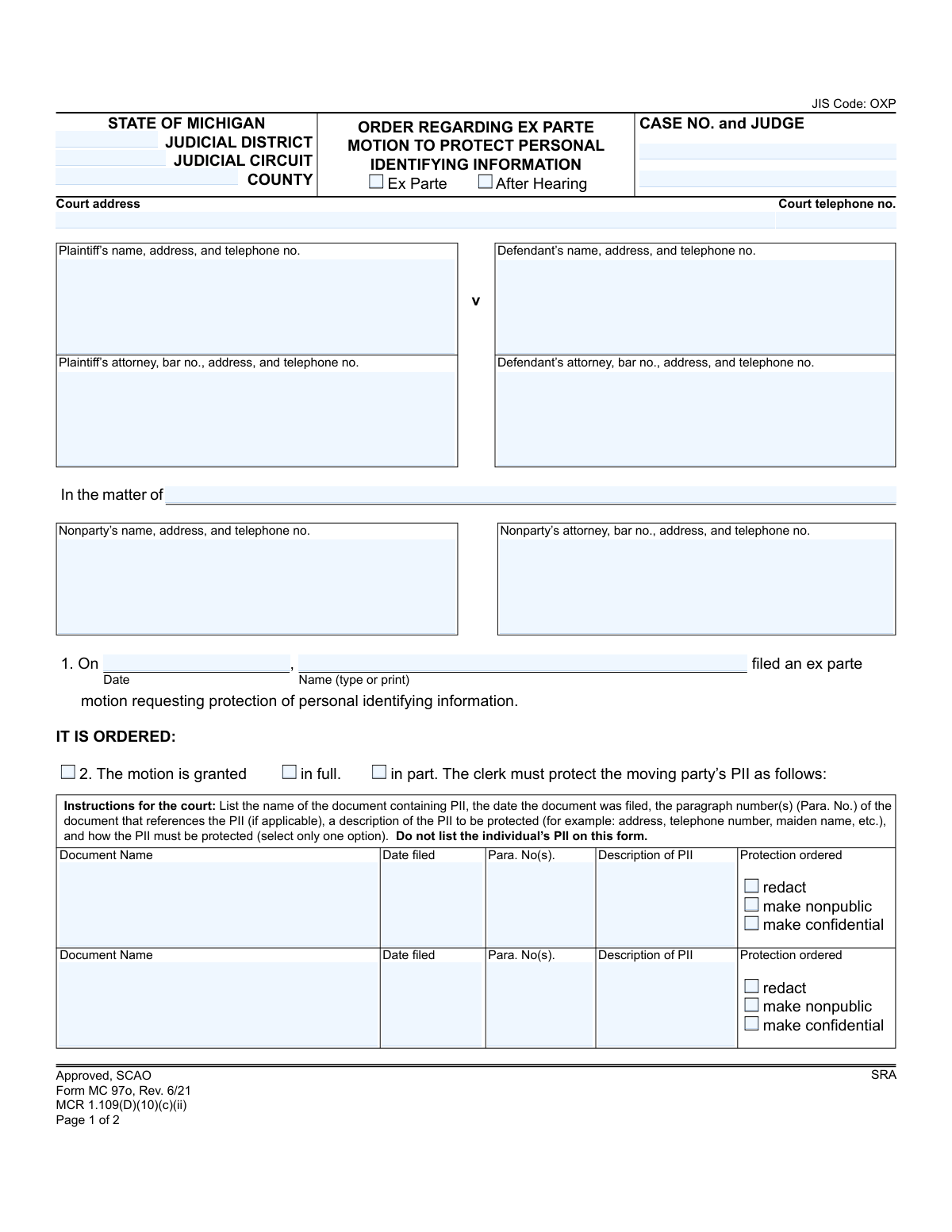
Yes! You can use AI to fill out Form MC 97o, Order Regarding Ex Parte Motion to Protect Personal Identifying Information
Form MC 97o, Order Regarding Ex Parte Motion to Protect Personal Identifying Information, is a legal document used in Michigan courts. A judge issues this order to rule on a motion requesting that sensitive personal data in court filings be kept private. It's crucial for balancing an individual's privacy rights against the public's right to access court records by specifying whether information should be redacted, made nonpublic, or kept confidential. Today, this form can be filled out quickly and accurately using AI-powered services like Instafill.ai, which can also convert non-fillable PDF versions into interactive fillable forms.
MC 97o is part of the
Michigan court forms category on Instafill.
Our AI automatically handles information lookup, data retrieval, formatting, and form filling.
It takes less than a minute to fill out MC 97o using our AI form filling.
Securely upload your data. Information is encrypted in transit and deleted immediately after the form is filled out.
Form specifications
| Form name: | Form MC 97o, Order Regarding Ex Parte Motion to Protect Personal Identifying Information |
| Number of fields: | 73 |
| Number of pages: | 1 |
| Language: | English |
More forms in Michigan court forms
Instafill Demo: How to fill out PDF forms in seconds with AI
How to Fill Out MC 97o Online for Free in 2026
Are you looking to fill out a MC 97O form online quickly and accurately? Instafill.ai offers the #1 AI-powered PDF filling software of 2026, allowing you to complete your MC 97O form in just 37 seconds or less.
Follow these steps to fill out your MC 97O form online using Instafill.ai:
- 1 Navigate to Instafill.ai and upload or select the MC 97o form.
- 2 Use the AI assistant to automatically populate case details such as the court address, case number, judge, and information for the plaintiff, defendant, and any nonparties.
- 3 Enter the date the ex parte motion was filed and the name of the person or entity who filed it.
- 4 Indicate the judge's decision by checking if the motion is granted (in full or in part) or denied.
- 5 If the motion is granted, list each document containing the PII, including its name, filing date, and a description of the information to be protected (e.g., address, phone number).
- 6 For each document listed, specify the protection method ordered by the court by selecting 'redact,' 'make nonpublic,' or 'make confidential'.
- 7 Review the entire completed order for accuracy, then secure the judge's signature and date before filing it with the court.
Our AI-powered system ensures each field is filled out correctly, reducing errors and saving you time.
Why Choose Instafill.ai for Your Fillable MC 97o Form?
Speed
Complete your MC 97o in as little as 37 seconds.
Up-to-Date
Always use the latest 2026 MC 97o form version.
Cost-effective
No need to hire expensive lawyers.
Accuracy
Our AI performs 10 compliance checks to ensure your form is error-free.
Security
Your personal information is protected with bank-level encryption.
Frequently Asked Questions About Form MC 97o
This form is a court order that documents a judge's decision on a request to protect Personal Identifying Information (PII) in court records. It is not the form used to make the request, but rather the court's official ruling on that request.
A judge or authorized court personnel fills out and signs this form. It is completed after they review a motion filed by a party in the case who is seeking to protect their personal information.
Ex Parte means the motion was presented to the judge by one party without the other parties being present. This is common for requests to protect sensitive information to prevent its disclosure before a ruling is made.
You must first file an 'Ex Parte Motion to Protect Personal Identifying Information' with the court. This order, Form MC 97o, is the judge's decision in response to the motion you file.
'Redact' means the information is blacked out, 'make nonpublic' restricts access from the general public, and 'make confidential' applies even stricter access controls, usually limiting it to the court and parties involved.
PII includes sensitive personal details like your address, telephone number, social security number, date of birth, or financial account numbers that may have been included in court filings.
A motion may be denied if the judge determines that the public's interest in accessing the information outweighs your personal privacy interest. The order will state this as the reason for denial.
This means the judge approved some of your requests to protect information but denied others. The order will specify exactly which pieces of information will be protected and which will remain public.
No, the court fills out this form and is instructed not to list the actual PII. The form will only contain a description of the information (e.g., 'home address') and its location in the court documents.
Once signed, the court clerk will carry out the judge's instructions. This involves redacting the specified information or changing the access level of the documents in the official case file as ordered.
Yes, while you don't fill out this specific order form, AI-powered services like Instafill.ai can help you accurately and quickly fill out the initial motion form required to request the protection of your information.
You can use Instafill.ai to complete the 'Ex Parte Motion to Protect Personal Identifying Information' form. Upload the motion form to the platform, and its AI will help you populate the fields with your case details and the information you want protected.
Services like Instafill.ai can convert flat, non-fillable PDFs into interactive, fillable forms. You can upload your non-fillable motion form, and the platform will make it easy to complete and prepare for filing.
Compliance MC 97o
Validation Checks by Instafill.ai
1
Case Number Presence and Format
Checks that the 'CASE NO.' field is not empty and conforms to the standard format used by the Michigan judicial system. A valid case number is essential for correctly filing the document and associating it with the proper legal proceedings. Failure to provide a valid case number will prevent the form from being processed and filed.
2
Exclusive Order Disposition Selection
Validates that only one disposition option is selected from 'granted in full,' 'granted in part,' or 'denied in full.' These options are mutually exclusive; a motion cannot be both granted and denied simultaneously. If more than one option is selected, the form is logically inconsistent and must be corrected by the user.
3
Conditional Requirement for Granted Motion Details
Ensures that if the motion is marked as 'granted in full' or 'granted in part,' at least one of the document detail sections is completed with the document name, date filed, PII description, and a protection method. An order granting protection must specify what is being protected and how. An incomplete order is unenforceable and will be rejected.
4
No Protection Details for Denied Motion
Verifies that if the 'motion is denied in full' box is checked, all document protection detail fields (Document Name, Date Filed, etc.) are left blank. A denied motion means no protection is granted, so specifying documents to be protected would be a logical contradiction. This check prevents the creation of an ambiguous and confusing court order.
5
Complete Information for Each Protected Document
Ensures that for every row where a 'Document Name' is provided, the 'Date filed', 'Description of PII', and exactly one 'Protection ordered' checkbox are also completed. Incomplete entries make the order ambiguous and unenforceable, as it's unclear what information to protect or how. The form should not be submittable until each specified document entry is complete.
6
Single Protection Method Per Document
Verifies that for each document listed for protection, only one of the three protection methods ('redact', 'make nonpublic', 'make confidential') is selected. These actions are distinct and mutually exclusive for a single piece of information. Selecting multiple methods creates ambiguity for the court clerk responsible for implementing the order.
7
Prohibition of Actual PII in Description Field
Scans the 'Description of PII' field to ensure it does not contain actual personal identifying information, but rather a category (e.g., 'plaintiff's home address'). The form explicitly states 'Do not list the individualâs PII on this form.' Including the PII on the form itself would be counterproductive and create a new security risk, defeating the purpose of the motion.
8
Valid Date Format for All Date Fields
Checks that the 'Ex Parte Motion Date' and all 'Date filed' fields for documents are entered in a valid date format, such as MM/DD/YYYY. Incorrect or ambiguous dates can lead to confusion about the timeline of events and the applicability of the order. The system should reject invalid date formats to maintain an accurate case record.
9
Logical Date Chronology
Validates that the 'Date filed' for each document listed is not a future date and is on or before the date the order is signed. A document cannot be filed in the future, and the order is based on documents already part of the record. This check prevents impossible or illogical data entry, ensuring the integrity of the court record.
10
Motion Filer Information Completeness
Checks that the date the motion was filed and the name of the filer in Section 1 are both provided. This information is crucial for the context of the order, identifying which motion this order is responding to. Missing this information makes the order's origin unclear and could lead to filing errors.
11
Court Identification Fields Completion
Validates that the form includes sufficient information to identify the specific court, requiring the 'court address' and at least one of 'judicial district', 'judicial circuit', or 'county'. Without proper court identification, the order is invalid and cannot be filed or enforced. This check ensures the document is routed to the correct jurisdiction.
12
Attorney Bar Number Validation
Checks that if an attorney's name is entered for any party, the corresponding 'bar no.' field is also filled and follows the expected format for a Michigan State Bar number. The bar number is a unique identifier for an attorney, critical for official records and communication. An invalid or missing bar number can cause processing delays.
13
Presiding Judge Identification
Ensures that the 'JUDGE' field contains the name of the judge issuing the order. An order is an official judicial command and is invalid without being attributed to a specific judge. This is a critical completeness check to ensure the document's legal authority.
Common Mistakes in Completing MC 97o
The form explicitly warns, 'Do not list the individualâs PII on this form.' However, filers often mistakenly enter the actual sensitive data (e.g., '123-45-6789' or '555 Main St') in the 'Description of PII' column. This critical error defeats the entire purpose of the motion by placing the confidential information directly into a public court order. To avoid this, use only generic descriptions of the data type, such as 'Social Security Number,' 'home address,' or 'personal telephone number.'
In the 'Document Name' field, people frequently use ambiguous terms like 'Motion,' 'Filing,' or 'Pleading.' This is insufficient for a court clerk to locate the specific document among potentially hundreds of filings in a case. This can lead to the wrong document being protected or the order being rejected as unclear. Always use the full, official title of the document as it appears on the court's docket, including any exhibit or attachment numbers.
For each document listed, the form provides three mutually exclusive options: 'redact,' 'make nonpublic,' or 'make confidential.' A common mistake is checking more than one box for a single entry, creating an ambiguous and unenforceable instruction for the court clerk. This will result in delays as the court seeks clarification. You must select only one protection method that best suits the situation for each document entry.
The 'CASE NO. and JUDGE' field is the primary identifier linking this order to the correct court file. Errors such as transposing digits, omitting the year or case type code, or leaving it blank can cause the order to be misfiled or not processed at all. This means the sensitive information remains unprotected. Always double-check the complete case number against other official documents in the case before submitting the form.
When PII appears in a specific part of a document, the 'Para. No(s).' field should be filled out. Many filers leave this blank, forcing the court clerk to manually scan the entire document to find the information that needs protection. This significantly increases the chance of human error, where the PII might be missed, and delays the processing of the order. Review the source document and provide the exact paragraph numbers for precision.
The top section of the form requires complete contact information for all parties and their attorneys, including names, addresses, phone numbers, and attorney bar numbers. Leaving any of these fields blank can lead to the form's rejection or cause significant delays. The court needs this information for proper identification and communication. Using a tool like Instafill.ai can help prevent this by ensuring all required fields are completed before submission.
The 'Date filed' for each document is crucial for identifying the correct version, especially if multiple drafts or amended versions exist. Entering the wrong date can lead the clerk to redact an outdated document or fail to find the correct one, leaving the PII exposed in the official filing. Always verify the exact filing date from the court's official docket or the file-stamped copy of the document.
A filer might inadvertently check a box in Section 2 (e.g., 'granted in part') and also check the box for Section 3 ('The motion is denied in full'). This creates a direct contradiction that makes the order legally invalid and unenforceable. The form must clearly state a single outcome. Carefully review the form to ensure only one of the three main outcomesâgranted in full, granted in part, or denied in fullâis selected.
If the form is printed and filled out by hand, illegible handwriting is a common reason for rejection. If a clerk cannot decipher the case number, document names, or other critical details, they cannot process the order correctly, leading to errors or delays. To prevent this, it is best to type the information. If you only have a non-fillable PDF, a service like Instafill.ai can convert it into a fillable version, ensuring all entries are clear and legible.
Section 1 asks for the name of the party who 'filed an ex parte motion.' People sometimes enter the name of the attorney instead of the actual party (Plaintiff, Defendant, or Nonparty) seeking the protection. This can create confusion in the court record about who the order applies to. The name of the individual or entity whose PII is at stake should be listed here.
Saved over 80 hours a year
âI was never sure if my IRS forms like W-9 were filled correctly. Now, I can complete the forms accurately without any external help.â
Kevin Martin Green
Your data stays secure with advanced protection from Instafill and our subprocessors

Robust compliance program
Transparent business model
Youâre not the product. You always know where your data is and what it is processed for.
ISO 27001, HIPAA, and GDPR
Our subprocesses adhere to multiple compliance standards, including but not limited to ISO 27001, HIPAA, and GDPR.
Security & privacy by design
We consider security and privacy from the initial design phase of any new service or functionality. Itâs not an afterthought, itâs built-in, including support for two-factor authentication (2FA) to further protect your account.
Fill out MC 97o with Instafill.ai
Worried about filling PDFs wrong? Instafill securely fills form-mc-97o-order-regarding-ex-parte-motion-to-protect-personal-identifying-information forms, ensuring each field is accurate.