Yes! You can use AI to fill out MC 239, Removal of Entry from LEIN

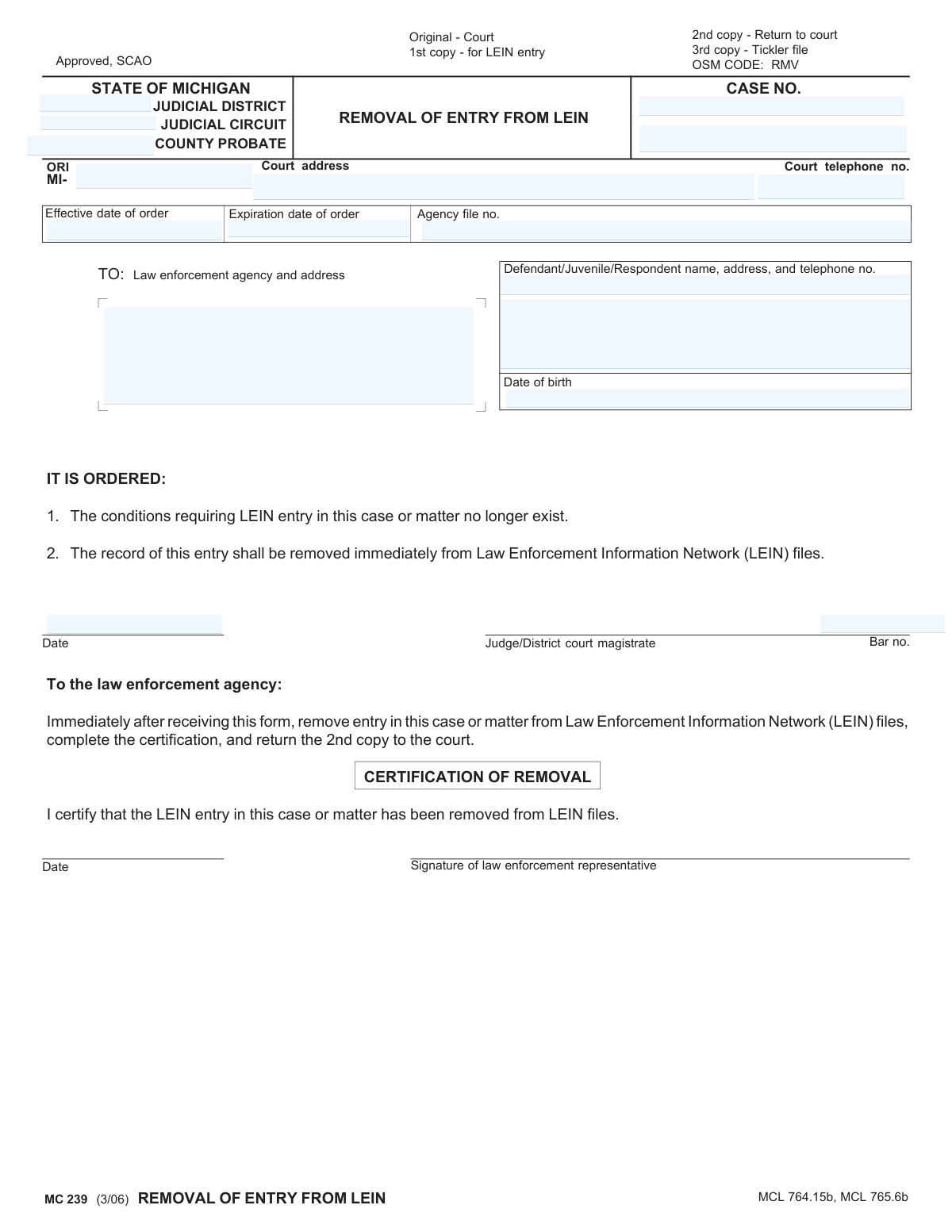
Form MC 239, Removal of Entry from LEIN, is a legal document issued by a Michigan court ordering a law enforcement agency to delete a specific entry from the Law Enforcement Information Network (LEIN) files. This is typically done when the legal conditions that required the entry, such as a personal protection order or a warrant, no longer exist, making it crucial for clearing an individual's record in the system. Today, this form can be filled out quickly and accurately using AI-powered services like Instafill.ai, which can also convert non-fillable PDF versions into interactive fillable forms.
MC 239 is part of the Michigan court forms category on Instafill.
Our AI automatically handles information lookup, data retrieval, formatting, and form filling.
It takes less than a minute to fill out MC 239 using our AI form filling.
Securely upload your data. Information is encrypted in transit and deleted immediately after the form is filled out.

Form specifications

Form name: MC 239, Removal of Entry from LEIN
Number of fields: 17
Number of pages: 1
Language: English
main-image

Instafill Demo: How to fill out PDF forms in seconds with AI

How to Fill Out MC 239 Online for Free in 2026

Are you looking to fill out a MC 239 form online quickly and accurately? Instafill.ai offers the #1 AI-powered PDF filling software of 2026, allowing you to complete your MC 239 form in just 37 seconds or less.
Follow these steps to fill out your MC 239 form online using Instafill.ai:
  1. 1 Navigate to Instafill.ai and upload the MC 239 form or select it from their template library.
  2. 2 Provide the court information, including the judicial district/circuit, county, court address, and case number.
  3. 3 Enter the personal details of the defendant, juvenile, or respondent, such as their full name, address, and date of birth.
  4. 4 Specify the receiving law enforcement agency's name, address, and ORI (Originating Agency Identifier).
  5. 5 Input the effective date of the order and have the judge or magistrate provide their signature, date, and bar number.
  6. 6 Use the AI to review all entered information for accuracy and completeness before generating the final document.
  7. 7 Download, print, and distribute the copies as indicated on the form (Court, LEIN entry, Tickler file, etc.).

Our AI-powered system ensures each field is filled out correctly, reducing errors and saving you time.

Why Choose Instafill.ai for Your Fillable MC 239 Form?

Speed

Complete your MC 239 in as little as 37 seconds.

Up-to-Date

Always use the latest 2026 MC 239 form version.

Cost-effective

No need to hire expensive lawyers.

Accuracy

Our AI performs 10 compliance checks to ensure your form is error-free.

Security

Your personal information is protected with bank-level encryption.

Frequently Asked Questions About Form MC 239

This form is a legal court order directing a law enforcement agency to remove a specific record from the Michigan Law Enforcement Information Network (LEIN) because the conditions requiring the entry no longer exist.

LEIN stands for the Law Enforcement Information Network. It is a secure, statewide database used by Michigan criminal justice agencies to access information on things like warrants, missing persons, and personal protection orders.

A judge or district court magistrate initiates and signs the order. It is then sent to a law enforcement agency, where an officer completes the 'Certification of Removal' section after deleting the record from LEIN.

No, you do not fill out this form. It is an official document handled exclusively by the court and law enforcement agencies as part of a legal process.

The order is sent to the specified law enforcement agency, which must immediately remove the entry from the LEIN system. The agency then certifies the removal and returns a copy of the form to the court as proof of compliance.

The process includes a 'Certification of Removal' that the law enforcement agency must sign and return to the court. This serves as the official confirmation that the order has been carried out.

ORI stands for 'Originating Agency Identifier.' It is a unique code assigned to a specific law enforcement agency, which ensures the removal order is sent to and processed by the correct department.

The form requires specific details from the court case, including the case number, court address, and the full name, address, and date of birth of the person whose record is being removed.

You should contact the court that handled your original case or consult with an attorney. They can help you determine if you are eligible for a removal order and guide you on the next steps.

Yes, authorized personnel can use services like Instafill.ai to auto-fill form fields accurately from case management systems. This helps save time and reduces the risk of data entry errors.

An authorized user can upload the form to a platform like Instafill.ai. The service allows them to fill out all the necessary fields electronically, manage the document digitally, and prepare it for signatures.

You can use a service like Instafill.ai, which can convert flat, non-fillable PDFs into interactive forms. Simply upload the document, and the AI will automatically make the fields editable.

Compliance MC 239
Validation Checks by Instafill.ai

1
Case Number Presence
This check ensures the 'caseno' field is not empty. The case number is the primary identifier for the legal matter and is absolutely essential for locating the correct court file and associated LEIN entry. Without a case number, the order is ambiguous and cannot be processed, leading to rejection of the form.
2
Case Number Format Validation
Verifies that the 'caseno' field conforms to the standard format used by Michigan courts (e.g., YY-######-XX). This is important for automated processing and ensures the case number is not a typo or from an incorrect jurisdiction. A malformed case number will prevent the system from finding the case record, causing the removal request to fail.
3
Defendant/Respondent Identification Completeness
This validation confirms that both the 'dname' (name) and 'dob' (date of birth) fields are populated. These two fields are the minimum required personal identifiers to accurately locate the correct individual's entry in the LEIN system and distinguish them from others with similar names. Failure to provide both pieces of information would create a high risk of removing the wrong record or failing to find the correct one.
4
Date of Birth Validity
This check ensures the 'dob' field contains a valid date in a recognized format (e.g., MM/DD/YYYY) and that the date is in the past. It prevents nonsensical data entry, such as future dates or impossible dates like February 30th. An invalid date of birth makes it impossible to verify the subject's identity, causing the request to be rejected.
5
Order Date and Judge Signature Presence
Verifies that the 'odate' (date of order) and 'judge' (judge's name) fields are both filled. An order is not legally valid without the signature of an authorized official and the date it was issued. Submitting a form without this information would result in an immediate rejection, as the document lacks legal authority.
6
Judge's Bar Number Format
This check validates that the 'barno' field follows the correct format for a Michigan State Bar number, which is typically a 'P' followed by a series of digits (e.g., P12345). This helps verify the credentials of the signing judge or magistrate. An incorrectly formatted bar number may indicate a data entry error and could delay processing while the information is manually verified.
7
ORI Code Presence and Format
Ensures the 'ori' (Originating Agency Identifier) field is populated and follows the standard format. The ORI code is critical for routing the removal certification to the correct law enforcement agency that originally made the LEIN entry. An absent or malformed ORI will cause the request to be misdirected or fail entirely.
8
Law Enforcement Agency Presence
This check confirms that the 'agency' field, which specifies the law enforcement agency responsible for the removal, is not empty. The form is an order directed 'TO' a specific agency, and without this information, it's unclear who is responsible for executing the removal. The form would be unserviceable and returned to the court.
9
Logical Date Sequence: Effective vs. Expiration
This validation ensures that if an 'expdate' (expiration date) is provided, it is on or after the 'effdate' (effective date). An expiration date cannot occur before the order becomes effective. This check prevents logical impossibilities in the data which could cause confusion or legal issues, leading to rejection of the form for correction.
10
Logical Date Sequence: Order vs. Effective Date
This check verifies that the 'effdate' (effective date of order) is on or after the 'odate' (the date the order was signed). An order cannot be effective before it legally exists. This validation maintains the logical and legal timeline of events, and a failure would indicate a significant data entry error requiring correction.
11
Court Telephone Number Format
Validates that the 'telno' field contains a number in a recognizable phone number format (e.g., (XXX) XXX-XXXX). This is important for practical reasons, as the law enforcement agency may need to contact the court for clarification. An invalid number would hinder communication and could delay the removal process if questions arise.
12
Logical Date Sequence: Birth Date vs. Order Date
This is a sanity check to ensure the 'dob' (date of birth) is before the 'odate' (date of order). While seemingly obvious, this check prevents significant data entry errors where dates might be transposed or entered incorrectly. An order cannot be issued for a person before they were born, and a failure here indicates a critical error in the identifying information.

Common Mistakes in Completing MC 239

Entering an Incorrect or Incomplete Case Number

The case number is a unique identifier that must be transcribed perfectly from court documents. Users often make typos or omit prefixes/suffixes, which leads to the system being unable to locate the correct LEIN entry for removal, requiring the form to be resubmitted. To avoid this, meticulously double-check the number; AI-powered tools like Instafill.ai can also help by validating the format of the case number to catch potential errors before submission.

Using an Invalid or Incorrect ORI Code

The Originating Agency Identifier (ORI) is a nine-character code that directs the removal order to the correct law enforcement agency. Entering the wrong code, even by one digit, will send the legal document to the wrong jurisdiction, causing significant delays or complete failure of the process. This code must be verified from an official source, and using an AI form-filler can help by flagging codes that don't match a standard format.

Misspelling the Defendant's Name or Using an Alias

The defendant's name on the form must be an exact match to the name listed in the LEIN system, including any middle names or suffixes. Using a nickname, a common alias, or making a simple spelling error will result in a 'no match' finding, preventing the record's removal. This requires a corrected form to be filed, extending the time the incorrect entry remains in the system.

Formatting the Date of Birth Incorrectly

The Date of Birth (DOB) is a primary data point used to confirm the subject's identity. A common mistake is entering the date in an ambiguous or incorrect format (e.g., MM-DD-YY instead of MM/DD/YYYY) or transposing the month and day. AI-powered form fillers like Instafill.ai can automatically format the date correctly and flag impossible dates to prevent this common error.

Omitting the Judge's Signature, Date, or Bar Number

A removal order is not legally valid without the signature of the authorizing judge or magistrate, the date of the order, and the judge's bar number. Omitting any of these elements will cause the law enforcement agency to reject the form as incomplete and unenforceable. The form must be returned to the court for proper execution, causing unnecessary delays.

Submitting a Form with Illegible Handwriting

This form is often a non-fillable PDF that gets printed and completed by hand, leading to issues with illegible handwriting. Critical information like the case number or defendant's name can be easily misread, resulting in data entry errors or rejection. AI tools like Instafill.ai can convert such PDFs into digitally fillable forms, ensuring all entries are perfectly clear and legible.

Entering Incorrect Judicial Court Identifiers

The form requires specifying the correct Judicial District, Circuit, and County. Entering incorrect court information can create jurisdictional confusion and cause the receiving agency to question the order's validity, leading to verification delays. Using a system like Instafill.ai can help by pre-populating correct court information based on the case number or county, reducing manual entry mistakes.

Confusing the Order's Effective and Expiration Dates

This form includes fields for both an 'Effective date' and an 'Expiration date' of the order. Users may inadvertently switch these dates, enter illogical dates, or leave one blank when it is required. This creates legal ambiguity and may cause the agency to reject the form for clarification. AI tools can validate that the expiration date is after the effective date, preventing logical errors that would invalidate the form.
Saved over 80 hours a year

“I was never sure if my IRS forms like W-9 were filled correctly. Now, I can complete the forms accurately without any external help.”

Kevin Martin Green

Your data stays secure with advanced protection from Instafill and our subprocessors

Robust compliance program

Transparent business model

You’re not the product. You always know where your data is and what it is processed for.

ISO 27001, HIPAA, and GDPR

Our subprocesses adhere to multiple compliance standards, including but not limited to ISO 27001, HIPAA, and GDPR.

Security & privacy by design

We consider security and privacy from the initial design phase of any new service or functionality. It’s not an afterthought, it’s built-in, including support for two-factor authentication (2FA) to further protect your account.

Fill out MC 239 with Instafill.ai

Worried about filling PDFs wrong? Instafill securely fills mc-239-removal-of-entry-from-lein forms, ensuring each field is accurate.