Yes! You can use AI to fill out MC 305, Order for Security for Costs
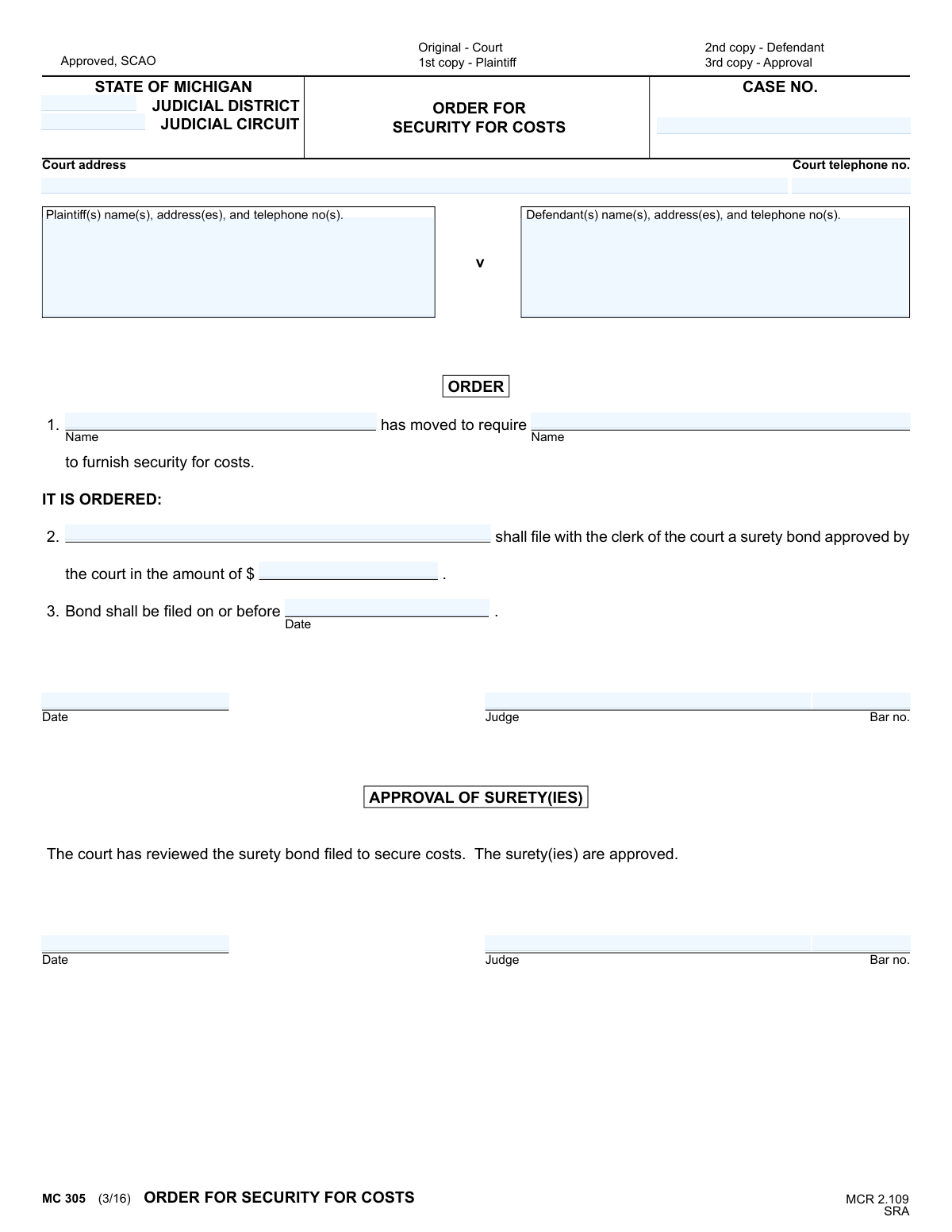
The MC 305 is a legal document issued by a Michigan court that requires a plaintiff or defendant to provide a financial guarantee, known as a surety bond, for the opposing party's potential court costs. This order ensures that if the party providing security loses the case, funds are available to cover the winner's allowable expenses. Today, this form can be filled out quickly and accurately using AI-powered services like Instafill.ai, which can also convert non-fillable PDF versions into interactive fillable forms.
MC 305 is part of the
Michigan court forms category on Instafill.
Our AI automatically handles information lookup, data retrieval, formatting, and form filling.
It takes less than a minute to fill out MC 305 using our AI form filling.
Securely upload your data. Information is encrypted in transit and deleted immediately after the form is filled out.
Form specifications
| Form name: | MC 305, Order for Security for Costs |
| Number of fields: | 18 |
| Number of pages: | 1 |
| Language: | English |
More forms in Michigan court forms
Instafill Demo: How to fill out PDF forms in seconds with AI
How to Fill Out MC 305 Online for Free in 2026
Are you looking to fill out a MC 305 form online quickly and accurately? Instafill.ai offers the #1 AI-powered PDF filling software of 2026, allowing you to complete your MC 305 form in just 37 seconds or less.
Follow these steps to fill out your MC 305 form online using Instafill.ai:
- 1 Navigate to Instafill.ai and upload or select the MC 305, Order for Security for Costs form.
- 2 Provide the court and case information, including the judicial district/circuit, case number, and court address.
- 3 Enter the complete details for both the plaintiff(s) and defendant(s), including their names, addresses, and telephone numbers.
- 4 Specify the name of the party required to furnish the security and the amount of the surety bond ordered by the court.
- 5 Input the date by which the bond must be filed and the date the order is signed by the judge.
- 6 Review all the information auto-filled by the AI to ensure accuracy, particularly the names, dates, and monetary amounts.
- 7 Download the completed form to be signed by the judge and filed with the court clerk.
Our AI-powered system ensures each field is filled out correctly, reducing errors and saving you time.
Why Choose Instafill.ai for Your Fillable MC 305 Form?
Speed
Complete your MC 305 in as little as 37 seconds.
Up-to-Date
Always use the latest 2026 MC 305 form version.
Cost-effective
No need to hire expensive lawyers.
Accuracy
Our AI performs 10 compliance checks to ensure your form is error-free.
Security
Your personal information is protected with bank-level encryption.
Frequently Asked Questions About Form MC 305
This form is a court order requiring a party in a lawsuit, usually the plaintiff, to post a bond to guarantee payment of the opposing party's legal costs if they lose the case.
A judge fills out and signs this official court order. The parties involved, the plaintiff and defendant, receive copies and must comply with the order's terms.
A surety bond is a financial guarantee from a third party (a surety company) to cover costs if you fail to pay them. You can typically purchase one from an insurance company or a specialized bond agency.
If you fail to file the security bond by the date specified in section 3 of the order, the court may dismiss your case.
The judge determines the required bond amount based on the potential costs of the lawsuit. This amount is written in section 2 of the order.
After you file the bond, the judge reviews it to ensure it's valid. The judge signs this section to formally approve the surety and the bond you have provided.
A court may issue this order if there's a concern that you might not be able to pay the defendant's legal fees if you lose. This is more common if the plaintiff lives out-of-state or if their ability to pay is in question.
The order requires essential case details, including the court address, case number, and the names and addresses of the plaintiff(s) and defendant(s).
If you are the party ordered to provide security, you must obtain a surety bond for the specified amount and file it with the court clerk before the deadline. It is strongly advised to consult an attorney.
If you cannot afford the bond, you should immediately speak with an attorney. You may be able to file a motion asking the court to reduce the amount or waive the requirement due to financial hardship.
Yes, services like Instafill.ai use AI to accurately auto-fill form fields, saving time and reducing errors. This can be useful for preparing a draft of the form or managing related case documents.
You can upload the MC 305 PDF to the Instafill.ai platform. Its AI will identify all the form fields, allowing you to easily enter your information and generate a completed document for review and submission.
Services like Instafill.ai can convert flat, non-fillable PDFs into interactive forms. This allows you to type your information directly into the fields instead of having to print and fill the form by hand.
Compliance MC 305
Validation Checks by Instafill.ai
1
Case Number Format Validation
This check ensures the 'case no' field conforms to the standard Michigan case number format (e.g., YY-######-XX). Validating the case number is critical for correct document filing and linking it to the proper case file within the court's system. A failure in this validation would prevent the form from being processed, as it cannot be associated with a specific legal action.
2
Logical Date Sequence for Bond Filing
This validation verifies that the 'bond filed date' is set to a date after the 'it is ordered date'. It is logically impossible to require a bond to be filed on a date that has already passed. This check prevents the creation of unenforceable or nonsensical orders, ensuring the timeline for compliance is valid.
3
Bond Amount is a Positive Value
This check validates that the 'bond amount' field contains a positive numeric value greater than zero. The purpose of the bond is to provide financial security, so it must have a monetary value. An entry that is zero, negative, or non-numeric would invalidate the order's financial requirement and cause the form to be rejected.
4
Michigan Bar Number Format
This validation ensures that the 'it is ordered bar number' and 'approval of surety bar number' fields follow the correct format for a Michigan State Bar number, which is typically a 'P' followed by a series of digits (e.g., P12345). Correct bar numbers are essential for identifying the signing judge and verifying their credentials. An invalid format would indicate a data entry error and require correction.
5
Party Name Consistency in Order
This check confirms that the names entered in 'order name 1', 'order name 2 to furnish security', and 'it is ordered shall file name' match one of the parties listed as plaintiff or defendant. This is crucial for ensuring the order correctly identifies which party is making the motion and which party must provide the security. A mismatch would create ambiguity and make the order legally defective.
6
Initial Order Section Completeness
This validation ensures that all mandatory fields for the initial order are filled, including the case number, party information, bond amount, bond filing date, and the judge's signature details. An incomplete order cannot be legally executed and would be rejected by the court clerk. This check guarantees the fundamental components of the order are present before it can be submitted.
7
Logical Date Sequence for Surety Approval
This check verifies that the 'approval of surety date' is on or after the 'it is ordered date'. The approval of a surety bond can only happen after the order requiring the bond has been issued. This validation prevents chronological errors in the legal record and ensures the document's timeline is logical and defensible.
8
Judge and Bar Number Pairing
This validation ensures that if a judge's name is entered in either the 'it is ordered judge' or 'approval of surety judge' field, the corresponding bar number field is also filled. The judge's name and bar number are a pair used for official identification and verification. Submitting one without the other would result in an incomplete and potentially invalid judicial signature block.
9
Court Jurisdiction Identification
This check ensures that either the 'judicial district' or 'judicial circuit' field is completed. These fields identify the specific court with jurisdiction over the case, which is a fundamental requirement for any legal filing. Failure to specify the correct court would lead to the document being rejected or misfiled.
10
Completeness of Party Information
This validation verifies that the plaintiff and defendant information blocks contain, at a minimum, a name and a full address for each party. This information is essential for proper service of the order and for maintaining an accurate court record. Missing contact information could lead to procedural delays or challenges to the validity of service.
11
Standard Telephone Number Format
This check validates that the 'court telephone no.' and any telephone numbers provided for the plaintiff or defendant adhere to a standard format (e.g., (XXX) XXX-XXXX or XXX-XXX-XXXX). Consistent formatting improves data quality and ensures that the contact information is usable and correctly parsed by automated systems. An invalid format would trigger an error requiring the user to correct the entry.
12
Conditional Requirement for Approval Section
This validation ensures that if any field within the 'APPROVAL OF SURETY(IES)' section is filled (date, judge, or bar number), then all fields in that section must be completed. This section functions as a complete block of information for a specific action. An incomplete approval section would be ambiguous and would be flagged for correction to ensure the approval is properly and fully documented.
Common Mistakes in Completing MC 305
Users frequently confuse the two name fields in item 1, incorrectly listing the party being asked to pay as the one making the motion. This happens due to misreading the sentence structure. This mistake renders the order legally nonsensical and unenforceable, requiring a corrected refiling and causing significant delays. To avoid this, carefully read who 'has moved' (the movant) versus who is required 'to furnish security' (the subject of the motion).
Entering the case number with typos, missing characters, or in the wrong format is a very common error. Case numbers are unique identifiers, and even a small mistake can cause the court clerk to be unable to associate the order with the correct case file. This results in rejection of the filing and delays the legal process. Always double-check the case number against official court documents from the same case.
Parties often mistakenly fill out the 'APPROVAL OF SURETY(IES)' section at the bottom of the form when preparing the initial order. This section is reserved for the judge's use at a later time, specifically after a surety bond has been filed and reviewed by the court. Filling it out prematurely creates a confusing and inaccurate document that will be rejected, as it falsely implies a court action has already been taken.
In the main 'IT IS ORDERED' section (item 2), filers sometimes forget to enter the name of the party who is being ordered to file the bond. This leaves the order's primary directive ambiguous and unenforceable, as it doesn't specify who must take action. To prevent this, ensure the name of the party required to furnish security (usually the plaintiff) is clearly written in the blank space after 'IT IS ORDERED:' and before 'shall file...'
This form is often available as a non-fillable PDF, leading users to print it and fill it out by hand. Poor or illegible handwriting can cause the court clerk to misinterpret names, dates, or amounts, or reject the document outright. This forces the filer to redo the form, wasting time and effort. To avoid this, use a tool like Instafill.ai, which can convert non-fillable PDFs into digitally fillable versions, ensuring all entries are perfectly legible.
Filers often get confused between 'Judicial District' and 'Judicial Circuit,' or they enter an incomplete court address. Filing a document with the wrong court information guarantees its rejection, as it cannot be processed or docketed correctly. This requires the filer to start over, potentially missing deadlines. Always verify the exact court name, address, and circuit/district from the original case filing documents.
When entering the bond amount or the filing deadline, users may use incorrect formatting, leave out dollar signs, or write ambiguous dates (e.g., '30 days from now' instead of a specific date). This creates uncertainty and can lead to disputes or the filing of an incorrect bond. These fields must be filled with precise, unambiguous figures and dates (e.g., '$2,500.00', '10/21/2024') as specified by the judge's ruling.
The boxes for plaintiff and defendant information are frequently submitted with missing data, such as an incomplete address, a missing phone number, or using abbreviations instead of full legal names. This can lead to issues with serving the order and communicating with the parties, potentially creating grounds for a procedural challenge later. Using a tool like Instafill.ai can help by storing party information and auto-populating it completely and consistently across all case documents.
While the judge is the one who signs the order, the form is typically prepared by an attorney's office. Preparers often neglect to type in the judge's name and bar number, leaving it for the judge's staff to fill in. Submitting a fully prepared form, including the judge's typed name and bar number, is a professional courtesy that streamlines the signature process and reduces the chance of administrative delays or errors.
Saved over 80 hours a year
“I was never sure if my IRS forms like W-9 were filled correctly. Now, I can complete the forms accurately without any external help.”
Kevin Martin Green
Your data stays secure with advanced protection from Instafill and our subprocessors

Robust compliance program
Transparent business model
You’re not the product. You always know where your data is and what it is processed for.
ISO 27001, HIPAA, and GDPR
Our subprocesses adhere to multiple compliance standards, including but not limited to ISO 27001, HIPAA, and GDPR.
Security & privacy by design
We consider security and privacy from the initial design phase of any new service or functionality. It’s not an afterthought, it’s built-in, including support for two-factor authentication (2FA) to further protect your account.
Fill out MC 305 with Instafill.ai
Worried about filling PDFs wrong? Instafill securely fills mc-305-order-for-security-for-costs forms, ensuring each field is accurate.