Yes! You can use AI to fill out MC 406b, Order on Petition to Discontinue Sex Offender Registration

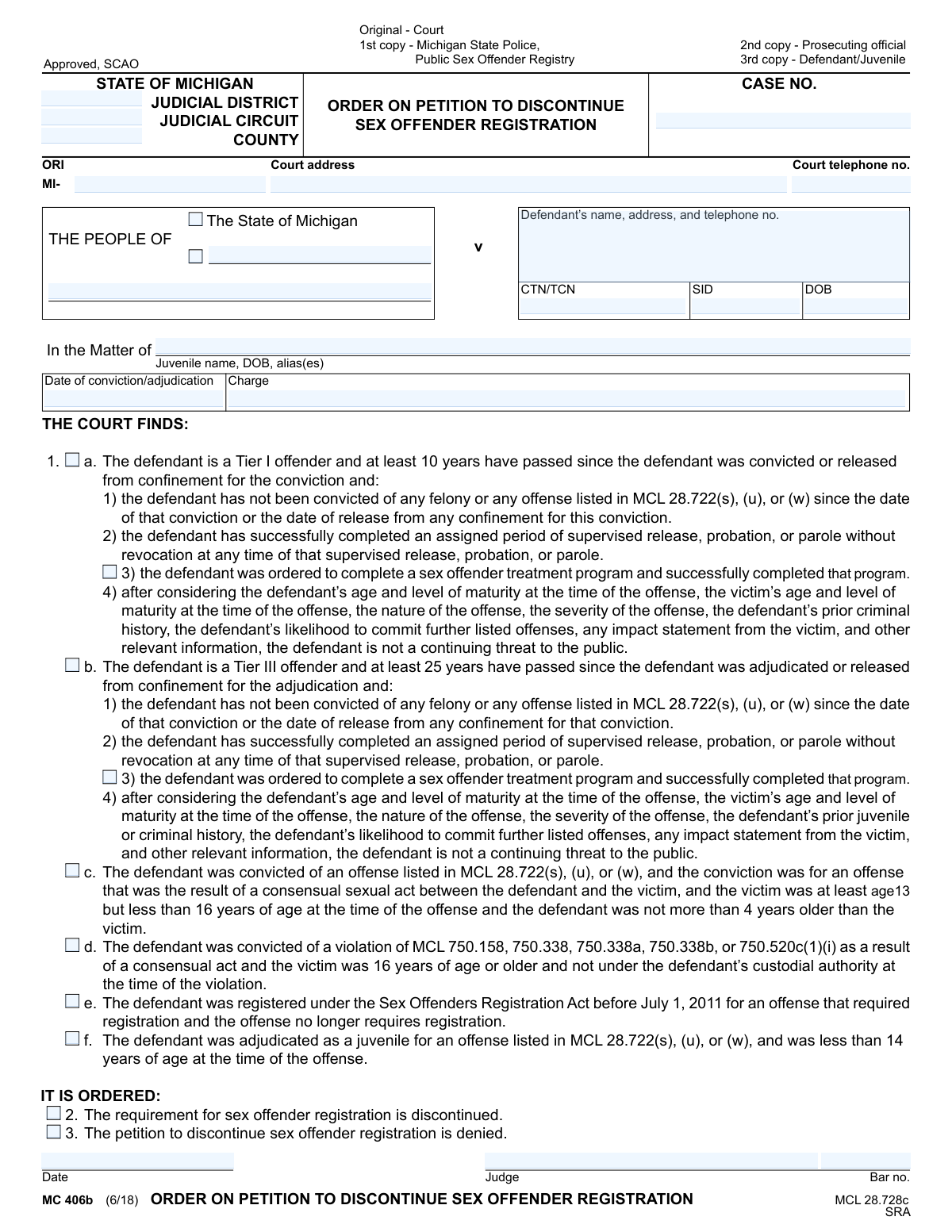
Form MC 406b is a legal document used by Michigan courts to issue an official order regarding a petition to be removed from the sex offender registry. A judge uses this form to document the court's findings and final decision, either granting or denying the request to discontinue registration based on specific legal criteria. Today, this form can be filled out quickly and accurately using AI-powered services like Instafill.ai, which can also convert non-fillable PDF versions into interactive fillable forms.
MC 406b is part of the Michigan court forms category on Instafill.
Our AI automatically handles information lookup, data retrieval, formatting, and form filling.
It takes less than a minute to fill out MC 406b using our AI form filling.
Securely upload your data. Information is encrypted in transit and deleted immediately after the form is filled out.

Form specifications

Form name: MC 406b, Order on Petition to Discontinue Sex Offender Registration
Number of fields: 31
Number of pages: 1
Language: English
main-image

Instafill Demo: How to fill out PDF forms in seconds with AI

How to Fill Out MC 406b Online for Free in 2026

Are you looking to fill out a MC 406B form online quickly and accurately? Instafill.ai offers the #1 AI-powered PDF filling software of 2026, allowing you to complete your MC 406B form in just 37 seconds or less.
Follow these steps to fill out your MC 406B form online using Instafill.ai:
  1. 1 Navigate to Instafill.ai and upload or select the MC 406b form.
  2. 2 Allow the AI to scan the document, making all fields interactive and ready for input.
  3. 3 Enter the court and case information, including the judicial district, county, case number, and court address.
  4. 4 Provide the defendant's or juvenile's personal details, such as name, address, date of birth, and other case identifiers.
  5. 5 The judge or authorized court personnel will check the appropriate box under 'THE COURT FINDS' that corresponds to the legal basis for the decision.
  6. 6 The judge will then mark the final decision by checking either box 2 to discontinue the registration requirement or box 3 to deny the petition.
  7. 7 Review all entered information for accuracy before the judge signs and dates the order to execute it. The completed form can then be downloaded and distributed to the required parties.

Our AI-powered system ensures each field is filled out correctly, reducing errors and saving you time.

Why Choose Instafill.ai for Your Fillable MC 406b Form?

Speed

Complete your MC 406b in as little as 37 seconds.

Up-to-Date

Always use the latest 2026 MC 406b form version.

Cost-effective

No need to hire expensive lawyers.

Accuracy

Our AI performs 10 compliance checks to ensure your form is error-free.

Security

Your personal information is protected with bank-level encryption.

Frequently Asked Questions About Form MC 406b

This form is a court order that officially documents the judge's decision to either grant or deny a person's request to be removed from the Michigan Sex Offender Registry. It is the final document issued after a hearing on the petition.

This is an official court order that is completed and signed by a judge. The petitioner or their attorney does not fill out this specific form, but they do file the initial petition that leads to this order.

Copies of the order are sent to the court file, the Michigan State Police Public Sex Offender Registry, the prosecuting official, and the defendant or juvenile who filed the petition.

The court must find that at least 10 years have passed since conviction/release, you have no new disqualifying offenses, you successfully completed supervision and any required treatment, and you are not a continuing threat to the public.

A Tier III offender must wait at least 25 years since their adjudication or release from confinement. They must also meet similar criteria as Tier I offenders regarding their record, completion of supervision and treatment, and current risk level.

If the judge denies your petition, they will check box 3 on the order. This means you must continue to comply with all sex offender registration requirements.

If the judge grants your petition by checking box 2, your registration requirement is discontinued. A copy of the order is sent to the Michigan State Police to officially remove your information from the public registry.

The court evaluates many factors, including the nature of the original offense, your criminal history since the offense, completion of treatment programs, any victim impact statements, and an overall assessment of your current risk to the public.

Yes, AI-powered services like Instafill.ai can help you accurately fill out the petition form required to start this process. These tools can save time by auto-filling your information and ensuring the form is completed correctly.

You can upload the petition form, which is often a PDF, to the Instafill.ai platform. The AI will identify the fields, allowing you to quickly and accurately fill in your information before printing it for submission.

Services like Instafill.ai can convert flat, non-fillable PDFs into interactive, fillable forms. This allows you to easily type your information directly onto the document, ensuring it is neat and legible for the court.

After the judge signs the order, it is sent to the Michigan State Police. While processing times can vary, they will act upon the court order to remove your information from the public-facing registry.

The law allows for removal from the registry in certain cases, such as those involving consensual acts where the age difference was small or the offense no longer requires registration. The court reviews the specific facts of the original case to see if an exception applies.

Compliance MC 406b
Validation Checks by Instafill.ai

1
Exclusive Party Type Selection
Ensures that information is provided for either a 'Defendant' or a 'Juvenile', but not both. The form structure separates these two party types, and a single court order should pertain to only one individual. If data is entered in both the 'Defendant’s name, address, and telephone no.' field and the 'In the Matter of Juvenile name' field, the submission should be flagged for review to clarify the correct party.
2
Case Number Completeness
Verifies that the 'CASE NO.' field is not empty. The case number is a critical unique identifier for tracking the legal proceeding within the judicial system. Without it, the order cannot be correctly filed or associated with the proper case file, leading to significant administrative and legal errors.
3
ORI Number Format
Checks that the 'ORI' field follows the standard Michigan format, which should begin with 'MI-' followed by a specific sequence of characters. The Originating Agency Identifier (ORI) is crucial for routing the document to the correct law enforcement agency (Michigan State Police). An incorrect format will cause the document to be rejected or misrouted.
4
Date of Birth Validity
Validates that the 'DOB' field contains a legitimate date and represents a plausible age for a person involved in such a proceeding. The check should ensure the date is in the past and not more than a reasonable human lifespan (e.g., 120 years) ago. This prevents data entry errors and ensures the identity information is credible.
5
Conviction/Adjudication Date Logic
Confirms that the 'Date of conviction/adjudication' is a valid date that occurs after the individual's Date of Birth ('DOB') and on or before the final 'Date' of the order. This logical check prevents impossible scenarios, such as a conviction pre-dating birth or an order being signed before the conviction it references.
6
Mutually Exclusive Finding Selection
Ensures that only one of the findings from section 1 (1a, 1b, 1c, 1d, 1e, or 1f) is selected. Each finding represents a distinct legal basis for the court's decision, and they are mutually exclusive. Selecting more than one would create an ambiguous and legally invalid order.
7
Mutually Exclusive Order Decision
Validates that only one of the final order options, '2. The requirement...is discontinued' or '3. The petition...is denied', is checked. The court's decision is binary—the petition is either granted or denied. Selecting both or neither would render the order unenforceable and nonsensical.
8
Order Justification Check
Verifies that if the order is granted (Box 2, 'discontinued'), one of the supporting findings (1a through 1f) must also be selected. An order to discontinue registration requires a specific legal justification as outlined in the findings section. An order without a corresponding finding is legally insufficient.
9
Judge's Bar Number Format
Checks that the 'Bar no.' field for the judge is in the correct format for the State of Michigan, typically a 'P' followed by a sequence of digits. This ensures the signing authority is a valid and identifiable member of the state bar. An invalid number could call the authenticity of the entire order into question.
10
Tier I Time Eligibility
If finding '1.a' (Tier I offender) is checked, this validation cross-references the 'Date of conviction/adjudication' with the current date to confirm at least 10 years have passed. This is a mandatory statutory requirement for eligibility. If the time period is less than 10 years, this finding is invalid, and the petition cannot be granted on this basis.
11
Tier III Time Eligibility
If finding '1.b' (Tier III offender) is checked, this validation cross-references the 'Date of conviction/adjudication' with the current date to confirm at least 25 years have passed. This is a critical eligibility requirement defined by law. An order based on this finding would be invalid if the 25-year period has not been met.
12
Juvenile Finding Consistency
Ensures that if finding '1.f' (adjudicated as a juvenile...less than 14 years of age) is selected, the party identified on the form is the 'Juvenile' and not the 'Defendant'. This check maintains logical consistency between the legal finding and the party to whom the order applies. Applying a juvenile-specific finding to an adult defendant would be a critical error.
13
Signature Block Completeness
Verifies that if an order is made (Box 2 or 3 is checked), the 'Date', 'Judge' name, and 'Bar no.' fields are all filled out. An official court order is not valid until it is signed and dated by an authorized judge. Missing any of these elements would render the document incomplete and non-binding.

Common Mistakes in Completing MC 406b

Incomplete or Incorrect Case Number

The 'CASE NO.' is a unique identifier for the legal proceeding and is essential for linking the order to the correct court file. People often enter this number incorrectly by transposing digits, omitting prefixes/suffixes, or leaving it blank entirely. An incorrect case number will cause the court clerk to reject the filing, as it cannot be docketed, leading to significant delays in the legal process.

Omitting Critical Identification Numbers (CTN/SID/ORI)

Fields like 'CTN/TCN', 'SID', and 'ORI MI-' are crucial for law enforcement and state record-keeping but are often left blank because filers don't know what they are. These numbers ensure the Michigan State Police can accurately identify the individual and update the Public Sex Offender Registry. Failure to provide these numbers can cause major processing delays on the law enforcement side, even after a judge has signed the order.

Confusing Adult 'Defendant' vs. Juvenile 'In the Matter of'

The form has two distinct sections for identifying the petitioner: one for an adult 'Defendant' and another for a 'Juvenile'. A common mistake is filling out the wrong section or entering information in both. This creates legal ambiguity about the original case and can lead to the form being returned for clarification or rejected outright.

Incorrectly Calculating Eligibility Timeframes

Sections 1.a and 1.b require a specific period (10 or 25 years) to have passed since conviction or release from confinement. A frequent error is miscalculating this timeframe, for example, by counting from the offense date instead of the release date. Filing a petition based on an incorrect calculation will result in a denial, wasting time and filing fees.

Using Vague or Incorrect 'Charge' Information

The 'Charge' field requires the specific Michigan Compiled Laws (MCL) statutory citation for the original offense. Filers often write a generic description like 'sexual assault' instead of the precise legal code. This lack of specificity forces the court to verify the original conviction and may lead to requests for more information, delaying the judge's decision.

Incorrectly Identifying the Court Jurisdiction

Entering the wrong 'Judicial District', 'Judicial Circuit', or 'County' is a frequent problem, especially if the filer is not from the area or the original case was long ago. Filing the order in the wrong jurisdiction means it has no legal effect and will be rejected. This forces the petitioner to start the process over in the correct court, causing major setbacks.

Improper Date of Birth (DOB) Formatting

The 'DOB' field is critical, as the petitioner's age at the time of the offense can be a determining factor (per sections 1.c and 1.f). Mistakes include transposing month and day, using an incorrect year, or using a non-standard format. An incorrect DOB can undermine the legal basis for the petition and lead to its denial.

Failure to Provide a Complete Court Address

The 'Court address' and 'Court telephone no.' fields are sometimes left incomplete or filled with generic information. This information is vital for all parties, including the Michigan State Police who receive a copy, to verify the order's authenticity. Incomplete contact information can cause delays if any party needs to contact the court for clarification.

Submitting a Non-Fillable or Poorly Scanned Form

Often, individuals can only find this form as a flat, non-fillable PDF, leading them to print it and fill it out by hand. This can result in illegible handwriting, smudges, and information written outside the designated fields, making it difficult for the court and other agencies to process. AI-powered tools like Instafill.ai can convert such non-fillable PDFs into an interactive, fillable format, ensuring all entries are clean, legible, and correctly placed.

Using an Outdated Version of the Form

This form is marked 'MC 406b(6/18)', indicating a June 2018 revision. Laws and court procedures change, and using an outdated form that doesn't reflect the current statute can lead to automatic rejection by the court clerk. It is crucial to ensure you are using the most current version provided by the State Court Administrative Office (SCAO). AI form-filling tools like Instafill.ai are often updated with the latest form versions to help prevent this issue.
Saved over 80 hours a year

“I was never sure if my IRS forms like W-9 were filled correctly. Now, I can complete the forms accurately without any external help.”

Kevin Martin Green

Your data stays secure with advanced protection from Instafill and our subprocessors

Robust compliance program

Transparent business model

You’re not the product. You always know where your data is and what it is processed for.

ISO 27001, HIPAA, and GDPR

Our subprocesses adhere to multiple compliance standards, including but not limited to ISO 27001, HIPAA, and GDPR.

Security & privacy by design

We consider security and privacy from the initial design phase of any new service or functionality. It’s not an afterthought, it’s built-in, including support for two-factor authentication (2FA) to further protect your account.

Fill out MC 406b with Instafill.ai

Worried about filling PDFs wrong? Instafill securely fills mc-406b-order-on-petition-to-discontinue-sex-offender-registration forms, ensuring each field is accurate.