Yes! You can use AI to fill out MC 439, Notice of Order Appointing Receiver (Receivership Estate)

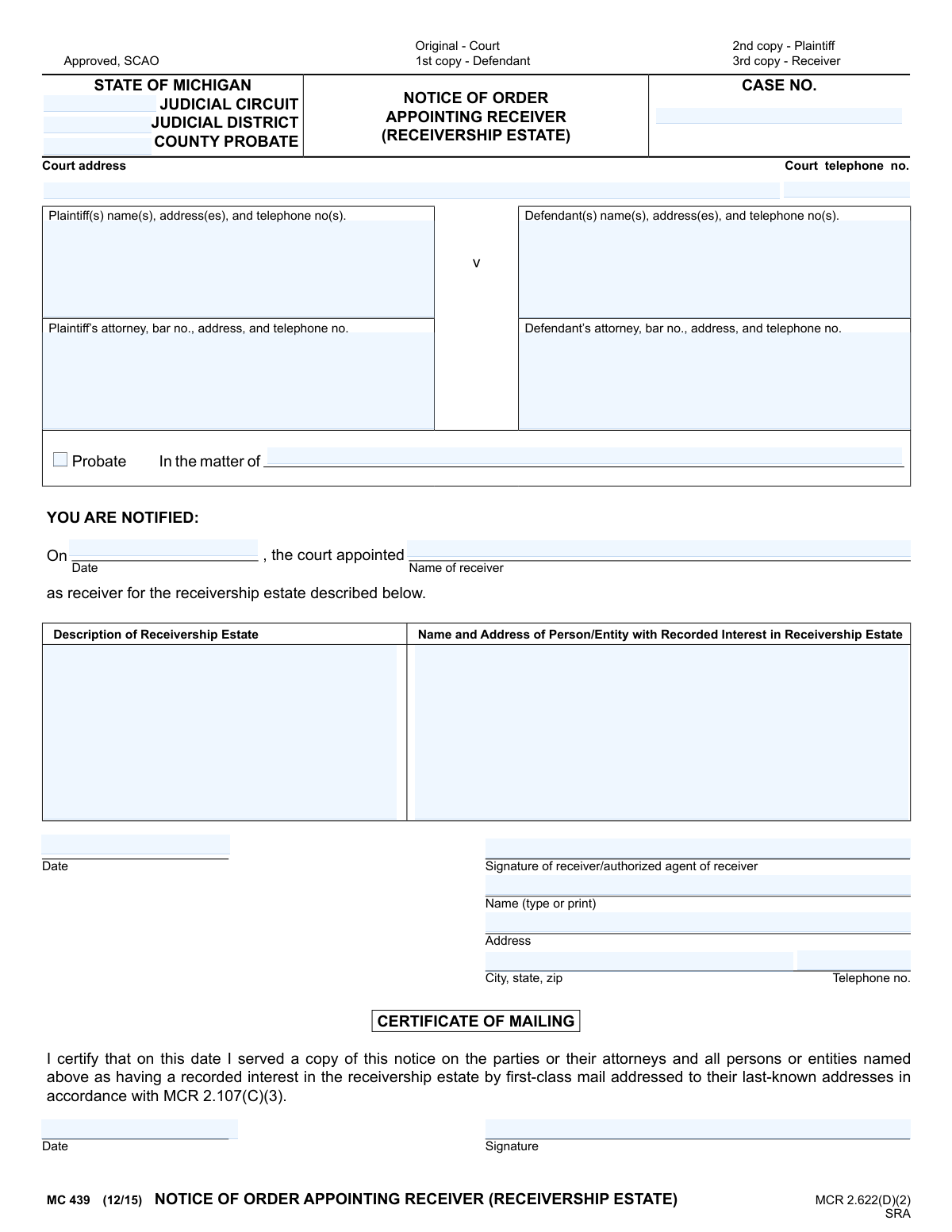
Form MC 439, Notice of Order Appointing Receiver (Receivership Estate), is a legal document used in the state of Michigan to inform all relevant parties that a court has appointed a receiver to manage a specific property or estate. This notice is crucial for ensuring all stakeholders, including plaintiffs, defendants, and those with an interest in the estate, are officially aware of the receivership. Today, this form can be filled out quickly and accurately using AI-powered services like Instafill.ai, which can also convert non-fillable PDF versions into interactive fillable forms.
MC 439 is part of the Michigan court forms category on Instafill.
Our AI automatically handles information lookup, data retrieval, formatting, and form filling.
It takes less than a minute to fill out MC 439 using our AI form filling.
Securely upload your data. Information is encrypted in transit and deleted immediately after the form is filled out.

Form specifications

Form name: MC 439, Notice of Order Appointing Receiver (Receivership Estate)
Number of fields: 24
Number of pages: 1
Language: English
main-image

Instafill Demo: How to fill out PDF forms in seconds with AI

How to Fill Out MC 439 Online for Free in 2026

Are you looking to fill out a MC 439 form online quickly and accurately? Instafill.ai offers the #1 AI-powered PDF filling software of 2026, allowing you to complete your MC 439 form in just 37 seconds or less.
Follow these steps to fill out your MC 439 form online using Instafill.ai:
  1. 1 Navigate to Instafill.ai and upload or select the MC 439 form.
  2. 2 Use the AI assistant to automatically populate court details, including the judicial circuit, district, and case number.
  3. 3 Enter the plaintiff's and defendant's information, along with their respective attorneys' details.
  4. 4 Provide the specific details of the court order, including the date of appointment and the name of the appointed receiver.
  5. 5 Clearly describe the receivership estate and list any persons or entities with a recorded interest in it.
  6. 6 Review all the information for accuracy, then have the receiver or their authorized agent digitally sign and date the form.
  7. 7 Securely download, print, or share the completed MC 439 form for filing with the court and serving to all parties.

Our AI-powered system ensures each field is filled out correctly, reducing errors and saving you time.

Why Choose Instafill.ai for Your Fillable MC 439 Form?

Speed

Complete your MC 439 in as little as 37 seconds.

Up-to-Date

Always use the latest 2026 MC 439 form version.

Cost-effective

No need to hire expensive lawyers.

Accuracy

Our AI performs 10 compliance checks to ensure your form is error-free.

Security

Your personal information is protected with bank-level encryption.

Frequently Asked Questions About Form MC 439

This form is used to officially notify all parties in a lawsuit, and other interested entities, that a court has appointed a receiver to manage specific property or assets (the 'receivership estate').

The court-appointed receiver or their authorized agent is responsible for completing, signing, and mailing this notice to all required parties.

Receiving this notice means you are either a party to the legal case (plaintiff or defendant) or have a recorded interest in the property now being managed by a neutral third party under the court's supervision.

A 'receiver' is a person appointed by the court to manage property during a lawsuit. The 'receivership estate' is the specific property, business, or assets that the receiver is now in control of.

You must provide a clear and specific description of the property and assets the receiver has been appointed to manage. This should match the description in the court's order.

This includes any person or company with a legal claim on the property, such as a bank holding a mortgage, a government agency with a tax lien, or another creditor with a recorded judgment.

This section is where the receiver certifies that they have mailed a copy of the notice to all parties involved in the case and anyone with a recorded interest. It serves as proof of proper notification.

The original is filed with the court, and copies must be sent to the plaintiff, the defendant, and the receiver for their records, as indicated at the top of the form.

Yes, services like Instafill.ai use AI to auto-fill form fields accurately from your case files, which can save significant time and help prevent errors.

You can use a service like Instafill.ai to upload the form and make it fillable online. This allows you to type information directly into the fields, then save or print the completed document.

If you have a non-fillable or 'flat' PDF, platforms like Instafill.ai can convert it into an interactive, fillable form. This lets you easily complete it on your computer without needing to print and write by hand.

You will need the court case number, the full names and addresses of all parties, the date the court appointed the receiver, and a description of the receivership estate.

The appointed receiver or an authorized agent of the receiver must sign and date the form. This signature certifies that the information is correct and that the notice was mailed as stated.

Compliance MC 439
Validation Checks by Instafill.ai

1
Case Number Format and Presence
This validation ensures the 'Case no.' field is not empty and conforms to the standard format for Michigan court cases (e.g., YY-######-XX). The case number is the primary identifier for the legal proceeding, and its accuracy is critical for correct filing and document association. A missing or incorrectly formatted number will lead to the document being rejected by the court clerk.
2
Court Jurisdiction Identification
This check verifies that the appropriate court jurisdiction is clearly identified by completing either the 'Judicial Circuit'/'Judicial District' fields or the 'County Probate' field. This information is essential for routing the document to the correct court system. Ambiguity in jurisdiction can cause significant delays or misfiling of the notice.
3
Adversarial Party Completeness
This validation ensures that the name and address for at least one plaintiff and one defendant are provided. A legal action fundamentally requires at least two opposing parties. A notice that fails to identify both sides is legally insufficient and cannot be processed.
4
Attorney Bar Number Validation
This check confirms that if an attorney is listed for either the plaintiff or defendant, a valid State of Michigan bar number is included. The bar number serves as official verification of the attorney's license and authority to practice. Filings with missing or invalid bar numbers may be questioned or rejected, as they fail to properly establish legal representation.
5
Receiver Appointment Date Validity
This validation ensures the 'On [date] the court appointed' field contains a valid calendar date that is not in the future. The appointment must have already occurred for the notice to be valid. An invalid or future date would render the notice factually incorrect and legally void.
6
Receiver Name Completeness
This check verifies that the 'name of receiver' field is populated. The primary purpose of this form is to notify parties of who has been appointed as the receiver. If the receiver's name is missing, the notice fails its essential function and is rendered useless.
7
Receivership Estate Description Requirement
This validation ensures the 'Description of Receivership Estate' field is not left blank. This description defines the specific assets and property under the receiver's control, which is critical for establishing the scope of their authority. An empty description creates legal ambiguity and could lead to disputes over the receiver's actions.
8
Receiver Contact Information Completeness
This check ensures that the receiver's printed name, full address, and telephone number are all provided in their designated signature block. This contact information is crucial for all interested parties who need to communicate with the receiver regarding the estate. Incomplete information hinders the administration of the receivership.
9
Chronological Date Consistency
This validation performs a logical check across all dates on the form. It ensures the receiver appointment date is on or before the receiver's signature date, which in turn must be on or before the 'Certificate of Mailing' date. This chronological order is essential for the document's credibility, as it reflects a logical sequence of events.
10
Mandatory Signature Verification
This check verifies that both the 'Signature of receiver/authorized agent of receiver' and the signature for the 'Certificate of Mailing' are present. Signatures are required to authenticate the document and certify that service was performed. A missing signature invalidates the legal power of the notice and the proof of mailing.
11
Standard Phone Number Format
This validation examines all telephone number fields on the form to ensure they contain a plausible number, typically conforming to a 10-digit format. Correctly formatted phone numbers are essential for ensuring communication channels between the court, parties, and receiver are viable. This prevents data entry errors that could impede the case.
12
Probate Case Field Consistency
This check ensures that if the 'Probate' checkbox is selected, the 'In the matter of' field is also filled out. In probate cases, the 'In the matter of' field is used to identify the estate or individual at the center of the proceeding. Its absence in a probate context would represent an incomplete and potentially confusing filing.

Common Mistakes in Completing MC 439

Incorrect Court and Case Number

Filers often enter the wrong judicial circuit, district, or case number due to typographical errors or confusion between different courts. This is a critical error as it can lead to the notice being rejected or filed in the wrong case, causing significant delays and legal complications. To prevent this, meticulously cross-reference the case number and court details with the official Order Appointing Receiver.

Insufficient Description of Receivership Estate

People frequently provide a vague or incomplete description of the assets, such as writing "real estate" instead of the full property address and parcel ID. This ambiguity can create legal challenges regarding the scope of the receiver's authority and may render the notice ineffective. Always use the precise legal description of the assets as detailed in the court's order to ensure clarity and enforceability.

Missing Attorney Bar Number

When filling out the attorney information for the plaintiff or defendant, the state bar number is frequently omitted. This happens when the filer doesn't have the information handy and forgets to look it up. The bar number is the primary identifier for an attorney, and its absence can cause delays as the court clerk must manually verify the attorney's identity and standing.

Failure to List All Parties with a Recorded Interest

A common oversight is failing to identify and list every person or entity with a recorded interest in the estate, such as mortgage lenders, lienholders, or co-owners. This often results from an inadequate records search and can invalidate the notice for any omitted party, jeopardizing the receiver's actions. A thorough title search should be conducted to identify all interested parties before filing.

Confusing Key Dates

Filers often mix up the various dates on the form, such as using the date of signing for the date the court appointed the receiver. The appointment date must match the court order exactly, while the signature date reflects when the notice was signed. This error misrepresents the timeline of events and can lead to the document being questioned or rejected, so carefully read each field and use the correct corresponding date.

Invalid or Missing Signature

The form may be submitted without the receiver's signature or signed by an unauthorized person, such as an assistant who is not an authorized agent. An unsigned or improperly signed notice is legally void and has no effect, requiring a corrected version to be re-filed and re-served. Ensure the appointed receiver or a legally designated authorized agent signs the document to validate it.

Incomplete Certificate of Mailing

The 'Certificate of Mailing' section is often left blank or is signed by the wrong person. This certificate serves as proof of service and must be signed and dated by the individual who physically mails the notices on the date of mailing. Failure to complete this section properly can lead to legal challenges arguing that proper notice was never given to all parties.

Submitting an Illegible Handwritten Form

Since this form is often a non-fillable PDF, it gets filled out by hand, resulting in illegible entries. Poor handwriting can cause court clerks to make data entry errors, leading to incorrect names, addresses, or case numbers in the official record. To avoid this, use an AI-powered tool like Instafill.ai, which can convert the flat PDF into a fillable version, ensuring all information is typed, clear, and accurate.

Incomplete Plaintiff or Defendant Information

The sections for plaintiff and defendant details are frequently submitted with missing information, such as incomplete addresses or absent phone numbers. This usually happens due to haste or not having all the details on hand. Incomplete contact information can impede proper service of future documents and hinder communication, causing unnecessary delays in the legal process.
Saved over 80 hours a year

“I was never sure if my IRS forms like W-9 were filled correctly. Now, I can complete the forms accurately without any external help.”

Kevin Martin Green

Your data stays secure with advanced protection from Instafill and our subprocessors

Robust compliance program

Transparent business model

You’re not the product. You always know where your data is and what it is processed for.

ISO 27001, HIPAA, and GDPR

Our subprocesses adhere to multiple compliance standards, including but not limited to ISO 27001, HIPAA, and GDPR.

Security & privacy by design

We consider security and privacy from the initial design phase of any new service or functionality. It’s not an afterthought, it’s built-in, including support for two-factor authentication (2FA) to further protect your account.

Fill out MC 439 with Instafill.ai

Worried about filling PDFs wrong? Instafill securely fills mc-439-notice-of-order-appointing-receiver-receivership-estate forms, ensuring each field is accurate.