Yes! You can use AI to fill out MC 48, Final Statement on Garnishment of Periodic Payments
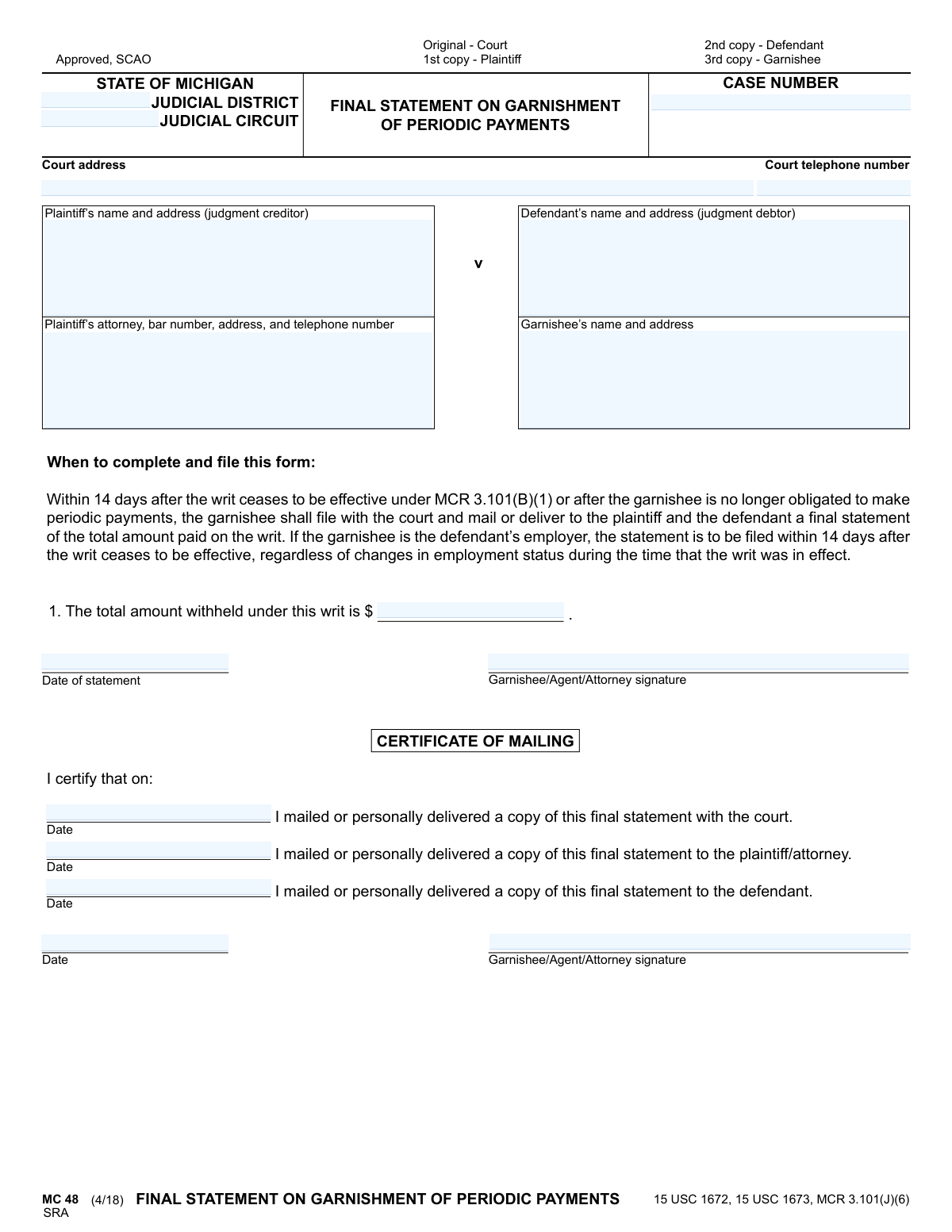
The MC 48, Final Statement on Garnishment of Periodic Payments, is a Michigan court form used by a garnishee (such as an employer) to provide a final accounting of funds withheld from a debtor's periodic payments. This statement is filed with the court and sent to the plaintiff and defendant within 14 days after the garnishment writ is no longer effective, officially closing out the garnishment action. Today, this form can be filled out quickly and accurately using AI-powered services like Instafill.ai, which can also convert non-fillable PDF versions into interactive fillable forms.
MC 48 is part of the
Michigan court forms category on Instafill.
Our AI automatically handles information lookup, data retrieval, formatting, and form filling.
It takes less than a minute to fill out MC 48 using our AI form filling.
Securely upload your data. Information is encrypted in transit and deleted immediately after the form is filled out.
Form specifications
| Form name: | MC 48, Final Statement on Garnishment of Periodic Payments |
| Number of fields: | 17 |
| Number of pages: | 1 |
| Language: | English |
More forms in Michigan court forms
Instafill Demo: How to fill out PDF forms in seconds with AI
How to Fill Out MC 48 Online for Free in 2026
Are you looking to fill out a MC 48 form online quickly and accurately? Instafill.ai offers the #1 AI-powered PDF filling software of 2026, allowing you to complete your MC 48 form in just 37 seconds or less.
Follow these steps to fill out your MC 48 form online using Instafill.ai:
- 1 Navigate to Instafill.ai and upload the MC 48 form or select it from the template library.
- 2 Provide the court and case information, including the judicial district/circuit, case number, and court address.
- 3 Enter the full names and addresses for the plaintiff (judgment creditor), defendant (judgment debtor), and the garnishee.
- 4 In section 1, state the total dollar amount withheld under the writ of garnishment.
- 5 Use the AI assistant to review the completed form for accuracy, ensuring all required fields are filled correctly.
- 6 Sign and date the statement as the garnishee, agent, or attorney.
- 7 Complete the Certificate of Mailing section by dating and signing to certify that copies were delivered to the court, plaintiff, and defendant as required.
Our AI-powered system ensures each field is filled out correctly, reducing errors and saving you time.
Why Choose Instafill.ai for Your Fillable MC 48 Form?
Speed
Complete your MC 48 in as little as 37 seconds.
Up-to-Date
Always use the latest 2026 MC 48 form version.
Cost-effective
No need to hire expensive lawyers.
Accuracy
Our AI performs 10 compliance checks to ensure your form is error-free.
Security
Your personal information is protected with bank-level encryption.
Frequently Asked Questions About Form MC 48
This form is used by a garnishee, such as an employer, to officially report the total amount of money withheld and paid under a specific writ of garnishment. It serves as the final accounting to the court, plaintiff, and defendant once the garnishment period ends.
The garnishee, which is the third party holding the defendant's funds (like an employer holding wages), is responsible for completing and filing this form.
You must file this form within 14 days after the writ of garnishment ceases to be effective or after you are no longer obligated to make payments. This deadline applies even if the defendant's employment status changed during the garnishment period.
The original form must be filed with the court, and copies must be mailed or delivered to the plaintiff (the creditor) and the defendant (the debtor). The form includes a Certificate of Mailing to document this action.
This field requires the cumulative total of all funds you withheld from the defendant's periodic payments for this specific writ of garnishment. It should represent the entire sum paid out over the life of the writ.
You are still required to file this final statement. You must file it within 14 days after the writ becomes ineffective, reporting the total amount you were able to withhold during the defendant's employment.
You will need the case number, court details, the full names and addresses for the plaintiff, defendant, and yourself (the garnishee), and the final total of all money withheld under the writ.
The Plaintiff is the person or company who won the judgment and is owed money. The Garnishee is the third party, often an employer, who holds the defendant's money (e.g., wages) and is directed by the court to pay the Plaintiff.
The Certificate of Mailing is your sworn statement that you have sent copies of the final statement to all required parties on the dates you listed. Your signature certifies that you have complied with the court's service requirements.
Yes, services like Instafill.ai use AI to accurately auto-fill form fields with your case information, which can save time and help prevent errors.
You can use a service like Instafill.ai to upload the form. The platform makes the PDF interactive, allowing you to easily type your information into the fields and then download or print the completed document.
If you have a non-fillable or 'flat' PDF, you can upload it to a tool like Instafill.ai. It will automatically convert the document into a fully interactive, fillable form for you to complete online.
Compliance MC 48
Validation Checks by Instafill.ai
1
Case Number Format and Presence
Checks that the 'Case Number' field is not empty and follows the expected format for the specified Michigan judicial district/circuit. This is crucial for correctly associating the document with the legal case file. An incorrect or missing case number will cause the filing to be rejected or misfiled, delaying the legal process.
2
Total Amount Withheld is a Valid Currency
Ensures the 'Total Amount Withheld' is a valid, non-negative numerical value, formatted as currency (e.g., with a dollar sign and two decimal places). This is the most critical piece of financial data on the form, and it must be clear and unambiguous. An invalid entry would make the entire statement useless and require correction.
3
Date of Statement is a Valid Date
Verifies that the 'Date of Statement' field contains a valid date in a recognized format (e.g., MM/DD/YYYY). This date establishes when the final accounting was performed. An invalid date would call the document's timeline into question and could lead to its rejection by the court.
4
Mailing Dates Occur On or After Statement Date
Performs a logical check to ensure that the 'Delivered To Court Date', 'Delivered To Plaintiff Attorney Date', and 'Delivered To Defendant Date' are all on or after the 'Date of Statement'. It is logically impossible to mail a statement before it has been created. This check prevents clerical errors that could create legal challenges regarding timely notice.
5
Required Party Information Completeness
Verifies that the name and address fields for the Plaintiff, Defendant, and Garnishee are all populated. This information is essential for identifying all parties involved in the garnishment action. Missing information would make the document incomplete and could lead to it being rejected by the court clerk.
6
Attorney Bar Number Format and Presence
Checks that if the 'Plaintiff’s attorney' field is filled, the associated 'bar number' is also present and follows the standard Michigan State Bar format (e.g., P-XXXXX). The bar number is a unique identifier for the attorney, and its accuracy is required for official court records. An invalid or missing number can cause filing issues.
7
Garnishee Signature Presence
Confirms that the 'Garnishee/Agent/Attorney Signature' field is not empty. The signature is a legal attestation to the accuracy of the information provided. A missing signature invalidates the document, making it legally non-binding and unacceptable for court filing.
8
Certificate of Mailing Section Completeness
Ensures that if the form is being submitted, the entire 'CERTIFICATE OF MAILING' section is filled out, including all three delivery dates, the certification date, and the signature. This section is a sworn statement of service, and any missing element renders the proof of service invalid. This could jeopardize the case by failing to meet procedural requirements.
9
Certificate Signature Date Consistency
Validates that the 'Certificate of Mailing Date' (the date the certification is signed) is on or after the individual dates of mailing/delivery to the court, plaintiff, and defendant. A person cannot certify that they have mailed something in the future. This check ensures the chronological integrity of the certification process.
10
Signature Consistency Check
Verifies that the signatory in the 'Garnishee/Agent/Attorney signature' field is consistent with the signatory in the 'Certificate of Mailing Garnishee/Agent/Attorney signature' field. Both signatures should be from the same authorized individual or entity attesting to the information. A mismatch could indicate an unauthorized person completed the form, raising legal questions about its validity.
11
Court Jurisdiction Identification
Validates that either the 'Judicial District' or 'Judicial Circuit' field is completed, as they are essential for identifying the specific court with jurisdiction over the case. Without this information, the document cannot be routed to the correct courthouse or judge. This check prevents filings from being lost or rejected due to incomplete jurisdictional information.
12
Court Telephone Number Format
Validates that the 'Court Telephone Number' is in a recognizable format, such as (XXX) XXX-XXXX or XXX-XXX-XXXX. This ensures that parties can contact the court if necessary. An invalid format could lead to communication errors and delays.
13
Form Version Verification
Checks the form identifier 'MC 48 (4/18)' against a database of current, approved SCAO forms. Using an outdated form can lead to automatic rejection by the court clerk because it may not comply with current laws or court rules. This validation ensures the filer is using the correct, legally compliant version of the document.
14
Address Field Structure Validation
Performs a basic structural validation on all address fields to ensure they contain plausible address information, including elements like a street name, city, and a valid state/ZIP code format. This is important for ensuring mail and legal notices are deliverable to all parties. An improperly formatted address can lead to failed service and significant delays.
Common Mistakes in Completing MC 48
The case number is the unique identifier for the legal proceeding, and typos are common when transcribing it from other documents. An incorrect case number will prevent the court clerk from matching the statement to the correct case, leading to rejection, filing delays, and potential non-compliance penalties. To avoid this, meticulously double-check the case number against the original writ of garnishment before submission.
This is the most critical data point on the form, yet it's prone to arithmetic errors or failing to include all garnished payments. A miscalculation can lead to disputes with the plaintiff or defendant, requiring corrected filings and exposing the garnishee to liability for the difference. Carefully audit all payroll records and payment stubs related to the garnishment to ensure the final total is accurate.
The form must be filed within 14 days after the writ ceases to be effective, a deadline that busy payroll departments can easily overlook. Missing this deadline can be considered contempt of court, potentially resulting in fines or other sanctions against the garnishee. It is crucial to set a calendar reminder the moment the garnishment period ends to ensure timely completion and filing.
This form requires two separate signatures: one on the main statement and another on the Certificate of Mailing. It is a very common oversight to sign in one place but miss the other. A form with a missing signature is invalid and will be rejected by the court, which can cause you to miss the filing deadline and require you to resubmit the entire document.
The Certificate of Mailing section requires separate dates to prove the document was sent to the court, plaintiff, and defendant. People often forget to fill in these dates, use the same date for all actions even if they occurred on different days, or use a future date. This failure to properly document service can lead to legal challenges from parties claiming they were not properly notified, so ensure each date is filled in accurately.
The names and addresses for the plaintiff, defendant, and garnishee must be perfectly accurate for legal notices to be delivered correctly. Transcribing this information from other documents often leads to typos or the use of outdated addresses. Incorrect information can cause mail to be returned as undeliverable, which violates notification requirements and can delay the closure of the garnishment.
If the form is printed and filled out by hand, poor handwriting can make critical information like the case number or dollar amounts unreadable. This can lead to processing errors by the court clerk or cause the form to be rejected outright. To prevent this, either print clearly in block letters or use a tool like Instafill.ai, which can convert a non-fillable PDF into a fillable version, allowing you to type information for perfect clarity.
A case belongs to a specific court, either District or Circuit, and garnishees may not know the difference, leading them to fill in the wrong field or leave it blank. This error can cause the form to be misrouted or rejected by the court clerk, delaying the filing. To avoid this, refer to the original writ of garnishment, which will specify the exact court, and enter it in the correct corresponding field.
The form explicitly requires that copies be sent to the plaintiff and the defendant, not just the court. A common mistake is for the garnishee to file the form with the court but neglect to mail the other two copies, as confirmed in the Certificate of Mailing. This is a procedural violation that can lead to legal challenges for failure to provide proper notice. Always follow the instructions and mail all copies as certified on the form.
Courts periodically update their forms, which is noted by a revision date like '(4/18)' in the corner. Using an old version found in company files or through a generic web search can lead to a submission that is missing required information or has outdated legal references. Courts may reject outdated forms, forcing a refiling and potentially causing a missed deadline. Always download the latest version of any legal form directly from the official court's website.
Saved over 80 hours a year
“I was never sure if my IRS forms like W-9 were filled correctly. Now, I can complete the forms accurately without any external help.”
Kevin Martin Green
Your data stays secure with advanced protection from Instafill and our subprocessors

Robust compliance program
Transparent business model
You’re not the product. You always know where your data is and what it is processed for.
ISO 27001, HIPAA, and GDPR
Our subprocesses adhere to multiple compliance standards, including but not limited to ISO 27001, HIPAA, and GDPR.
Security & privacy by design
We consider security and privacy from the initial design phase of any new service or functionality. It’s not an afterthought, it’s built-in, including support for two-factor authentication (2FA) to further protect your account.
Fill out MC 48 with Instafill.ai
Worried about filling PDFs wrong? Instafill securely fills mc-48-final-statement-on-garnishment-of-periodic-payments forms, ensuring each field is accurate.