Yes! You can use AI to fill out MC 50, Garnishment Release
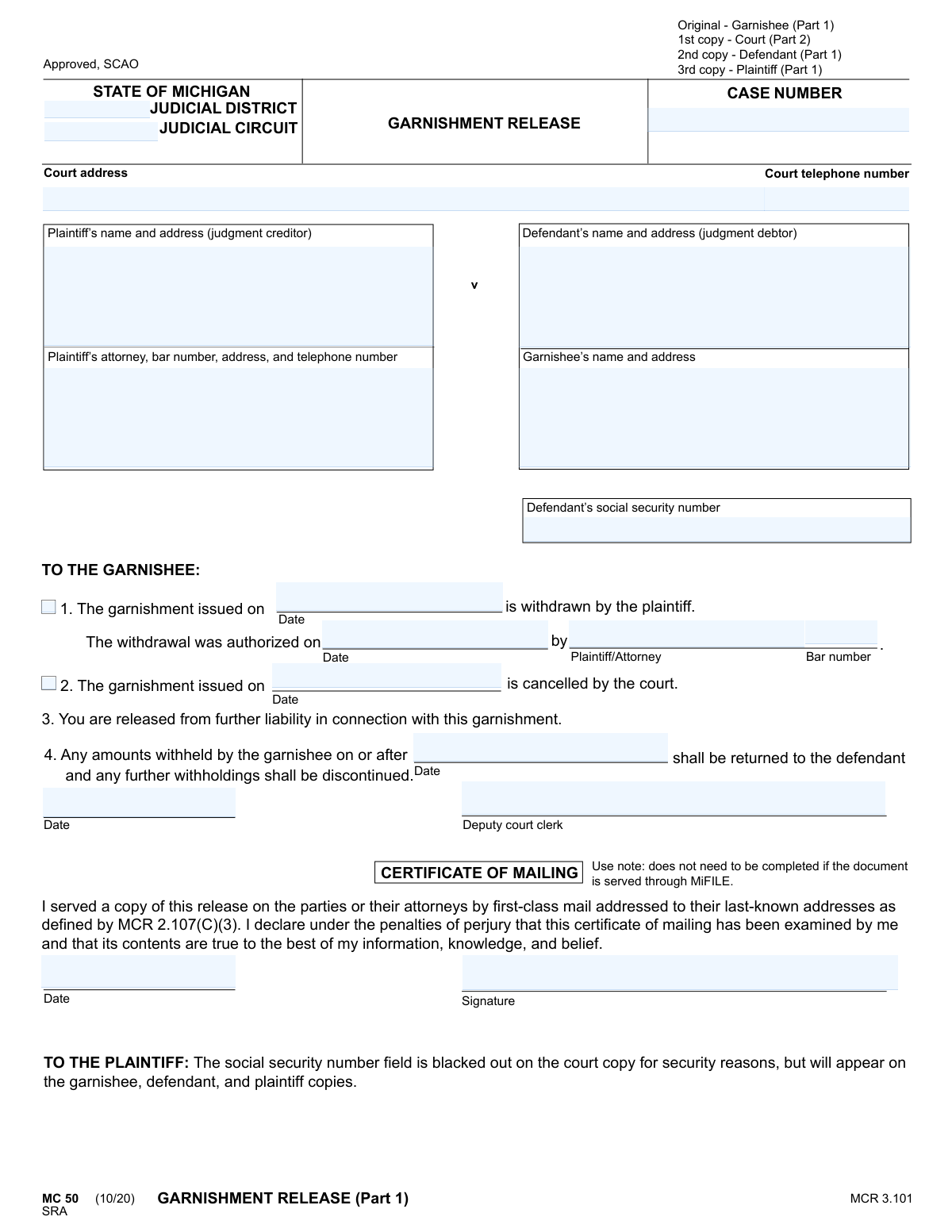
The MC 50, Garnishment Release, is a State of Michigan court form used to notify a garnishee (such as an employer or bank) to stop withholding funds from a judgment debtor. This document is issued when a garnishment is either withdrawn by the plaintiff or canceled by the court, releasing the garnishee from further liability. Today, this form can be filled out quickly and accurately using AI-powered services like Instafill.ai, which can also convert non-fillable PDF versions into interactive fillable forms.
MC 50 is part of the
Michigan court forms category on Instafill.
Our AI automatically handles information lookup, data retrieval, formatting, and form filling.
It takes less than a minute to fill out MC 50 using our AI form filling.
Securely upload your data. Information is encrypted in transit and deleted immediately after the form is filled out.
Form specifications
| Form name: | MC 50, Garnishment Release |
| Number of fields: | 43 |
| Number of pages: | 1 |
| Language: | English |
More forms in Michigan court forms
Instafill Demo: How to fill out PDF forms in seconds with AI
How to Fill Out MC 50 Online for Free in 2026
Are you looking to fill out a MC 50 form online quickly and accurately? Instafill.ai offers the #1 AI-powered PDF filling software of 2026, allowing you to complete your MC 50 form in just 37 seconds or less.
Follow these steps to fill out your MC 50 form online using Instafill.ai:
- 1 Navigate to Instafill.ai and upload or select the MC 50 Garnishment Release form.
- 2 Enter the court information, including the judicial district/circuit, case number, and court address.
- 3 Provide the full names and addresses for the plaintiff (judgment creditor), defendant (judgment debtor), and the garnishee.
- 4 Indicate whether the garnishment is being withdrawn by the plaintiff or canceled by the court by checking the appropriate box and entering the relevant dates.
- 5 Specify the date on or after which any withheld amounts must be returned to the defendant.
- 6 The appropriate party (plaintiff/attorney or deputy court clerk) must sign and date the release.
- 7 Review all the information for accuracy before downloading, printing, and serving the completed MC 50 form to all required parties.
Our AI-powered system ensures each field is filled out correctly, reducing errors and saving you time.
Why Choose Instafill.ai for Your Fillable MC 50 Form?
Speed
Complete your MC 50 in as little as 37 seconds.
Up-to-Date
Always use the latest 2026 MC 50 form version.
Cost-effective
No need to hire expensive lawyers.
Accuracy
Our AI performs 10 compliance checks to ensure your form is error-free.
Security
Your personal information is protected with bank-level encryption.
Frequently Asked Questions About Form MC 50
This form is used in Michigan to officially notify a garnishee, such as an employer or bank, that a garnishment order has been terminated. It releases the garnishee from the legal obligation to continue withholding funds from the defendant.
Typically, the plaintiff (the creditor who won the judgment) or their attorney completes this form once the debt is satisfied. A court clerk may also complete it if the garnishment is cancelled by a court order.
You will need the court case number, the names and addresses of the plaintiff, defendant, and garnishee, and the date the original garnishment was issued. The defendant's social security number is also required for the garnishee's copy to ensure correct identification.
The garnishee is the third party holding the defendant's assets, who was ordered to withhold funds. This is most commonly an employer withholding wages or a bank holding funds in an account.
A withdrawal by the plaintiff (Option 1) means the creditor voluntarily ends the garnishment, usually because the debt is paid. A cancellation by the court (Option 2) means a judge has ordered the garnishment to stop for a legal reason.
The garnishee must stop withholding any further funds from the defendant. They are also required to return any money that was improperly withheld on or after the effective date of the release directly to the defendant.
The defendant's SSN is used by the garnishee, like an employer's payroll department, to accurately identify the correct individual and stop the garnishment. For security, this number is blacked out on the copy filed with the court.
The form specifies that copies must be distributed to the garnishee, the court, the defendant (judgment debtor), and the plaintiff (judgment creditor). This ensures all parties are officially notified of the termination.
You only need to complete the Certificate of Mailing if you are serving the document by first-class mail. The form notes that this section is not required if the release is served electronically through Michigan's MiFILE system.
Yes, services like Instafill.ai use AI to auto-fill form fields accurately and save time. This can help you complete the Garnishment Release form more efficiently and with fewer errors.
You can use a service like Instafill.ai to complete the form digitally. Simply upload the PDF, and the AI will make it an interactive, fillable form that you can type directly into, sign, and download.
If you have a non-fillable or 'flat' PDF, Instafill.ai can convert it into an interactive, fillable form. This allows you to easily type your information into the correct fields without needing to print and fill it out by hand.
Compliance MC 50
Validation Checks by Instafill.ai
Common Mistakes in Completing MC 50
Users often mistype the case number or reference a related but incorrect case. This is a critical error because the case number is the primary identifier linking the release to the original garnishment order in the court's system. An incorrect number will cause the clerk to reject the form or, worse, misfile it, leading to the garnishment continuing illegally and requiring further legal action to correct. To avoid this, double-check the number against the original court order. If the form is a non-fillable PDF, a tool like Instafill.ai can convert it to a fillable version and help populate the correct case number from a central record, reducing manual entry errors.
It's surprisingly common for filers to mix up the parties, especially placing the plaintiff's (creditor) information in the defendant's (debtor) field or vice versa. This happens due to haste or misunderstanding the legal terms. This error will cause the form to be immediately rejected by the court and create confusion for all parties involved, delaying the release. Always verify that the 'judgment creditor' is the plaintiff and the 'judgment debtor' is the defendant whose wages are being garnished.
Filers may list a generic company name or a main office address instead of the specific legal entity name and the address for the payroll or HR department that handles garnishments. This causes the release to be lost within the garnishee's organization or sent to the wrong location, meaning the payroll department never receives it. As a result, wage withholding continues unlawfully. To prevent this, contact the garnishee's HR department directly to confirm the correct legal name and address for serving legal documents.
The form provides two distinct reasons for the release: a voluntary withdrawal by the plaintiff (Section 1) or a cancellation by the court (Section 2). A plaintiff's attorney might mistakenly check Section 2, or a filer might fill out both, creating ambiguity. This error can invalidate the document, as the signing authority and procedure differ for each section. Ensure you select only one section that accurately reflects why the garnishment is being stopped.
The Defendant's SSN is a crucial identifier for the garnishee (employer) to locate the correct employee and stop the withholding, especially in large companies with common names. Leaving this field blank or entering an incorrect number can lead to the release being ignored, as the employer cannot confidently match it to an employee. This results in continued garnishment. Always verify the SSN and enter it completely, as the form notes it will be blacked out on the court copy for security.
A Garnishment Release is a legal document that is invalid without the proper signatures. If the plaintiff is withdrawing the garnishment (Section 1), the plaintiff or their attorney must sign and provide their bar number. If the court cancels it, the deputy court clerk must sign. Forgetting a signature or the bar number is a frequent oversight that renders the form legally ineffective, causing it to be rejected and delaying the release.
When not filing electronically via MiFILE, the filer must complete the 'Certificate of Mailing' section, which certifies that all parties have been served a copy of the release. People often forget to sign and date this section, or they sign it without actually mailing the copies. This failure can lead to legal challenges, as the defendant or garnishee could claim they were never properly notified of the release, creating disputes over funds withheld after the release date.
The form requires several key dates, such as when the original garnishment was issued and when withheld amounts should be returned (Section 4). Entering an incorrect original issue date may cause the court to be unable to locate the garnishment being released. More critically, an unclear or wrong date in Section 4 can cause financial disputes between the garnishee and the defendant over how much money should be returned. These dates must be precise and clearly written.
The form explicitly states who receives which copy: Garnishee, Court, Defendant, and Plaintiff. A common mistake is failing to distribute all copies or sending the wrong version to a party. For example, sending the court a copy with the defendant's full SSN visible, or sending the garnishee the 'Part 2' court copy without the SSN, can cause rejection or processing delays. Careful attention must be paid to ensure each party receives their designated and correct copy.
The form has a dedicated field for the 'Plaintiff’s attorney, bar number, address, and telephone number.' Often, if the plaintiff has an attorney, this field is left incomplete, with just a name or missing a bar number or phone number. This makes it difficult for the court, defendant, or garnishee to contact the responsible party with questions, potentially delaying the resolution of any issues that arise with the release. This field must be filled out completely if an attorney is involved. AI-powered tools like Instafill.ai can help by storing and auto-populating complete attorney details across multiple forms.
Saved over 80 hours a year
“I was never sure if my IRS forms like W-9 were filled correctly. Now, I can complete the forms accurately without any external help.”
Kevin Martin Green
Your data stays secure with advanced protection from Instafill and our subprocessors

Robust compliance program
Transparent business model
You’re not the product. You always know where your data is and what it is processed for.
ISO 27001, HIPAA, and GDPR
Our subprocesses adhere to multiple compliance standards, including but not limited to ISO 27001, HIPAA, and GDPR.
Security & privacy by design
We consider security and privacy from the initial design phase of any new service or functionality. It’s not an afterthought, it’s built-in, including support for two-factor authentication (2FA) to further protect your account.
Fill out MC 50 with Instafill.ai
Worried about filling PDFs wrong? Instafill securely fills mc-50-garnishment-release forms, ensuring each field is accurate.