Yes! You can use AI to fill out Order Reinstating Conviction(s) for Improper or Erroneous Set Aside and Objection to Order
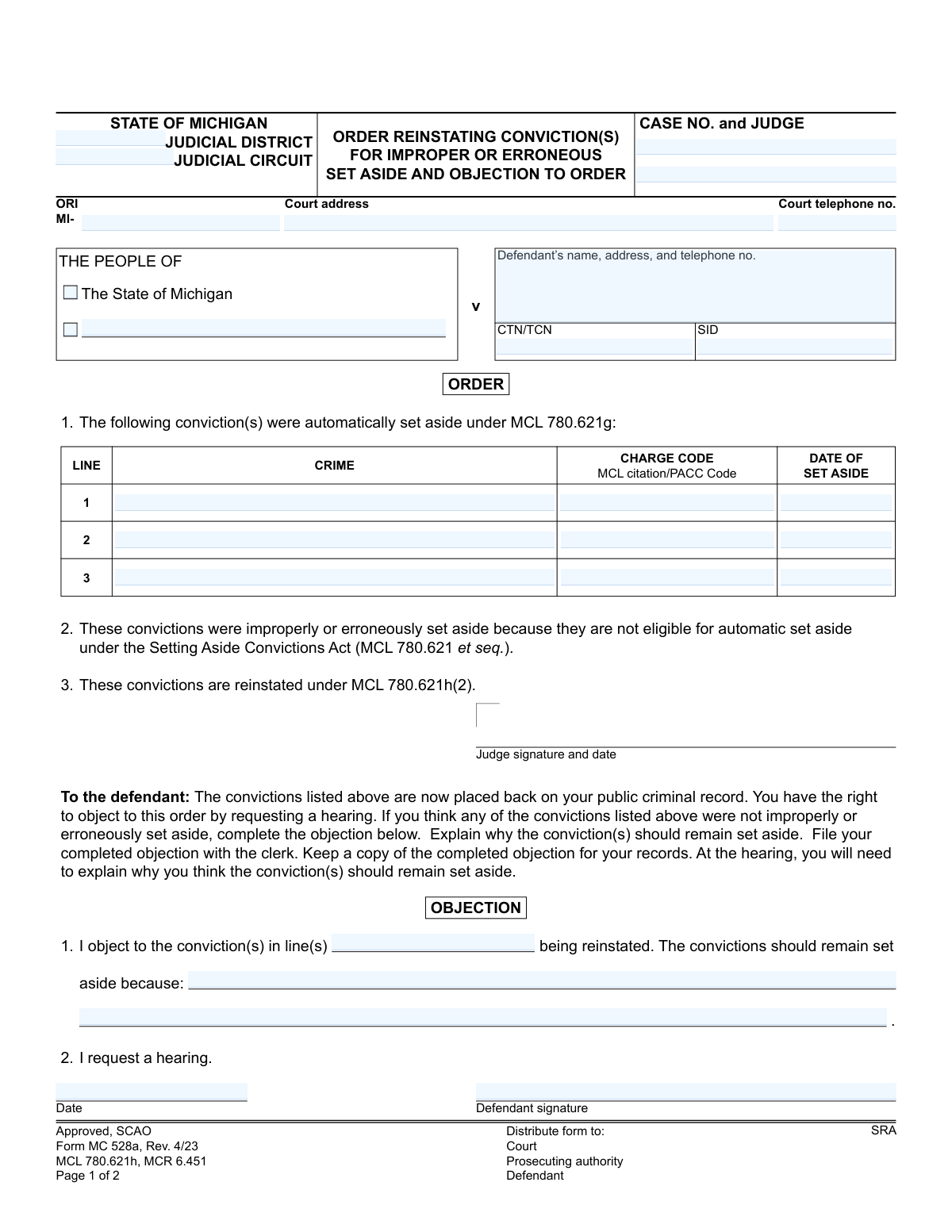
The MC 528a form is issued by a Michigan court to inform an individual that certain criminal convictions, previously cleared from their public record automatically, have been reinstated due to being ineligible for the set-aside. The form details the specific convictions and provides the legal basis for their reinstatement. It also serves as the official document for the defendant to object to the court's decision and request a hearing. Today, this form can be filled out quickly and accurately using AI-powered services like Instafill.ai, which can also convert non-fillable PDF versions into interactive fillable forms.
MC 528a is part of the
Michigan court forms category on Instafill.
Our AI automatically handles information lookup, data retrieval, formatting, and form filling.
It takes less than a minute to fill out MC 528a using our AI form filling.
Securely upload your data. Information is encrypted in transit and deleted immediately after the form is filled out.
Form specifications
| Form name: | Order Reinstating Conviction(s) for Improper or Erroneous Set Aside and Objection to Order |
| Number of fields: | 29 |
| Number of pages: | 1 |
| Language: | English |
More forms in Michigan court forms
Instafill Demo: How to fill out PDF forms in seconds with AI
How to Fill Out MC 528a Online for Free in 2026
Are you looking to fill out a MC 528A form online quickly and accurately? Instafill.ai offers the #1 AI-powered PDF filling software of 2026, allowing you to complete your MC 528A form in just 37 seconds or less.
Follow these steps to fill out your MC 528A form online using Instafill.ai:
- 1 Navigate to Instafill.ai and upload or select the MC 528a form.
- 2 Use the AI assistant to input court and case details, such as the judicial district, case number, and judge's name.
- 3 If you are the defendant filing an objection, provide your full name, address, and contact information in the designated section.
- 4 In the 'Objection' section, specify the line number(s) of the conviction(s) you are objecting to.
- 5 Clearly state the reasons why you believe the conviction(s) were correctly set aside and should not be reinstated.
- 6 Review all the information you have entered for accuracy, then sign and date the objection to certify your request for a hearing.
- 7 Download the completed form to file with the court clerk and keep a copy for your personal records.
Our AI-powered system ensures each field is filled out correctly, reducing errors and saving you time.
Why Choose Instafill.ai for Your Fillable MC 528a Form?
Speed
Complete your MC 528a in as little as 37 seconds.
Up-to-Date
Always use the latest 2026 MC 528a form version.
Cost-effective
No need to hire expensive lawyers.
Accuracy
Our AI performs 10 compliance checks to ensure your form is error-free.
Security
Your personal information is protected with bank-level encryption.
Frequently Asked Questions About Form MC 528a
This form is a court order from the State of Michigan that reinstates criminal convictions that were previously set aside automatically. It also includes a section for you, the defendant, to object to this reinstatement.
You received this because the court has determined that one or more of your convictions were improperly or erroneously set aside automatically. This order officially places those convictions back on your public criminal record.
Reinstating a conviction means it is no longer set aside or expunged from your record. The conviction will reappear on your public criminal record, which can be seen in background checks.
If you believe your conviction should remain set aside, you must complete the 'OBJECTION' section at the bottom of the form. You will need to explain your reasoning and request a hearing.
In the 'OBJECTION' section, write the line number(s) of the conviction(s) you are objecting to, explain why they should remain set aside, and then sign and date the form. You must then file this with the court clerk.
After you file your objection with the court clerk, a hearing will be scheduled. At the hearing, you will need to explain to the judge why you believe the conviction(s) should remain set aside.
You must file your completed objection with the clerk of the court that issued the order, whose address is listed at the top of the form. Be sure to keep a copy for your records.
The top 'ORDER' section is completed and signed by a judge from the court. This section details which of your convictions are being reinstated.
You must explain why your conviction was eligible for automatic set aside in the first place and therefore was not 'improperly or erroneously' set aside. It is highly recommended to consult with an attorney to formulate your legal argument.
The form does not state a specific deadline, but you should act immediately. Contact the court clerk's office at the telephone number on the form to inquire about the deadline for filing your objection.
Yes, services like Instafill.ai use AI to accurately auto-fill your personal information and case details into the form fields, saving you time. However, you must write the legal reasoning for your objection yourself or with an attorney's help.
You can use a service like Instafill.ai to fill out your form online. Simply upload the document, and the platform will make it interactive so you can type your information directly into the fields before printing.
If you have a non-fillable or 'flat' PDF, you can upload it to Instafill.ai. The service's AI can convert it into an interactive, fillable form that you can easily complete on your computer.
Compliance MC 528a
Validation Checks by Instafill.ai
1
Ensures Case Number Consistency Across Pages
This check verifies that the 'Case No.' entered at the top of page 1 is identical to the 'Case No.' entered on page 2. Mismatched case numbers can lead to the document being filed incorrectly or associated with the wrong legal proceeding. If the numbers do not match, the submission should be flagged for manual review to ensure clerical accuracy before processing.
2
Validates Case Number Format
This validation ensures the 'Case No.' field adheres to the standard format used by Michigan courts (e.g., YY-######-XX). Proper formatting is crucial for automated docketing systems and for ensuring the case can be uniquely and correctly identified within the judicial system. A failure indicates a potential data entry error that could prevent the order from being processed.
3
Validates ORI Number Structure
This check confirms that the 'ORI' (Originating Agency Identifier) field follows the correct structure, which starts with 'MI-' followed by a specific alphanumeric code. The ORI is essential for routing information to the correct law enforcement or state agency. An invalid format could cause the updated conviction status to be rejected or misdirected by state record systems.
4
Requires At Least One Conviction for Reinstatement
This validation ensures that at least one of the three available conviction lines (containing Crime, Charge Code, and Date of Set Aside) is filled out. The entire purpose of this order is to reinstate one or more convictions. An order with no convictions listed is incomplete and serves no legal function, so it should be rejected.
5
Ensures Completeness of Each Conviction Line
This check verifies that if a 'CRIME' is entered on any given line (1, 2, or 3), then the corresponding 'CHARGE CODE' and 'DATE OF SET ASIDE' fields for that same line are also completed. All three pieces of information are required to uniquely identify the specific conviction being reinstated. Incomplete entries make the order ambiguous and legally insufficient.
6
Validates Date Field Formatting
This check ensures that all date fields, including 'DATE OF SET ASIDE', the judge's signature date, the defendant's objection date, and the clerk's mailing date, are entered in a valid date format (e.g., MM/DD/YYYY). Incorrectly formatted dates can cause errors in system processing and create ambiguity about when key events occurred. The validation prevents invalid data from entering the record.
7
Conditional Validation for Objection Section
This validation rule is triggered if the defendant's signature is present in the 'OBJECTION' section. If signed, it then requires that the 'objection line(s)' field and the 'because' reason field are both filled out. An objection is not legally valid without specifying which conviction is being disputed and the reason for the objection, so this prevents incomplete objections from being filed.
8
Validates Objection Line Number Reference
This check ensures that the line number(s) entered in the 'I object to the conviction(s) in line(s)' field are valid. The numbers must be 1, 2, or 3 and must correspond to a conviction line that was actually filled out in the 'ORDER' section above. Objecting to a non-existent or blank conviction line is a logical error that should be prevented.
9
Requires Judge's Signature Date
This validation confirms that the date field next to the judge's signature line is filled out. The date of the judge's signature is the effective date of the order, making it a critical piece of information for legal and administrative purposes. An undated order is considered incomplete and may not be legally enforceable until dated.
10
Requires Clerk's Certificate of Mailing Date
This check ensures the date field is completed in the 'CERTIFICATE OF MAILING' section. This date officially records when the order was served to the defendant and prosecuting authority, which is crucial for establishing legal notice and calculating deadlines for appeal or objection. A missing date invalidates the proof of service.
11
Ensures Defendant Information is Present
This validation verifies that the 'Defendant’s name, address, and telephone no.' field is not empty. This information is fundamental to the document, as it identifies the individual to whom the order applies. Without it, the order is legally meaningless and cannot be correctly associated with a person's criminal record.
12
Validates Criminal Identifier Formats (CTN/TCN/SID)
This check validates that the 'CTN/TCN' (Complaint/Transaction Control Number) and 'SID' (State Identification Number) fields adhere to their expected alphanumeric formats. These unique identifiers are critical for accurately linking the court order to the correct individual and case in statewide criminal justice databases. Incorrect formats can lead to record-keeping errors or failure to update the public criminal record.
Common Mistakes in Completing MC 528a
Users often misenter the Case Number, Judicial District/Circuit, or Judge's Name, typically by copying from memory or an outdated document. This can cause the objection to be misfiled or delayed, potentially leading to a missed hearing deadline and the finalization of the conviction reinstatement. To avoid this, carefully copy all header information directly from the court's 'Order Reinstating Conviction(s)' that you received.
The form requires specifying which conviction is being challenged by referencing its line number (1, 2, or 3) from the order section. Defendants often forget this detail, writing a general objection instead. This ambiguity can lead the court to dismiss the objection as unclear or only apply it to the first conviction, forfeiting the right to challenge the others. Always fill in the specific line number(s) for the convictions you are objecting to.
In the explanation section, defendants may provide emotional pleas or vague statements like 'this is unfair' instead of a factual or legal reason why the conviction was eligible for set aside. A weak or non-legal argument will likely result in the objection being denied, as the court needs a valid basis to reconsider the reinstatement. Clearly state why the conviction was eligible for automatic set aside under the law (MCL 780.621 et seq.).
Forgetting to sign or date the objection section is a simple but critical error that invalidates the entire filing. An unsigned form will be rejected by the court clerk, which can cause you to miss the strict filing deadline and lose your right to a hearing. Always perform a final check to ensure you have signed and dated the form before submitting it.
Defendants sometimes provide an old address or phone number, especially if they have moved recently. This is a major mistake, as the court uses this information to mail crucial notices, such as the hearing date. If you don't receive the notice, you will miss your hearing, and the objection will likely be dismissed. Always ensure your name, address, and telephone number are current.
The CTN/TCN (Complaint Tracking Number/Tracking Control Number) and SID (State Identification Number) are unique identifiers that must be accurate. Transcribing these numbers incorrectly or leaving them blank can cause significant administrative delays while court staff search for the correct record. To prevent this, carefully copy these numbers directly from the original order sent by the court. AI-powered form fillers like Instafill.ai can help validate such formats.
The form explicitly advises keeping a copy, but many people forget this step and file their only original. Without a personal copy, you have no proof of what you filed or when, and you lack a document to reference when preparing for your hearing. Always make a photocopy or take a clear digital photo of the completed and signed form before you submit it to the court.
Rushed or messy handwriting can make it impossible for court staff to read your name, case number, or the reason for your objection. If the form is unreadable, it may be rejected or misinterpreted, severely harming your case. To ensure clarity, print neatly in block letters. If the form is a non-fillable PDF, tools like Instafill.ai can convert it into a fillable version, allowing you to type your responses for maximum legibility.
The form includes a field for the 'Case No.' at the top of page 2, which is often overlooked. If the pages become separated during processing, the second page cannot be linked to your case file, causing administrative confusion. To prevent this, double-check that the case number is correctly entered on all pages where a field is provided.
A defendant might mistakenly use this form to argue their original innocence or request a new trial. This form's only purpose is to object to the *reinstatement* of a conviction by arguing it was, in fact, eligible for the automatic set-aside process. Using the form to re-litigate the original case is improper and will result in the objection being dismissed.
Saved over 80 hours a year
“I was never sure if my IRS forms like W-9 were filled correctly. Now, I can complete the forms accurately without any external help.”
Kevin Martin Green
Your data stays secure with advanced protection from Instafill and our subprocessors

Robust compliance program
Transparent business model
You’re not the product. You always know where your data is and what it is processed for.
ISO 27001, HIPAA, and GDPR
Our subprocesses adhere to multiple compliance standards, including but not limited to ISO 27001, HIPAA, and GDPR.
Security & privacy by design
We consider security and privacy from the initial design phase of any new service or functionality. It’s not an afterthought, it’s built-in, including support for two-factor authentication (2FA) to further protect your account.
Fill out MC 528a with Instafill.ai
Worried about filling PDFs wrong? Instafill securely fills order-reinstating-convictions-for-improper-or-erroneous-set-aside-and-objection-to-order forms, ensuring each field is accurate.